LIBER II · CAPUT 25
THEIR NATURE, SITUATION, AND SPECIES
Latine · Mayhoff 1906
cometas Graeci vocant, nostri crinitas, horrentes crine sanguineo et comarum modo in vertice hispidas. iidem pogonias quibus inferiore ex parte in speciem barbae longae promittitur iuba. acontiae iaculi modo vibrantur, ocissimo significatu. haec fuit, de qua quinto consulatu suo Titus Imperator Caesar praeclaro carmine perscripsit, ad hunc diem novissima visa. easdem breviores et in mucronem fastigatas xiphias vocavere, quae sunt omnium pallidissimae et quodam gladii nitore ac sine ullis radiis, quos et disceus, nomini similis, colore autem electro, raros e margine emittit. pitheus doliorum cernitur figura, in concavo fumidae lucis. ceratias cornus speciem habet, qualis fuit cum Graecia apud Salamina depugnavit. lampadias ardentes imitatur faces, hippeus equinas iubas, celerrimi motus atque in orbem circa se euntes. fit et candidus διὸς cometes, argenteo crine ita refulgens, ut vix contueri liceat, specieque humana dei effigiem in se ostendens. fiunt et hirci, villorum specie et nube aliqua circumdati. semel adhuc iubae effigies mutata in hastam est, Olympiade CVIII, urbis anno CCCCVIII. brevissimum quo cernerentur spatium VII dierum adnotatum est, longissimum CLXXX.
Moventur autem aliae errantium modo, aliae inmobiles haerent, omnes ferme sub ipso septentrione aliqua eius parte non certa, sed maxime in candida, quae lactei circuli nomen accepit. Aristoteles tradit et simul plures cerni, nemini conpertum alteri, quod equidem sciam, ventos autem ab iis graves aestusve significari. fiunt et hibernis mensibus et in austrino polo, sed ibi citra ullum iubar. diraque conperta Aethiopum et Aegypti populis cui nomen aevi eius rex dedit Typhon, ignea specie ac spirae modo intorta, visu quoque torvo, nec stella verius quam quidam igneus nodus. sparguntur aliquando et errantibus stellis ceterisque crines. sed cometes numquam in occasura parte caeli est, terrificum magna ex parte sidus atque non leviter piatum, ut civili motu Octavio consule iterumque Pompei et Caesaris bello, in nostro vero aevo circa veneficium, quo Claudius Caesar imperium reliquit Domitio Neroni, ac deinde principatu eius adsiduum prope ac saevum. referre arbitrantur, in quas partes sese iaculetur aut cuius stellae vires accipiat quasque simili tudines reddat et quibus in locis emicet: tibiarum specie musicae arti portendere, obscenis autem moribus in verendis partibus signorum, ingeniis et eruditioni, si triquetram figuram quadratamve paribus angulis ad aliquos perennium stellarum situs edat; venena fundere in capite septentrionalis austrinaeve serpentis.
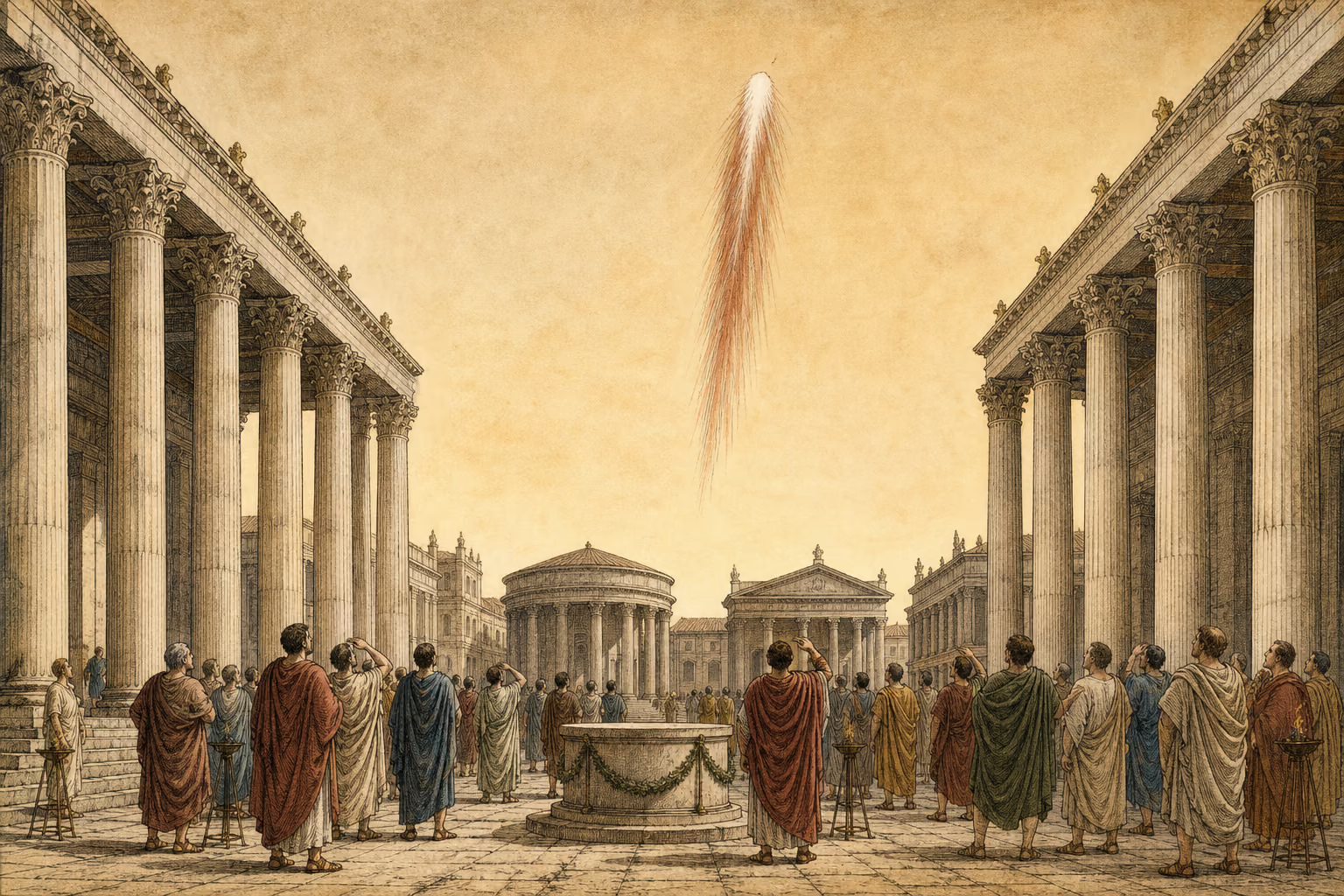
Cometes in uno totius orbis loco colitur in templo Romae, admodum faustus Divo Augusto iudicatus ab ipso, qui incipiente eo apparuit ludis, quos faciebat Veneri Genetrici non multo post obitum patris Caesaris in collegio ab eo instituto. namque his verbis in.... gaudium prodit is: Ipsis ludorum meorum diebus sidus crinitum per septem dies in regione caeli sub septemtrionibus est conspectum. id oriebatur circa undecimam horam diei clarumque et omnibus e terris conspicuum fuit. eo sidere significari vulgus credidit Caesaris animam inter deorum inmortalium numina receptam, quo nomine id insigne simulacro capitis eius, quod mox in foro consecravimus, adiectum est. haec ille in publicum; interiore gaudio sibi ilium natum seque in eo nasci interpretatus est. et, si verum fatemur, salutare id terris fuit.
Sunt qui et haec sideraperpetua esse credant suoque ambitu ire, sed non nisi relicta ab sole cerni; alii vero qui nasci umore fortuito et ignea vi ideoque solvi.
English · Bostock & Riley 1855–57
The Greeks name these stars comets; we name them Crinitæ, as if shaggy with bloody locks, and surrounded with bristles like hair. Those stars, which have a mane hanging down from their lower part, like a long beard, are named Pogoniæ. Those that are named Acontiæ vibrate like a dart with a very quick motion. It was one of this kind which the Emperor Titus described in his very excellent poem, as having been seen in his fifth consulship; and this was the last of these bodies which has been observed. When they are short and pointed they are named Xiphiæ; these are the pale kind; they shine like a sword and are without any rays; while we name those Discei, which, being of an amber colour, in conformity with their name, emit a few rays from their margin only. A kind named Pitheus exhibits the figure of a cask, appearing convex and emitting a smoky light. The kind named Cerastias has the appearance of a horn; it is like the one which was visible when the Greeks fought at Salamis. Lampadias is like a burning torch; Hippias is like a horse’s mane; it has a very rapid motion, like a circle revolving on itself. There is also a white comet, with silver hair, so brilliant that it can scarcely be looked at, exhibiting, as it were, the aspect of the Deity in a human form. There are some also that are shaggy, having the appearance of a fleece, surrounded by a kind of crown. There was one, where the appearance of a mane was changed into that of a spear; it happened in the 109th olympiad, in the 398th year of the City. The shortest time during which any one of them has been observed to be visible is 7 days, the longest 180 days.
Some of them move about in the manner of planets, others remain stationary. They are almost all of them seen towards the north, not indeed in any particular portion of it, but generally in that white part of it which has obtained the name of the Milky Way. Aristotle informs us that several of them are to be seen at the same time, but this, as far as I know, has not been observed by any one else; also that they prognosticate high winds and great heat. They are also visible in the winter months, and about the south pole, but they have no rays proceeding from them. There was a dreadful one observed by the Æthiopians and the Egyptians, to which Typhon, a king of that period, gave his own name; it had a fiery appearance, and was twisted like a spiral; its aspect was hideous, nor was it like a star, but rather like a knot of fire. Sometimes there are hairs attached to the planets and the other stars. Comets are never seen in the western part of the heavens. It is generally regarded as a terrific star, and one not easily expiated; as was the case with the civil commotions in the consulship of Octavius, and also in the war of Pompey and Cæsar. And in our own age, about the time when Claudius Cæsar was poisoned and left the Empire to Domitius Nero, and afterwards, while the latter was Emperor, there was one which was almost constantly seen and was very frightful. It is thought important to notice towards what part it darts its beams, or from what star it receives its influence, what it resembles, and in what places it shines. If it resembles a flute, it portends something unfavourable respecting music; if it appears in the parts of the signs referred to the secret members, something respecting lewdness of manners; something respecting wit and learning, if they form a triangular or quadrangular figure with the position of some of the fixed stars; and that some one will be poisoned, if they appear in the head of either the northern or the southern serpent.
Rome is the only place in the whole world where there is a temple dedicated to a comet; it was thought by the late Emperor Augustus to be auspicious to him, from its appearing during the games which he was celebrating in honour of Venus Genetrix, not long after the death of his father Cæsar, in the College which was founded by him. He expressed his joy in these terms: “During the very time of these games of mine, a hairy star was seen during seven days, in the part of the heavens which is under the Great Bear. It rose about the eleventh hour of the day, was very bright, and was conspicuous in all parts of the earth. The common people supposed the star to indicate, that the soul of Cæsar was admitted among the immortal Gods; under which designation it was that the star was placed on the bust which was lately consecrated in the forum.” This is what he proclaimed in public, but, in secret, he rejoiced at this auspicious omen, interpreting it as produced for himself; and, to confess the truth, it really proved a salutary omen for the world at large.
Some persons suppose that these stars are permanent, and that they move through their proper orbits, but that they are only visible when they recede from the sun. Others suppose that they are produced by an accidental vapour together with the force of fire, and that, from this circumstance, they are liable to be dissipated.