LIBER II · CAPUT 65
WHETHER THERE BE ANTIPODES?
Latine · Mayhoff 1906
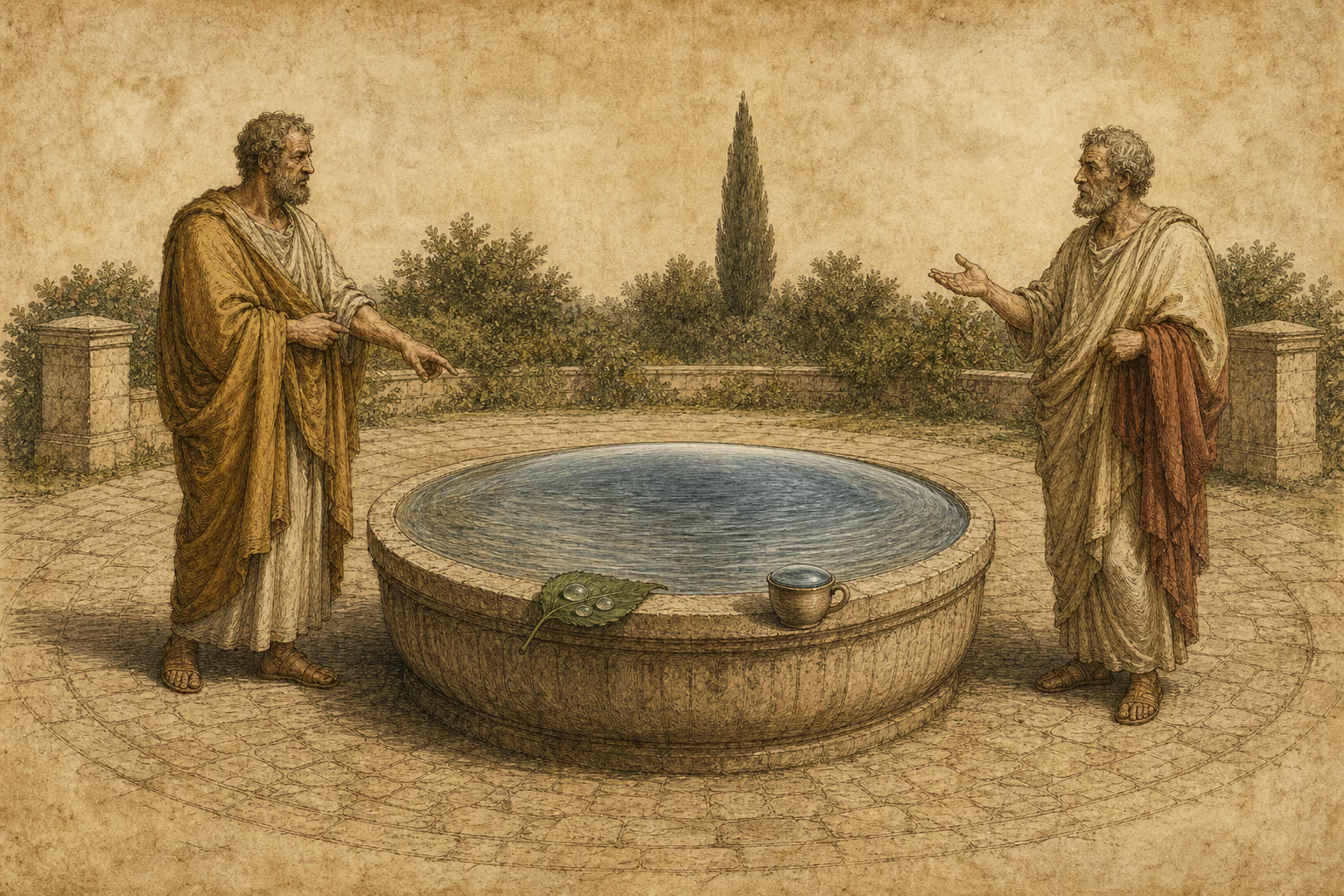
Ingens hic pugna litterarum contraque vulgi, circumfundi terrae undique homines conversisque inter se pedibus stare, et cunctis similem esse verticem, simili modo et quacumque parte media calcari, illo quaerente, cur non decidant contra siti, tamquam non ratio praesto sit, ut nos non decidere mirentur illi. intervenit sententia quamvis indocili probabilis turbae, inaequali globo, ut si sit figura pineae nucis, nihilo minus terram undique incoli. sed quid hoc refert, alio miraculo exoriente, pendere ipsam ac non cadere nobiscum, ceu spiritus vis, mundo praesertim inclusi, dubia sit, aut possit cadere, natura repugnante et quo cadat negante. nam sicut ignium sedes non est nisi in ignibus, aquarum nisi in aquis, spiritus nisi in spiritu, sic terrae, arcentibus cunctis, nisi in se locus non est. globum tamen effici mirum est in tanta planitie maris camporumque. cui sententiae adest Dicaearchus, vir in primis eruditus, regum cura permensus montes, ex quibus altissimum prodidit Pelium MCCL passuum ratione perpendiculi, nullam esse eam portionem universae rotunditatis colligens. mihi incerta haec videtur coniectatio, haud ignaro quosdam Alpium vertices longo tractu nec breviore quinquaginta milium passuum adsurgere. sed vulgo maxime haec pugna est, si coactam in verticem aquarum quoque figuram credere cogatur. atqui non aliud in rerum natura adspectu manifestius. namque et dependentes ubique guttae parvis globantur orbibus et pulveri inlatae frondiumque lanugini inpositae absoluta rotunditate cernuntur, et in poculis repletis media maxime tument, quae propter subtilitatem umoris mollitiamque in se residentem ratione facilius quam visu deprehenduntur. idque etiam magis mirum, in poculis repletis addito umore minimo circumfluere quod supersit, contra evenire ponderibus additis ad vicenos saepe denarios, scilicet quia intus recepta liquorem in verticem attollant, at cumulo eminenti infusa delabantur. eadem est causa, propter quam e navibus terra non cernatur, e navium malis conspicua, ac procul recedente navigio, si quid quod fulgeat religetur in mali cacumine, paulatim descendere videatur et postremo occultetur. denique oceanus, quemfatemur ultimum, quanam alia figura cohaereret atque non decideret nullo ultra margine includente? id ipsum ad miraculum redit, quonam modo, etiamsi globetur, extremum non decidat mare. contra quod, ut sint plana maria et qua videntur figura, non posse id accidere, magno suo gaudio magnaque gloria inventores Graeci subtilitate geometrica docent. namque cum e sublimi in inferiora aquae ferantur et sit haec natura earum confessa nec quisquam dubitet in litore ullo accessisse eas quo longissime devexitas passa sil, procul dubio apparere, quo quid humilius sit, propius a centro esse terrae, omnesque linias, quae emittantur ex eo ad proximas aquas, breviores fieri quam quae ad extremum mare a primis aquis; ergo totas omnique ex parte aquas vergere in centrum ideoque non decidere, quoniam in interiora nitantur.
Quod ita formasse artifex natura credi debet, ut, cum terra arida et sicca constare per se ac sine umore non posset, nec rursus stare aqua nisi sustinente terra, mutuo inplexu iungerentur, hac sinus pandente, illa vero permeante totam, intra extra, supra infra, venis ut vinculis discurrentibus, atque etiam in summis iugis erumpente, quo spiritu acta et terrae pondere expressa siphonum modo emicat tantumque a periculo decidendi abest, ut in summa quaeque et altissima exsiliat. qua ratione manifestum est, quare tot fluminum cotidiano accessu maria non crescant.
English · Bostock & Riley 1855–57
On this point there is a great contest between the learned and the vulgar. We maintain, that there are men dispersed over every part of the earth, that they stand with their feet turned towards each other, that the vault of the heavens appears alike to all of them, and that they, all of them, appear to tread equally on the middle of the earth. If any one should ask, why those situated opposite to us do not fall, we directly ask in return, whether those on the opposite side do not wonder that we do not fall. But I may make a remark, that will appear plausible even to the most unlearned, that if the earth were of the figure of an unequal globe, like the seed of a pine, still it may be inhabited in every part.
But of how little moment is this, when we have another miracle rising up to our notice! The earth itself is pendent and does not fall with us; it is doubtful whether this be from the force of the spirit which is contained in the universe, or whether it would fall, did not nature resist, by allowing of no place where it might fall. For as the seat of fire is nowhere but in fire, nor of water except in water, nor of air except in air, so there is no situation for the earth except in itself, everything else repelling it. It is indeed wonderful that it should form a globe, when there is so much flat surface of the sea and of the plains. And this was the opinion of Dicæarchus, a peculiarly learned man, who measured the heights of mountains, under the direction of the kings, and estimated Pelion, which was the highest, at 1250 paces perpendicular, and considered this as not affecting the round figure of the globe. But this appears to me to be doubtful, as I well know that the summits of some of the Alps rise up by a long space of not less than 50,000 paces. But what the vulgar most strenuously contend against is, to be compelled to believe that the water is forced into a rounded figure; yet there is nothing more obvious to the sight among the phænomena of nature. For we see everywhere, that drops, when they hang down, assume the form of small globes, and when they are covered with dust, or have the down of leaves spread over them, they are observed to be completely round; and when a cup is filled, the liquid swells up in the middle. But on account of the subtile nature of the fluid and its inherent softness, the fact is more easily ascertained by our reason than by our sight. And it is even more wonderful, that if a very little fluid only be added to a cup when it is full, the superfluous quantity runs over, whereas the contrary happens if we add a solid body, even as much as would weigh 20 denarii. The reason of this is, that what is dropt in raises up the fluid at the top, while what is poured on it slides off from the projecting surface. It is from the same cause that the land is not visible from the body of a ship when it may be seen from the mast; and that when a vessel is receding, if any bright object be fixed to the mast, it seems gradually to descend and finally to become invisible. And the ocean, which we admit to be without limits, if it had any other figure, could it cohere and exist without falling, there being no external margin to contain it? And the same wonder still recurs, how is it that the extreme parts of the sea, although it be in the form of a globe, do not fall down? In opposition to which doctrine, the Greeks, to their great joy and glory, were the first to teach us, by their subtile geometry, that this could not happen, even if the seas were flat, and of the figure which they appear to be. For since water always runs from a higher to a lower level, and this is admitted to be essential to it, no one ever doubted that the water would accumulate on any shore, as much as its slope would allow it. It is also certain, that the lower anything is, so much the nearer is it to the centre, and that all the lines which are drawn from this point to the water which is the nearest to it, are shorter than those which reach from the beginning of the sea to its extreme parts. Hence it follows, that all the water, from every part, tends towards the centre, and, because it has this tendency, does not fall.
We must believe, that the great artist, Nature, has so arranged it, that as the arid and dry earth cannot subsist by itself and without moisture, nor, on the other hand, can the water subsist unless it be supported by the earth, they are connected by a mutual union. The earth opens her harbours, while the water pervades the whole earth, within, without, and above; its veins running in all directions, like connecting links, and bursting out on even the highest ridges; where, forced up by the air, and pressed out by the weight of the earth, it shoots forth as from a pipe, and is so far from being in danger of falling, that it bounds up to the highest and most lofty places. Hence the reason is obvious, why the seas are not increased by the daily accession of so many rivers.