LIBER II · CAPUT 70
OF THE OBLIQUITY OF THE ZONES
Latine · Mayhoff 1906
Tres autem circuli supra dictis zonis inplexi inaequalitates temporum distingunt: solstitialis a parte signiferi excelsissima nobis ad septentrionalem plagam versus, contraque ad alium polum brumalis, item medio ambitu signiferi orbis incedens aequinoctialis.
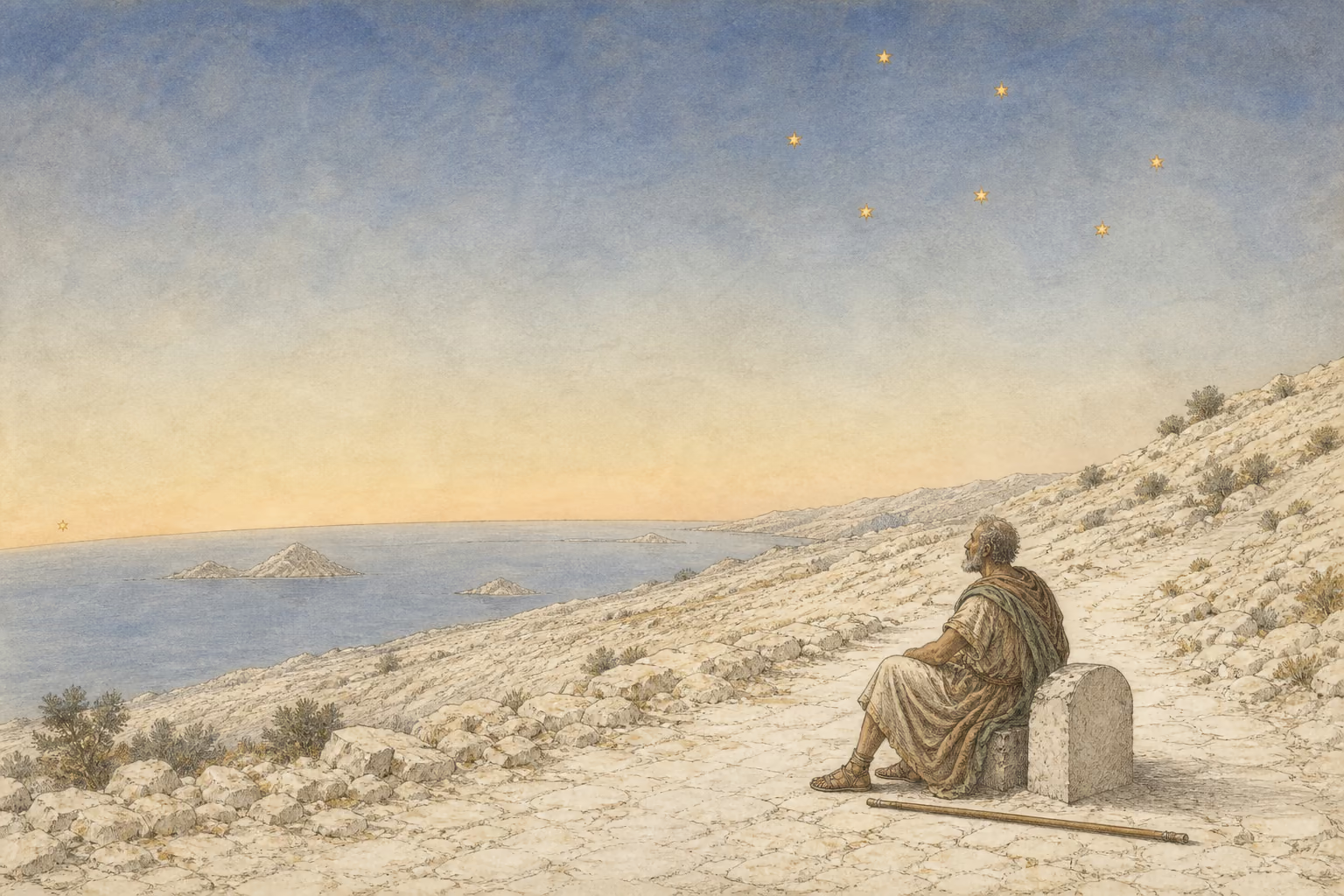
Reliquorum quae miramur causa in ipsius terrae figura est, quam globo similem et cum ea aquas isdem intellegitur argumentis. sic enim fit haut dubie, ut nobis septentrionalis plagae sidera numquam occidant, contra meridianae numquam oriantur, rursusque haec illis non cernantur, attollente se contra medios visus terrarum globo. septentriones non cernit Trogodytice et confinis Aegyptus, nec canopum Italia et quem vocant Berenices crinem, item quem sub Divo Augusto cognominavere Caesaris thronon, insignes ibi stellas. adeoque manifesto adsurgens fastigium curvatur, ut canopus quartam fere partem signi unius supra terram eminere Alexandriae intuentibus videatur, eadem a Rhodo terrain quodammodo ipsam stringere, in Ponto omnino non cernatur, ubi maxime sublimis septentrio. idem a Rhodo absconditur magisque Alexandriae, in Arabia Novembri mense, prima vigilia occultus, secunda se ostendit, in Meroë solstitio vesperi paulisper apparet paucisque ante exortum arcturi diebus pariter cum die cernitur. navigantium haec maxime cursus deprehendunt, in alia adverso, in alia prono mari, subitoque conspicuis atque ut e freto emergentibus, quake in anfractu pilae latuere, sideribus. neque enim, ut dixere aliqui, mundus hoc polo excelsiore se attollit— aut undique cernerentur haec sidera —, verum haec eadem quibusque proximis sublimiora creduntur eademque demersa longinquis, utque nunc sublimis in deiectu positis videtur hic vertex, sic in illam terrae devexitatem transgressis illa se attollunt, residentibus quae hic excelsa fuerant, quod nisi in figura pilae accidere non posset.
Ideo defectus solis ac lunae vespertinos orientis incolae non sentiunt nec matutinos ad occasum habitantes, meridianos vero serius nobis illi. apud Arbilam Magni Alexandri victoria luna defecisse noctis secunda hora est prodita eademque in Sicilia exoriens. solis defectum Vipstano et Fonteio cos., qui fuere ante paucos annos, factum pridie kalendas Maias Campania hora diei inter septimam et octavam sensit, Corbulo dux in Armenia inter horam diei decimam et undecimam prodidit visum, circuitu globi alia aliis detegente et occultante. quod si plana esset terra, simul omnia apparerent cunctis noctesque non fierent inaequales; nam aeque aliis quam in medio sitis paria duodecim horarum intervalla cernerentur, quae nunc non in omni parte simili modo congruunt.
English · Bostock & Riley 1855–57
The three circles, which are connected with the above-mentioned zones, distinguish the inequalities of the seasons; these are, the solstitial circle, which proceeds from the part of the Zodiac the highest to us and approaching the nearest to the district of the north; on the other side, the brumal, which is towards the south pole; and the equinoctial, which traverses the middle of the Zodiac.
The cause of the other things which are worthy of our admiration depends on the figure of the earth itself, which, together with all its waters, is proved, by the same arguments, to be a globe. This certainly is the cause why the stars of the northern portion of the heavens never set to us, and why, on the other hand, those in the south never rise, and again, why the latter can never be seen by the former, the globe of the earth rising up and concealing them. The Northern Wain is never seen in Troglodytice, nor in Egypt, which borders on it; nor can we, in Italy, see the star Canopus, or Berenice’s Hair; nor what, under the Emperor Augustus, was named Cæsar’s Throne, although they are, there, very brilliant stars. The curved form of the earth is so obvious, rising up like a ridge, that Canopus appears to a spectator at Alexandria to rise above the horizon almost the quarter of a sign; the same star at Rhodes appears, as it were, to graze along the earth, while in Pontus it is not seen at all; where the Northern Wain appears considerably elevated. This same constellation cannot be seen at Rhodes, and still less at Alexandria. In Arabia, in the month of November, it is concealed during the first watch of the night, but may be seen during the second; in Meroë it is seen, for a short time, in the evening, at the solstice, and it is visible at day-break, for a few days before the rising of Arcturus. These facts have been principally ascertained by the expeditions of navigators; the sea appearing more elevated or depressed in certain parts; the stars suddenly coming into view, and, as it were, emerging from the water, after having been concealed by the bulging out of the globe. But the heavens do not, as some suppose, rise higher at one pole, otherwise its stars would be seen from all parts of the world; they indeed are supposed to be higher by those who are nearest to them, but the stars are sunk below the horizon to those who are more remote. As this pole appears to be elevated to those who are beneath it; so, when we have passed along the convexity of the earth, those stars rise up, which appear elevated to the inhabitants of those other districts; all this, however, could not happen unless the earth had the shape of a globe.
Hence it is that the inhabitants of the east do not see those eclipses of the sun or of the moon which occur in the evening, nor the inhabitants of the west those in the morning, while such as take place at noon are more frequently visible. We are told, that at the time of the famous victory of Alexander the Great, at Arbela, the moon was eclipsed at the second hour of the night, while, in Sicily, the moon was rising at the same hour. The eclipse of the sun which occurred the day before the calends of May, in the consulship of Vipstanus and Fonteius, not many years ago, was seen in Campania between the seventh and eighth hour of the day; the general Corbulo informs us, that it was seen in Armenia, between the eleventh and twelfth hour; thus the curve of the globe both reveals and conceals different objects from the inhabitants of its different parts. If the earth had been flat, everything would have been seen at the same time, from every part of it, and the nights would not have been unequal; while the equal intervals of twelve hours, which are now observed only in the middle of the earth, would in that case have been the same everywhere.