LIBER XX · CAPUT 23
MEUM, AND MEUM ATHAMANTICUM: SEVEN REMEDIES
Latine · Mayhoff 1906
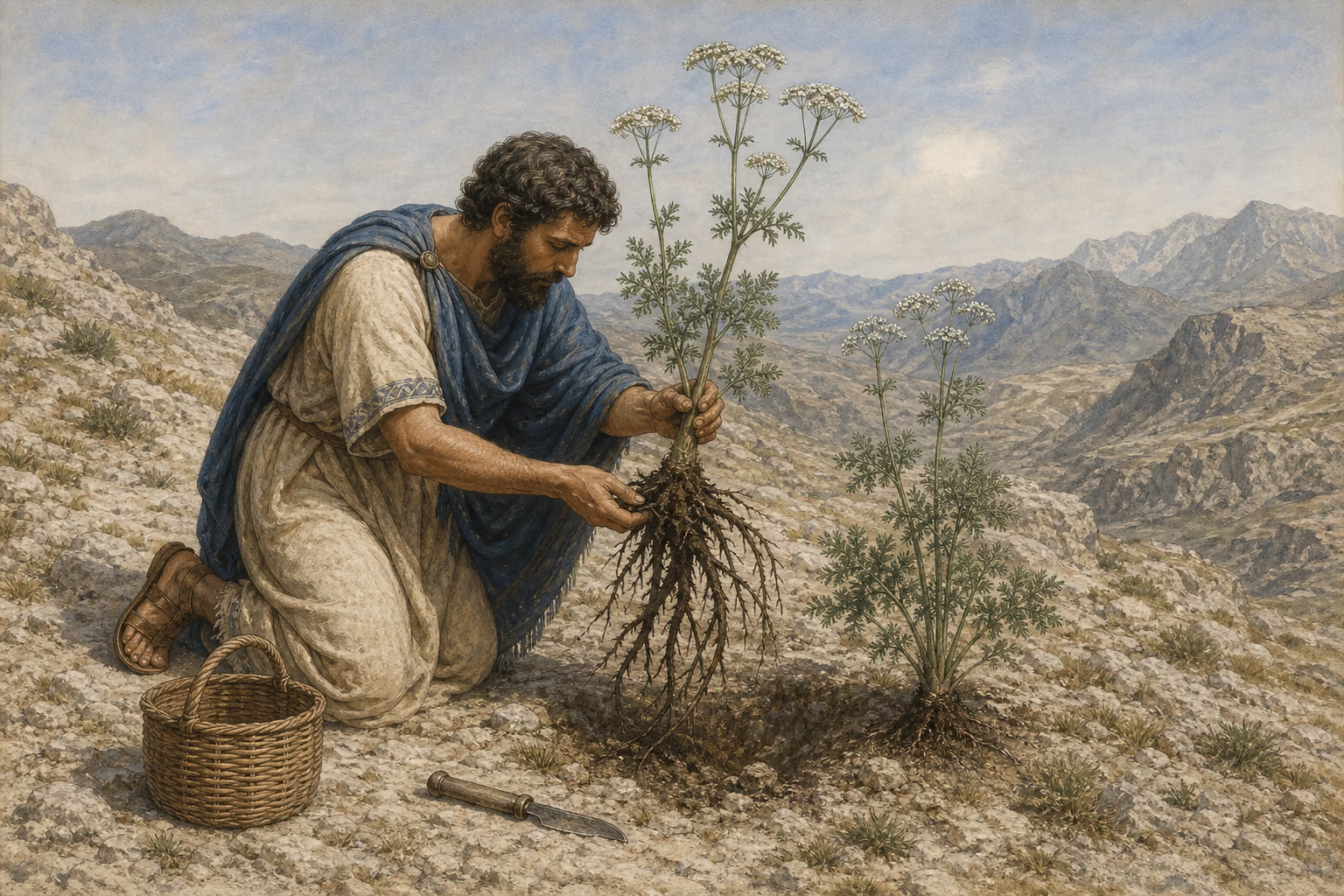
Meum in Italia non nisi a medicis seritur et his admodum paucis. duo genera eius: nobilius Athamanticum vel Athamanicum vocant, illi tamquam ab Athamante inventum, hi quoniam laudatissimum in Athamania reperiatur, foliis aneto simile et caule, aliquando bipedale, radicibus multis obliquis nigris, quibusdam et altis, minus rufum quam illud alterum. urinamciet in aqua pota radice trita vel decocta, inflationes stomachi mire discutit, item tormina et vesicae vitia vulvarumque. articulis cum melle..... infantibus cum apio inlitum imo ventri urinas movet.
Feniculum nobilitavere serpentes gustatu, ut diximus, senectam exuendo oculorumque aciem suco eius reficiendo, unde intellectum, hominum quoque caliginem praecipue eo levari. colligitur hic caule turgescente et in sole siccatur inunguiturque ex melle. [ubique hoc est] laudatissimus in Hiberia lacrimis fit. et e semine recenti fit et e radicibus prima germinatione incisis.
Est in hoc genere et silvestre, quod hippomarathum, alii myrsineum vocant, foliis maioribus, gustu acriore, procerius, baculi crassitudine, radice candida. nascitur in calidis et saxosis. Diocles et aliud hippomarathi genus tradidit, longo et angusto folio, semine coriandri.
Medicinae in sativo ad scorpionum ictus et serpentium semine in vino poto. sucus et auribus instillatur vermiculosque in his necat. ipsum condimentis prope omnibus inseritur, oxyporis etiam aptissime. quin et panis crustis subditur. semen stomachum dissolutum adstringit vel in febribus sumptum, nausiam ex aqua tritum sedat, pulmonibus et iocineribus laudatissimum. ventrem sistit, cum modice sumitur, urinam ciet et ad tormina potu. decoctum in lactis defectu potum mammas replet. radix cum tisana sumpta renes purgat sive decoctae suco ex vino sumpto. prodest et hydropicis radix ex vino pota, item convulsis. inlinuntur folia tumoribus ardentibus ex aceto, calculos vesicae pellunt, venerem stimulant. geniturae abundantiam quoquo modo haustum facit, verendis amicissimum sive ad fovendum radice cum vino decocta sive contrita in oleo inlita. multi et suggillatis cum cera inlinunt [et] radicem. seminis suco vel radice cum melle contra canis morsum utuntur et contra multipedam ex vino.
Hippomarathum ad omnia vehementius calculos praecipue pellit, prodest vesicae cum vino leni et feminarum menstruis haerentibus. efficacius in eo semen quam radix. modus in utroque quod duobus digitis tritum addatur in potionem. Petrichus, qui ophiaca scripsit, et Micion, qui rhizotomumena, adversus serpentes nihil efficacius hippomaratho putavere; sane et Nicander non in novissimis posuit.
Cannabis in silvis primum nata est, nigrior foliis et asperior. semen eius extinguere genituram virorum dicitur. sucus ex eo vermiculos aurium et quodcumque animal intraverit eicit, sed cum dolore capitis, tantaque vis ei est, ut aquae infusus coagulare eam dicatur; et ideo iumentorum alvo succurrit potus in aqua. radix articulos contractos emollit in aqua cocta, item podagras et similes impetus. ambustis cruda inlinitur, sed saepius mutatur, priusquam arescat.
Ferula semen aneto simile habet. quae ab uno caule dividitur in cacumine, femina putatur. caules eduntur decocti commendanturque muria ac melle, stomacho utiles. sin plures sumpti, capitis dolorem faciunt. radix denarii pondere in vini cyathis duobus bibitur adversus serpentes, et ipsa radix inponitur. sic et torminibus medetur, ex oleo autem et aceto contra sudores inmodicos vel in febribus proficit. sucus ferulae alvum solvit fabae magnitudine devoratus. e viridi medulla vulvis utilis et ad. omnia ea vitia. ad sanguinem sistendum decem grana seminis bibuntur in vino trita vel medulla. sunt qui comitialibus dandum putent luna IIII usque VII lingulae mensura. natura ferularum murenis infestissima est, tactae siquidem ea moriuntur. Castor radicis sucum et oculorum claritati conferre multum putavit.
Et de carduorum satu inter hortensia diximus, quapropter et medicinam ex his non differamus. silvestrium genera sunt duo, unum fruticosius a terra statim, alterum unicaule crassius. utrique folia pauca, spinosa, muricatis cacuminibus, sed alter florem purpureum emittit inter medios aculeos celeriter canescentem et abeuntem cum aura; σκόλυμον Graeci vocant. hic, antequam floreat, contusus atque expressus inlito suco alopecias replet. radix cuiuscumque ex aqua decocta potoribus sitim facere narratur. stomachum corroborat et vulvis.... si credimus, etiam conferre aliquid traditur, ut mares gignantur. ita certe Glaucias scripsit, qui circa carduos diligentissimus videtur. mastichee carduis odorem commendat oris.
English · Bostock & Riley 1855–57
Meum is never cultivated in Italy except by medical men, and by very few of those. There are two varieties of it, the finer kind being known as “athamanticum,” because, according to some, it was first discovered by Athamas; or else because, as others think, that of the best quality is found upon Mount Athamas. The leaf of it is similar to that of dill, and the stem is sometimes as much as two cubits in length: the roots, which run obliquely, are numerous and mostly black, though sometimes white: it is not of so red a hue as the other kind.
The root of this plant, pounded or boiled, and taken in water, is diuretic, and is marvellously efficacious for dispelling flatulency of the stomach. It is good, too, for gripings of the bowels and affections of the bladder: applied with honey to the region of the uterus, it acts as a diuretic; and used as a liniment with parsley, upon the lower regions of the abdomen in infants, it has a similar effect.
Fennel has been rendered famous by the serpent, which tastes it, as already stated, when it casts its old skin, and sharpens its sight with the juice of this plant: a fact which has led to the conclusion that this juice must be beneficial, also, in a high degree to the human sight. Fennel-juice is gathered when the stem is swelling with the bud; after which it is dried in the sun and applied as an ointment with honey. This plant is to be found in all parts of the world. The most esteemed preparation from it, is that made in Iberia, from the tear-like drops which exude from the stalk and the seed fresh-gathered. The juice is extracted, also, from incisions made in the root at the first germination of the plant.
There is, also, a wild variety of fennel, known by some persons as “hippomarathron,” and by others as “myrsineum;” it has a larger leaf and a more acrid taste than the other kind. It is taller, also, about the thickness of a walking-stick, and has a white root: it grows in warm, but stony localities. Diocles speaks, too, of another variety of hippomarathron, with a long narrow leaf, and a seed like that of coriander.
The seed of the cultivated fennel is medicinally employed in wine, for the stings of scorpions and serpents, and the juice of it, injected into the ears, has the effect of destroying small worms that breed there. Fennel is employed as an ingredient in nearly all our seasonings, vinegar sauces more particularly: it is placed also beneath the undercrust of bread. The seed, in fevers even, acts as an astringent upon a relaxed stomach, and beaten up with water, it allays nausea: it is highly esteemed, also, for affections of the lungs and liver. Taken in moderate quantities, it arrests looseness of the bowels, and acts as a diuretic; a decoction of it is good for gripings of the stomach, and taken in drink, it restores the milk. The root, taken in a ptisan, purges the kidneys—an effect which is equally produced by a decoction of the juice or of the seed; the root is good too, boiled in wine, for dropsy and convulsions. The leaves are applied to burning tumours, with vinegar, expel calculi of the bladder, and act as an aphrodisiac.
In whatever way it is taken in drink, fennel has the property of promoting the secretion of the seminal fluids; and it is extremely beneficial to the generative organs, whether a decoction of the root in wine is employed as a fomentation, or whether it is used beaten up in oil. Many persons apply fennel with wax to tumours and bruises, and employ the root, with the juice of the plant, or else with honey, for the bites of dogs, and with wine for the stings of multipedes.
Hippomarathron is more efficacious, in every respect, than cultivated fennel; it expels calculi more particularly, and, taken with weak wine, is good for the bladder and irregularities of the menstrual discharge.
In this plant, the seed is more efficacious than the root; the dose of either of them being a pinch with two fingers, beaten up, and mixed with the usual drink. Petrichus, who wrote a work “On Serpents,” and Micton, who wrote a treatise “On Botany,” are of opinion that there is nothing in existence of greater efficacy against serpents than hippomarathron: indeed, Nicander has ranked it by no means among the lowest of antidotes.
Hemp originally grew in the forests, where it is found with a blacker and rougher leaf than in the other kinds. Hempseed, it is said, renders men impotent: the juice of this seed will extract worms from the ears, or any insect which may have entered them, though at the cost of producing head-ache. The virtues of hemp, it is said, are so great, that an infusion of it in water will cause it to coagulate: hence it is, that if taken in water, it will arrest looseness in beasts of burden. A decoction of the root in water, relaxes contractions of the joints, and cures gout and similar maladies. It is applied raw to burns, but it must be frequently changed, so as not to let it dry.
Fennel-giant has a seed similar to that of dill. That which has a single stem, bifurcated at the top, is generally thought to be the female plant. The stalks of it are eaten boiled; and, pickled in brine and honey, they are recommended as particularly beneficial to the stomach; if taken, however, in too large quantities, they are apt to produce head-ache. The root of it in doses of one denarius to two cyathi of wine, is used in drink for the stings of serpents, and the root itself is applied topically for the same purpose, as also for the cure of gripings of the stomach. Taken in oil and vinegar, it is used as a check for excessive perspirations, in fevers even. The inspissated juice of fennel-giant, taken in quantities the size of a bean, acts as a purgative; and the pith of it is good for the uterus, as well as all the maladies previously mentioned. To arrest hæmorrhage, ten of the seeds are taken in drink, bruised in wine, or else with the pith of the plant. There are some persons who think that the seed should be administered for epilepsy, from the fourth to the seventh day of the moon, in doses of one spoonful.
Fennel-giant is naturally so inimical to the muræna, that the very touch of it even will kill that fish. Castor was of opinion that the juice of the root is extremely beneficial to the sight.
We have already spoken, when treating of the garden plants, of the cultivation of the thistle; we may as well, therefore, not delay to mention its medicinal properties. Of wild thistles there are two varieties; one of which throws out numerous stalks immediately it leaves the ground, the other being thicker, and having but a single stem. They have, both of them, a few leaves only, and covered with prickles, the head of the plant being protected by thorny points: the last mentioned, however, puts forth in the middle of these points a purple blossom, which turns white with great rapidity, and is carried off by the wind; the Greeks give it the name of “scolymos.”
This plant, gathered before it blossoms, and beaten up and subjected to pressure, produces a juice, which, applied to the head, makes the hair grow again when it has fallen off through alopecy. The root of either kind, boiled in water, creates thirst, it is said, in those who drink it. It strengthens the stomach also, and if we are to believe what is said, has some influence upon the womb in promoting the conception of male offspring: at all events, Glaucias, who seems to have paid the most attention to the subject, has written to that effect. The thin juice, like mastich, which exudes from these plants, imparts sweetness to the breath.