LIBER XXI · CAPUT 21
FOUR REMEDIES DERIVED PROM TREFOIL
Latine · Mayhoff 1906
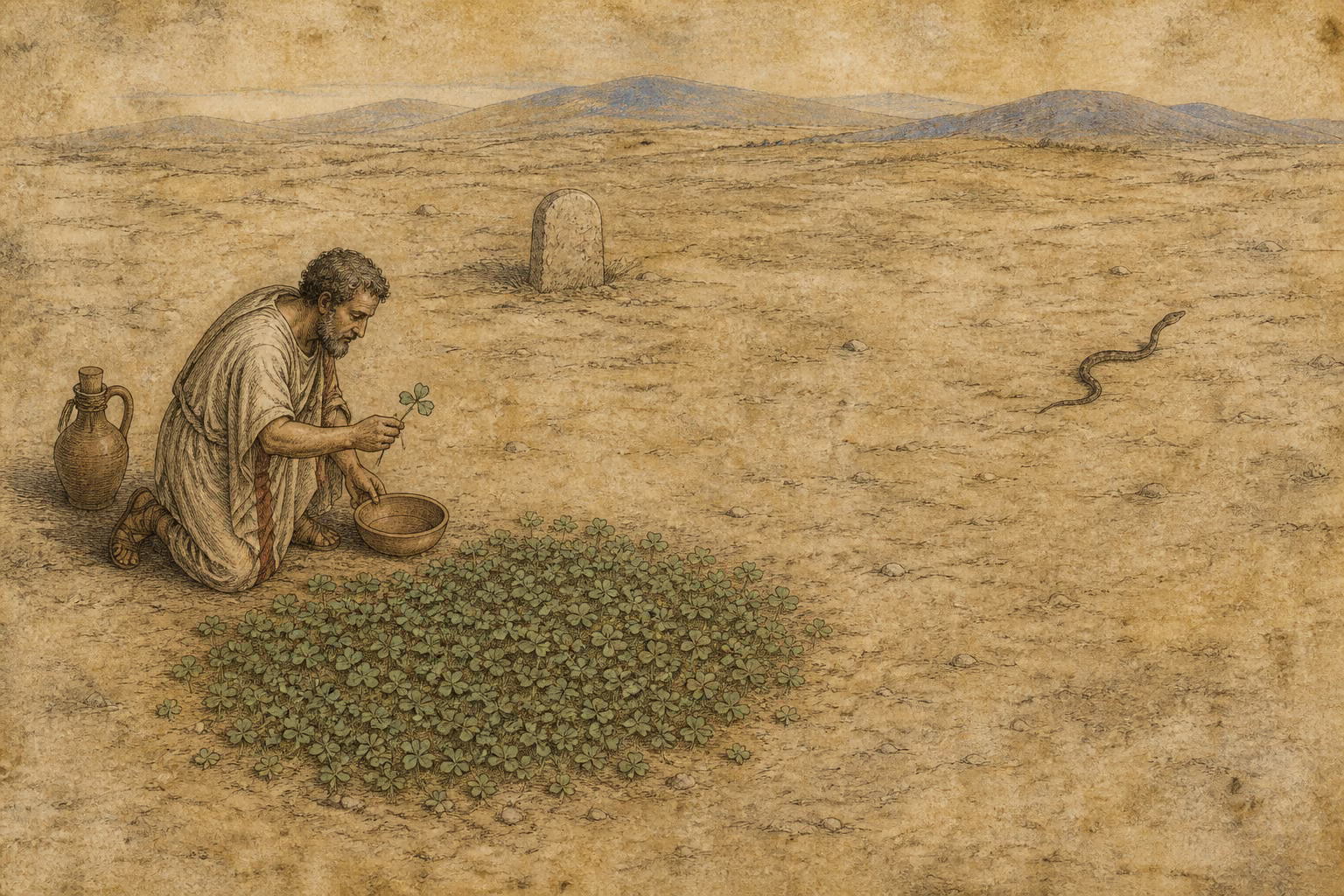
Trifolium scio credi praevalere contra serpentium et scorpionum ictus ex vino aut posca, seminis granis xx potis vel foliis et tota herba decocta, serpentesque numquam in trifolio aspici; praeterea a celebratis auctoribus contra omnia venena pro antidoto sufficere xxv grana eius, quod minyanthes ex eo appellavimus, tradi, multa alia praeterea in remediis eius adscribi. sed me contra sententias eorum gravissimi viri auctoritas movet, Sophocles enim poeta venenatum id dicit, Simos quoque ex medicis, decocti aut contriti sucum infusum corpori easdem uredines facere, quas si percussis a serpente inponatur. ergo non aliter utendum eo quam contra venena censuerim. fortassis enim et his venenis inter se contraria sit natura, sicut multis aliis. item animadverto semen eius, cuius minima sint folia, utile esse ad custodiendam mulierum cutis gratiam in facie inlitum.
Thymum colligi oportet in flore et in umbra siccari. duo autem sunt genera eius: candidum, radice lignosa, in collibus nascens, quod et praefertur; alterum nigrius florisque nigri. utraque oculorum claritati multum conferre existimantur et in cibo et in medicamentis; item diutinae tussi ecligmate faciles excreationes facere cum aceto et sale, sanguinem concrescere non pati e melle, longas faucium destillationes extra inlita cum sinapi extenuare, item stomachi et ventris vitia. modicis tamen utendum est, quoniam excalfaciunt; qua vi sistunt alvum, quae si exulcerata sit, denarii pondus in sextarium aceti et mellis addi oporteat, item si lateris dolor sit, aut inter scapulas aut in thorace. praecordiis medentur ex aceto cum melle, quae potio datur et in alienatione mentis ac melancholicis. datur et comitialibus, quos correptos olfactu excitat thymum. aiunt et dormire eos oportere in molli thymo. prodest et orthopnoicis et anhelatoribus mulierumque mensibus retardatis vel si emortui sint in utero partus, decoctum in aqua ad tertias, et viris vero contra inflationes cum melle et aceto et si venter turgueat testesve aut si vesicae dolor exigat. e vino tumores et impetus inpositum tollit, item cum aceto callum et verrucas. coxendicibus inponitur cum vino, articulariis morbis et luxatis tritum ac lanae inspersum ex oleo, ambustis cum adipe suillo. dant et potioniin articulariis morbis trium obolorum pondere in tribus cyathis aceti et mellis, in fastidio tritum cum sale.
Hemerocalles pallidum e viridi et molle folium habet, grandi radice odorataque, bulbosa. cum melle inposita ventri aquas pellit et sanguinem etiam inutilem. folia epiphoris oculorum mammarumque post partum inlinuntur.
Helenium ab Helena, ut diximus, natum favere creditur formae, cutem mulierum in facie reliquoque corpore nutrire incorruptam. praeterea putant usu eius quandam vitae gratiam his veneremque conciliari. adtribuunt et hilaritatis effectum eidem potae in vino eumque, quem habuerit nepenthes illud praedicatum ab Homero, quod tristitia omnis aboleretur. est autem suci praedulcis. prodest et orthopnoicis radix eius in aqua ieiunis pota. est autem candida intus et dulcis. bibitur et contra serpentium ictus ex vino. mures quoque contrita dicitur necare.
Habrotonum duorum traditur generum, campestre ac montanum. hoc feminam, illud marem intellegi volunt. amaritudo absinthii in utroque. Siculum laudatissimum, dein Galaticum. usus et foliis, sed maior semini ad excalfaciendum, ideo nervis utile, tussi, orthopnoeae, ruptis, convulsis, lumbis, urinae angustiis. datur bibendum manualibus fasciculis decoctis ad tertias partes; ex his quaternis cyathis bibitur. datur et semen tusum in aqua drachmae pondere. prodest et vulvae. concoquit panos cum farina hordeacia et oculorum inflammationi inlinitur cotoneo malo cocto. serpentes fugat; contra ictus earum bibitur cum vino inliniturque, efficacissimum contra ea, quorum veneno tremores et frigus accidunt, ut scorpionum et phalangiorum; et contra venena alia pota prodest et quoquo modo algentibus. vis ei et extrahendi ea, quae inhaereant corporibus. pellit et interaneorum mala. ramo eius, si subiciatur pulvino, venerem stimulari aiunt, efficacissimamque esse herbam contra omnia veneficia, quibus coitus inhibeatur.
English · Bostock & Riley 1855–57
The trefoil, I know, is generally looked upon as being particularly good for the stings of serpents and scorpions, the seed being taken in doses of twenty grains, with either wine or oxycrate; or else the leaves and the plant itself are boiled together, and a decoction made of them; indeed, it is stated, that a serpent is never to be seen among trefoil. Celebrated authors, too, I find, have asserted that twenty-five grains of the seed of the kind of trefoil which we have spoken of as the “minyanthes,” are a sufficient antidote for all kinds of poisons: in addition to which, there are numerous other remedial virtues ascribed to it.
But these notions, in my opinion, are counterbalanced by the authority of a writer of the very highest repute: for we find the poet Sophocles asserting that the trefoil is a venomous plant. Simus, too, the physician, maintains that a decoction of it, or the juice, poured upon the human body, is productive of burning sensations similar to those experienced by persons when they have been stung by a serpent and have trefoil applied to the wound. It is my opinion, then, that trefoil should never be used in any other capacity than as a counter-poison; for it is not improbable that the venom of this plant has a natural antipathy to all other kinds of poisons, a phænomenon which has been observed in many other cases as well. I find it stated, also, that the seed of the trefoil with an extremely diminutive leaf, applied in washes to the face, is extremely beneficial for preserving the freshness of the skin in females.
Thyme should be gathered while it is in flower, and dried in the shade. There are two kinds of thyme: the white thyme with a ligneous root, which grows upon declivities, and is the most esteemed of the two, and another variety, which is of a darker colour, and bears a swarthy flower. They are, both of them, considered to be extremely beneficial to the sight, whether used as an article of food or as a medicament, and to be good for inveterate coughs. Used as an electuary, with vinegar and salt, they facilitate expectoration, and taken with honey, they prevent the blood from coagulating. Applied externally with mustard, they dispel chronic fluxes of the fauces, as well as various affections of the stomach and bowels. Still, however, these plants must be used in moderation, as they are of a heating nature, for which reason it is that they act so astringently upon the bowels. In cases of ulceration of the intestines, the dose should be one denarius of thyme to one sextarius of oxymel; the same proportions, too, should be taken for pains in the sides, between the shoulder-blades, or in the thoracic organs. Taken with oxymel, these plants are used for the cure of intestinal diseases, and a similar draught is administered in cases of alienation of the senses and melancholy.
Thyme is given also for epilepsy, when the fits come on, the smell of it reviving the patient; it is said, too, that epileptic persons should sleep upon soft thyme. It is good, also, for hardness of breathing, and for asthma and obstructions of the catamenia. A decoction of thyme in water, boiled down to one-third, brings away the dead fœtus, and it is given to males with oxymel, as a remedy for flatulency, and in cases of swelling of the abdomen or testes and of pains in the bladder. Applied with wine, it removes tumours and fluxes, and, in combination with vinegar, callosities and warts. Mixed with wine, it is used as an external application for sciatica; and, beaten up with oil and sprinkled upon wool, it is employed for diseases of the joints, and for sprains. It is applied, also, to burns, mixed with hogs’ lard. For maladies of the joints of recent date, thyme is administered in drink, in doses of three oboli to three cyathi of oxymel. For loss of appetite, it is given, beaten up with salt.
The hemerocalles has a soft, pale green leaf, with an odoriferous, bulbous root. This root, applied with honey to the abdomen, draws off the aqueous humours and all corrupt blood. The leaves of it are applied for defluxions of the eyes, and for pains in the mamillæ, after childbirth.
The helenium, which springs, as we have already stated, from the tears of Helena, is generally thought to have been produced for improving the appearance, and to maintain unimpaired the freshness of the skin in females, both of the face and of other parts of the body. Besides this, it is generally supposed that the use of it confers additional graces on the person, and ensures universal attraction. They say, too, that, taken with wine, it promotes gaiety of spirit, having, in fact, a similar effect to the nepenthes, which has been so much vaunted by Homer, as producing forgetfulness of all sorrow. The juice of this plant is remarkably sweet, and the root of it, taken fasting in water, is good for hardness of breathing; it is white within, and sweet. An infusion of it is taken in wine for the stings of serpents; and the plant, bruised, it is said, will kill mice.
We find two varieties of abrotonum mentioned, the field, and the mountain kind; this last, it is generally understood, is the female plant, the other the male. They are both of them bitter, like wormwood. That of Sicily is the most esteemed, and next to it, that of Galatia. The leaves of it are sometimes employed, but it is the seed that possesses the most warming properties; hence it is, that it is so beneficial for maladies of the sinews, for cough, hardness of breathing, convulsions, ruptures, lumbago, and strangury. Several handfuls of this plant are boiled down to one-third, and the decoction of it, in doses of four cyathi, is administered in drink. The seed is given, pounded, in water, in doses of one drachma; it is very good for affections of the uterus.
Mixed with barley-meal, this plant brings tumours to a head, and boiled with quinces, it is employed as a liniment for inflammations of the eyes. It keeps away serpents, and for their stings it is either taken in wine, or else employed in combination with it as a liniment. It is extremely efficacious, also, for the stings of those noxious insects by which shivering fits and chills are produced, such as the scorpion and the spider called “phalangium,” for example; taken in a potion, it is good for other kinds of poison, as also for shivering fits, however produced, and for the extraction of foreign substances adhering to the flesh; it has the effect, also, of expelling intestinal worms. It is stated that a sprig of this plant, if put beneath the pillow, will act as an aphrodisiac, and that it is of the very greatest efficacy against all those charms and spells by which impotence is produced.