LIBER XXI · CAPUT 8
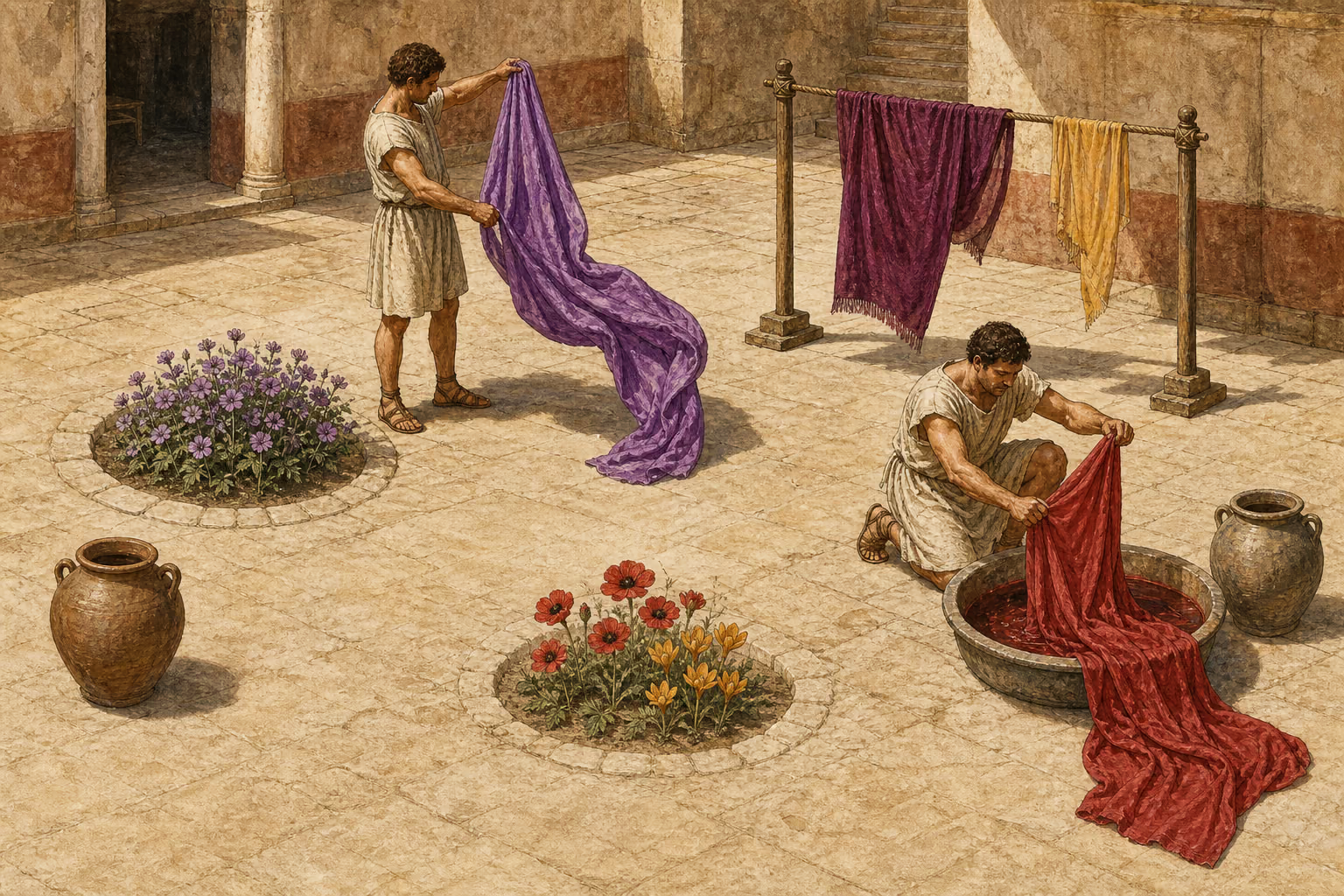
FABRICS WHICH RIVAL THE COLOURS OF FLOWERS
Latine · Mayhoff 1906
Et de odoratis floribus satis dictum. in quibus unguento vicisse naturam gaudens luxuria vestibus quoque provocavit eos flores, qui colore commendantur. hos animadverto tris esse principales: rubentem in cocco, qui a rosae nigrantis gratia nitido trahitur suspectu et in purpuras Tyrias dibaphasque ac Laconicas; amethysti- num, qui a viola et ipse in purpureum, quemque ianthinum appellavimus. genera enim tractamus in species mul- tas sese spargentia. tertius est, qui proprie conchylii intellegitur, multis modis: unus in heliotropio et in aliquo exilis, plerumque saturatior; alius in malva ad purpuram inclinans; alius in viola serotina conchyliorum vegetissimus. paria nunc componuntur, et natura atque luxuria depugnant. lutei video honorem antiquissimum, in nuptialibus flammeis totum feminis concessum, et fortassis ideo non numerari inter principales, hoc est communes maribus ac feminis, quoniam societas principatum dedit.
Amaranto non dubie vincimur. est autem spica purpurea verius quam flos aliquis, et ipse sine odore. mirum in eo gaudere decerpi et laetius renasci. provenit Augusto mense, durat in autumnum. Alexandrino palma, qui decerptus adservatur; mireque, postquam defecere cuncti flores, madefactus aqua revivescit et hibernas coronas facit. summa natura eius in nomine est, appellati, quoniam non marcescat. in nomine et cyani colos, item holochrysi.
Omnes autem hi flores non fuere in usu Alexandri Magni aetate, quoniam proximi a morte eius auctores siluere de illis; quo manifestum est postea placuisse. a Graecis tamen repertos quis dubitet, non aliter Italia usurpante nomina illorum? at, Hercules, petellio ipsa nomen inposuit, autumnali circaque vepres nascenti. ei tantum color est commendatus, qui est rosae silvestris, folia parva, quina; mirumque in eo flore inflecti cacumen et e nodis intorta folia nasci parvolo calice ac versicolori luteum semen includentia. luteo et bellio, pastillicantibus quinquagenis quinis barbulis. coronant pratenses hi flore; at sine usu plerique et ideo sine nominibus, quin et his ipsis alia alii vocabula inponunt. chrysocome sive chrysitis non habet Latinam appellationem. palmi altitudine est, comantibus fulgore auri corymbis, radice nigra, ex austero dulci, in petrosis opacisque nascens.
English · Bostock & Riley 1855–57
We have now said enough on the subject of the odoriferous flowers; in relation to which, luxury not only glories in having vanquished Nature in the composition of unguents, but has even gone so far as to challenge, in her fabrics, those flowers which are more particularly recommended by the beauty of their tints. I remark that the following are the three principal colours; the red, that of the kermes for instance, which, beginning in the tints of the rose, reflects, when viewed sideways and held up to the light, the shades that are found in the Tyrian purple, and the colours of the dibapha and Laconian cloths: the amethystine colour, which is borrowed from the violet, and to which, bordering as it does on the purple, we have given the name of “ianthinum” —it must, however, be remembered, that we here give a general name to a colour which is subdivided into numerous tints —and a third, properly known as the “conchyliated” colour, but which comprehends a variety of shades, such, for instance, as the tints of the heliotropium, and others of a deeper colour, the hues of the mallow, inclining to a full purple, and the colours of the late violet; this last being the most vivid, in fact, of all the conchyliated tints. The rival colours being now set side by side, Nature and luxury may enter the lists, to vie for the mastery.
I find it stated that, in the most ancient times, yellow was held in the highest esteem, but was reserved exclusively for the nuptial veils of females; for which reason it is perhaps that we do not find it included among the principal colours, those being used in common by males and females: indeed, it is the circumstance of their being used by both sexes in common that gives them their rank as principal colours.
There is no doubt that all the efforts of art are surpassed by the amaranth, which is, to speak correctly, rather a purple ear than a flower, and, at the same time, quite inodorous. It is a marvellous feature in this plant, that it takes a delight in being gathered; indeed, the more it is plucked, the better it grows. It comes into flower in the month of August, and lasts throughout the autumn. The finest of all is the amaranth of Alexandria, which is generally gathered for keeping; for it is a really marvellous fact, that when all the other flowers have gone out, the amaranth, upon being dipped in water, comes to life again: it is used also for making winter chaplets. The peculiar quality of the amaranth is sufficiently indicated by its name, it having been so called from the circumstance that it never fades.
The name, too, of the cyanos indicates its colour, and so does that of the holochrysos. None of these flowers were in use in the time of Alexander the Great, for the authors, we find, who flourished at a period immediately after his decease, have made not the slightest mention of them; from which circumstance it is very clear that they only came into fashion at a later period. Still, however, who can entertain any doubt that they were first introduced by the Greeks, from the fact that Italy has only their Greek names by which to designate them?
But, by Hercules! it is Italy herself that has given its name to the petilium, an autumnal flower, which springs up in the vicinity of thorny brakes, and recommends itself solely by its colour, which is that of the wild rose. The petals of it are small, and five in number; and it is a remarkable circumstance in this plant, that the head of it droops at first, and it is only after it becomes erect that the petals make their appearance, forming a small corolla of various colours, enclosing a yellow seed.
The bellio, too, is a yellow flower, formed of fifty-five filaments circularly arranged, in the shape of a chaplet. These are, both of them, meadow flowers, which are mostly of no use whatever, and consequently without names: even the flowers just mentioned are known sometimes by one name, and sometimes by another.
The chrysocome, or chrysitis, has no Latin appellation: it is a palm in height, the flowers forming clusters of a golden colour. The root of it is black, and it has a taste both rough and sweet: it is found growing in stony and umbrageous spots.