LIBER XXI · CAPUT 7
THE NATURE OF ODOURS
Latine · Mayhoff 1906
Troianis temporibus iam erat honos ei; hos certe flores Homerus tris laudat loton, crocum, hyacinthum.
Omnium autem odoramentorum atque adeo herbarum differentia est in colore et odore et suco. odorato sapor raro ulli non amarus, e contrario dulcia raro odorata; itaque et vina mustis odoratiora et silvestria magis omnia sativis. quorundam odor suavior e longinquo, propius admotus hebetatur, ut violae. rosa recens a longinquo olet, sicca propius. omnis autem verno tempore acrior et matutinis; quidquid ad meridianas horas dies vergit, hebetatur. novella quoque vetustis minus odorata; acerrimus tamen odor omnium aetate media. rosa et crocum odoratiora, cum serenis diebus leguntur, et omnia in calidis quam in frigidis; in Aegypto tamen minime odorati flores, quia nebulosus et roscidus aer est a multo flumine. quorundam suavitati gravitas inest. quaedam, dum virent, non olent propter umorem nimium, ut buceras, quod est fenum Graecum. aquatis odor non omnino sine suco est, ut violae, rosae, croco; quae vero ex aquatis carent suco, eorum omnium odor gravis, ut in lilio utriusque generis. habrotonum et amaracum acres habent odores. quorundam flos tantum iucundus, reliquae partes ignavae, ut violae ac rosae. hortensium odoratissima quae sicca, ut ruta, menta, apium, et quae in siccis nascantur. quaedam vetustate odoratiora, ut cotonea, eademque decerpta quam in suis radicibus. quaedam non nisi defracta aut ex adtritu olent, alia non nisi detracto cortice, quaedam vero non nisi usta, sicut tura murraeque. flores triti omnes amariores quam intacti. aliqua arida diutius odorem continent, ut melilotos. quaedam locum ipsum odoratiorem faciunt, ut iris, quin et arborem totam, cuiuscumque radices adtingat. hesperis noctu magis olet, inde nomine invento. animalium nullum odoratum, nisi si de pantheris quod dictum est credimus.
Illa quoque non omittenda differentia est, et odoratorum multa nihil adtinere ad coronamenta, ut irim atque saliuncam, quamquam nobilissimi odoris utramque. sed iris radice tantum commendatur, unguentis nascens et medicinae. laudatissima in Illyrico, et ibi quoque non in maritimis, sed in silvestribus Drinonis et Naronae, proxima in Macedonia, longissima haec et candicans et exilis. tertium locum habet Africana, amplissima inter omnes gustuque amarissima. Illyrica quoque duorum generum est: raphanitis a similitudine, quae et melior, rhizotomos. subrufa optima, quae sternumenta tractatu movet. caulem habet cubitalem, erectum; floret versicolori specie, sicut arcus caelestis, unde et nomen. non inprobatur et Pisidica. effossuri tribus ante mensibus mulsa aqua circumfusa hoc veluti placamento terrae blandiuntur, circumscriptam mucrone gladii orbe triplici cum legerunt, protinus in caelum adtollunt. natura est fervens, tractataque pusulas ambusti modo facit. praecipitur ante omnia, ut casti legant. teredines non sicca modo, verum et in terra celerrime sentit. —Optimum antea irinum Leucade et Elide ferebatur— iam pridem enim et seritur—, nunc e Pamphylia, sed Cilicium maxime laudatur atque e septentrionalibus.—
Saliunca folio quidem subbrevi et quod necti non possit, radici numerosae cohaeret, herba verius quam flos, densa veluti manu pressa breviterque caespes sui generis. Pannonia hanc gignit et Norici Alpiumque aprica, urbium Eporedia, tantae suavitatis, ut metallum esse coeperit. vestibus interponi eam gratissimum, sicut apud Graecos polium herbam, inclutam Musaei et Hesiodi laudibus ad omnia utilem praedicantium superque cetera ad famam etiam ac dignitates, prorsusque miram, si modo, ut tradunt, folia eius mane candida, meridie purpurea, sole occidente caerulea aspiciuntur. duo genera eius: campestre maius; silvestre, quod minus est, quidam teuthrion vocant. folia canis hominis similia, a radice protinus, numquam palmo altiora.
English · Bostock & Riley 1855–57
Saffron was already held in high esteem in the time of the Trojan War; at all events, Homer, we find, makes mention of these three flowers, the lotus, the saffron, and the hyacinth.
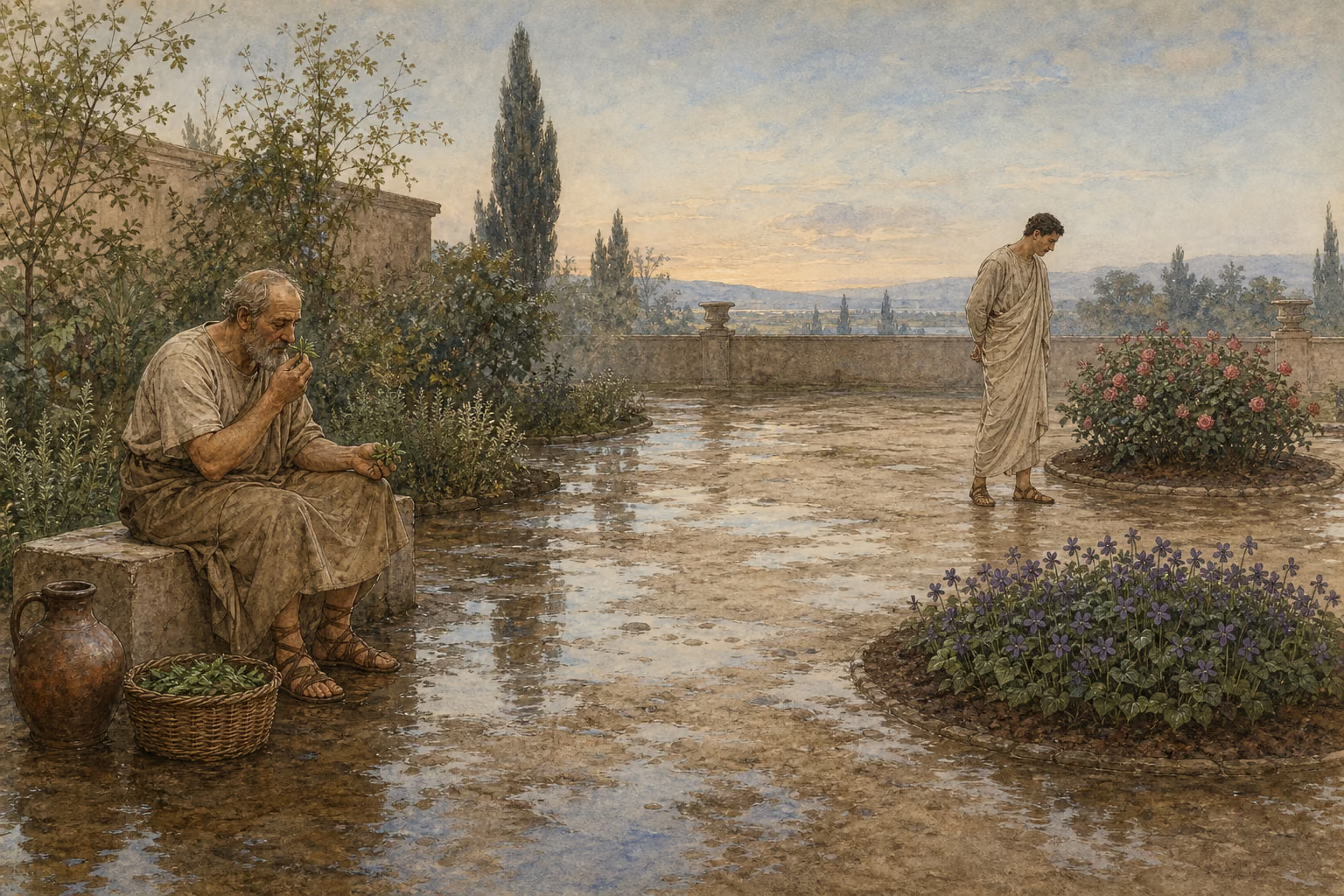
All the odoriferous substances, and consequently the plants, differ from one another in their colour, smell, and juices. It is but rarely that the taste of an odoriferous substance is not bitter; while sweet substances, on the other hand, are but rarely odoriferous. Thus it is, too, that wine is more odoriferous than must, and all the wild plants more so than the cultivated ones. Some flowers have a sweet smell at a distance, the edge of which is taken off when they come nearer; such is the case with the violet, for instance. The rose, when fresh gathered, has a more powerful smell at a distance, and dried, when brought nearer. All plants have a more penetrating odour, also, in spring and in the morning; as the hour of midday approaches, the scent becomes gradually weakened. The flowers, too, of young plants are less odoriferous than those of old ones; but it is at mid-age that the odour is most penetrating in them all.
The rose and the crocus have a more powerful smell when gathered in fine weather, and all plants are more powerfully scented in hot climates than in cold ones. In Egypt, however, the flowers are far from odoriferous, owing to the dews and exhalations with which the air is charged, in consequence of the extended surface of the river. Some plants have an agreeable, though at the same time extremely powerful smell; some, again, while green, have no smell at all, owing to the excess of moisture, the buceros for example, which is the same as fenugreek. Not all flowers which have a penetrating odour are destitute of juices, the violet, the rose, and the crocus, for example; those, on the other hand, which have a penetrating odour, but are destitute of juices, have all of them a very powerful smell, as we find the case with the two varieties of the lily. The abrotonum and the amaracus have a pungent smell. In some plants, it is the flower only that is sweet, the other parts being inodorous, the violet and the rose, for example.
Among the garden plants, the most odoriferous are the dry ones, such as rue, mint, and parsley, as also those which grow on dry soils. Some fruits become more odoriferous the older they are, the quince, for example, which has also a stronger smell when gathered than while upon the tree. Some plants, again, have no smell but when broken asunder, or when bruised, and others only when they are stripped of their bark. Certain vegetable substances, too, only give out a smell when subjected to the action of fire, such as frankincense and myrrh, for example. All flowers are more bitter to the taste when bruised than when left untouched. Some plants preserve their smell a longer time when dried, the melilote, for example; others, again, make the place itself more odoriferous where they grow, the iris for instance, which will even render the whole of a tree odoriferous, the roots of which it may happen to have touched. The hesperis has a more powerful odour at night, a property to which it owes its name.
Among the animals, we find none that are odoriferous, unless, indeed, we are inclined to put faith in what has been said about the panther.
There is still another distinction, which ought not to be omitted,—the fact, that many of the odoriferous plants never enter into the composition of garlands, the iris and the saliunca, for example, although, both of them, of a most exquisite odour. In the iris, it is the root only that is held in esteem, it being extensively employed in perfumery and medicine. The iris of the finest quality is that found in Illyricum, and in that country, even, not in the maritime parts of it, but in the forests on the banks of the river Drilon and near Narona. The next best is that of Macedonia, the plant being extremely elongated, white, and thin. The iris of Africa occupies the third rank, being the largest of them all, and of an extremely bitter taste.
The iris of Illyricum comprehends two varieties—one of which is the raphanitis, so called from its resemblance to the radish, of a somewhat red colour, and superior in quality to the other, which is known as the “rhizotomus.” The best kind of iris is that which produces sneezing when handled. The stem of this plant is a cubit in length, and erect, the flower being of various colours, like the rainbow, to which circumstance it is indebted for its name. The iris, too, of Pisidia is far from being held in disesteem. Persons who intend taking up the iris, drench the ground about it some three months before with hydromel, as though a sort of atonement offered to appease the earth; with the point of a sword, too, they trace three circles round it, and the moment they gather it, they lift it up towards the heavens.
The iris is a plant of a caustic nature, and when handled, it causes blisters like burns to rise. It is a point particularly recommended, that those who gather it should be in a state of chastity. The root, not only when dried, but while still in the ground, is very quickly attacked by worms. In former times, it was Leucas and Elis that supplied us with the best oil of iris, for there it has long been cultivated; at the present day, however, the best comes from Pamphylia, though that of Cilicia and the northern climates is held in high esteem.
The saliunca has a rather short leaf, which does not admit of its being plaited for garlands, and numerous roots, by which it is held together; being more of a herb than a flower, and so closely matted and tangled that it would almost appear to have been pressed together with the hand—in short, it is a turf of a peculiar nature. This plant grows in Pannonia and the sunny regions of Noricum and the Alps, as also the vicinity of the city of Eporedia; the smell being so remarkably sweet that the crops of it have been of late quite as profitable as the working of a mine. This plant is particularly valued for the pleasant smell it imparts to clothes among which it is kept.
It is the same, too, with the polium, a herb employed for a similar purpose among the Greeks, and highly extolled by Musæus and Hesiod, who assert that it is useful for every purpose, and more particularly for the acquisition of fame and honour; indeed, it is a truly marvellous production, if it is the fact, as they state, that its leaves are white in the morning, a purple at midday, and azure at sunset. There are two varieties of it, the field polium, which is larger, and the wild, which is more diminutive. Some persons give it the name of “teuthrion.” The leaves resemble the white hairs of a human being; they take their rise immediately from the root, and never exceed a palm in height.