LIBER XXI · CAPUT 6
HOW THE SEVERAL VARIETIES OF THE VIOLET ARE RESPECTIVELY PRODUCED, GROWN, AND CULTIVATED. THE THREE DIFFERENT COLOURS OF THE VIOLET. THE FIVE VARIETIES OF THE YELLOW VIOLET
Latine · Mayhoff 1906
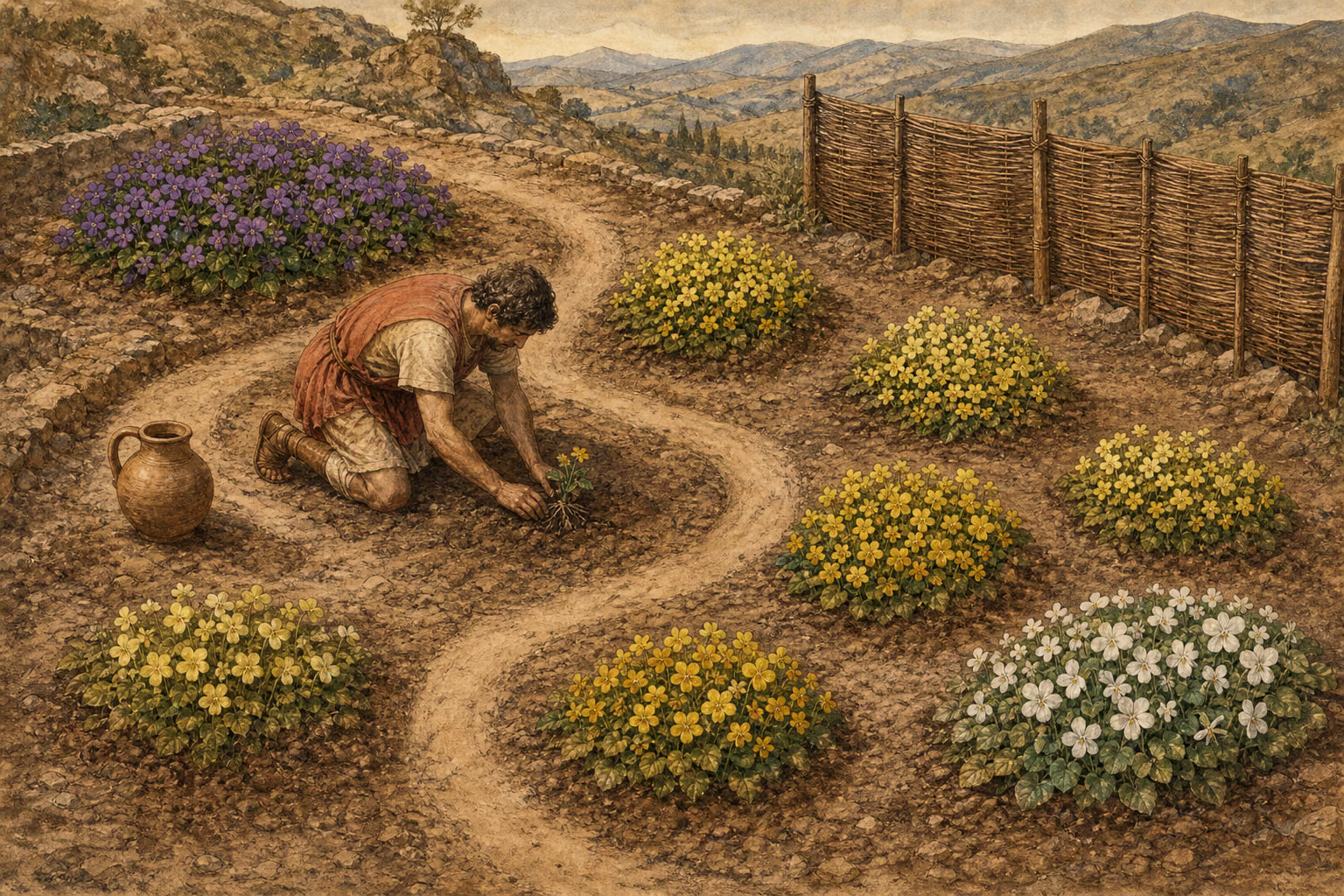
Violis honos proximus, earumque plura genera, purpureae, luteae, albae, plantis omnes, ut olus, satae. ex his vero, quae sponte apricis et macris locis proveniunt, purpureae latiore folio, statim ab radice exeunti, carnoso solaeque Graeco nomine a ceteris discernuntur, appellatae ia et ab his ianthina vestis. e sativis maxima auctoritas luteis; genera autem Tusculana et quae marina appellatur, folio aliquanto latiore, sed minus odorata; in totum vero sine odore minutoque folio Calatina, munus autumni, ceterae veris.
Proxima ei caltha est et concolori... amplitudine. vincit numero foliorum marinam quina non excedentem; eadem odore superatur. est enim gravi caltha, non leviore quam scopam regiam appellant, quamquam folia eius olent, non flores.
Baccar quoque radicis tantum odoratae est, a quibusdam nardum rusticum appellatum. unguenta ex ea radice fieri solita apud antiquos Aristophanes, priscae comoediae poeta, testis est; unde quidam errore falso barbaricam eam appellabant. odor est cinnamomo proximus. gracili solo nec umido provenit. simillimum ei combretum appellatur, foliorum exilitate usque in fila adtenuata et procerius quam baccar. haec sutilia tantum. eorum quoque error corrigendus est, qui baccar rusticum nardum appellavere. est enim alia herba sic cognominata, quam Graeci asaron vocant, cuius speciem figuramque diximus in nardi generibus. quin immo asaron invenio vocitari, quoniam in coronas non addatur.
Crocum silvestre optimum. serere in Italia minime expedit, ad scripula usque singula areis decoquentibus. seritur radicis bulbo. sativum latius maiusque et nitidius, sed multo lenius, degenerans ubique nec fecundum etiam Cyrenis, ubi semper flores laudatissimi. prima nobilitas Cilicio et ibi in Coryco monte, dein Lycio e monte Olympo, mox Centuripino Siciliae. aliqui Theraeo secundum locum dedere. adulteratur nihil aeque. probatio sinceri, si inposita manu crepitet veluti fragile; umidum enim, quod event adulteratione, sentit. altera probatio, si manu relata ad ora leniter faciem oculosque mordeat. est per se genus sativi blandissimum volgo, cum sit mediocre, dialeucon vocant. contra Cyrenaico vitium, quod omni croco nigrius est et celerrime marcescit. optimum ubicumque quod pinguissimum et brevis capilli, pessimum vero quod situm redolet. Mucianus auctor est, in Lycia anno septimo aut octavo transferri in locum subactum atque ita degenerans renovari. usus eius in coronis nusquam; herba enim est folio angusto paene in capillamenti modum. sed vino mire congruit, praecipue dulci, tritum ad theatra replenda. floret vergiliarum occasu paucis diebus folioque florem expellit. viret bruma et colligitur; siccatur umbra, melius etiam hiberna. carnosa et illi radix vivaciorque quam ceteris. gaudet calcari et atteri pereundoque melius provenit; ideo iuxta semitas ac fontes laetissimum.
English · Bostock & Riley 1855–57
Next after the roses and the lilies, the violet is held in the highest esteem: of this there are several varieties, the purple, the yellow, and the white, all of them reproduced from plants, like the cabbage. The purple violet, which springs up spontaneously in sunny spots, with a thin, meagre soil, has larger petals than the others, springing immediately from the root, which is of a fleshy substance. This violet has a name, too, distinct from the other wild kinds, being called “ion,” and from it the ianthine cloth takes its name.
Among the cultivated kinds, the yellow violet is held in the greatest esteem. The Tusculan violet, and that known as the “marine” violet, have petals somewhat broader than the others, but not so odoriferous; the Calatian violet, too, which has a smaller leaf, is entirely destitute of smell. This last is a present to us from the autumn, the others from the spring.
Next to it comes the caltha, the flowers of which are of similar colour and size; in the number of its petals, however, it surpasses the marine violet, the petals of which are never more than five in number. The marine violet is surpassed, too, by the other in smell; that of the caltha being very powerful. The smell, too, is no less powerful in the plant known as the “scopa regia;” but there it is the leaves of the plant, and not the flowers, that are odoriferous.
The bacchar, too, by some persons known as “field nard,” is odoriferous in the root only. In former times, it was the practice to make unguents of this root, as we learn from the poet Aristophanes, a writer of the Ancient Comedy; from which circumstance some persons have erroneously given the name of “exotic” to the plant. The smell of it strongly resembles that of cinnamomum; and the plant grows in thin soils, which are free from all humidity.
The name of “combretum” is given to a plant that bears a very strong resemblance to it, the leaves of which taper to the fineness of threads; in height, however, it is taller than the bacchar. These are the only * * * * The error, however, ought to be corrected, on the part of those who have bestowed upon the bacchar the name of “field nard;” for that in reality is the surname given to another plant, known to the Greeks as “asaron,” the description and features of which we have already mentioned, when speaking of the different varieties of nard. I find, too, that the name of “asaron” has been given to this plant, from the circumstance of its never being employed in the composition of chaplets.
The wild saffron is the best; indeed, in Italy it is of no use whatever to attempt to propagate it, the produce of a whole bed of saffron being boiled down to a single scruple; it is reproduced by offsets from the bulb. The cultivated saffron is larger, finer, and better looking than the other kinds, but has much less efficacy. This plant is everywhere degenerating, and is far from prolific at Cyrenæ even, a place where the flowers are always of the very finest quality. The most esteemed saffron, however, is that of Cilicia, and there of Mount Corycus in particular; next comes the saffron of Mount Olympus, in Lycia, and then of Centuripa, in Sicily; some persons, however, have given the second rank to the Phlegræan saffron.
There is nothing so much adulterated as saffron: the best proof of its goodness is when it snaps under pressure by the fingers, as though it were friable; for when it is moist, a state which it owes to being adulterated, it is limp, and will not snap asunder. Another way of testing it, again, is to apply it with the hand to the face, upon which, if good, it will be found to be slightly caustic to the face and eyes. There is a peculiar kind, too, of cultivated saffron, which is in general extremely mild, being only of middling quality; the name given to it is “dialeucon.” The saffron of Cyrenaica, again, is faulty in the opposite extreme; for it is darker than any other kind, and is apt to spoil very quickly. The best saffron everywhere is that which is of the most unctuous quality, and the filaments of which are the shortest; the worst being that which emits a musty smell.
Mucianus informs us that in Lycia, at the end of seven or eight years, the saffron is transplanted into a piece of ground which has been prepared for the purpose, and that in this way it is prevented from degenerating. It is never used for chaplets, being a plant with an extremely narrow leaf, as fine almost as a hair; but it combines remarkably well with wine, sweet wine in particular. Reduced to a powder, it is used to perfume the theatres.
Saffron blossoms about the setting of the Vergiliæ, for a few days only, the leaf expelling the flower. It is verdant at the time of the winter solstice, and then it is that they gather it; it is usually dried in the shade, and if in winter, all the better. The root of this plant is fleshy, and more long-lived than that of the other bulbous plants. It loves to be beaten and trodden under foot, and in fact, the worse it is treated the better it thrives: hence it is, that it grows so vigorously by the side of foot-paths and fountains.