LIBER XXI · CAPUT 5
THE LILY: FOUR VARIETIES OF IT
Latine · Mayhoff 1906
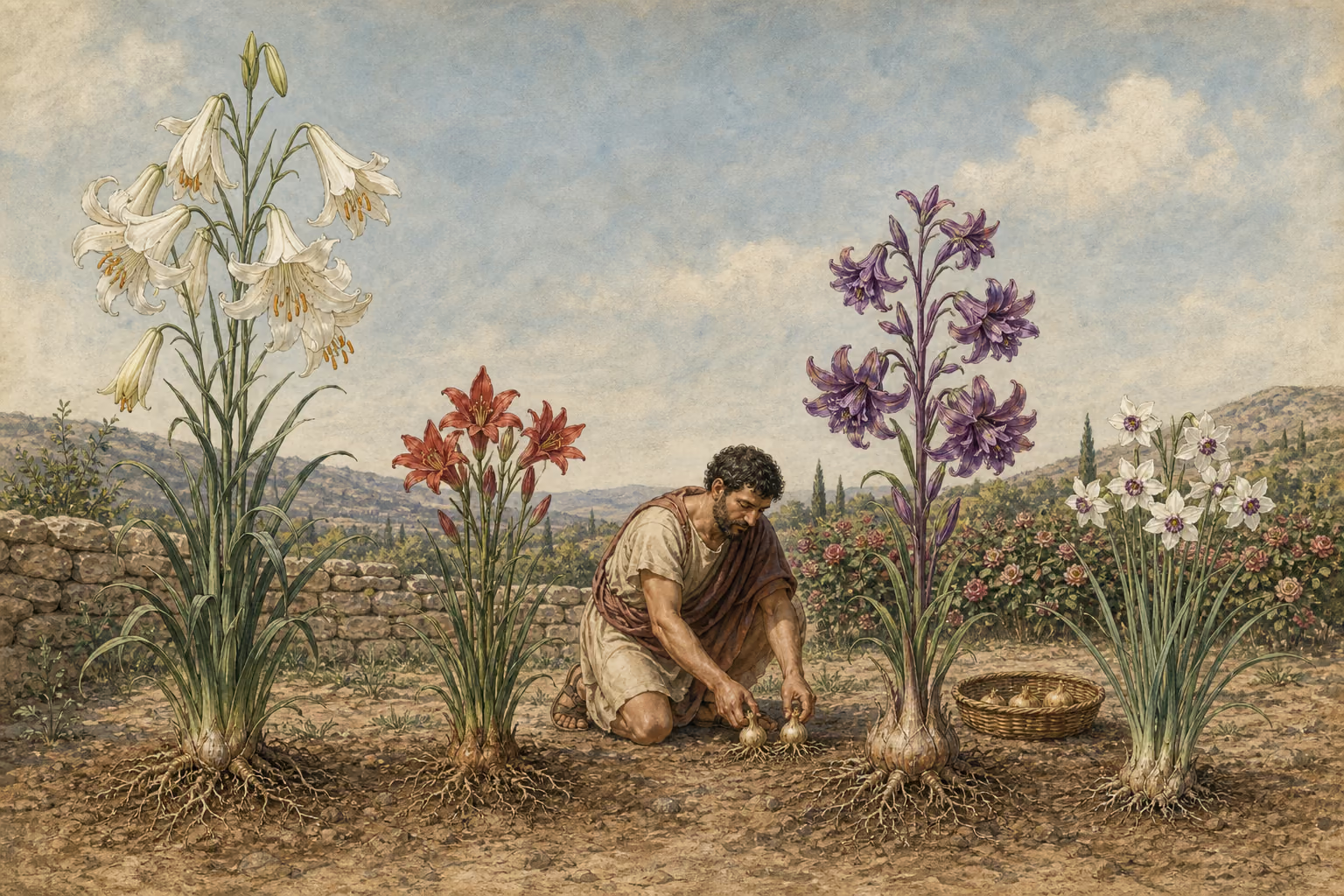
Lilium rosae nobilitate proximum est et quadam cognatione unguenti oleique, quod lilinum appellatur. interpositum etiam maxime rosas decet, medio proventu earum incipiens. nec ulli forum excelsitas maior, interdum cubitorum trium, languido semper collo et non sufficiente capitis oneri. candor eius eximius foris striati et ab angustiis in latitudinem paulatim sese laxantis effigie calathi, resupinis per ambitum labris tenuique pilo et staminis stantibus in medio crocis. ita odor colorque duplex, et alius calicis, alius staminis, differentia angusta. in unguenti vero oleique usu et folia non spernuntur. est flos non dissimilis illi in herba, quam convolvolum vocant, nascens per frutecta, nullo odore nec crocis intus, candorem tantum referens ac veluti naturae rudimentum lilia facere condiscentis. alba lilia iisdem omnibus modis seruntur, quibus rosa, et hoc amplius lacrima sua, ut hipposelinum, nihilque est fecundius una radice quinquagenos saepe emittente bulbos. est et rubens lilium, quod Graeci crinon vocant, alii florem eius cynorrhodon. laudatissimum in Antiochia ac Laudicea Syriae, mox in Phaselide. quartum locum optinet in Italia nascens.
Sunt et purpurea lilia, aliquando gemino caule, carnosiore tantum radice maiorisque bulbi, sed unius; narcissum vocant. huius alterum genus flore candido, calice purpureo. differentia a liliis et haec, quod narcissis in radice folia sunt, probatissimis in Lyciae montibus. tertio generi cetera eadem, calix herbaceus. omnes serotini, post arcturum enim florent ac per aequinoctium autumnum.
Inventa est in his et ratio inserendi monstrificis hominum ingeniis. colligantur namque mense Iulio scapi arescentis lilii atque suspenduntur in fumo; dein nudantibus se nodulis in faece nigri vini vel Graeci mense Martio macerantur, ut colorem percipiant, atque ita in scrobiculis seruntur heminis faecis circumfusis. sic fiunt purpurea lilia, mirumque tingui aliquid, ut nascatur infectum.
English · Bostock & Riley 1855–57
The lily holds the next highest rank after the rose, and has a certain affinity with it in respect of its unguent and the oil extracted from it, which is known to us as “lirinon.” Blended, too, with roses, the lily produces a remarkably fine effect; for it begins to make its appearance, in fact, just as the rose is in the very middle of its season. There is no flower that grows to a greater height than the lily, sometimes, indeed, as much as three cubits; the head of it being always drooping, as though the neck of the flower were unable to support its weight. The whiteness of the lily is quite remarkable, the petals being striated on the exterior; the flower is narrow at the base, and gradually expanding in shape like a tapering cup with the edges curving outwards, the fine pistils of the flower, and the stamens with their antheræ of a saffron colour, standing erect in the middle. Hence the perfume of the lily, as well as its colour, is two-fold, there being one for the petals and another for the stamens. The difference, however, between them is but very small, and when the flower is employed for making lily unguents and oils, the petals are never rejected.
There is a flower, not unlike the lily, produced by the plant known to us as the “convolvulus.” It grows among shrubs, is totally destitute of smell, and has not the yellow antheræ of the lily within: only vying with it in its whiteness, it would almost appear to be the rough sketch made by Nature when she was learning how to make the lily. The white lily is propagated in all the various ways which are employed for the cultivation of the rose, as also by means of a certain tearlike gum which belongs to it, similarly to hipposelinum in fact: indeed, there is no plant that is more prolific than this, a single root often giving birth to as many as fifty bulbs. There is, also, a red lily, known by the name of “crinon” to the Greeks, though there are some authors who call the flower of it “cynorrodon.” The most esteemed are those of Antiochia and Laodicea in Syria, and next to them that of Phaselis. To the fourth rank belongs the flower that grows in Italy.
There is a purple lily, too, which sometimes has a double stem; it differs only from the other lilies in having a more fleshy root and a bulb of larger size, but undivided: the name given to it is “narcissus.” A second variety of this lily has a white flower, with a purple corolla. There is also this difference between the ordinary lily and the narcissus, that in the latter the leaves spring from the root of the plant. The finest are those which grow on the mountains of Lycia. A third variety is similar to the others in every respect, except that the corolla of the plant is green. They are all of them late flowers: indeed, they only bloom after the setting of Arcturus, and at the time of the autumnal equinox.
There has been invented also a method of tinting the lily, thanks to the taste of mankind for monstrous productions. The dried stalks of the lily are tied together in the month of July, and hung up in the smoke: then, in the following March, when the small knots are beginning to disclose themselves, the stalks are left to steep in the lees of black or Greek wine, in order that they may contract its colour, and are then planted out in small trenches, some semi-sextarii of wine-lees being poured around them. By this method purple lilies are obtained, it being a very remarkable thing that we should be able to dye a plant to such a degree as to make it produce a coloured flower.