LIBER XXI · CAPUT 4
THE ROSE: TWELVE VARIETIES OF IT
Latine · Mayhoff 1906
Paucissima nostri genera coronamentorum inter hortensia novere, ac paene violas rosasque tantum. rosa nascitur spina verius quam frutice, in rubo quoque proveniens, illic etiam iucundi odoris, quamvis angusti. germinat omnis primo inclusa granoso cortice, quo mox intumescente et in virides alabastros fastigato paulatim rubescens dehiscit ac sese pandit, in calice medio staminis conplexa luteos apices. usus eius in coronis prope minimus est. oleo maceratur, idqueiam a Troianis temporibus Homero teste. praeterea in unguenta transit, ut diximus. medicas per se artes praebet. emplastris atque collyriis inseritur mordaci subtilitate, mensarum etiam deliciis perunguendis, minime noxia carie.
Genera eius nostri fecere celeberrima Praenestinam et Campanam; addidere alii Milesiam, cuius ardentissimus colos, non excedentis duodena folia, proximam ei Trachiniam minus rubentem, mox Alabandicam viliorem, albicantibus foliis, vilissimam vero plurimis, sed minutissimis, spiniolam. differunt enim multitudine foliorum, asperitate, levore, colore, odore. paucissima quina folia, ac deinde numerosiora, cum sit genus eius, quam centifoliam vocant, quae est in Campania Italiae, Graeciae vero circa Philippos, sed ibi non suae terrae proventu: Pangaeus mons in vicino fert numerosis foliis ac parvis; accolae transferentes conserunt, ipsaque plantatione proficiunt. non autem talis odoratissima nec cui latissimum maximumve folium, breviterque indicium est odoris scabritia corticis. Caepio Tiberii Caesaris principatu negavit centifoliam in coronas addi, praeterquam extremas velut ad cardines, nec odore nec specie probabilem. est et quae Graeca appellatur a nostris, a Graecis lychnis, non nisi in umidis locis proveniens nec umquam excedens quina folia violaeque magnitudine, odore nullo. est et alia Graecula appellata, convolutis foliorum paniculis nec dehiscens nisi manu coacta semperque nascenti similis, latissimis foliis; alia funditur e caule malvaceo folia oleae habente—mucetum vocant—, atque inter has media magnitudine autumnalis, quam coroniolam appellant, omnes sine odore praeter coroniolam et in rubo natam. tot modis adulteratur.
Et alias vera quoque plurimum solo praevalet. Cyrenis odoratissima est, ideoque ibi unguentum pulcherrimum, Carthagine Hispaniae hieme tota praecox. refert et caeli temperies, quibusdam enim annis minus odorata provenit, praeterea omnis siccis quam umidis odoratior. seri neque pinguibus vult neque argillosis locis nec riguis, contenta roribus, proprieque ruderatum agrum amat. praecox Campana est, sera Milesia, novissima tamen desinit Praenestina. fodiuntur altius quam fruges, levius quam vites. tardissime proveniunt semine, quod in ipso cortice est, sub ipso flore, opertum lanugine. ob id potius caule conciso inseruntur. et ocellis radicis, ut harundo, unum genus inseritur pallidae, spinosae, longissimis virgis, quinquefoliae, quae Graecis altera est. omnis autem recisione atque ustione proficit; tralatione quoque, ut vites, optime ocissimeque provenit surculis quaternum digitorum longitudine aut ampliore post vergiliarum occasum sata, dein per favonium translata pedalibus intervallis crebroque circum- fossa. qui praecocem faciunt, pedali circa radicem scrobe aquam calidam infundunt germinare incipiente calice.
English · Bostock & Riley 1855–57
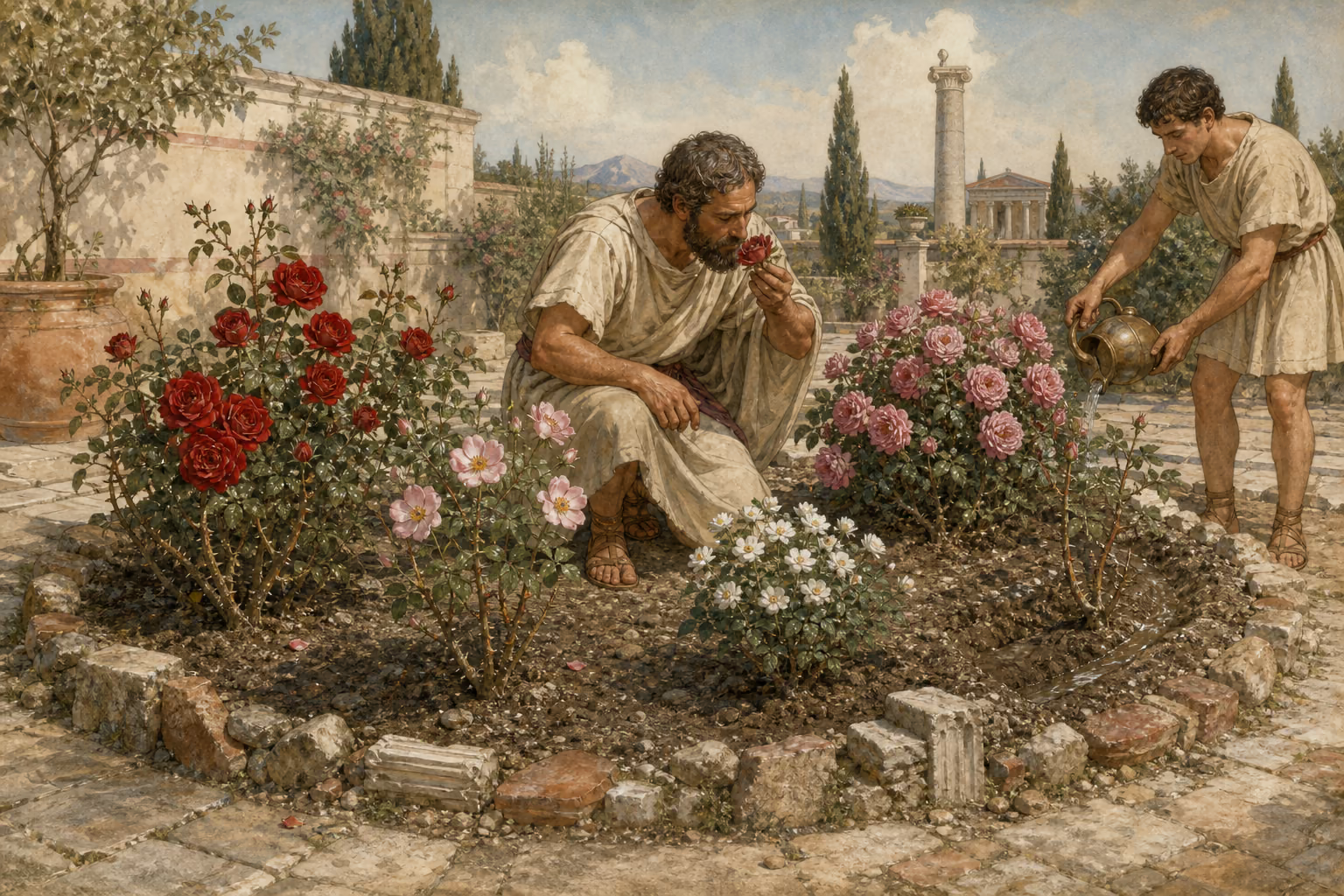
The people of our country were acquainted with but very few garland flowers among the garden plants, and those few hardly any but the violet and the rose. The plant which bears the rose is, properly speaking, more of a thorn than a shrub—indeed, we sometimes find it growing on a bramble even; the flower having, even then, a pleasant smell, though by no means penetrating. The flower in all roses is originally enclosed in a bud, with a grained surface within, which gradually swells, and assumes the form of a green pointed cone, similar to our alabaster unguent boxes in shape. Gradually acquiring a ruddy tint, this bud opens little by little, until at last it comes into full blow, developing the calyx, and embracing the yellow-pointed filaments which stand erect in the centre of it.
The employment of the rose in chaplets is, so to say, the least use that is made of it. The flower is steeped in oil, a practice which has prevailed from the times of the Trojan war, as Homer bears witness; in addition to which, it now forms an ingredient in our unguents, as mentioned on a previous occasion. It is employed also by itself for certain medicinal purposes, and is used in plasters and eye-salves for its penetrating qualities: it is used, also, to perfume the delicacies of our banquets, and is never attended with any noxious results.
The most esteemed kinds of rose among us are those of Præneste and Campania. Some persons have added to these varieties the rose of Miletus, the flower of which is an extremely brilliant red, and has never more than a dozen petals. The next to it is the rose of Trachyn, not so red as the last, and then that of Alabanda, with whitish petals, but not so highly esteemed. The least esteemed of all, however, is the thorn rose, the petals of which are numerous, but extremely small. The essential points of difference in the rose are the number of the petals, the comparative number of thorns on the stem, the colour, and the smell. The number of the petals, which is never less than five, goes on increasing in amount, till we find one variety with as many as a hundred, and thence known as the “centifolia:” in Italy, it is to be found in Campania, and in Greece, in the vicinity of Philippi, though this last is not the place of its natural growth. Mount Pangæeus, in the same vicinity, produces a rose with numerous petals of diminutive size: the people of those parts are in the habit of transplanting it, a method which greatly tends to improve its growth. This kind, however, is not remarkable for its smell, nor yet is the rose which has a very large or very broad petal: indeed, we may state in a few words, that the best proof of the perfume of the flower is the comparative roughness of the calyx.
Cæpio, who lived in the reign of the Emperor Tiberius, asserts that the centifolia is never employed for chaplets, except at the extreme points of union as it were, being remarkable neither for its smell nor its beauty. There is another variety of rose, too, called the “Grecian” rose by our people, and “lychnis” by the Greeks: it grows nowhere except in humid soils, and has never more than five petals: it does not exceed the violet in size, and is destitute of smell. There is another kind, again, known to us as the “Græcula” the petals of which are tightly rolled together, and which never open except when pressed in the hand, it having always the appearance, in fact, of being in bud: the petals of it are remarkably large. Another kind, again, springs from a stem like that of the mallow, the leaves being similar to those of the olive—the name given to it is “macetum.” There is the rose of autumn, too, known to us as the “coroniola,” which is of a middle size, between the varieties just mentioned. All these kinds, however, are destitute of smell, with the exception of the coroniola, and the one which grows on the bramble: so extended is the scope for fictitious productions!
And, indeed, the genuine rose, for the most part, is indebted for its qualities to the nature of the soil. That of Cyrenæ is the most odoriferous of all, and hence it is that the unguents of that place are so remarkably fine: at Carthage, again, in Spain, there are early roses throughout all the winter. The temperature, too, of the climate is not without its influence: for in some years we find the roses much less odoriferous than in others; in addition to which, their smell is always more powerful when grown in dry soils than in humid ones. The rose does not admit of being planted in either a rich or an argillaceous soil, nor yet on irrigated land; being contented with a thin, light earth, and more particularly attached to ground on which old building rubbish has been laid.
The rose of Campania is early, that of Miletus late, but it is the rose of Præneste that goes off the very latest of all. For the rose, the ground is generally dug to a greater depth than it is for corn, but not so deep as for the vine. It grows but very slowly from the seed, which is found in the calyx beneath the petals of the flower, covered with a sort of down; hence it is that the method of grafting is usually the one preferred, or else propagation from the eyes of the root, as in the reed. One kind is grafted, which bears a pale flower, with thorny branches of a remarkable length; it belongs to the quinquefolia variety, being one of the Greek roses. All roses are improved by being pruned and cauterized; transplanting, too, makes them grow, like the vine, all the better, and with the greatest rapidity. The slips are cut some four fingers in length or more, and are planted immediately after the setting of the Vergiliæ; then, while the west winds are prevalent, they are transplanted at intervals of a foot, the earth being frequently turned up about them.
Persons whose object it is to grow early roses, make a hole a foot in width about the root, and pour warm water into it, at the period when the buds are beginning to put forth.