LIBER XXI · CAPUT 3
WHO WAS THE FIRST TO GIVE CHAPLETS WITH LEAVES OF SILVER AND GOLD. LEMNISCI: WHO WAS THE FIRST TO EMBOSS THEM
Latine · Mayhoff 1906
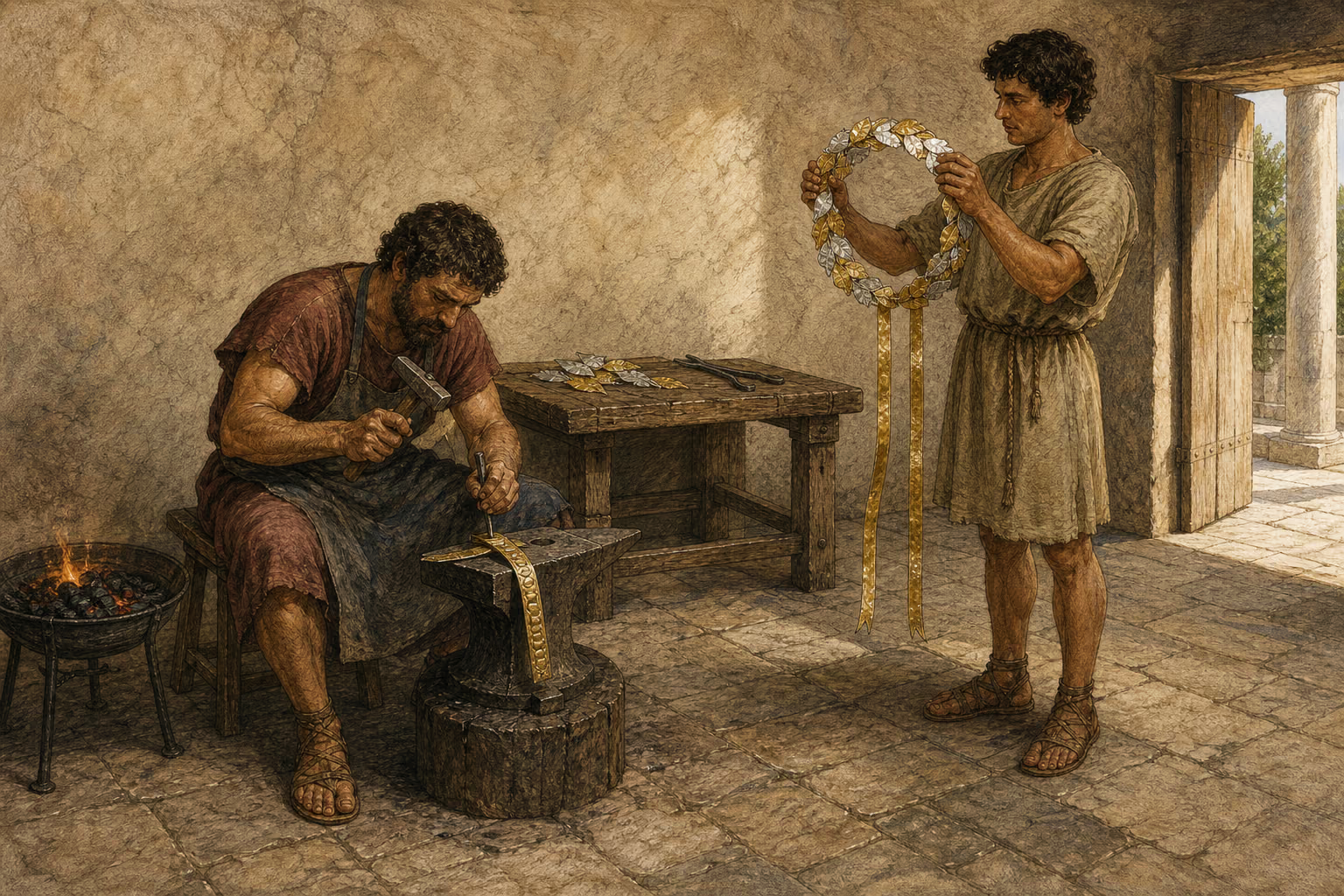
Crassus Dives primus argento auroque folia imitatus ludis suis coronas dedit, accesseruntque et lemnisci, quos adici ipsarum coronarum honor erat, propter 5 Etruscas, quibus iungi nisi aurei non debebant. purl diu fuere hi; caelare eos primus instituit P. Claudius Pulcher bratteasque etiam philyrae dedit.
Semper tamen auctoritas vel ludicro quaesitarum fuit. namque ad certamina in circum per ludos et ipsi descendebant et servos suos equosque mittebant. inde illa XII tabularum lex: qui coronam parit ipse pecuniave eius, virtutis suae ergo duitor ei. quam servi equive meruissent, pecunia partam lege dici nemo dubitavit. quis ergo honos? ut ipsi mortuo parentibusque eius, dum intus positus esset forisve ferretur, sine fraude esset inposita. alias in usu promiscuo ne ludicrae quidem erant, ingensque et hinc severitas. L. Fulvius argentarius bello Punico secundo cum corona rosacea interdiu e pergula sua in forum prospexisse dictus ex auctoritate senatus in carcerem abductus non ante finem belli emissus est. P. Munatius cum demptam Marsuae coronam e floribus capiti suo inposuisset, atque ob id duci eum in vincula triumviri iussissent, appellavit tribunos plebei, nec intercessere illi, aliter quam Athenis, ubi comissabundi iuvenes ante meridiem conventus sapientium quoque doctrinae frequentabant. apud nos exemplum licentiae huius non est aliud quam filia divi Augusti, cuius luxuria noctibus coronatum Marsuam litterae illius dei gemunt.
Florum quidem populus Romanus honorem Scipioni tantum habuit. Serapio cognominabatur propter similitudinem suarii cuiusdam negotiatoris. obierat in tribunatu plebei admodum gratus dignusque Africanorum familia, nec erat in bonis funeris inpensa. asses ergo contulit populus ac funus elocavit, quaque praeferebatur, flores e prospectu omni sparsit.
Et iam tunc coronae deorum honos erant et larum publicorum privatorumque ac sepulchrorum et manium, summaque auctoritas pactili coronae, ut in Saliorum sacris invenimus sollemnes cenae. transiere deinde ad rosaria, eoque luxuria processit, ut non esset gratia nisi mero folio sutilibus, mox petitis ab India aut ultra Indos. lautissimum quippe habetur e nardi folio eas dari aut veste Serica versicolori, unguentis madida. hunc habet novissime exitum luxuria feminarum.
Et apud Graecos quidem de coronis privatim scripserunt Mnesitheus atque Callimachus medici, quae nocerent capiti, quoniam et in hoc est aliqua valitudinis portio, in potu atque hilaritate praecipue odorum vi subrepente fallaciter. scelerata Cleopatrae sollertia. namque in apparatu belli Actiaci gratificationem ipsius reginae Antonio timente nec nisi praegustatos cibos sumente fertur pavore eius lusisse extremis coronae floribus veneno inlitis ipsaque capiti inposita; mox procedente hilaritate invitavit Antonium, ut coronas biberent. quis ita timeret insidias? ergo concerptam in scyphum incipienti haurire opposita manu: en ego sum, inquit illa, Marce Antoni, quam tu nova praegustantium diligentia caves; adeo mihi, si possim sine te vivere, occasio aut ratio deest! inductam custodiam bibere iussit ilico expirantem.
De floribus..... supra dictis scripsit Theophrastus apud Graecos; ex nostris autem inscripsere aliqui libros anthologicon, flores vero persecutus est nemo, quod equidem inveniam. nec nos nunc scilicet coronas nectemus —id enim frivolum est—, sed de floribus quae videbuntur digna memorabimus.
English · Bostock & Riley 1855–57
Crassus Dives was the first who gave chaplets with artificial leaves of silver and gold, at the games celebrated by him. To embellish these chaplets, and to confer additional honour on them, lemnisci were added, in imitation of the Etruscan chaplets, which ought properly to have none but lemnisci made of gold. For a long period these lemnisci were destitute of ornament: P. Claudius Pulcher was the first who taught us to emboss them, and added leaves of tinsel to the laminæ of which the lemniscus was formed.
Chaplets, however, were always held in a high degree of estimation, those even which were acquired at the public games. For it was the usage of the citizens to go down in person to take part in the contests of the Circus, and to send their slaves and horses thither as well. Hence it is that we find it thus written in the laws of the Twelve Tables: “If any person has gained a chaplet himself, or by his money, let the same be given to him as the reward of his prowess.” There is no doubt that by the words “gained by his money,” the laws meant a chaplet which had been gained by his slaves or horses. Well then, what was the honour acquired thereby? It was the right secured by the victor, for himself and for his parents, after death, to be crowned without fail, while the body was laid out in the house, and on its being carried to the tomb.
On other occasions, chaplets were not indiscriminately worn, not even those which had been won in the games.
Indeed the rules upon this point were remarkably severe. L. Fulvius, a banker, having been accused, at the time of the Second Punic War, of looking down from the balcony of his house upon the Forum, with a chaplet of roses upon his head, was imprisoned by order of the Senate, and was not liberated before the war was brought to a close. P. Munatius, having placed upon his head a chaplet of flowers taken from the statue of Marsyas, was condemned by the Triumviri to be put in chains. Upon his making appeal to the tribunes of the people, they refused to intercede in his behalf—a very different state of things to that at Athens, where the young men, in their drunken revelry, were in the habit, before midday, of making their way into the very schools of the philosophers even. Among ourselves, no such instance of a similar licentiousness is to be found, unless, indeed, in the case of the daughter of the late Emperor Augustus, who, in her nocturnal debaucheries, placed a chaplet on the statue of Marsyas, conduct deeply deplored in the letters of that god.
Scipio is the only person that ever received from the Roman people the honour of being decked with flowers. This Scipio received the surname of Serapio, from his remarkable resemblance to a certain person of that name who dealt in pigs. He died in his tribuneship, greatly beloved by the people, and in every way worthy of the family of the Africani. The property he left was not sufficient to pay the expenses of his burial; upon which the people made a subscription and contracted for his funeral, flowers being scattered upon the body from every possible quarter as it was borne along.
In those days, too, chaplets were employed in honour of the gods, the Lares, public as well as domestic, the sepulchres, and the Manes. The highest place, however, in public estimation, was held by the plaited chaplet; such as we find used by the Salii in their sacred rites, and at the solemnization of their yearly banquets. In later times, the rose chaplet has been adopted, and luxury arose at last to such a pitch that a chaplet was held in no esteem at all if it did not consist entirely of leaves sown together with the needle. More recently, again, they have been imported from India, or from nations beyond the countries of India.
But it is looked upon as the most refined of all, to present chaplets made of nard leaves, or else of silk of many colours steeped in unguents. Such is the pitch to which the luxuriousness of our women has at last arrived!
Among the Greeks, the physicians Mnesitheus and Callimachus have written separate treatises on the subject of chaplets, making mention of such flowers as are injurious to the head. For, in fact, the health is here concerned to some extent, as it is at the moments of carousal and gaiety in particular that penetrating odours steal insidiously upon the brain—witness an instance in the wicked cunning displayed upon one occasion by Cleopatra.
At the time when preparations were making for the battle that was eventually fought at Actium, Antonius held the queen in such extreme distrust as to be in dread of her very attentions even, and would not so much as touch his food, unless another person had tasted it first. Upon this, the queen, it is said, wishing to amuse herself with his fears, had the extremities of the flowers in a chaplet dipped in poison, and then placed it upon her head. After a time, as the hilarity increased apace, she challenged Antonius to swallow the chaplets, mixed up with their drink. Who, under such circumstances as these, could have apprehended treachery? Accordingly, the leaves were stripped from off the chaplet, and thrown into the cup. Just as Antonius was on the very point of drinking, she arrested his arm with her hand.—“Behold, Marcus Antonius,” said she, “the woman against whom you are so careful to take these new precautions of yours in employing your tasters! And would then, if I could exist without you, either means or opportunity of effecting my purpose be wanting to me?” Saying this, she ordered a man to be brought from prison, and made him drink off the potion; he did so, and fell dead upon the spot.
Besides the two authors above-mentioned, Theophrastus, among the Greeks, has written on the subject of flowers. Some of our own writers also have given the title of “Anthologica” to their works, but no one, to my knowledge at least, has treated expressly of flowers. In fact, we ourselves have no intention here of discussing the mode of wearing chaplets, for that would be frivolous indeed; but shall proceed to state such particulars in relation to flowers as shall appear to us deserving of remark.