LIBER XXIV · CAPUT 14
THE IDÆAN BRAMBLE
Latine · Mayhoff 1906
cynosbaton, alii cynapanxin, alii neurospaston vocant. folium habet vestigio hominis simile. fert et uvam nigram, in cuius acino nervum habet, unde neurospastos dicitur tota, alia quam cappari, quod medici cynosbaton appellarunt. hius thyrsus ad remedia splenis et inflationes conditus ex aceto manditur. nervus eius cum mastiche Chia commanducatus os purgat. ruborum rosa alopecias cum axungia emendat. mora capillum tingunt cum omphacino oleo. flos mori messe colligitur; candidus pleuriticis praecipuus ex vino potus, item coeliacis. radix ad tertias decocta alvum sistit et sanguinem, item dentes collutos decocto. eodem suco foventur sedis atque genitalium ulcera. cinis e radice reprimit uvam.
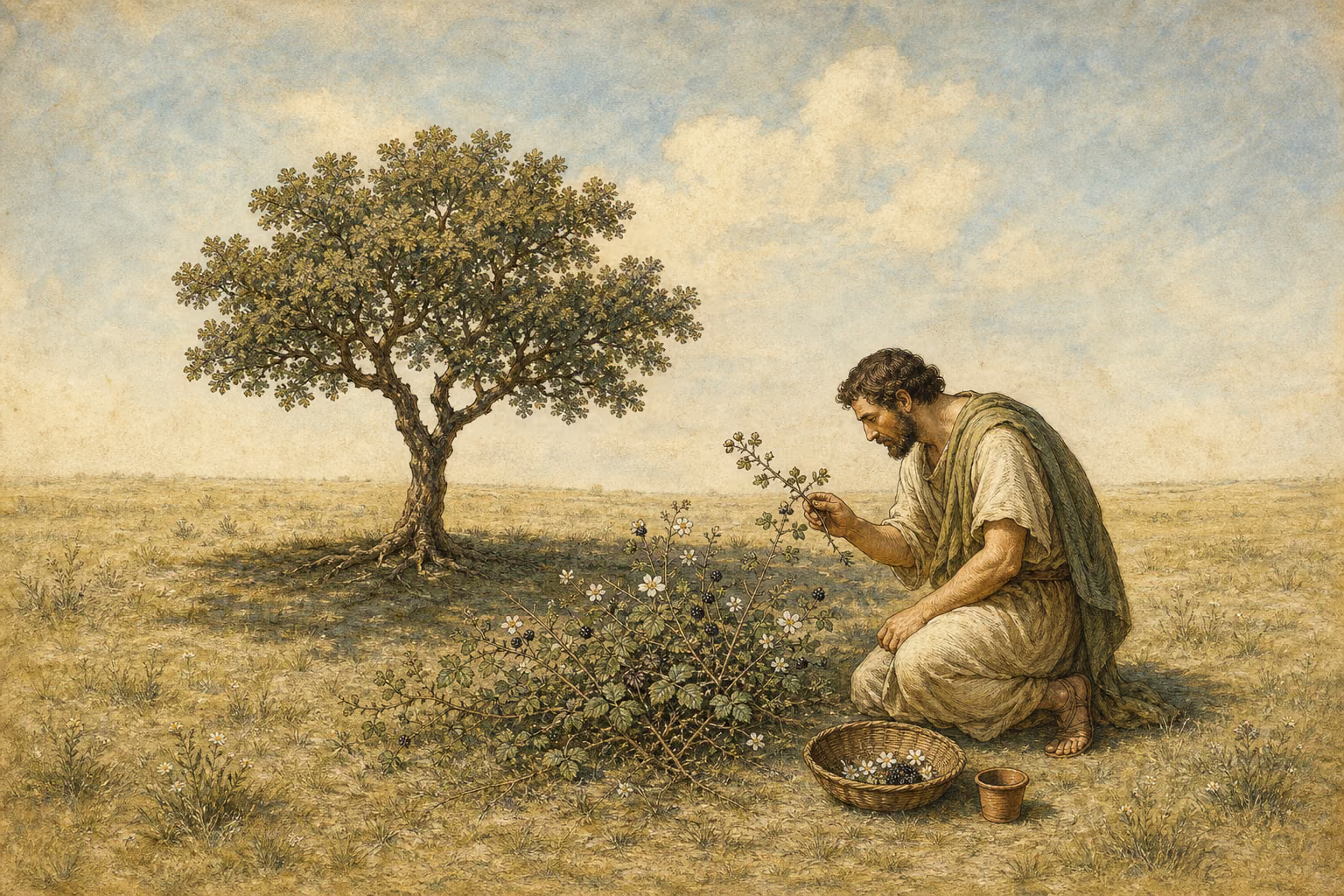
Idaeus rubus appellatus est, quoniam in Ida non alius nascitur. est autem tenerior ac minor, rarioribus calamis innocentioribusque, sub arborum umbra nascens. huius flos cum melle epiphoris inlinitur et ignibus sacris, stomachicisque ex aqua bibendus datur. cetera eadem praestat, quae supra dicta.
Inter genera ruborum rhamnos appellatur a Graecis, candidior, fruticosior et ramos spargens rectis aculeis, non, ut ceteri, aduncis, foliis maioribus. alterum genus eius silvestre, nigrius et quadamtenus rubens; fert veluti folliculos. huius radice decocta in aqua fit medicamentum, quod vocatur Lycium. semen secundas trahit. alter ille candidior adstringit magis, refrigerat, collectionibus et vulneribus adcommodatior. folia utriusque et cruda et decocta inlinuntur cum oleo.
Lycium praestantius spina fieri tradunt, quam et pyxacanthon Chironian vocant, qualem in Indicis arboribus diximus, quoniam longe praestantissimum existimatur Indicum. coquuntur in aqua tusi rami radicesque summae amaritudinis aereo vase per triduum iterumque exempto ligno, donec mellis crassitudo fiat. adulteratur amaris sucis etiam amurca et felle bubulo. spuma eius ac flos quidam oculorum medicamentis additur. reliquo suco faciem purgat et psoras sanat, erosos angulos oculorum veteresque fluctiones, aures purulentas, tonsillas, gingivas, tussim, sanguinis excreationes fabae magnitudine devoratum aut, si ex vulneribus fluat, inlitum, rhagadia, genitalium ulcera, attritus, ulcera recentia et serpentia ac putrescentia, in naribus clavos, suppurationes. bibitur et mulieribus in lacte contra profluvia. Indici differentia glaebis extrinsecus nigris, intus rufis, cum fregeris, cito nigrescentibus. adstringit vehementer cum amaritudine. ad eadem omnia utile est, sed praecipue ad genitalia.
Sunt qui et sarcocollam spinae lacrimam patent, pollini turis similem, cum quadam acrimonia dulcem, cumminosam. sistit fluctiones, inlinitur infantibus maxime. vetustate et haec nigrescit, melior quo candidior.
Unum etiamnum arborum medicinis debetur nobile medicamentum, quod oporicen vocant. fit ad dysintericos stomachique vitia in congio musti albi lento vapore decoctis malis cotoneis v cum suis seminibus, punicis totidem, sorborum sextario et pari mensura eius, quod rhun Syriacam vocant, croci semuncia. coquitur usque ad crassitudinem mellis.
His subtexemus ea, quae Graeci communicatione nominum in ambiguo fecere, anne arborum essent.
English · Bostock & Riley 1855–57
The cynosbatos is by some called “cynapanxis,” and by others “neurospastos;” the leaf resembles the human footstep in shape. It bears also a black grape, in the berries of which there is a nerve, to which it is indebted for its name of “neurospastos.” It is quite a different plant from the capparis or caper, to which medical men have also given the name of “cynosbatos.” The clusters of it, pickled in vinegar, are eaten as a remedy for diseases of the spleen, and flatulency: and the string found in the berries, chewed with Chian mastich, cleanses the mouth.
The rose of the bramble, mixed with axle-grease, is curative of alopecy: and the bramble-berries themselves, combined with oil of omphacium, stain the hair. The blossom of the bramble is gathered at harvest, and the white blossom, taken in wine, is an excellent remedy for pleurisy and cœliac affections. The root, boiled down to one third, arrests looseness of the bowels and hæmorrhage, and a decoction of it, used as a gargle, is good for the teeth: the juice too is employed as a fomentation for ulcers of the rectum and generative organs. The ashes of the root are curative of relaxations of the uvula.
The Idæan bramble is so called from the fact that it is the only plant of the kind found growing upon Mount Ida. It is of a more delicate nature than the others, and smaller; the canes too are thinner, and not so prickly: it mostly grows beneath the shade of trees. The blossom of it, mixed with honey, is applied topically for defluxions of the eyes, and is administered in water for erysipelas and affections of the stomach. In other respects, it has properties similar to those of the plants already mentioned.
Among the several kinds of bramble is reckoned the plant called “rhamnos” by the Greeks. One variety of it is whiter than the other, and has a more shrublike appearance, throwing out branches armed with straight thorns, and not hooked, like those of the other kinds; the leaves too are larger. The other kind, which is found growing wild, is of a more swarthy hue, in some measure inclining to red; it bears too a sort of pod. With the root of it boiled in water a medicament is made, known as “lycium:” the seed of it is useful for bringing away the after-birth. The white kind, however, is of a more astringent and cooling nature, and better adapted for the treatment of gatherings and wounds. The leaves of both kinds, either raw or boiled, are employed topically with oil.
The best lycium, they say, is that prepared from the thorn of that name, known also as the “Chironian pyxacanthus,” and mentioned by us when speaking of the trees of India, the lycium of those regions being generally looked upon as by far the best. The branches and roots, which are intensely bitter, are first pounded and then boiled for three days in a copper vessel, after which the woody parts are removed, and the decoction is boiled again, till it has attained the consistency of honey. It is adulterated with various bitter extracts, as also with amurca of olive oil and ox-gall. The froth or flower of this decoction is used as an ingredient in compositions for the eyes: and the other part of it is employed as a cosmetic for the face, and for the cure of itch-scabs, corroding sores in the corners of the eyes, inveterate fluxes, and suppurations of the ears. It is useful too for diseases of the tonsillary glands and gums, for coughs, and for discharges of blood from the mouth, being generally taken in pieces the size of a bean. For the cure of discharges from wounds, it is applied to the part affected; and it is similarly used for chaps, ulcerations of the genitals, excoriations, ulcers, whether putrid, serpiginous, or of recent date, hard excrescences of the nostrils, and suppurations. It is taken also by females, in milk, for the purpose of arresting the catamenia when in excess.
The Indian lycium is distinguished from the other kinds by its colour, the lumps being black outside, and, when broken, red within, though they turn black very quickly. It is bitter and remarkably astringent, and is employed for all the purposes above mentioned, diseases of the generative organs in particular.
Some authors are of opinion that sarcocolla is a tearlike gum which exudes from a kind of thorn; it is similar to powdered incense in appearance, has a sweet flavour with a slight degree of bitter, and is of the consistency of gum. Pounded in wine, it arrests defluxions, and is used as a topical application for infants more particularly. This substance too becomes black when old; the whiter it is, the more highly it is esteemed.
We are indebted too to the medicinal properties of trees for one very celebrated medicament, known as “oporice.” This preparation is used for dysentery and various affections of the stomach; the following being the method of preparing it. Five quinces, seeds and all, with the same number of pomegranates, one sextarius of sorbs, a similar quantity of Syrian rhus, and half an ounce of saffron, are boiled in one congius of white grape-juice at a slow heat, till the whole mixture is reduced to the consistency of honey.
We shall now add to these plants, certain vegetable productions to which the Greeks have given names belonging to trees, so that it would be doubtful whether they themselves are not trees as well.