LIBER XXIV · CAPUT 9
THE WILLOW: FOURTEEN REMEDIES. THE WILLOW OF AMERIA: ONE REMEDY
Latine · Mayhoff 1906
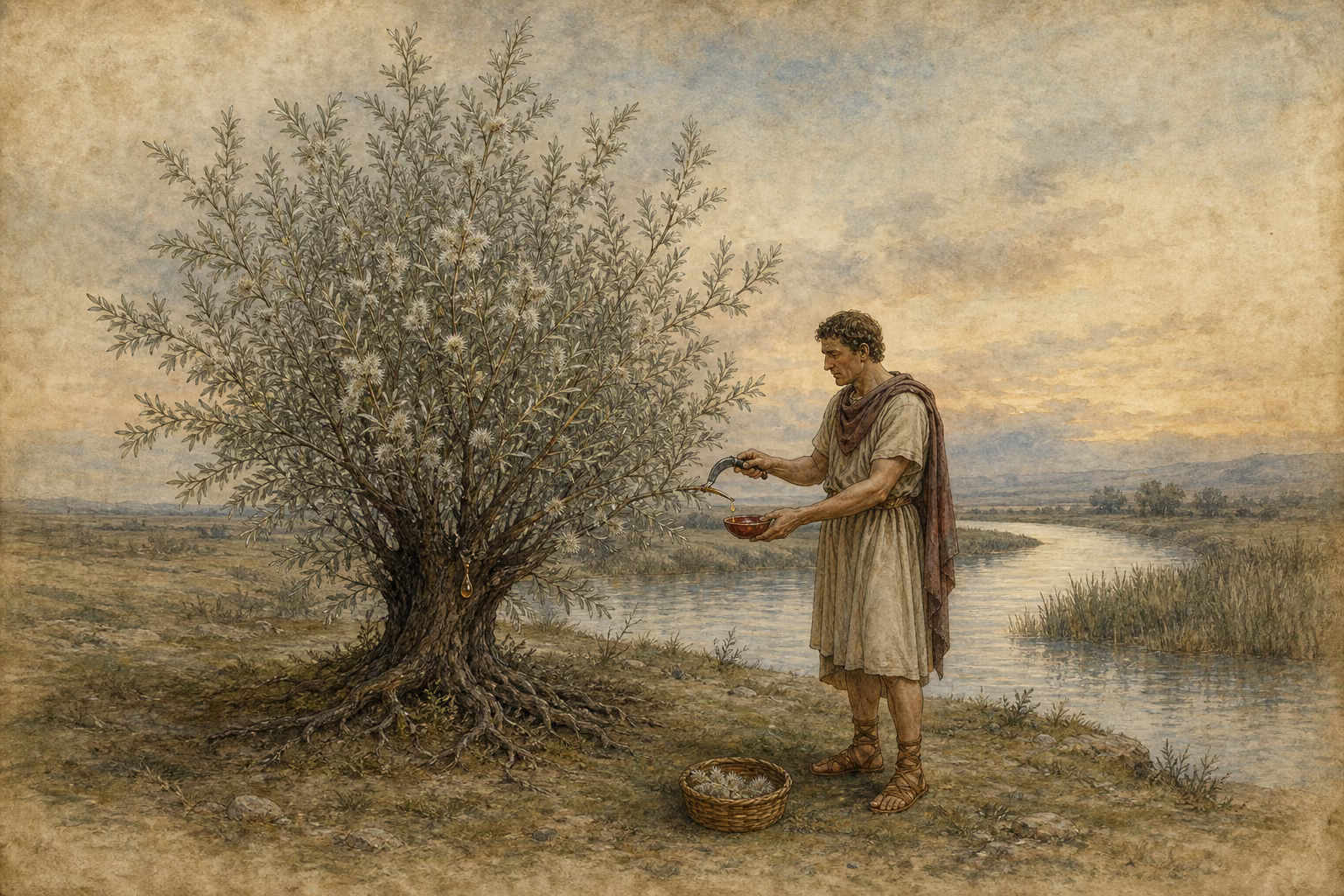
Salicis fructus ante maturitatem in araneam abit, sed, si prius colligatur, sanguinem reicientibus prodest. corticis e ramis primis cinis clavum et callum aqua mixta sanat. vitia cutis in facie emendat, magis admixto suco suo. est autem hic trium generum: unum arbor ipsa exsudat cummium modo, altero manat in plaga, cum floret, exciso cortice III digitorum magnitudine. vis ad expurganda quae obstent oculis, item ad spissanda quae opus sit, ciendamque urinam et ad omnes collectiones intus extrahendas. tertius sucus est detruncatione ramorum a falce destillans. ex his ergo aliquis cum rosaceo in calice punici calfactus auribus infunditur vel folia cocta et cum cera trita inponuntur. item podagricis cortice et foliis in vino decoctis foveri nervos utilissimum. flos tritus cum foliis furfures purgat in facie. folia contrita et pota intemperantiam libidinis coercent atque in totum auferunt usum saepius sumpta. Amerinae nigrae semen cum spuma argenti pari pondere a balneo inlitum psilotrum est.
Non multum a salice vitilium usu distat vitex, foliorum quoque adspectu, nisi odore gratior esset. Graeci lygon vocant, alias agnon, quoniam matronae Thesmophoriis Athenieniensium castitatem custodientes his foliis cubitus sibi sternunt. duo genera eius: maior in arborem salicis modo adsurgit, minor ramosa, foliis candidioribus, lanuginosis. prima album florem emittit cum purpureo; quae et candida vocatur, nigra quae tantum purpureum. nascuntur palustribus campis. semen potum vini quendam saporem habet et dicitur febres solvere et, cum unguantur oleo admixto, sudorem facere, sicut lassitudines dissolvere. urinam cient et menses. caput temptant vini modo—nam et odor similis—, set inflationes pellunt in inferiora, alvum sistunt, hydropicis et lienibus perquam utiles. lactis ubertatem faciunt. adversantur venenis [serpentium ], maxime quae frigus inferunt; minor efficacior ad serpentes: bibitur seminis drachma in vino vel posca aut II foliorum tenerrimorum. et inlinuntur utraque adversus araneorum morsus; vel perunctis tantum, suffitu quoque aut substratu fugant venenata. ad venerem impetus inhibent eoque maxime phalangiis adversantur, quorum morsus genitale excitat. capitis dolorem ex ebrietate sedant cum rosaceo flos tenerique cauliculi. seminis decoctum vehementiorem capitis dolorem dissolvit fotu et volvam etiam suffitu vel adpositu purgat, alvum cum puleio et melle potum. vomicas et panos, difficile concoquens, cum farina hordeacea mollit. lichenas et lentigines cum aphronitro et aceto semen sanat et oris ulcera et eruptionum cum melle, testium cum butyro et foliis vitium, rhagadas sedis cum aqua illitum. luxatis cum sale et nitro et cera et semineutilissimae et folio. additur in malagmataad vitia nervorum et podagras semen; instillatur in oleo decoctum capiti in lethargia et phrenesi. virgam qui in manu habeant aut in cinctu, negantur intertriginem sentire.
Ericen Graeci vocant fruticem non multum a vitice differentem, colore roris marini et paene folio. hoc adversari serpentibus tradunt.
Genista quoque vinculi usum praestat, floris apibus gratissimi. dubito an haec sit quam Graeci auctores sparton appellavere, cum ex ea lina piscatoria apud eos factitari docuerim, et numquid hanc designaverit Homerus, cum dixit navium sparta dissoluta. nondum enim fuisse Hispanum Africanumve spartum in usu certum est et, cum fierent sutiles naves, lino tamen, non sparto umquam sutas. semen eius, quod Graeci eodem nomine appellant, in folliculis passiolorum modo nascens purgat hellebori vice drachma et dimidia pota in aquae mulsae cyathis IIII ieiunis. rami, similiter frondes, in aceto macerati pluribus diebus et tunsi sucum dant ischiadicis utilem cyathi unius potu. quidam marina aqua macerare malunt et infundere clystere. perunguntur eodem suco ischiadici addito oleo. quidam et ad stranguriam utuntur semine. genista tunsa cum axungia genua dolentia sanat.
Myricen ericam vocat Lenaeus, similem scopis Amerinis; sanari dicit ea carcinomata in vino decocta tritaque cum melle inlita. eandem esse arbitrantur quidam tamaricem et ad lienem praecipuam, si sucus eius expressus in vino bibatur, adeoque mirabilem eius antipathian contra solum.hoc viscerum faciunt, ut adfirment, si ex ea alveis factis bibant sues, sine liene inveniri. et ideo homini quoque splenico cibum potumque dant in vasis ex ea factis. gravis autem auctor in medicina virgam ex ea defractam, ut neque terrain neque ferrum attingeret, sedare ventris dolores adseveravit inpositam ita, ut tunica cinctuque corpori adprimeretur. volgus infelicem arborem eam appellat, ut diximus, quoniam nihil ferat nec seratur umquam. Corinthus et quae circa est Graecia bryan vocat eiusque duo genera facit, silvestrem plane sterilem, alteram mitiorem. haec fert in Aegypto Syriaque etiam abundanter lignosum fructum, maiorem galla, asperum gustu, quo medici utuntur vice gallae in compositionibus, quas antheras vocant. et lignum aultem et flos et folia et cortex in eosdem usus adhibentur, quamquam remissiora. datur sanguine reicientibus cortex tritus et contra profluvia feminarum, coeliacis quoque; idem tunsus inpositusque collectiones omnes inhibet. foliis exprimitur sucus ad haec eadem et in vino decoquitur; ipsa vero adiecto melle gangraenis inlinuntur. decoctum eorum in vino potum..... imposita cum rosaceo et cera sedant; sic et epinyctidas sanant. dentium dolori, aurium decoctum eorum salutare est. radix ad eadem similiter. folia hoc amplius ad ea, quae serpunt, inponuntur cum polenta. semen drachmae pondere adversus phalangia et araneos bibitur, cum altilium vero pingui furunculis inponitur, efficax et contra serpentium ictus praeterquam aspidum. nec non morbo regio, phthiriasi, lendibus decoctum infusum prodest abundantiamque mulierum sistit. cinis arboris ad omnia eadem prodest. aiunt, si bovis castrati urinae misceatur vel in potu vel in cibo, venerem finiri. carbo ex eo genere urina ea restinctus in umbra conditur: idem, cum libeat accendere, restituitur. Magi id et spadonis urina fieri tradiderunt.
English · Bostock & Riley 1855–57
The fruit of the willow, before it arrives at maturity, is covered with a down like a spider’s web: gathered before it is ripe, it arrests discharges of blood from the mouth. The bark of the upper branches, reduced to ashes and mixed with water, is curative of corns and callosities: it removes spots also upon the face, being still more efficacious for that purpose if mixed with, the juices of the tree.
The juices produced by the willow form three different varieties; one of which exudes in the shape of a gum from the tree itself, and another distils from an incision some three fingers in width, made in the bark while the tree is in blossom. This last is very useful for dispersing humours which impede the sight, acting also as an inspissative when needed, promoting the discharge of the urine, and bringing abscesses of all kinds to a head. The third kind of juice exudes from the wounds, when the branches are lopt off with the bill. Either of these juices, warmed in a pomegranate rind, is used as an injection for diseases of the ears. The leaves, too, boiled and beaten up with wax, are employed as a liniment for similar purposes, and for gout. The bark and leaves, boiled in wine, form a decoction that is remarkably useful as a fomentation for affections of the sinews. The blossoms, bruised with the leaves, remove scaly eruptions of the face; and the leaves, bruised and taken in drink, check libidinous tendencies, and effectually put an end to them, if habitually employed.
The seed of the black willow of Ameria, mixed with litharge in equal proportions, and applied to the body just after the bath, acts as a depilatory.
Not much unlike the willow, for the use that is made of it in wicker-work, is the vitex, which also resembles it in the leaves and general appearance, though the smell of it is more agreeable. The Greeks call it “lygos,” or “agnos,” from the fact that the matrons of Athens, during the Thesmophoria, a period when the strictest chastity is observed, are in the habit of strewing their beds with the leaves of this tree.
There are two species of vitex: the larger one, like the willow, attains the full proportions of a tree; while the other, which is smaller, is branchy, with a paler, downy leaf. The first kind, generally known as the “white” vitex, bears a white blossom mixed with purple, whereas the black one has a flower that is entirely purple. Both of these trees grow on level spots of a marshy nature.
The seed of these trees, taken in drink, has a sort of vinous flavour, and has the reputation of being a febrifuge. It is said also to act as a sudorific, if the body is rubbed with it mixed with oil, and to have the effect of dispelling extreme lassitude: it acts too as a diuretic and emmenagogue. The produce of both trees is trying to the head, like wine, and indeed the odour of them is very similar. They have the effect also of removing flatulence in the lower regions of the body, act astringently upon the bowels, and are remarkably useful for dropsy and affections of the spleen. They promote the secretion of the milk, and neutralize the venom of serpents, when of a cold nature more particularly. The smaller kind, however, is the more efficacious of the two for injuries inflicted by serpents, the seed being taken in doses of one drachma, in wine or oxycrate, or else the more tender leaves in doses of two drachmæ.
From both trees also a liniment is prepared for the bites of spiders, but it is quite sufficient to rub the wounds with the leaves; and if a fumigation is made from them, or if they are spread beneath the bed, they will repel the attacks of all venomous creatures. They act also as an antaphrodisiac, and it is by this tendency in particular that they neutralize the venom of the phalangium, the bite of which has an exciting effect upon the generative organs. The blossoms and young shoots, mixed with oil of roses, allay head-aches arising from inebriation. A decoction of the seed used as a fomentation cures head-ache, however intense it may be; and employed as a fumigation or as a pessary, the seeds acts as a detergent upon the uterus. Taken in drink with honey and penny-royal, it has a laxative effect; pounded and used with barley-meal, it quickly brings abscesses and hard tumours to a head, and has an emollient effect.
The seed, in combination with saltpetre and vinegar, removes lichens and freckles; mixed with honey, it heals ulcers and eruptions of the mouth; applied with butter and vine-leaves, it reduces swellings of the testes; used with water, as a linment, it cures chaps of the rectum; and employed with salt, nitre, and wax, it is good for sprains. The seed and leaves are used as ingredients also in emollient plasters for diseases of the sinews, and for gout; and a decoction of the seed in oil is employed as a fomentation for the head in cases of phrenitis and lethargy. Persons who carry a sprig of this plant in the hand, or stuck in the girdle, will be proof, it is said, against chafing between the thighs.
The Greeks give the name of “erice,” to a shrub that is but little different from the myrice. It has the colour, and very nearly the leaf, of rosemary. It neutralizes the venom of serpents, it is said.
The broom is used for making withes; the flowers of it are greatly sought by bees. I have my doubts whether this is not the same plant that the Greek writers have called “sparton,” and of which, in those parts of the world, as I have already stated, they are in the habit of making fishing-nets. I doubt also whether Homer has alluded to this plant, when he speaks of the seams of the ships,—“the sparta” coming asunder; for it is certain that in those times the spartum of Spain or Africa was not as yet in use, and that vessels made of materials sown together, were united by the agency, not of spartum, but of flax.
The seed of the plant to which the Greeks now give the name of “sparton,” grows in pods like those of the kidney-bean. It is as strongly drastic as hellebore, and is usually taken fasting, in doses of one drachma and a half, in four cyathi of hydromel. The branches also, with the foliage, are macerated for several days in vinegar, and are then beaten up, the infusion being recommended for sciatica, in doses of one cyathus. Some persons think it a better plan, however, to make an infusion of them in sea-water, and to inject it as a clyster. The juice of them is used also as a friction for sciatica, with the addition of oil. Some medical men, too, make use of the seed for strangury. Broom, bruised with axle-grease, is a cure for diseases of the knees.
Lenæus says, that the myrice, otherwise known as the “erica,” is a similar plant to that of which brooms are made at Ameria. He states also that, boiled in wine and then beaten up and applied with honey, it heals carcinomatous sores. I would here remark, parenthetically, that some persons identify it with the tamarice. Be this as it may, it is particularly useful for affections of the spleen, the juice of it being extracted for the purpose, and taken in wine; indeed so marvellous, they say, is its antipathy to this part of the viscera, and this only, that if swine drink from troughs made of this wood, they will be found to lose the spleen. Hence it is that in maladies of the spleen victuals and drink are given to the patient in vessels made of this wood.
A medical author too, of high repute, has asserted that a sprig broken from off this tree, without being allowed to touch the earth or iron, will allay pains in the bowels, if applied to the body, and kept close to it by the clothes and girdle. The common people, as already stated, look upon this tree as ill-omened, because it bears no fruit, and is never propagated from seed.
At Corinth, and in the vicinity of that city, the Greeks give the name of “brya” to a plant of which there are two varieties; the wild brya, which is altogether barren, and the cultivated one. This last, when found in Syria and Egypt, produces a ligneous fruit, somewhat larger than a gall-nut, in great abundance, and of an acrid flavour; medical men employ it as a substitute for galls in the compositions known as “antheræ.” The wood also, with the blossoms, leaves, and bark of the tree, is used for similar purposes, but their properties are not so strongly developed. The bark is pounded also, and given for discharges of blood from the mouth, irregularities of the catamenia, and cœliac affections: beaten up and applied to the part affected, it checks the increase of all kinds of abscesses.
The juice too is extracted from the leaves for similar purposes, and a decoction is made of them in wine; they are applied also to gangrenes, in combination with honey. A decoction of them taken in wine, or the leaves themselves applied with oil of roses and wax, has a sedative effect: it is in this form that they are used for the cure of epinyctis. This decoction is useful also for tooth-ache or ear-ache, and the root is employed for similar purposes. The leaves too have this additional use—they are applied with polenta to serpiginous sores. The seed, in doses of one drachma, is administered in drink for injuries inflicted by spiders or the phalangium; and mixed with the grease of poultry, it is applied to boils. It is very efficacious also for stings inflicted by all kinds of serpents, the asp excepted. The decoction used as a fomentation, is curative of jaundice, phthiriasis, and lice; it also arrests the catamenia when in excess. The ashes of the tree are employed for all these purposes; there is a story told, too, that mixed with the urine of an ox, and taken in the food or drink they will act most effectually as an antaphrodisiac. The charcoal too of this wood is quenched in urine of a similar nature, and kept in a shady spot. When it is the intention of the party to rekindle the flames of desire, it is set on fire again. The magicians say, that the urine of an eunuch, will have a similar effect.