LIBER XXV · CAPUT 2
THE LATIN AUTHORS WHO HAVE WRITTEN UPON THESE PLANTS
Latine · Mayhoff 1906
Minus hoc quam par erat nostri celebravere, omnium utilitatium et virtutum rapacissimi, primusque et diu solus idem ille M. Cato, omnium bonarum artium magister, paucis dumtaxat attigit, boum etiam medicina non omissa. post eum unus inlustrium temptavit Gaius Valgius eruditione spectatus inperfecto volumine ad divum Augustum, inchoata etiam praefatione religiosa, ut omnibus malis humanis illius potissimum principis semper mederetur maiestas.
Antea condiderat solus apud nos, quod equidem inveniam, Pompeius Lenaeus Magni libertus, quo primum tempore hanc scientiam ad nostros pervenisse animo adverto. namque Mithridates, maximus sua aetate regum, quem debellavit Pompeius, omnium ante se genitorum diligentissimus vitae fuisse argumentis, praeterquam fama, intellegitur. uni ei excogitatum cotidie venenum bibere praesumptis remediis, ut consuetudine ipsa innoxium fieret; primo inventa genera antidoti, ex quibus unum etiam nomen eius retinet; illius inventum, sanguinem anatum Pontic arum miscere antidotis, quoniam veneno viverent; ad ilium Asclepiadis medendi arte clari volumina composita extant, cum sollicitatus ex urbe Roma praecepta pro se mitteret; illum solum mortalium certum est XXII linguis locutum, nec e subiectis gentibus ullum hominem per interpretem appellatum ab eo annis LVI, quibus regnavit. is ergo in reliqua ingeni magnitudine medicinae peculiariter curiosus et ab omnibus subiectis, qui fuere magna pars terrarum, singula exquirens scrinium commentationum harum et exemplaria effectusque in arcanis suis reliquit, Pompeius autem omni praeda regia potitus transferre ea sermone nostro libertum suum Lenaeum grammaticae artis iussit vitaeque ita profuit non minus quam reipublicae victoria ilia.
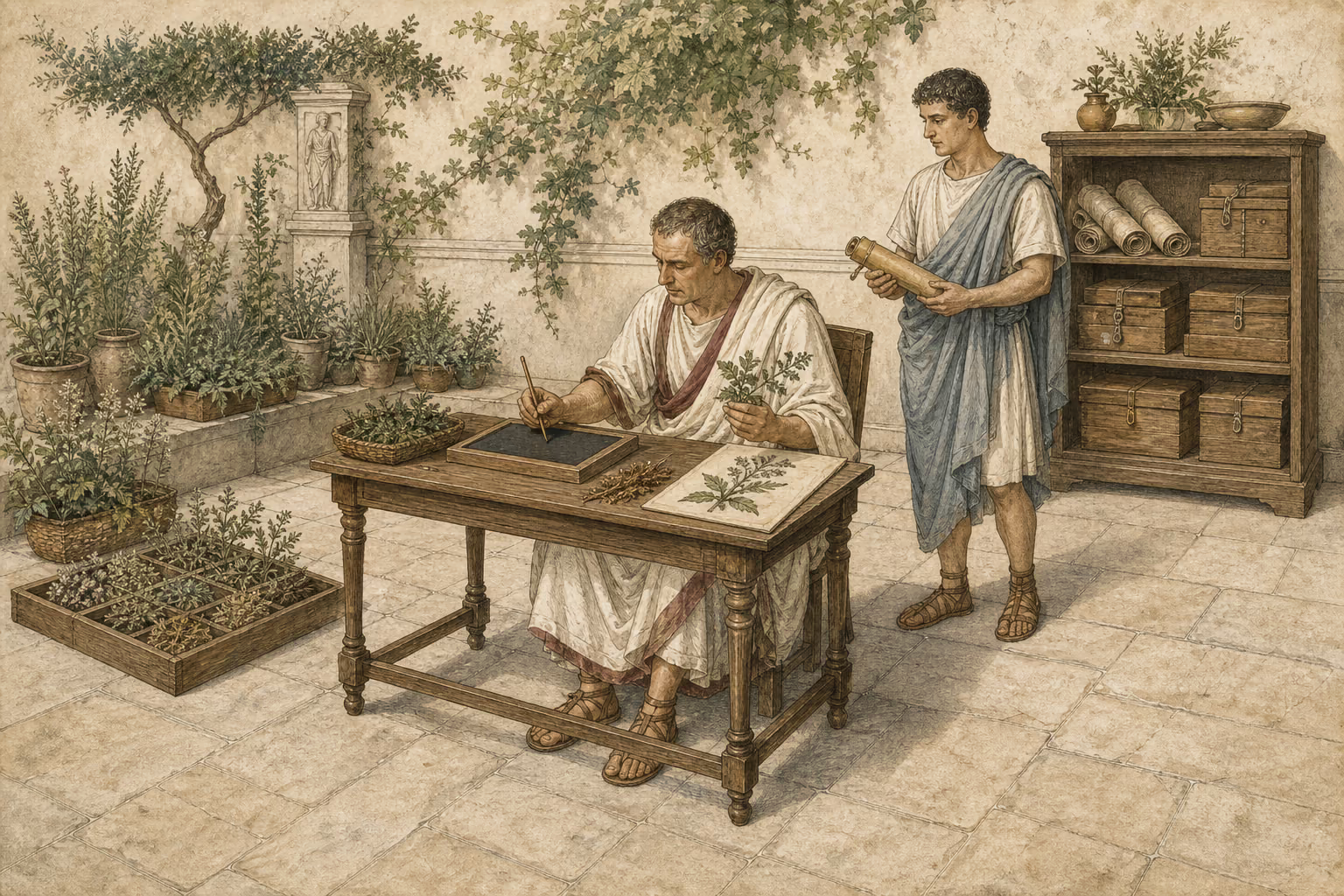
Praeter hos Graeci auctores prodidere, quos suis locis diximus, ex his Crateuas, Dionysius, Metrodorus ratione blandissima, sed qua nihil paene aliud quam difficultas rei intellegatur. pinxere namque effigies herbarum atque ita subseripsere effectus. verum et pictura fallax est coloribus tam numerosis, praesertim in aemulationem naturae, multumque degenerat transcribentium socordia. praeterea parum est singulas earum aetates pingi, cum quadripertitis varietatibus anni faciem mutent.
Quare ceteri sermone eas tradidere, aliqui ne effigie quidem indicata et nudis plerumque nominibus defuncti, quoniam satis videbatur potestates vimque demonstrare quaerere volentibus. nec est difficilis cognitio: nobis certe, exceptis admodum paucis, contigit reliquas contemplari cientia Antoni Castoris, cui summa auctoritas erat in ea arte nostro aevo, visendo hortulo eius, in quo plurimas alebat centesimum annum aetatis excedens, nullum corporis malum expertus ac ne aetate quidem memoria aut vigore concussis. neque aliud mirata magis antiquitas reperietur. inventa iam pridem ratio est praenuntians horas —non modo dies ac noctes—solis lunaeque defectuum; durat tamen tradita persuasio in magna parte vulgi, veneficiis et herbis id cogi eamque unam feminarum scientiam praevalere. certe quid non repleverunt fabulis Colchis Media aliaeque, in primis Itala Circe dis etiam adscripta? unde arbitror natum, ut Aeschylus e vetustissimis in poetica refertam Italiam herbarum potentia proderet, multique Circeios, ubi habitavit illa, magno argumento etiam nunc durante in Marsis, a filio eius orta gente, quoniam esse domitores serpentium constat.
Homerus quidem primus doctrinarum et antiquitatis parens, multus alias in.admiratione Circae, gloriam herbarum Aegypto tribuit, cum etiam tum quae rigatur Aegyptus illa non esset, postea fluminis limo invecta. herbas certe Aegyptias a regis uxore traditas Helenae suae plurimas narrat ac nobile illud nepenthes oblivionem tristitiae veniamque adferens et ab Helena utique omnibus mortalibus propinandum. primus autem omnium, quos memoria novit, Orpheus de herbis curiosius aliqua prodidit. post eum Musaeus et Hesiodus polium herbam in quantum mirati sint diximus. Orpheus et Hesiodus suffitiones commendavere. Homerus et alias nominatim herbas celebrat, quas suis locis dicemus. ab eo Pythagoras clarus sapientia primus volumen de effectu earum composuit, Apollini, Aesculapio et in totum dis immortalibus inventione et origine adsignata; composite et Democritus, ambo peragratis Persidis, Arabiae, Aethiopiae, Aegypti Magis, adeoque ad haec attonita antiquitas fuit, ut adfirmaverit etiam incredibilia dictu. Xanthus historiarum auctor in prima earum tradit, occisum draconis catulum revocatum ad vitam a parente herba, quam balim nominat, eademque Tylonem, quem draco occiderat, restitutum saluti. et luba in Arabia herba revocatum ad vitam hominem tradit. dixit Democritus, credidit Theophrastus esse herbam, cuius contactu inlatae ab alite, quam retulimus, exiliret cuneus a pastoribus arbori adactus. quae etiamsi fide carent, admirationem tamen implent coguntque confiteri multum esse quod vero supersit. inde et plerosque ita video existimare, nihil non herbarum vi effici posse, sed plurimarum vires esse incognitas, quorum in numero fuit Herophilus clarus medicina, a quo ferunt dictum, quasdam fortassis etiam calcatas prodesse. observatum certe est, inflammari vulnera ac morbos superventu eorum qui pedibus iter confecerint.
Haec erat antiqua medicina, quae tota migrabat in Graeciae linguas. sed quare non plures noscantur, causa est quod eas agrestes litterarumque ignari experiuntur, ut qui soli inter illas vivant; praeterea securitas quaerendi obvia medicorum turba. multis etiam inventis desunt nomina, sicut illi, quam retulimus in frugum cura scimusque defossam in angulis segetis praestare, ne qua ales intret. turpissima causa raritatis quod etiam qui sciunt demonstrare nolunt, tamquam ipsis periturum sit quod tradiderint aliis. accedit ratio inventionis anceps, quippe etiam in repertis alias invenit casus, alias, ut vere dixerim, deus. insanabile ad hosce annos fuit rabidi canis morsus, pavorem aquae potusque omnis adferens odium. nuper cuiusdam militantis in praetorio mater vidit in quiete, ut radicem silvestris rosae, quam cynorrhodon vocant, blanditam sibi aspectu pridie in frutecto, mitteret filio bibendam. in Laeetania res gerebatur, Hispaniae proxima parte, casuque accidit, ut milite a morsu canis incipiente expavescere aquas superveniret epistula orantis, ut pareret religioni, servatusque est ex insperato et postea quisquis auxilium simile temptavit. alias apud auctores cynorrhodi una medicina erat spongiolae, quae in mediis spinis eius nascitur, cinere cum melle alopecias capitis expleri. in eadem provincia cognovi in agro hospitis nuper ibi repertum dracunculum appellatum caulem pollicari crassitudine, versicoloribus viperarum maculis, quem ferebant contra omnium morsus esse remedio, alium quam quos in priore volumine eiusdem nominis diximus. est huic alia figura, aliud miraculum exerenti se terra ad primas serpentium vernationes bipedali fere altitudine rursusque cum isdem in terrain condenti, nec omnino occultato eo apparet serpens, vel hoc per se satis officioso naturae munere, si tantum praemoneret tempusque formidinis demonstraret.
English · Bostock & Riley 1855–57
This subject has not been treated of by the writers in our own language so extensively as it deserves, eager as they have proved themselves to make enquiry into everything that is either meritorious or profitable. M. Cato, that great master in all useful knowledge, was the first, and, for a long time, the only author who treated of this branch of learning; and briefly as he has touched upon it, he has not omitted to make some mention of the remedial treatment of cattle. After him, another illustrious personage, C. Valgius, a man distinguished for his erudition, commenced a treatise upon the same subject, which he dedicated to the late Emperor Augustus, but left unfinished. At the beginning of his preface, replete as it is with a spirit of piety, he expresses a hope that the majestic sway of that prince may ever prove a most efficient remedy for all the evils to which mankind are exposed.
The only person among us, at least so far as I have been able to ascertain, who had treated of this subject before the time of Valgius, was Pompeius Lenæus, the freedman of Pompeius Magnus; and it was in his day, I find, that this branch of knowledge first began to be cultivated among us. Mithridates, the most powerful monarch of that period, and who was finally conquered by Pompeius, is generally thought to have been a more zealous promoter of discoveries for the benefit of mankind, than any of his predecessors—a fact evinced not only by many positive proofs, but by universal report as well. It was he who first thought, the proper precautions being duly taken, of drinking poison every day; it being his object, by becoming habituated to it, to neutralize its dangerous effects. This prince was the first discoverer too of the various kinds of antidotes, one of which, indeed, still retains his name; and it is generally supposed that he was the first to employ the blood of the ducks of Pontus as an ingredient in antidotes, from the circumstance that they derive their nutriment from poisons.
It was to Mithridates that Asclepiades, that celebrated physician, dedicated his works, still extant, and sent them, as a substitute for his own personal attendance, when requested by that monarch to leave Rome and reside at his court. It is a well-known fact, that this prince was the only person that was ever able to converse in so many as two-and-twenty languages, and that, during the whole fifty-six years of his reign, he never required the services of an interpreter when conversing with any individuals of the numerous nations that were subject to his sway.
Among the other gifts of extraordinary genius with which he was endowed, Mithridates displayed a peculiar fondness for enquiries into the medical art; and gathering items of information from all his subjects, extended, as they were, over a large proportion of the world, it was his habit to make copies of their communications, and to take notes of the results which upon experiment had been produced. These memoranda, which he kept in his private cabinet, fell into the hands of Pompeius, when he took possession of the royal treasures; who at once commissioned his freedman, Lenæus the grammarian, to translate them into the Latin language: the result of which was, that his victory was equally conducive to the benefit of the republic and of mankind at large.
In addition to these, there are some Greek writers who have treated of this subject, and who have been already mentioned on the appropriate occasions. Among them, Crateuas, Dionysius, and Metrodorus, adopted a very attractive method of description, though one which has done little more than prove the remarkable difficulties which attended it. It was their plan to delineate the various plants in colours, and then to add in writing a description of the properties which they possessed. Pictures, however, are very apt to mislead, and more particularly where such a number of tints is required, for the imitation of nature with any success; in addition to which, the diversity of copyists from the original paintings, and their comparative degrees of skill, add very considerably to the chances of losing the necessary degree of resemblance to the originals. And then, besides, it is not sufficient to delineate a plant as it appears at one period only, as it presents a different appearance at each of the four seasons of the year.
Hence it is that other writers have confined themselves to a verbal description of the plants; indeed some of them have not so much as described them even, but have contented themselves for the most part with a bare recital of their names, considering it sufficient if they pointed out their virtues and properties to such as might feel inclined to make further enquiries into the subject. Nor is this a kind of knowledge by any means difficult to obtain; at all events, so far as regards myself, with the exception of a very few, it has been my good fortune to examine them all, aided by the scientific researches of Antonius Castor, who in our time enjoyed the highest reputation for an intimate acquaintance with this branch of knowledge. I had the opportunity of visiting his garden, in which, though he had passed his hundredth year, he cultivated vast numbers of plants with the greatest care. Though he had reached this great age, he had never experienced any bodily ailment, and neither his memory nor his natural vigour had been the least impaired by the lapse of time.
There was nothing more highly admired than an intimate knowledge of plants, in ancient times. It is long since the means were discovered of calculating before-hand, not only the day or the night, but the very hour even at which an eclipse of the sun or moon is to take place; and yet the greater part of the lower classes still remain firmly persuaded that these phænomena are brought about by compulsion, through the agency of herbs and enchantments, and that the knowledge of this art is confined almost exclusively to females. What country, in fact, is not filled with the fabulous stories about Medea of Colchis and other sorceresses, the Italian Circe in particular, who has been elevated to the rank of a divinity even? It is with reference to her, I am of opinion, that Æschylus, one of the most ancient of the poets, asserts that Italy is covered with plants endowed with potent effects, and that many writers say the same of Circeii, the place of her abode. Another great proof too that such is the case, is the fact, that the nation of the Marsi, descendants of a son of Circe, are well known still to possess the art of taming serpents.
Homer, that great parent of the learning and traditions of antiquity, while extolling the fame of Circe in many other respects, assigns to Egypt the glory of having first discovered the properties of plants, and that too at a time when the portion of that country which is now watered by the river Nilus was not in existence, having been formed at a more recent period by the alluvion of that river. At all events, he states that numerous Egyptian plants were sent to the Helena of his story, by the wife of the king of that country, together with the celebrated nepenthes, which ensured oblivion of all sorrows and forgetfulness of the past, a potion which Helena was to administer to all mortals. The first person, however, of whom the remembrance has come down to us, as having treated with any degree of exactness on the subject of plants, is Orpheus; and next to him Musæus and Hesiod, of whose admiration of the plant called polium we have already made some mention on previous occasions. Orpheus and Hesiod too we find speaking in high terms of the efficacy of fumigations. Homer also speaks of several other plants by name, of which we shall have occasion to make further mention in their appropriate places.
In later times again, Pythagoras, that celebrated philosopher, was the first to write a treatise on the properties of plants, a work in which he attributes the origin and discovery of them to Apollo, Æsculapius, and the immortal gods in general. Democritus too, composed a similar work. Both of these philosophers had visited the magicians of Persia, Arabia, Æthiopia, and Egypt, and so astounded were the ancients at their recitals, as to learn to make assertions which transcend all belief. Xanthus, the author of some historical works, tells us, in the first of them, that a young dragon was restored to life by its parent through the agency of a plant to which he gives the name of “ballis,” and that one Tylon, who had been killed by a dragon, was restored to life and health by similar means. Juba too assures us that in Arabia a man was resuscitated by the agency of a certain plant. Democritus has asserted—and Theophrastus believes it—that there is a certain herb in existence, which, upon being carried thither by a bird, the name of which we have already given, has the effect, by the contact solely, of instantaneously drawing a wedge from a tree, when driven home by the shepherds into the wood.
These marvels, incredible as they are, excite our admiration nevertheless, and extort from us the admission that, making all due allowance, there is much in them that is based on truth. Hence it is too that I find it the opinion of most writers, that there is nothing which cannot be effected by the agency of plants, but that the properties of by far the greater part of them remain as yet unknown. In the number of these was Herophilus, a celebrated physician, a saying of whose is reported, to the effect that some plants may possibly exercise a beneficial influence, if only trodden under foot. Be this as it may, it has been remarked more than once, that wounds and maladies are sometimes inflamed upon the sudden approach of persons who have been journeying on foot.
Such was the state of medical knowledge in ancient times, wholly concealed as it was in the language of the Greeks. But the main reason why the medicinal properties of most plants remain still unknown, is the fact that they have been tested solely by rustics and illiterate people, such being the only class of persons that live in the midst of them: in addition to which, so vast is the multitude of medical men always at hand, that the public are careless of making any enquiries about them. Indeed, many of those plants, the medicinal properties of which have been discovered, are still destitute of names—such, for instance, as the one which we mentioned when speaking of the cultivation of grain, and which we know for certain will have the effect of keeping birds away from the crops, if buried at the four corners of the field.
But the most disgraceful cause of all, why so few simples are known, is the fact that those even who are acquainted with them are unwilling to impart their knowledge; as though, forsooth, they should lose for ever anything that they might think fit to communicate to others! Added to all this, there is no well-ascertained method to guide us to the acquisition of this kind of knowledge; for, as to the discoveries that have been made already, they have been due, some of them, to mere accident, and others again, to say the truth, to the interposition of the Deity.
Down to our own times, the bite of the mad dog, the symptoms of which are a dread of water and an aversion to every kind of beverage, was incurable; and it was only recently that the mother of a soldier who was serving in the prætorian guard, received a warning in a dream, to send her son the root of the wild rose, known as the cynorrhodos, a plant the beauty of which had attracted her attention in a shrubbery the day before, and to request him to drink the extract of it. The army was then serving in Lacetania, the part of Spain which lies nearest to Italy; and it so happened that the soldier, having been bitten by a dog, was just beginning to manifest a horror of water when his mother’s letter reached him, in which she entreated him to obey the words of this divine warning. He accordingly complied with her request, and, against all hope or expectation, his life was saved; a result which has been experienced by all who have since availed themselves of the same resource. Before this, the cynorrhodos had been only recommended by writers for one medicinal purpose; the spongy excrescences, they say, which grow in the midst of its thorns, reduced to ashes and mixed with honey, will make the hair grow again when it has been lost by alopecy. I know too, for a fact, that in the same province there was lately discovered in the land belonging to a person with whom I was staying, a stalked plant, the name given to which was dracunculus. This plant, about an inch in thickness, and spotted with various colours, like a viper’s skin, was generally reported to be an effectual preservative against the sting of all kinds of serpents. I should remark, however, that it is a different plant from the one of the same name of which mention has been made in the preceding Book, having altogether another shape and appearance. There is also another marvellous property belonging to it: in spring, when the serpents begin to cast their slough, it shoots up from the ground to the height of about a couple of feet, and again, when they retire for the winter it conceals itself within the earth, nor is there a serpent to be seen so long as it remains out of sight. Even if this plant did nothing else but warn us of impending danger, and tell us when to be on our guard, it could not be looked upon otherwise than as a beneficent provision made by Nature in our behalves.