LIBER XXVIII · CAPUT 10
REMEDIES FOR THE BITE OF THE MAD DOG. REMEDIES DERIVED FROM THE CALF, THE HE-GOAT, AND VARIOUS OTHER ANIMALS
Latine · Mayhoff 1906
Apri quoque cerebrum contra eas laudatur cum sanguine, iocur etiam inveteratum cum ruta potum ex vino, item adips cum melle resinaque, simili modo verrinum iocur et fellis dumtaxat fibra $X$ IIII pondere vel cerebrum in vino potum.—Caprarum cornu vel pilis accensis fugari serpentes dicunt, cineremque e cornu potum vel inlitum contra ictus valere, item lactis haustus cum uva taminia vel urinae cum aceto scillite, caseum caprinum cum origano inpositum vel sebum cum cera. milia praeterea remediorum ex eo animali demonstrantur, sicut apparebit, quod equidem miror, cum febri negetur carere. amplior potentia feris eiusdem generis, quod numerosissimum esse diximus, alia vero et hircis. Democritus etiamnum effectus auget eius, qui singularis natus sit. fimo quoque caprarum in aceto decocto inlini ictus serpentium placet et recentis cinere in vino, atque in totum difficilius sese recolligentes a serpentium ictu in caprilibus optime convalescunt. qui efficacius volunt mederi, occisae caprae alvum dissectam cum fimo intus reperto inligant statim. alii carnem recentem haedorum cum pilo suffiunt eodelmque nidore fugant serpentes. utuntur et pelle eorum recenti, ad plagas et came et fimo equi in agro pasti, coagulo leporis ex aceto contraque scorpionem et murem araneum; aiunt non feriri leporis coagulo perunctos. a scorpione percussis fimum caprae efficacius aceto decoctum auxiliatur, lardum iusque decocti potum etiis, qui buprestim hauserint. quin etiam si quis asino in aurem percussum a scorpione se dicat, transire malum protinus tradunt, venenataque omnia accenso pulmone eius fugere. et fimo vituli suffiri percussos a scorpione prodest.
Canis rabiosi morsu facta volnera circumcidunt ad vivas usque partes quidam carnemque vituli admovent et ius ex eodem carnis decoctae dant potui aut axungiam cum calce tusam, hirci iocur, quo inposito ne temptari quidem aquae metu adfirmant. laudant et caprae fimum ex vino inlitum, melis et cuculi et hirundinis decoctum et potum. ad reliquos bestiarum morsus caprinum caseum siccum cum origano inponunt et bibi iubent, ad hominis morsus carnem bubulam coctam, efficacius vituli, si non ante quintum diem solvant.
Veneficiis rostrum lupi resistere inveteratum aiunt ob idque villarum portis praefigunt. hoc idem praestare et pellis e cervice solida manica existimatur, quippe tanta vis est animalis praeter ea, quae retulimus, ut vestigia eius calcata equis adferant torporem. — Iis, qui argentum vivum biberint, lardum remedio est.—Asinino lacte poto venena restinguntur, peculiariter si hyoscyamum potum sit aut viscum aut cicuta aut lepus marinus aut opocarpatum aut cerussa ant dorycnium et si coagulum alicui nocuerit, nam id quoque venenum est in prima lactis coagulatione. multos et alios usus eius dicemus, sed meminisse oportebit recenti utendum aut non multo postea tepefacto; nullum enim celerius evanescit. ossa quoque asini confracta et decocta contra leporis marini venenum dantur. omnia eadem onagris efficaciora. —De equiferis non scripserunt Graeci, quoniam terrae illae non gignebant, verum tamen fortiora omnia eadem quam in equis intellegi debent. lacte equino venena leporis marini et toxica expugnantur. nec uros aut bisontes habuerunt Graeci in experimentis, quamquam bove fero refertis Indiae silvis; pro portione tamen eadem efficaciora omnia ex his credi par est. sic quoque lacte bubulo cuncta venena expugnari tradunt, maxime supra dicta et si ephemerum inpactum sit aut si cantharides datae; omnia vomitione egeri, sic et caprino iure cantharidas. contra ea vero, quae exulceratione enecant, sebum vitulinum vel bubulum auxiliatur. nam contra sanguisugas potas butyrum remedio est cum aceto ferro calefacto, quod et per se prodest contra venena, nam si oleum non sit, vicem eius repraesentat. multipedae morsus cum melle sanat. omasi quoque iure poto venena supra dicta expugnari putant, privatim vero aconita et cicutas, itemque vitulino sebo.— Caprinus caseus recens iis, qui viscum biberint, lac contra cantharidas remedio est, contra ephemeri potum cum taminia uva. sanguis caprinus decoctus cum medulla contra toxica venena sumitur, haedinus contra reliqua, coagulum haedi contra viscum et chamaeleonem album sanguinemque taurinum, contra quem et leporis coagulum est ex aceto, contra pastinacam vero et omnium marinorum ictus vel morsus coagulum leporis vel haedi vel agni drachmae pondere ex vino. leporis coagulum et contra venena additur antidotis. papilio quoque lucernarum luminibus advolans inter mala medicamenta numeratur; huic contrarium est iocur caprinum, sicut fel veneficiis ex mustella rustica factis. hinc deinde praevertemur ad genera morborum.
English · Bostock & Riley 1855–57
As a preservative against the attacks of serpents, the brains and blood of the wild boar are held in high esteem: the liver also, dried and taken in wine with rue; and the fat, used with honey and resin. Similar properties are attributed to the liver of the domesticated boar and the outer filaments, and those only, of the gall, these last being taken in doses of four denarii; the brains also, taken in wine, are equally effectual. The fumes of the burning horns or hair of a she-goat will repel serpents, they say: the ashes, too, of the horns, used either internally or externally, are thought to be an antidote to their poison. A similar effect is attributed to goats’ milk, taken with Taminian grapes; to the urine of those animals, taken with squill vinegar; to goats’ milk cheese, applied with origanum; and to goat suet, used with wax.
In addition to all this, as will be seen hereafter, there are a thousand other remedial properties attributed to this animal; a fact which surprises me all the more, seeing that the goat, it is said, is never free from fever. The wild animals of the same species, which are very numerous, as already stated, have a still greater efficacy attributed to them; but the he-goat has certain properties peculiar to itself, and Democritus attributes properties still more powerful to the animal when it has been the only one yeaned. It is recommended also to apply she-goat’s dung, boiled in vinegar, to injuries inflicted by serpents, as also the ashes of fresh dung mixed with wine. As a general rule, persons who find that they are recovering but slowly from injuries inflicted by a serpent, will find their health more speedily re-established by frequenting the stalls where goats are kept. Those, however, whose object is a more assured remedy, attach immediately to the wound the paunch of a she-goat killed for the purpose, dung and all. Others, again, use the flesh of a kid just killed, and fumigate it with the singed hair, the smell of which has the effect of repelling serpents.
For stings of serpents, as also for injuries inflicted by the scorpion and shrew-mouse, some employ the skin of a goat newly killed, as also the flesh and dung of a horse that has been out at pasture, or a hare’s rennet in vinegar. They say, too, that if a person has the body well rubbed with a hare’s rennet, he will never receive injury from venomous animals. When a person has been stung by a scorpion, she-goat’s dung, boiled with vinegar, is considered a most efficient remedy: in cases too, where a buprestis has been swallowed, bacon and the broth in which it has been boiled, are highly efficacious. Nay, what is even more than this, if a person applies his mouth to an ass’s ear, and says that he has been stung by a scorpion, the whole of the poison, they say, will immediately pass away from him and be transferred to the animal. All venomous creatures, it is said, are put to flight by a fumigation made by burning an ass’s lights. It is considered an excellent plan too, to fumigate persons, when stung by a scorpion, with the smoke of burnt calves’ dung.
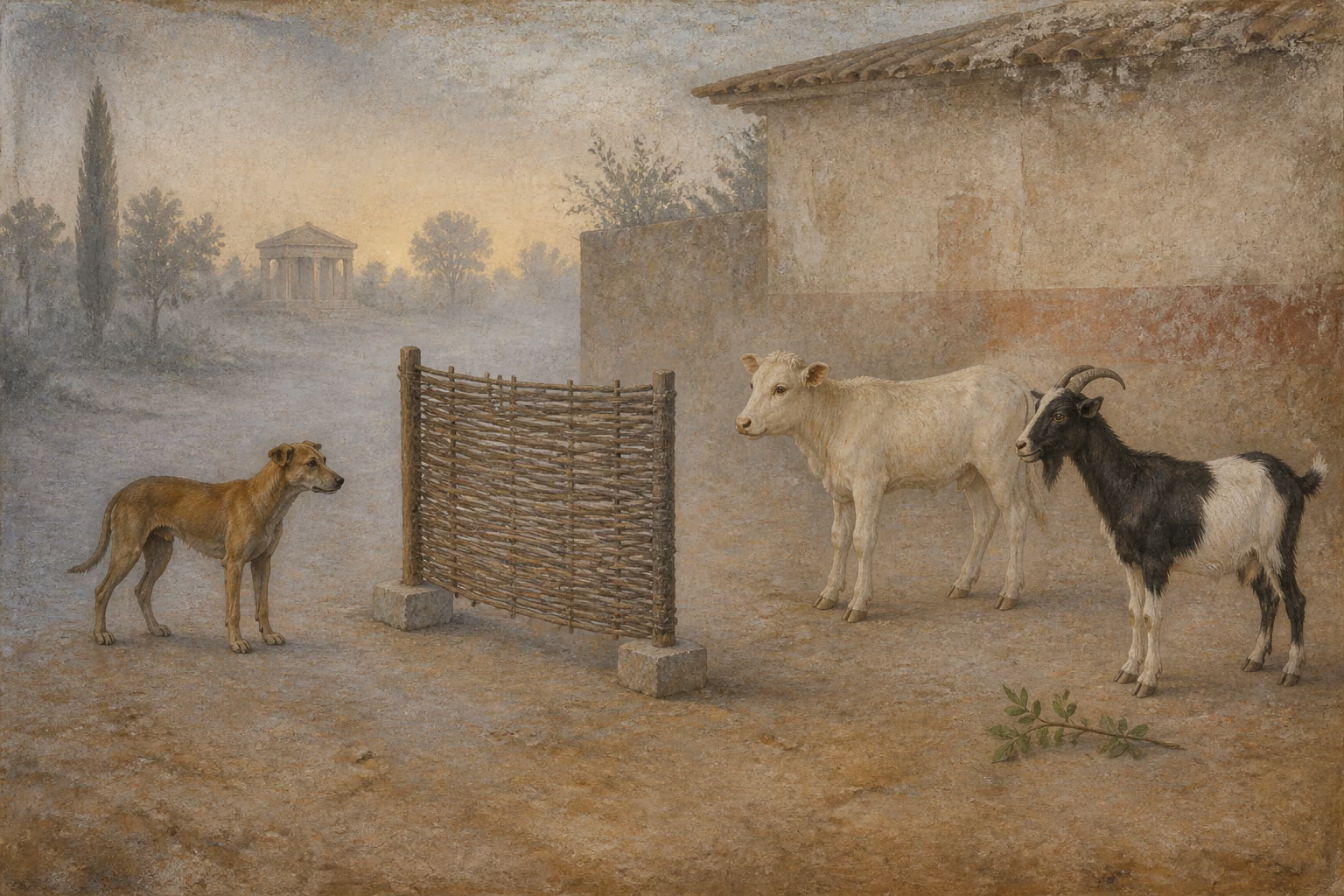
When a person has been bitten by a mad dog, it is the practice to make an incision round the wound to the quick, and then to apply raw veal to it, and to make the patient take either veal broth or hogs’ lard, mixed with lime internally. Some persons recommend a he-goat’s liver, and maintain that if it is applied to the wound the patient will never be attacked with hydrophobia. She-goat’s dung, too, is highly spoken of, applied with wine, as also the dung of the badger, cuckoo, and swallow, boiled and taken in drink.
For bites inflicted by other animals, dried goats’ milk cheese is applied with origanum and taken with the drink; and for injuries caused by the human teeth, boiled beef is applied; veal, however, is still more efficacious for the purpose, provided it is not removed before the end of four days.
The dried muzzle of a wolf, they say, is an effectual preservative against the malpractices of magic; and it is for this reason that it is so commonly to be seen fastened to the doors of farm-houses. A similar degree of efficacy, it is thought, belongs to the skin of the neck, when taken whole from the animal. Indeed, so powerful is the influence of this animal, in addition to what we have already stated, that if a horse only treads in its track, it will be struck with torpor in consequence.
In case where persons have swallowed quicksilver, bacon is the proper remedy to be employed. Poisons are neutralized by taking asses’ milk; henbane more particularly, mistletoe, hemlock, the flesh of the sea-hare, opocarpathon, pharicon, and dorycnium: the same, too, where coagulated milk has been productive of bad effects, for the biestings, or first curdled milk, should be reckoned as nothing short of a poison. We shall have to mention many other uses to which asses’ milk is applied; but it should be remembered that in all cases it must be used fresh, or, if not, as new as possible, and warmed, for there is nothing that more speedily loses its virtue. The bones, too, of the ass are pounded and boiled, as an antidote to the poison of the sea-hare. The wild ass is possessed of similar properties in every respect, but in a much higher degree.
Of the wild horse the Greek writers have made no mention, it not being a native of their country; we have every reason to believe, however, that it has the same properties as the animal in a tame state, but much more fully developed. Mares’ milk effectually neutralizes the venom of the sea-hare and all narcotic poisons. Nor had the Greeks any knowledge from experience of the urus and the bison, although in India the forests are filled with herds of wild oxen: it is only reasonable, however, to conclude that all their medicinal properties must be much more highly developed than in the animal as found among us. It is asserted also, that cows’ milk is a general counter-poison, in the cases above-mentioned, more particularly, as also where the poison of ephemeron has settled internally, or cantharides have been administered; it acting upon the poison by vomit. Broth, too, made from goats’ flesh, neutralizes the effects of cantharides, in a similar manner, it is said. To counteract the corrosive poisons which destroy by ulceration, veal or beef-suet is resorted to; and in cases where a leech has been swallowed, butter is the usual remedy, with vinegar heated with a red-hot iron. Indeed, butter employed by itself is a good remedy for poisons, for where oil is not to be procured, it is an excellent substitute for it. Used with honey, butter heals injuries inflicted by millepedes. The broth of boiled tripe, it is thought, is an effectual repellent of the above-mentioned poisons, aconite and hemlock more particularly; veal-suet also has a similar repute.
Fresh goats’ milk cheese is given to persons who have taken mistletoe, and goats’ milk itself is a remedy for cantharides. Taken with Taminian grapes, goats’ milk is an antidote to the effects of ephemeron. Goats’ blood, boiled down with the marrow, is used as a remedy for the narcotic poisons, and kids’ blood for the other poisons. Kid’s rennet is administered where persons have taken mistletoe, the juice of the white chamæleon, or bull’s blood; for which last, hare’s rennet in vinegar is also used by way of antidote. For injuries inflicted by the pastinaca, and the stings or bites of all kinds of marine animals, hare’s rennet, kid’s rennet, or lamb’s rennet is taken, in doses of one drachma, in wine. Hare’s rennet, too, generally forms an ingredient in the antidotes for poisons.
The moth that is seen fluttering about the flame of a lamp is generally reckoned in the number of the noxious substances: its bad effects are neutralized by the agency of goat’s liver. Goat’s gall, too, is looked upon as an antidote to venomous preparations from the field weazel. But we will now return to the other remedies, classified according to the various diseases.