LIBER XXX · CAPUT 11
REMEDIES FOR JAUNDICE
Latine · Mayhoff 1906
Morbo regio resistunt sordes aurium aut mammarum pecudis denarii pondere cum murrae momento et vini cyathis II canini capitis cinis in mulso, multipeda in vini hemina, vermes terreni in aceto mulso cum murra, gallina, si sit luteis pedibus, prius aqua purificatis, dein collutis vino, quod bibatur, cerebrum perdicis aut aquilae in vini cyathis III, cinis plumarum aut interaneorum palumbis in mulso ad coclearia III, passerum cinis sarmentis crematorum coclearibus II in aqua mulsa. avis icterus vocatur a colore; quae si spectetur, sanari id malum tradunt et avem mori. hanc puto Latine vocari galgulum.
Phreneticis prodesse videtur pulmo pecudum calidus circa caput alligatus. nam muris cerebrum dare potui ex aqua aut cinerem mustelae vel etiam inveteratas carnes irenacei quis possit furenti, etiamsi certa sit medicina? bubonis quidem oculorum cinerem inter ea, quibus prodigiose vitam ludificantur, acceperim, praecipueque febrium medicina placitis eorum renuntiat. namque et in duodecim signa digessere eam sole transmeante iterumque luna, quod totum abdicandum paucis e pluribus edocebo, siquidem crematis tritisque cum oleo perungui iubent aegros, cum geminos transeat sol, cristis et auribus et unguibus gallinaceorum; si luna, radiis barbisque eorum; si virginem alteruter, hordei granis; si sagittarium, vespertilionis alis; si leonem luna, tamaricis fronde, et adiciunt sativae; si aquarium, e buxo carbonibus tritis. ex istis confessa aut certe verisimilia ponemus, sicuti lethargum olfactoriis excitari et inter ea fortassis mustelae testiculis inveteratis aut iocinere usto. his quoque pulmonem pecudis calidum circa caput adalligari putant utile.
In quartanis medicina clinice propemodum nihil pollet. quam ob rem plura eorum remedia ponemus primumque ea, quae adalligari iubent: pulverem, in quo se accipiter volutaverit, lino rutilo in linteolo, canis nigri dentem longissimum. pseudosphecem vocant vespam, quae singularis volitat; hanc sinistra manu adprehensam subnectunt, alii vero quam quis eo anno viderit primam; viperae caput abscisum in linteolo vel cor viventi exemptum; muris rostellum auriculasque summas russeo panno ipsumque dimittunt; lacertae vivae dextrum oculum effossum, mox cum capite suo deciso in pellicula caprina scarabaeum, qui pilas volvit. propter hunc Aegypti magna pars scarabaeos inter numina colit, curiosa Apionis interpretatione, qua colligat Solis operum similitudinem huic animali esse, ad excusandos gentis suae ritus. sed et alios adalligant Magi: cui sunt cornicula reflexa, sinistra manu collectum; tertium, qui vocatur fullo, albis guttis, dissectum utrique lacerto adalligant, cetera sinistro: cor anguium sinistra manu exemptum viventibus, scorpionis caudae IIII articulos cum aculeo panno nigro ita, ut nec scorpionem dimissum nec eum, qui adalligaverit, videat aeger triduo, post tertium circuitum id condat. urucam in linteolo ter lino circumdant totidem nodis ad singulos dicente, quare faciat, qui medebitur, limacem in pellicula vel IIII limacum capita praecisa harundine, multipedam lana involutam, vermiculos, ex quibus tabani fiunt, antequam pennas germinent, alios e spinosis frutectis lanuginosos. quidam ex illis quaternos inclusos iuglandis nucis putarnine adalligant. cocleas, quae nudae inveniuntur, stelionem, cum incluserunt capsulis, subiciunt capiti et sub decessu febris emittunt. devorari autem iubent cor mergi marini sine ferro exemptum, inveteratumque conteri et in calida aqua bibi, hirundinum corda cum melle; alii fimum drachma una in lactis caprini vel ovilli vel passi cyathis III ante accessiones; sunt qui totas censeant devorandas. aspidis cutem pondere sexta parte denarii cum piperis pari modo Parthorum gentes in remedium quartanae bibunt. Chrysippus philosophus tradidit phryganion adalligatum remedio esse quartanis. quod esset animal, neque ille descripsit nec nos invenimus qui novisset; demonstrandum tamen fuit a tam gravi auctore dictum, si cuius cura efficacior esset inquirendi. cornicis carnes esse et nidum inlinere in longis morbis utilissimum putant. —Et in tertianis fiat potestas experiendi, quoniam miserias copia spei delectat, anne aranei, quem lycon vocant, tela cum ipso in spleniolo resinae ceraeque inposita utrisque temporibus et fronti prosit, aut ipse calamo adalligatus, qualiter et aliis febribus prodesse traditur, item lacerta viridis adalligata viva in eo vase, quod capiat, quo genere et recidivas frequenter abigi adfirmant.
Hydropicis oesypum ex vino addita murra modice potui datur, nucis abellanae magnitudine. aliqui addunt et anserinum adipem ex vino myrteo. sordes ab uberibus ovium eundem effectum habent, item carnes inveteratae irenacei sumptae. vomitus quoque canum inlitus ventri aquam trahere promittitur.
English · Bostock & Riley 1855–57
Jaundice is combated by administering ear-wax to the patient, or else the filth that adheres to the udders of sheep, in doses of one denarius, with a modicum of myrrh, in two cyathi of wine; the ashes, also, of a dog’s head, mixed with honied wine; a millepede, in one semi-sextarius of wine; earth-worms, in hydromel with myrrh; wine in which a hen’s feet have been washed, after being first cleansed with water—the hen must be one with yellow feet—the brains of a partridge or of an eagle, in three cyathi of wine; the ashes of a ring-dove’s feathers or intestines, in honied wine, in doses of three spoonfuls; or ashes of sparrows burnt upon twigs, in doses of two spoonfuls, in hydromel.
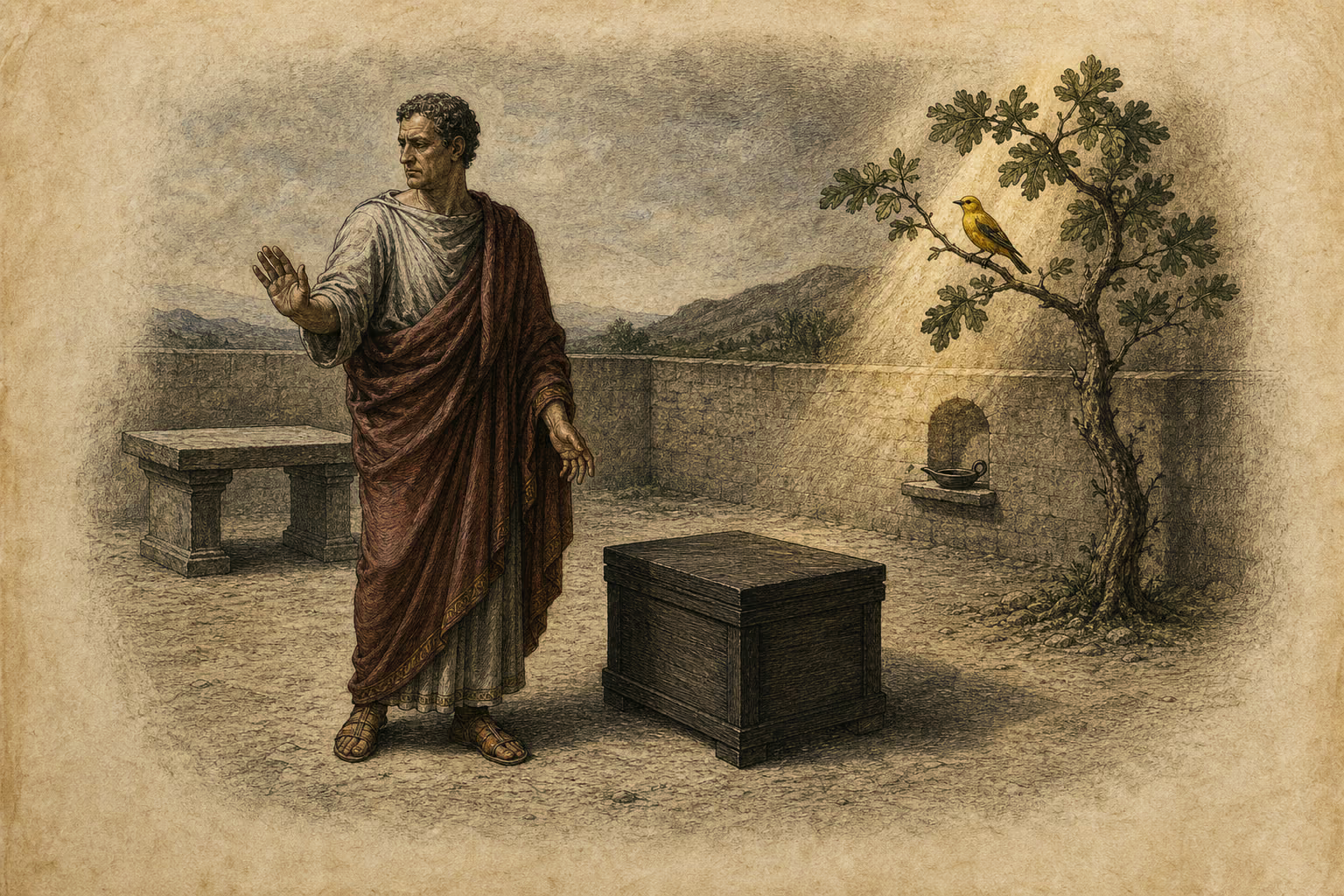
There is a bird, known as the “icterus,” from its peculiar colour: if the patient looks at it, he will be cured of jaundice, they say, and the bird will die. In my opinion this is the same bird that is known in Latin by the name of “galgulus.”
In cases of phrenitis a sheep’s lights, attached warm round the patient’s head, would appear to be advantageous. But as to giving a man suffering from delirium a mouse’s brains in water to drink, the ashes of a burnt weasel, or the dried flesh even of a hedgehog, who could possibly do it, supposing even the effects of the remedy were certain? I should be inclined, too, to rank the ashes of the eyes of a horned owl in the number of those monstrous prescriptions with which the adepts in the magic art abuse the credulity of mankind.
It is in cases, too, of fever, more particularly, that the acknowledged rules of medicine run counter to the prescriptions of these men: for they have classified the various modes of treating the disease in accordance with the twelve signs of the Zodiac, and relatively to the revolutions of the sun and moon, a system which deserves to be utterly repudiated, as I shall prove by a few instances selected from many. They recommend, for example, when the sun is passing through Gemini, that the patient should be rubbed with ashes of the burnt combs, ears, and claws of cocks, beaten up and mixed with oil. If, again, it is the moon that is passing through that sign, it is the spurs and wattles of cocks that must be similarly employed. When either of these luminaries is passing through Virgo, grains of barley must be used; and when through Sagittarius, a bat’s wings. When the moon is passing through Leo, it is leaves of tamarisk that must be employed, and of the cultivated tamarisk, they add: if, again, the sign is Aquarius, the patient must use an application of box-wood charcoal, pounded.
Of the remedies, however, that we find recommended by them, I shall be careful to insert those only the efficacy of which has been admitted, or, at least, is probable in any degree; such, for instance, as the use of powerful odours, as an excitant for patients suffering from lethargy; among which, perhaps, may be reckoned the dried testes of a weasel, or the liver of that animal, burnt. They consider it a good plan, too, to attach a sheep’s lights, made warm, round the head of the patient.
In the treatment of quartan fevers, clinical medicine is, so to say, pretty nearly powerless; for which reason we shall insert a considerable number of remedies recommended by professors of the magic art, and, first of all, those prescribed to be worn as amulets: the dust, for instance, in which a hawk has bathed itself, tied up in a linen cloth, with a red string, and attached to the body; the longest tooth of a black dog; or the wasp known by the name of “pseudosphex,” which is always to be seen flying alone, caught with the left hand and attached beneath the patient’s chin. Some use for this purpose the first wasp that a person sees in the current year. Other amulets are, a viper’s head, severed from the body and wrapped in a linen cloth; a viper’s heart, removed from the reptile while still alive; the muzzle of a mouse and the tips of its ears, wrapped in red cloth, the animal being set at liberty after they are removed; the right eye plucked from a living lizard, and enclosed with the head, separated from the body, in goat’s skin; the scarabæus also that forms pellets and rolls them along.
It is on account of this kind of scarabæus that the people of a great part of Egypt worship those insects as divinities; an usage for which Apion gives a curious reason, asserting, as he does, by way of justifying the rites of his nation, that the insect in its operations pictures the revolution of the sun. There is also another kind of scarabæus, which the magicians recommend to be worn as an amulet—the one that has small horns thrown backwards; it must be taken up, when used for this purpose, with the left hand. A third kind also, known by the name of “fullo,” and covered with white spots, they recommend to be cut asunder and attached to either arm, the other kinds being worn upon the left arm. Other amulets recommended by them, are, the heart of a snake taken from the living animal with the left hand; or four joints of a scorpion’s tail, together with the sting, attached to the body in a piece of black cloth; due care being taken that the patient does not see the scorpion, which is set at liberty after the operation, or the person who has attached the amulet, for the space of three days: after the recurrence, too, of the third paroxysm, he must bury the whole in the ground. Some enclose a caterpillar in a piece of linen with a thread passed three times round it, and tie as many knots, repeating at each knot why it is that the patient performs that operation. A slug is sometimes wrapped in a piece of skin, or the heads of four slugs, cut from the body with a reed: a millepede is rolled up in wool: the small grubs that produce the gadfly, are used before the wings of the insect are developed; or any other kind of hairy grub is employed that is found adhering to prickly shrubs. Some persons attach to the body four of these grubs, enclosed in an empty walnut shell, or else some of the snails that are found without a shell.
In other cases, again, it is the practice to enclose a spotted lizard in a little box, and to place it beneath the pillow of the patient, taking care to set it at liberty when the fever abates. It is recommended also, that the patient should swallow the heart of a sea-diver, removed from the bird without the aid of iron, it being first dried and then bruised and taken in warm water. The heart of a swallow is also recommended, with honey; and there are persons who say that, just before the paroxysms come on, the patient should take one drachma of swallow’s dung in three cyathi of goats’ milk or ewes’ milk, or of raisin wine: others, again, are of opinion that the birds themselves should be taken, whole. The nations of Parthia, as a remedy for quartan fevers, take the skin of the asp, in doses of one sixth of a denarius, with an equal quantity of pepper. The philosopher Chrysippus has left a statement to the effect, that the phryganion, worn as an amulet, is a remedy for quartan fevers; but what kind of animal this is he has nowhere informed us, nor have I been able to meet with any one who knows. Still, however, I felt myself bound to notice a remedy that was mentioned by an author of such high repute, in case any other person should happen to be more successful in his researches. To eat the flesh of a crow, and to use nitre in the form of a liniment, is considered highly efficacious for the treatment of chronic diseases.
In cases of tertian fever—so true it is that suffering takes delight in prolonging hope by trying every remedy—it may be worth while to make trial whether the web of the spider called “lycos” is of any use, applied, with the insect itself, to the temples and forehead in a compress covered with resin and wax; or the insect itself, attached to the body in a reed, a form in which it is said to be highly beneficial for other fevers. Trial may be made also of a green lizard, enclosed alive in a vessel just large enough to receive it, and worn as an amulet; a method, it is said, by which recurrent fevers are often dispelled.
For the cure of dropsy, wool-grease, a piece about the size of a hazel-nut, is given in wine, with the addition of a little myrrh: some add goose-grease, steeped in myrtle wine. The filth that adheres to the udders of sheep is productive of a similar effect, as also the dried flesh of a hedge-hog, taken with the food. Matter vomited by a dog, we are assured, applied to the abdomen, will draw off the water that has accumulated there.