LIBER XXX · CAPUT 6
REMEDIES FOR PAINS IN THE STOMACH
Latine · Mayhoff 1906
pulmonum quoque vitiis medentur, item mures, maxime Africani, detracta cute in oleo et sale decocti atque in cibo sumpti. eadem res et purulentis vel cruentis excreationibus medetur, praecipue vero coclearum cibus stomacho. in aqua eas subfervefieri intacto corpore earum oportet, mox in pruna torreri nihilo addito atque ita e vino garoque sumi, praecipue Africanas. nuper hoc conpertum plurimis prodesse; id quoque observant, ut numero inpari sumantur. virus tamen earum gravitatem halitus facit. prosunt et sanguine excreantibus dempta testa tritae in aqua potu. laudatissimae autem sunt Africanae —ex iis Iolitanae —, Astypalaeicae, item Siculae modicae, quoniam magnitudo duras facit et sine suco, Baliaricae, quas cavaticas vocant, quoniam in speluncis nascuntur, laudatae ex insulis et Caprearum, nullae autem cibis gratae neque veteres neque recentes. fluviatiles et albae virus habent, nec silvestres stomacho utiles, alvum solvunt, item omnes minutae. contra marinae stomacho utiliores, efficacissimae tamen in dolore stomachi e laudatis traduntur quaecumque vivae cum aceto devoratae. praeterea sunt quae ἀκέρατοι vocantur, latae, multifariam nascentes, de quarum usu dicemus suis locis. gallinaceorum ventris membrana, si inveterata est, inspersa potioni destillationes pectoris et umidam tussim vel recens tosta lenit. cocleae crudae tritae cum aquae tepidae cyathis III si sorbeantur, tussim sedant. destillationes sedat et canina cutis cuilibet digito circumdata. iure perdicum stomachus recreatur.
Iocinerum doloribus medetur mustela silvestris in cibo sumpta vel iocinera eius, item viverra porcelli modo inassata, suspiriosis multipeda, ut ter septenae in Attico melle diluantur et per harundinem bibantur; omne enim vas nigrescit contactu. quidam torrent sextarium in patina, donec candidae fiant, tune melle miscent [alii centipedam vocant ] et ex aqua calida dari iubent in cibo. cocleaeiis, quos linquit animus aut quorum alienatur mens aut quibus vertigines fiunt, ex passi cyathis III singulae contritae cum sua testa et calefactae in potu datae diebus plurimum VIIII; aliqui singulas primo die dedere, sequenti binas, tertio ternas, quarto II, quinto I; sic et suspiria emendant et vomicas. esse animal locustae simile sine pennis, quod trixallis Graece vocetur, Latinum nomen non habeat, aliqui arbitrantur, nec pauci auctores, hoc esse quod grylli vocentur; ex his xx torreri iubent ac bibi e mulso contra orthopnoeas. sanguinem expuentibus cocleae, si qui inlotis protropum infundat vel marina aqua ita decoquat et in cibo sumat aut si tritae cum testis suis sumantur cum protropo; sic et tussi medentur. vomicas privatim sanat mel, in quo apes sint demortuae. sanguinem reicientibus pulmo vulturinus vitigineis lignis conbustus, adiecto flore Punici mali ex parte dimidia, item cotoneorum liliorumque isdem portionibus, potus mane atque vesperi e vino, si febres absint, si minus, ex aqua, in qua cotonea decocta sint.
Pecudis lien recens magicis praeceptis super dolentem lienem extenditur dicente eo, qui medeatur, lieni se renedium facere. post hoc iubent in pariete dormitorii eius tectorio includi et obsignari anulo ter novies eademque dici. caninus si viventi eximatur et in cibo sumatur, liberat eo vitio. quidam recentem superinligant. alii duum dierum catuli ex aceto scillite dant ignoranti vel irenacei lienem, item coclearum cinerem cum semine lini et urticae addito melle, done persanet. liberat et lacerta viridis viva in olla ante cubiculum dormitorium eius, cui medeatur, suspensa, ut egrediens revertensque attingat manu, cinis e capite bubonis cum unguento, mel, in quo apes sint mortuae, araneus et maxime qui lycos vocatur.
Upupae cor lateris doloribus laudatur, coclearum cibus in tisana decoctarum; et per se inlinuntur. canis rabiosi calvariae cinis potioni inspergitur.—Lumborum dolori stelio transmarinus capite ablato et intestinis decoctus in vino cum papaveris nigri denarii pondere dimidio eo suco bibitur. lacertae virides decisis pedibus et capite in cibo sumuntur, cocleae III contritae cum testis suis atque in vino decoctae cum piperis granis xv. aquilae pedes evellunt in aversum a suffragine ita, ut dexter dextrae partis doloribus adalligetur, sinister laevae. multipeda quoque, quam oniscon appellavimus, medetur denarii pondere ex vini cyathis II pota. vermem terrenum catillo ligneo ante fisso et ferro vincto inpositum aqua excepta perfundere et defodere, unde effoderis, Magi iubent, mox aquam bibere catillo, mire id prodesse ischiadicis adfirmantes.
English · Bostock & Riley 1855–57
Affections of the lungs are cured by using mice, those of Africa more particularly, the animal being skinned and boiled, in salt and oil, and then taken with the food. The same preparation is used also, for the cure of purulent or bloody expectorations.
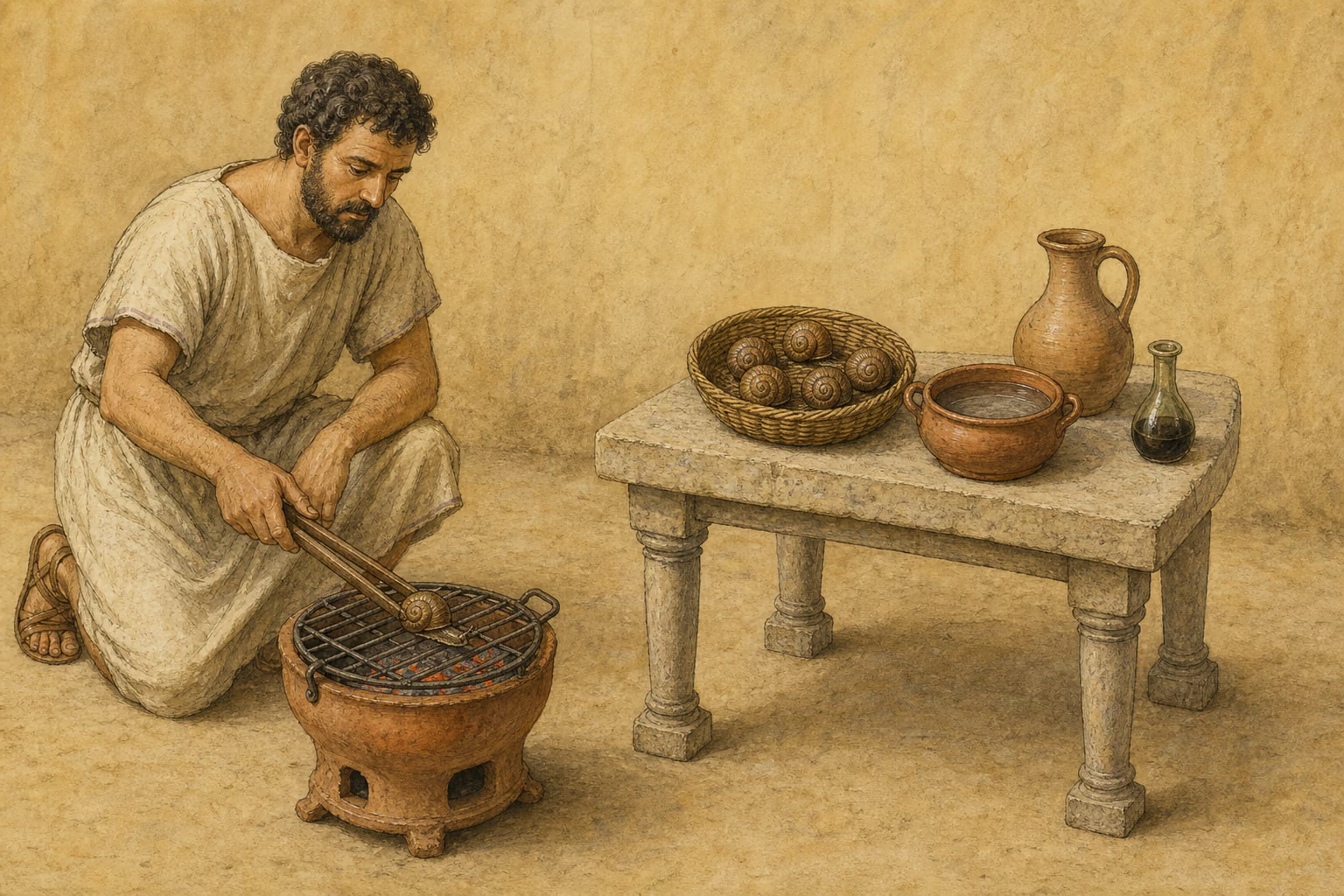
One of the very best remedies for affections of the stomach, is to use a snail diet. They must first be left to simmer in water for some time, without touching the contents of the shell, after which, without any other addition, they must be grilled upon hot coals, and eaten with wine and garum; the snails of Africa being the best of all for the purpose. The efficacy of this remedy has been proved in numerous instances of late. Another point, too, to be observed, is to take an uneven number of them. Snails, however, have a juice, it should be remembered, which imparts to the breath an offensive smell. For patients troubled with spitting of blood, they are remarkably good, the shell being first removed, and the contents bruised and administered in water. The most esteemed kinds of all are those of Africa—those which come from Iol,, in particular—of Astypalæa, and, after them, those of Ætna, in Sicily, those I mean of moderate size, for the large ones are hard, and destitute of juice. The Balearic snails, called “cavaticæ,” from being found in caverns, are much esteemed; and so, too, are those from the islands of Capreæ. Those of Greece, on the other hand, are never used for food, either old or fresh.
River snails, and those with a white shell, have a strong, rank, juice, and forest snails are by no means good for the stomach, having a laxative effect upon the bowels; the same too, with all kinds of small snails. Sea-snails, on the other hand, are more beneficial to the stomach; but it is for pains in that region that they are found the most efficacious: the best plan, it is said, is to eat them alive, of whatever kind they may happen to be, with vinegar. In addition to these, there are the snails called “aceratæ,” with a broad shell, and found in numerous localities: of the uses to which they are put we shall speak further on the appropriate occasions. The craw of poultry, dried and sprinkled in the drink, or else used fresh and grilled, has a soothing effect upon pectoral catarrhs and coughs attended with phlegm. Snails, beaten up raw and taken in three cyathi of warm water, allay cough. A piece of dog’s skin, wrapped round any one of the fingers, affords relief to patients suffering from catarrh. A broth made of boiled partridges is strengthening for the stomach.
For the cure of pains in the liver, a wild weasel is taken with the food, or the liver only of that animal; a ferret also, roasted like a sucking-pig. In cases of asthma, millepedes are used, thrice seven of them being soaked in Attic honey, and taken internally by the aid of a reed: for all vessels, it should be remembered, turn black on coming in contact with them. Some persons grill one sextarius of these insects on a flat pan, till they become white, and then mix them with honey. There are some authorities who call this insect a “centipede,” and recommend it to be given in warm water. Snails are administered to persons subject to fainting fits, alienation of the senses, and vertigo: for which purposes, a snail is beaten up, shell and all, with three cyathi of raisin wine, and the mixture is administered warm with the drink, for nine days at most. Others, again, give one snail the first day, two the second, three the third, two the fourth, and one the fifth; a mode of treatment also adopted for the cure of asthma and of abscesses.
There is, according to some authorities, an insect resembling the locust in appearance, destitute of wings, and known by the Greek name of “troxallis,” it being without a name in Latin: a considerable number of writers, however, consider it as identical with the insect known to us as “gryllus.” Twenty of these insects, they say, should be grilled, and taken in honied wine, by patients troubled with hardness of breathing or spitting of blood. Some persons pour pure grape-juice, or sea-water, upon unwashed snails, and then boil and eat them for food; or else they bruise the snails, shells and all, and take them with this grape-juice. A similar method is also adopted for the cure of cough. Honey in which the bees have died, is particularly good for the cure of abscesses. For spitting of blood a vulture’s lungs are used, burnt upon vine logs, and mixed with half the quantity of pomegranate blossoms, or with the same proportion of quince and lily blossom: the whole being taken morning and evening, in wine, if there is no fever; but where there are symptoms of fever, instead of wine, water is used in which quinces have been boiled.
According to the prescriptions given by the magicians, a fresh sheep’s milt is the best application for pains in the spleen, the person who applies it uttering these words: “This I do for the cure of the spleen.” This done, it is enjoined that the milt should be covered up with mortar in the wall of the patient’s sleeping-room, and sealed with a ring, a charm being repeated thrice nine times. A dog’s milt, removed from the animal while still alive, taken with the food, is a cure for diseases of the spleen: some, again, attach it fresh to that part of the patient’s body. Others give the patient—without his knowing it—the milt of a puppy two days old, to eat, in squill vinegar; the milt, too, of a hedge-hog is similarly used. Ashes of burnt snails are employed, in combination with linseed, nettle-seed, and honey, the treatment being persisted in till the patient is thoroughly cured.
A green lizard has a remedial effect, suspended alive in an earthen vessel, at the entrance of the sleeping-room of the patient, who, every time he enters or leaves it, must take care to touch it with his hand: the head, too, of a horned owl, reduced to ashes and incorporated with an unguent; honey, also, in which the bees have died; and spiders, the one known as the “lycos” in particular.
For pains in the side, the heart of a hoopoe is highly esteemed; ashes, too, of burnt snails, that have been boiled in a ptisan, snails being sometimes applied in the form of a liniment, alone. Potions employed for this purpose have a sprinkling in them of the ashes of a mad dog’s skull. For the cure of lumbago, the spotted lizard from beyond seas is used: the head and intestines being first removed, the body is boiled in wine, with half a denarius of black poppy, and the decoction is taken in drink. Green lizards, also, are taken with the food, the feet and head being first removed; or else three snails are crushed, shells and all, and boiled with fifteen peppercorns in wine. The feet of an eagle are wrenched off in a contrary direction to the joint, and the right foot is attached to the right side, the left foot to the left, according as the pains are situate. The millepede, which we have spoken of as being called the “oniscos,” is a cure for these pains, taken, in doses of one denarius, in two cyathi of wine. The magicians recommend an earth-worm to be put in a wooden dish, which has been split and mended with iron wire; which done, some water must be taken up with the dish, the worm drenched with it and buried in the spot from which it was taken, and the water drunk from the dish. They assert, also, that this is a marvellously excellent cure for sciatica.