LIBER XXXI · CAPUT 3
THE WHOLESOMENESS OF WATERS
Latine · Mayhoff 1906
Quaeritur inter medicos, cuius generis aquae sint utilissimae. stagnantes pigrasque merito damnant, utiliores quae profluunt existimantes, cursu enim percussuque ipso extenuari atque proficere; eoque miror cisternarum ab aliquis maxime probari. sed hi rationem adferunt, quoniam levissima sit imbrium, ut quae subire potuerit ac pendere in aëre. ideo et nives praeferunt nivibusque etiam glaciem, velut ad infinitum coacta subtilitate; leviora enim haec esse et glaciem multo leviorem aqua. horum sententiam refelli interest vitae. in primis enim levitas illa deprehendi aliter quam sensu vix potest, nullo paene momento ponderis aquis inter se distantibus. nec levitatis in pluvia aqua argumentum est subisse eam in caelum, cum etiam lapides subire appareat cadensque inficiatur halitu terrae, quo fit ut pluviae aquae sordium plurimum inesse sentiatur citissimeque ideo calefiat aqua pluvia. nivem quidem glaciemque subtilissimum elementi eius videri miror adposito grandinum argumento, e quibus pestilentissimum potum esse convenit. nec vero pauci inter ipsos e contrario ex gelu ac nivibus insaluberrimos potus praedicant, quoniam exactum sit inde quod tenuissimum fuerit. minui certe liquorem omnem congelatione deprehenditur et rore nimio scabiem fieri, pruina uredinem, cognatis et nivis causis. pluvias quidem aquas celerrime putrescere convenit minimeque durare in navigatione. Epigenes autem aquam, quae septies putrefacta purgata sit, ait amplius non putrescere. nam cisternas etiam medici confitentur inutiles alvo duritia faucibusque, etiam limi non aliis inesse plus aut animalium, quae faciunt taedium.item confitendum habent nec statim amnium utilissimas esse, sicuti nec torrentium ullius, lacusque plurimos salubres. quaenam igitur et cuius generis aptissimae? aliae alibi. Parthorum reges ex Choaspe et Eulaeo tantum bibunt; eae quamvis in longinqua comitantur illos. sed horum placere, non quia sint amnes, apparet, quoniam neque e Tigri neque Euphrate neque e multis aliis bibunt.
Limus aquarum vitium est. si tamen idem amnis anguillis scateat, salubritatis indicium habetur, sicuti frigoris taenias in fonte gigni. ante omnia autem damnantur amarae et quae sorbentem statim implent, quod evenit Troezene. nam nitrosas atque salmacidas in desertis Rubrum mare petentes addita polenta utiles intra duas horas faciunt ipsaque vescuntur polenta. damnantur in primis quae fonte caenum faciunt quaeque malum colorem bibentibus, refert et si vasa aerea inficiant aut si legumina tarde percocant, si liquatae leniter terram relinquant decoctaeque crassis obducant vasa crustis. est etiamnum vitium non fetidae modo, verum omnino quicquam resipientis, iucundum sit illud licet gratumque et, ut saepe, ad viciniam lactis accedens. aquam salubrem aëri quam simillimam esse oportet. unus in toto orbe traditur fons aquae iucunde olentis in Mesopotamia Chabura; fabulae rationem adferunt, quoniam eo Iuno perfusa sit. de cetero aquarum salubrium sapor odorve nullus esse debet.
Quidam statera iudicant de salubritate, frustrante diligentia, quando perrarum est ut levior sit aliqua. certior subtilitas, inter pares meliorem esse quae calefiat refrigereturque celerius. quin et haustam vasis portatis, ne manu pendeant, depositisque in humum tepescere adfirmant. ex quonam ergo genere maxime probabilis continget? puteis nimirum, ut in oppidis video constare, sed iis, quibus et exercitationis ratio crebro haustu continget et illa tenuitas colante terra. salubritati haec satis sunt; frigori et opacitas necessaria utque caelum videant. super omnia una observation—eadem et ad perennitatem pertinet—, ut illa e vado exiliat vena, non e lateribus. nam ut tactu gelida sit, etiam arte contingit, si expressa in altum aut e sublimi deiecta verberatum corripiat aëra. in natando quidem spiritum continentibus frigidior sentitur eadem. Neronis principis inventum est decoquere aquam vitroque demissam in nives refrigerare; ita voluptas frigoris contingit sine vitiis nivis. omnem utique decoctam utiliorem esse convenit, item calefactam magis refrigerari, subtilissimo invento. vitiosae aquae remedium est, si decoquatur ad dimidias partes. aqua frigida ingesta sistitur sanguis. aestus in balineis arcetur, si quis ore teneat. quae sint haustu frigidissimae, non perinde et tactu esse, alternante hoc bono, multi familiari exemplo colligunt.
Clarissima aquarum omnium in toto orbe frigoris salubritatisque palma praeconio urbis Marcia est, inter reliqua deum munera urbi tributa. vocabatur haec quondam Aufeia, fons autem ipse Pitonia. oritur in ultimis montibus Paelignorum, transit Marsos et Fucinum lacum, Romam non dubie petens. mox in specus mersa in Tiburtina se aperit, ita novem milibus passuum fornicibus structis perducta. primus eam in urbem ducere auspicatus est Ancus Marcius, unus e regibus, postea Q. Marcius Rex in praetura, rursusque restituit M. Agrippa. idem et Virginem adduxit ab octavi lapidis diverticulo duo milia passuum Praenestina via. iuxta est Herculaneus rivus, quem refugiens Virginis nomen obtinuit. horum amnium comparatione differentia supra dicta deprehenditur, cum quantum Virgo tactu praestat, tantum praestet Marcia haustu, quamquam utriusque iam pridem urbi periit voluptas, ambitione avaritiaque in villas ac suburbana detorquentibus publicam salutem.
Non ab re sit quaerendi aquas iunxisse rationem. reperiuntur in convallibus maxime et quodam convexitatis cardine aut montium radicibus. multi septentrionales ubique partes aquosas existimavere, qua in re varietatem naturae aperuisse conveniat. in Hyrcanis montibus a meridiano latere non pluit; ideo silvigeri ab aquilonis tantum parte sunt. at Olympus, Ossa, Parnasus, Appenninus, Alpes undique vestiuntur amnibusque perfunduntur, aliqui ab austro, sicut in Creta Albi montes. nihil ergo in his perpetuae observationis iudicabitur.
Aquarum sunt notae iuncus et herba, de qua dictum est, multumque alicui loco pectore incubans rana. salix enim erratica et alnus aut vitex aut harundo aut hedera sponte proveniunt et conrivatione aquae pluviae in locum humiliorem e superioribus defluentis, augurio fallaci, certiore multo nebulosa exhalatione ante ortum solis longius intuentibus, quod quidam ex edito speculantur proni terram adtingente mento. est et peculiaris aestimatio peritis tantum nota, quam ferventissimo aestu secuntur dieique horis ardentissimis, qualis ex quoque loco repercussus splendeat. nam si terra sitiente umidior sit ille, indubitata spes promittitur. sed tanta oculorum intentione opus est, ut indolescant. quod fugientes ad alia experiment decurrunt. loco in altitudinemn pedum quinque defosso ollisque e figlino opere crudis aut peruncta pelvi aerea lanae vellere cooperto lucernaque ardente concamarata frondibus, dein terra, si figlinum umidum ruptumve aut in aere sudor vel lucerna sine defect olei restincta aut etiam vellus lanae madidum reperiatur, non dubie promittunt aquas. quidam et igni prius excocunt locum, tanto efficaciore vasorum argumento.
Terra vero ipsa promittit candicantibus maculis aut tota glauci coloris. in nigra enim scaturigines non fere sunt perennes. figularis creta semper adimit spes, nec amplius puteum fodiunt coria terrae observantes, ut a nigra descendat ordo supra dictus. aqua semper dulcis in argillosa terra, frigidior in tofo. namque et hic probatur, dulces enim levissimasque facit et colando continet sordes. sabulum exiles limosasque promittit, glarea incertas venas, sed boni saporis, sabulum masculum et harena carbunculus certas stabilesque et salubres, rubra saxa optimas speique certissimae, radices montium saxosae et silex hoc amplius rigentes. oporteat autem fodientibus umidiores adsidue respondere glaebas faciliusque ferramenta descendere. depressis puteis sllpurata vel aluminosa occurrentia putearios necant. experimentum huius periculi est demissa ardens lucerna si extinguatur; tunc secundum puteum dextra ac sinistra fodiuntur aestuaria, quae graviorem illum halitum recipiant. fit et sine his vitiis altitudine ipsa gravior aër, quem emendant adsiduo linteorum iactatu eventilando. cum ad aquam ventum est, sine harenato opus surgit, ne venae obstruantur.
Quaedam aquae vere statim incipiente frigidiores sunt, quarum non in alto origo est—hibernis enim constant imbribus—, quaedam a canis ortu, sicut in Macedoniae Pella utrumque. ante oppidum enim incipiente aestate frigida est palustris, dein maximo aestu in excelsioribus oppidi riget. hoc et in Chio evenit simili ratione portus et oppidi. Athenis Enneacrunos nimbosa aestate frigidior est quam puteus in lovis horto, at ille siccitatibus riget.
English · Bostock & Riley 1855–57
It is a subject of enquiry among medical men, which kind of water is the most beneficial. They condemn, and with justice, all stagnant, sluggish, waters, and are of opinion that running water is the best, being rendered lighter and more salubrious by its current and its continuous agitation. Hence it is that I am much surprised that persons should be found to set so high a value as they do, upon cistern water. These last give as their reason, however, that rain-water must be the lightest water of all, seeing that it has been able to rise aloft and remain suspended in the air. Hence it is, too, that they prefer snow-water to rain-water, and ice, again, to snow, as being water subtilized to the highest possible degree; on the ground that snow-water and ice-water must be lighter than ordinary water, and ice, of necessity, considerably lighter. It is for the general interest, however, of mankind, that these notions should be refuted. For, in the first place, this comparative lightness which they speak of, could hardly be ascertained in any other way than by the sensation, there being pretty nearly no difference at all in weight between the kinds of water. Nor yet, in the case of rain-water, is it any proof of its lightness that it has made its way upwards into the air, seeing that stones, it is quite evident, do the same: and then, besides, this water, while falling, must of necessity become tainted with the vapours which rise from the earth; a circumstance owing to which it is, that such numerous impurities are to be detected in rain-water, and that it ferments with such extreme rapidity.
I am, surprised, too, that snow and ice should be regarded as the most subtilized states of this element, in juxtaposition with the proofs supplied us by hail, the water of which, it is generally agreed, is the most pernicious of all to drink. And then, besides, there are not a few among the medical men themselves, who assert that the use of ice-water and snow-water is highly injurious, from the circumstance that all the more refined parts thereof have been expelled by congelation. At all events, it is a well-ascertained fact that the volume of every liquid is diminished by congelation; as also that excessive dews a reproductive of blight in corn, and that hoar-frosts result in blast; of a kindred nature, both of them, to snow. It is generally agreed, too, that rain-water putrefies with the greatest rapidity, and that it keeps but very badly on a voyage. Epigenes, however, assures us that water which has putrefied seven times and as often purified itself, will no longer be liable to putrefaction. As to cistern-water, medical men assure us that, owing to its harshness, it is bad for the bowels and throat; and it is generally admitted by them that there is no kind of water that contains more slime or more numerous insects of a disgusting nature. But it does not, therefore, follow that river water is the best of all, or that, in fact, of any running stream, the water of many lakes being found to be wholesome in the very highest degree.
What water, then, out of all these various kinds, are we to look upon as best adapted for the human constitution? Different kinds in different localities, is my answer. The kings of Parthia drink no water but that of the Choaspes or of the Eulæus, and, however long their journies, they always have this water carried in their suite. And yet it is very evident that it is not merely because this water is river-water that it is thus pleasing to them, seeing that they decline to drink the water of the Tigris, Euphrates, and so many other streams.
Slime is one great impurity of water: still, however, if a river of this description is full of eels, it is generally looked upon as a proof of the salubrity of its water; just as it is regarded as a sign of its freshness when long worms breed in the water of a spring. But it is bitter water, more particularly, that is held in disesteem, as also the water which swells the stomach the moment it is drunk, a property which belongs to the water at Trœzen. As to the nitrous and salso-acid waters which are found in the deserts, persons travelling across towards the Red Sea render them potable in a couple of hours by the addition of polenta, which they use also as food. Those springs are more particularly condemned which secrete mud, or which give a bad complexion to persons who drink thereof. It is a good plan, too, to observe if water leaves stains upon copper vessels; if leguminous vegetables boil with difficulty in it; if, when gently decanted, it leaves an earthy deposit; or if, when boiled, it covers the vessel with a thick crust.
It is a fault also in water, not only to have a bad smell, but to have any flavour at all, even though it be a flavour pleasant and agreeable in itself, or closely approaching, as we often find the case, the taste of milk. Water, to be truly wholesome, ought to resemble air as much as possible. There is only one spring of water in the whole universe, it is said, that has an agreeable smell, that of Chabura, namely, in Mesopotamia: the people give a fabulous reason for it, and say that it is because Juno bathed there. Speaking in general terms, water, to be wholesome, should have neither taste nor smell.
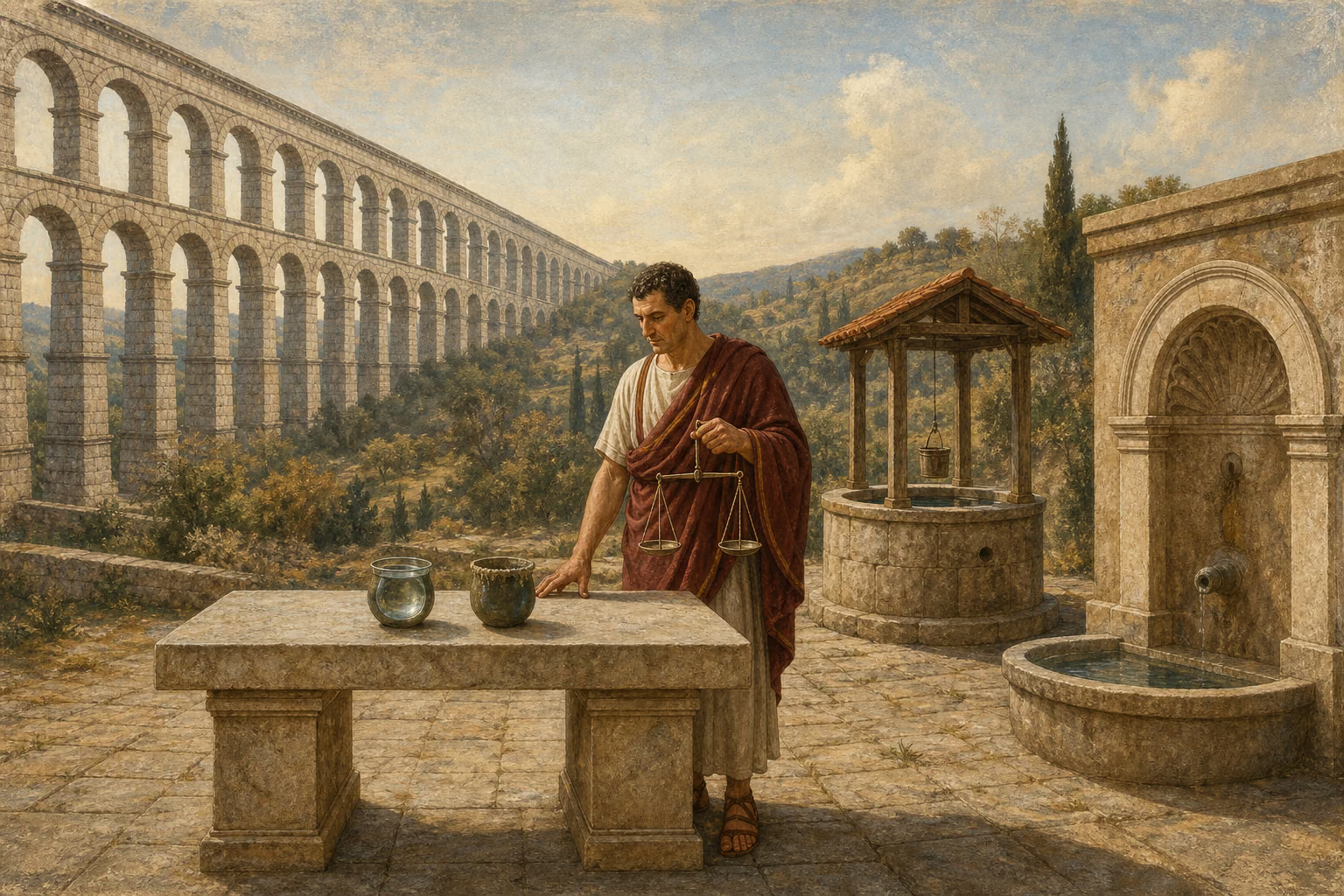
Some persons judge of the wholesomeness of water through the agency of a balance: their pains, however, are expended to little purpose, it being but very rarely that one water is lighter than another. There is, however, a more certain mode of ascertaining the difference in quality, that water being the better of the two which becomes hot and cold with the greatest rapidity: in addition to which, not to keep poising a balance, after water has been drawn up in vessels, if it is good, it should gradually become warmer, they say, when placed upon the ground. Which water, then, of the several kinds will be most likely to be good and wholesome? Well-water, no doubt if we are to judge from the general use made of it in cities: but only in the case of wells in which it is kept in continual agitation by repeated drawing, and is refined by the earth acting as a filter. These conditions are sufficient to ensure salubrity in water: in regard to coolness, the well must be in a shaded spot, and the water kept exposed to the air. There is, however one thing above all to be observed, a point, too, of considerable importance with reference to the continuance of the flow—the spring must issue from the bed of the well, and not from the sides. To make water cold to the touch may be effected artificially even, either by forcing it to rise aloft or by making it fall from a height, and so come in collision with the air, and become incorporated therewith: for in swimming, we find, when we hold our breath, the water is felt to be all the colder.
It was the Emperor Nero’s invention to boil water, and then enclose it in glass vessels and cool it in snow; a method which ensures all the enjoyment of a cold beverage, without any of the inconveniences resulting from the use of snow. Indeed, it is generally admitted that all water is more wholesome when it has been boiled; as also, that water when it has once been heated, will become more intensely cold than before—a most ingenious discovery. The best corrective of unwholesome water is to boil it down to one half. Cold water, taken internally, arrests hæmorrhage. By keeping cold water in his mouth, a person may render himself proof against the intense heat of the bath. Many a person knows by his own every-day experience, that water which is the coldest to drink is not of necessity the coldest to the touch, this delightful property being subject to considerable fluctuations.
The most celebrated water throughout the whole world, and the one to which our city gives the palm for coolness and salubrity, is that of the Marcian Spring, accorded to Rome among the other bounties of the gods: the name formerly given to the stream was the “Aufeian,” the spring itself being known as “Pitonia.” It rises at the extremity of the mountains of the Peligni, passes through the territory of the Marsi and through Lake Fucinus, and then, without deviating, makes directly for Rome: shortly after this, it loses itself in certain caverns, and only reappears in the territory of Tibur, from which it is brought to the City by an arched aqueduct nine miles in length. Ancus Marcius, one of the Roman kings, was the first who thought of introducing this water into the City. At a later period, the works were repaired by Quintus Marcius Rex: and, more recently, in his prætorship, by M. Agrippa.
It was he, too, who brought the Virgin Waters from the bye-road situate at the eighth milestone from the City, which runs for two miles along the Prænestine Way. Near these waters is the stream of Hercules, which the former shun, to all appearance, and have thence obtained the name of “Virgin Waters.” On instituting a comparison between the waters of these streams, the difference above-mentioned may be immediately detected, the Virgin water being as much cooler to the touch, as the Marcian water is in taste. And yet, for this long time past, the pleasure of drinking these waters has been lost to the City, owing to the ambition and avarice of certain persons who have turned them out of their course for the supply of their country-seats and of various places in the suburbs, to the great detriment of the public health.
It will not be out of place to append here an account of the method employed in searching for water. Water is mostly to be found in valleys, whether formed by the intersection of declivities or lying at the lower part of mountains. Many persons have been of opinion that all places with a northern aspect are naturally provided with water: a point upon which it will not be amiss to explain the diversities presented to us by Nature. On the south side of the mountains of Hyrcania it never rains; and hence it is that it is only on the north-east side that they are wooded. As for Olympus, Ossa, Parnassus, the Apennines, and the Alps, they are covered with wood on every side, and abundantly watered with streams. Some mountains, again, are wooded on the south side, the White Mountains in Crete, for example. On this point, therefore, we may come to the conclusion that there is no rule which in all cases holds good.
The following are indications of the presence of water:—rushes, reeds, the plant mentioned with reference to this point already, or frogs sitting squatted on a spot for a long time together. As to the wild willow, alder, vitex, reed, and ivy, all of which grow spontaneously on low grounds in which there is a settling of rain water from higher localities, considered as indications of the presence of water, they are all of them of a deceptive nature. A sign much more to be depended upon, is a certain misty exhalation, visible from a distance before sunrise. The better to observe this, some persons ascend an eminence, and lie flat at full length upon the ground, with the chin touching the earth. There is also another peculiar method of judging upon this point, known only to men of experience in these matters: in the very middle of the heats of summer they select the hottest hours of the day, and observe how the sun’s rays are reflected in each spot; and if, notwithstanding the general dryness of the earth, a locality is observed to present a moist appearance, they make no doubt of finding water there.
But so intense is the stress upon the eyes in doing this, that it is very apt to make them ache; to avoid which inconvenience, they have recourse to other modes of testing. They dig a hole, for instance, some five feet in depth, and cover it with vessels of unbaked pottery, or with a copper basin well-oiled; they then place a burning lamp on the spot, with an arch-work over it of leaves, and covered with earth on the top. If, after a time, they find the pots wet or broken, the copper covered with moisture, or the lamp extinguished, but not from want of oil, or if a lock of wool that has been left there is found to be moist, it is a sign of the presence of water, beyond all doubt. With some persons it is the practice to light a fire on the spot before they dig the hole, a method which renders the experiment with the vessels still more conclusive.
The soil itself, too, gives indications of the presence of water, by presenting white spots, or an uniformly green appearance: for where the stratum is black the springs are mostly not of a permanent nature. The presence of potter’s clay always puts an end to all hopes of finding water, and the excavation is immediately abandoned; an eye being carefully kept to the strata of the earth, to see whether, beginning with black mould, it successively presents the appearances above-mentioned. The water is always fresh that is found in argillaceous soils, but in a stratum of tufa it is colder than elsewhere; this, indeed, being a soil which is highly approved of, as having a tendency to make the water pure and extremely light to the stomach, and, by its action as a filter, to withhold all impurities. The presence of sand gives indications of springs of but limited extent, and of water impregnated with slime; while that of gravel announces the presence of water of excellent flavour, but not to be depended upon for permanence. Male sand, fine sea -sand, and charcoal earth, yield a constant supply of water of a highly wholesome quality; but it is the presence of red stones that is the most to be depended upon, and the water found there is of the very finest quality. Craggy localities at the foot of mountains, and silicious soils, are equally good; in addition to which, the water found there is cooler than elsewhere.
In boring for water, the soil should always become more and more humid, and, the deeper the descent, with the greater facility the implements should penetrate. In deep-sunk wells, the presence of sulphureous or aluminous substances is fatal to the sinkers; a danger that may be guarded against by letting down a lighted lamp, and ascertaining whether the flame is extinguished. When such is found to be the case, it is the practice to sink vent-holes on each side of the well, both right and left, in order to receive and carry off the noxious exhalations. Independently of these evils, the air becomes heavier, from the great depth merely of the excavation, an inconvenience which is remedied by keeping up a continual circulation with ventilators of linen cloth. As soon as water is reached, walls are constructed at the bottom, but without cement, in order that the springs may not be intercepted.
Some waters, the sources of which do not lie on elevated ground, are coldest at the beginning of spring, being maintained by the winter rains in fact. Others, again, are coldest at the rising of the Dog-star—peculiarities, both of them, to be witnessed at Pella in Macedonia; for in front of that city there is a marsh-spring, which at the beginning of summer is cold, while in the more elevated parts of the city the water is ice-cold in the hottest days of summer. The same is the case, too, at Chios, the water-supply of the harbour and of the city occupying the same relative positions. At Athens, the water of the Fountain Enneacrunos is colder in a cloudy summer than the well there in the garden of Jupiter; while on the other hand, this last is ice-cold during the drought of a hot summer. For the most part, however, wells are coldest about the rising of Arcturus.