LIBER XXXII · CAPUT 1
THE POWER OF NATURE AS MANIFESTED IN ANTIPATHIES. THE ECHENEÏS: TWO REMEDIES
Latine · Mayhoff 1906
Ventum est ad summa naturae exemplorumque per rerum ordinem, et ipsum sua sponte occurrit inmensum potentiae occultae documentum, ut prorsus neque aliud ultra quaeri debeat nec par ac simile possit invenir, ipsa se vincente natura, et quidem numerosis modis. quid enim violentius mari ventisve et turbinibus ac procellis? quo maiore hominum ingenio in ulla sui parte adiuta est quam velis remisque? addatur his et reciproci aestus inenarrabilis vis versumque totum mare in flumen.
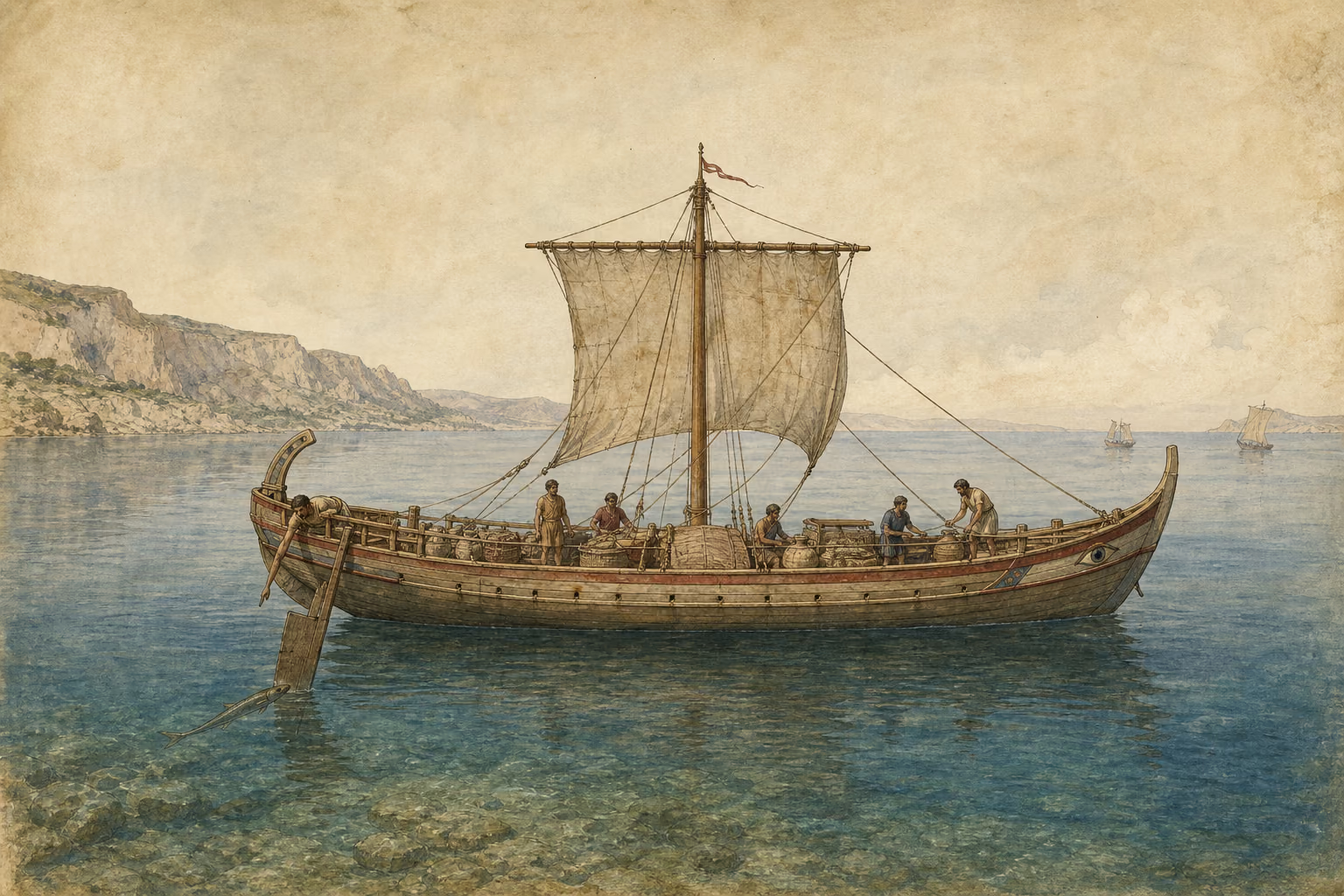
tamen omnia haec pariterque eodem inpellentia unus ac parvus admodum pisciculus, echenais appellatus, in se tenes. ruant venti licet, saeviant procellae: imperat furori viresque tantas compescit et cogit stare navigia, quod non vincula ulla, non ancorae pondere inrevocabili iactae. infrenat impetus et domat mundi rabiem nullo suo labore, non renitendo aut alio modo quam adhaerendo. hoc tantulo satis est, contra tot impetus ut vetet ire navigia. sed armatae classes inponunt sibi turrium propugnacula, ut in mari quoque pugnetur velut e muris. heu vanitas humana, cum rostra illa aere ferroque ad ictus armata semipedalis inhibere possit ac tenere devincta pisciculus! fertur Actiaco Marte tenuisse praetoriam navem Antoni properantis circumire et exhortari suos, donec transiret in aliam, ideoque Caesariana classis impetus maiore protinus venit. tenuit et nostra memoria Gai principis ab Astura Antium renavigantis—ut res est, etiam auspicalis pisciculus, siquidem novissime tum in urbem reversus ille imperator suis telis confossus est—, nec longa fuit illius morae admiratio, statim causa intellecta, cum e tota classe quinqueremis sola non proficeret, exilientibus protinus qui quaererent circa navem. invenere adhaerentem gubernaculo ostenderuntque Gaio indignanti hoc fuisse, quod se revocaret quadringentorumque remigum obsequio contra se intercederet. constabat peculiariter miratum, quomodo adhaerens tenuisset nec idem polleret in navigium receptus. qui tune posteaque videre eum, limaci magnae similem esse dicunt. nos plurium opiniones posuimus in natura aquatilium, cum de eo diceremus, nec dubitamus idem valere omnia ea genera, cum celebri et consecrato etiam exemplo apud Cnidiam Venerem conchas quoque esse eiusdem potentiae credi necesse sit. e nostris quidam Latine moram appellavere eum, mirumque, e Graecis alii lubricos partus atque pro cidentes continere ad maturitatem adalligatum, ut diximus prodiderunt, alii sale adservatum adalligatumque gravidis partus solvere, ob id alio nomine odinolyten appellari quocumque modo ista se habent, quis ab hoc tenend navigia exemplo de ulla potentia naturae vique et effectu in remediis sponte nascentium rerum dubitet?
Quid? non et sine hoc exemplo per se satis esset ex eodem maria torpedo? etiam procul et e longinquo, vel si hasta virgave attingatur, quamvis praevalidos lacertos torpescere, quamlibet ad cursum veloces alligari pedes? quod si necesse habemus fateri hoc exemplo esse vim aliquam, quae odore tantum et quadam aura corporis sui adficiat membra, quid non de remediorum omnium momentis sperandum est?
Non sunt minus mira quae de lepore marino traduntur. venenum est aliis in potu ant cibo datus, aliis etiam visu, siquidem gravidae, si omnino adspexerint feminam ex eo genere dumtaxat, statim nausiant et redundatione stomachi vitium fatentur ac deinde abortum faciunt. remedio est mas ob id induratus sale, ut in bracchialibus habeant. eadem res in maria ne tactu quidem nocet. vescitur eo unum tantum animalium, ut non intereat, mullus piscis; tenerescit tantum et inertior viliorque fit. homines, quibus inpactus est, piscem olent; hoc primo argumento veneficium id deprehenditur. cetero moriuntur totidem in diebus, quot vixerit lepus, incertique temporis veneficium id esse auctor est Licinius Macer. in India adfirmant non capi viventem invicemque ibi hominem illi pro veneno esse ac vel digito omnino in mari tactum mori, esse autem multo ampliorem, sicuti reliqua animalia.
luba in iis voluminibus, quae scripsit ad C. Caesarem Aug. F. de Arabia, tradit mitulos ternas heminas capere, cetos sescentorum pedum longitudinis et trecentorum sexaginta latitudinis in flumen Arabiae intrasse, pinguique eius mercatores negotiatos, et omnium pi scium adipe camelos perungui in eo situ, ut asilos al iis fugent odore.
English · Bostock & Riley 1855–57
Following the proper order of things, we have now arrived at the culminating point of the wonders manifested to us by the operations of Nature. And even at the very outset, we find spontaneously presented to us an incomparable illustration of her mysterious powers: so much so, in fact, that beyond it we feel ourselves bound to forbear extending our enquiries, there being nothing to be found either equal or analogous to an element in which Nature quite triumphs over herself, and that, too, in such numberless ways. For what is there more unruly than the sea, with its winds, its tornadoes, and its tempests? And yet in what department of her works has Nature been more seconded by the ingenuity of man, than in this, by his inventions of sails and of oars? In addition to this, we are struck with the ineffable might displayed by the Ocean’s tides, as they constantly ebb and flow, and so regulate the currents of the sea as though they were the waters of one vast river.
And yet all these forces, though acting in unison, and impelling in the same direction, a single fish, and that of a very diminutive size—the fish known as the “echeneïs” —possesses the power of counteracting. Winds may blow and storms may rage, and yet the echeneïs controls their fury, restrains their mighty force, and bids ships stand still in their career; a result which no cables, no anchors, from their ponderousness quite incapable of being weighed, could ever have produced! A fish bridles the impetuous violence of the deep, and subdues the frantic rage of the universe—and all this by no effort of its own, no act of resistance on its part, no act at all, in fact, but that of adhering to the bark! Trifling as this object would appear, it suffices to counteract all these forces combined, and to forbid the ship to pass onward in its way! Fleets, armed for war, pile up towers and bulwarks on their decks, in order that, upon the deep even, men may fight from behind ramparts as it were. But alas for human vanity!—when their prows, beaked as they are with brass and with iron, and armed for the onset, can thus be arrested and rivetted to the spot by a little fish, no more than some half foot in length!
At the battle of Actium, it is said, a fish of this kind stopped the prætorian ship of Antonius in its course, at the moment that he was hastening from ship to ship to encourage and exhort his men, and so compelled him to leave it and go on board another. Hence it was, that the fleet of Cæsar gained the advantage in the onset, and charged with a redoubled impetuosity. In our own time, too, one of these fish arrested the ship of the Emperor Caius in its course, when he was returning from Astura to Antium: and thus, as the result proved, did an insignificant fish give presage of great events; for no sooner had the emperor returned to Rome than he was pierced by the weapons of his own soldiers. Nor did this sudden stoppage of the ship long remain a mystery, the cause being perceived upon finding that, out of the whole fleet, the emperor’s five-banked galley was the only one that was making no way. The moment this was discovered, some of the sailors plunged into the sea, and, on making search about the ship’s sides, they found an echeneïs adhering to the rudder. Upon its being shown to the emperor, he strongly expressed his indignation that such an obstacle as this should have impeded his progress, and have rendered powerless the hearty endeavours of some four hundred men. One thing, too, it is well known, more particularly surprised him, how it was possible that the fish, while adhering to the ship, should arrest its progress, and yet should have no such power when brought on board.
According to the persons who examined it on that occasion, and who have seen it since, the echeneïs bears a strong resemblance to a large slug. The various opinions entertained respecting it we have already noticed, when speaking of it in the Natural History of Fishes. There is no doubt, too, that all fish of this kind are possessed of a similar power; witness, for example, the well-known instance of the shells which are still preserved and consecrated in the Temple of Venus at Cnidos, and which, we are bound to believe, once gave such striking evidence of the possession of similar properties. Some of our own authors have given this fish the Latin name of “mora.” It is a singular thing, but among the Greeks we find writers who state that, worn as an amulet, the echeneïs has the property, as already mentioned, of preventing miscarriage, and of reducing procidence of the uterus, and so permitting the fœtus to reach maturity: while others, again, assert that, if it is preserved in salt and worn as an amulet, it will facilitate parturition; a fact to which it is indebted for another name which it bears, “odinolytes.” Be all this as it may, considering this most remarkable fact of a ship being thus stopped in its course, who can entertain a doubt as to the possibility of any manifestation of her power by Nature, or as to the effectual operation of the remedies which she has centred in her spontaneous productions?
And then, besides, even if we had not this illustration by the agency of the echeneïs, would it not have been quite sufficient only to cite the instance of the torpedo, another inhabitant also of the sea, as a manifestation of the mighty powers of Nature? From a considerable distance even, and if only touched with the end of a spear or staff, this fish has the property of benumbing even the most vigorous arm, and of rivetting the feet of the runner, however swift he may be in the race. If, upon considering this fresh illustration, we find ourselves compelled to admit that there is in existence a certain power which, by the very exhalations and, as it were, emanations therefrom, is enabled to affect the members of the human body, what are we not to hope for from the remedial influences which Nature has centred in all animated beings?
No less wonderful, too, are the particulars which we find stated relative to the sea-hare. Taken with the food or drink, it is a poison to some persons; while to others, again, the very sight of it is venomous. Indeed, if a woman in a state of pregnancy so much as looks upon one of these fishes, she is immediately seized with nausea and vomiting—a proof that the injury has reached the stomach—and abortion is the ultimate result. The proper preservative against these baneful effects is the male fish, which is kept dried for the purpose in salt, and worn in a bracelet upon the arm. And yet this same fish, while in the sea, is not injurious, by its contact even. The only animal that eats it without fatal consequences, is the mullet; the sole perceptible result being that its flesh is rendered more tender thereby, but deteriorated in flavour, and consequently not so highly esteemed.
Persons when poisoned by the sea-hare smell strongly of the fish—the first sign, indeed, by which the fact of their having been so poisoned is detected. Death also ensues at the end of as many days as the fish has lived: hence it is that, as Licinius Macer informs us, this is one of those poisons which have no definite time for their operation. In India, we are assured, the sea-hare is never taken alive; and, we are told that, in those parts of the world, man, in his turn, acts as a poison upon the fish, which dies instantly in the sea, if it is only touched with the human finger. There, like the rest of the animals, it attains a much larger size than it does with us.
Juba, in those books descriptive of Arabia, which he has dedicated to Caius Cæsar, the son of Augustus, informs us that there are mussels on those coasts, the shells of which are capable of holding three semisextarii; and that, on one occasion, a whale, six hundred feet in length and three hundred and sixty feet broad, made its way up a river of Arabia, the blubber of which was bought up by the merchants there. He tells us, too, that in those parts they anoint their camels with the grease of all kinds of fish, for the purpose of keeping off the gad-flies by the smell.