LIBER XXXII · CAPUT 2
THE INSTINCTS OF FISHES
Latine · Mayhoff 1906
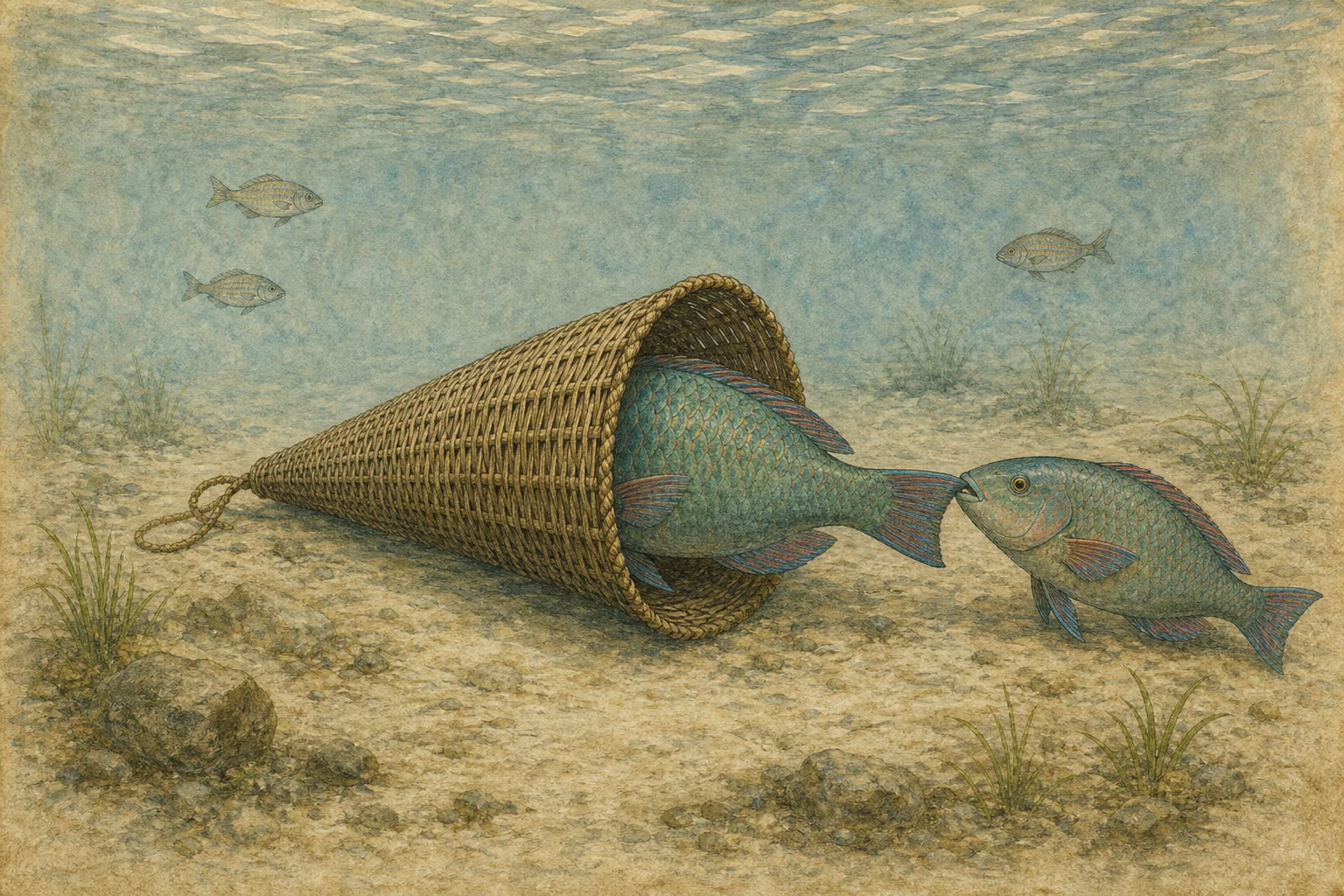
Mihi videntur mira et quae Ovidius prodidit piscium ingenia in eo volumine, quod halieuticon inscribitur: scarum inclusum nassis non fronte erumpere nec infestis viminibus caput inserere, sed aversum caudae ictibus crebris laxare fores atque ita retrorsum repere, quem luctatum eius si forte alius scarus extrinsecus videat, adprehensa mordicus cauda adiuvare nisus erumpentis; lupum rete circumdatum harenas arare cauda atque ita condi, dum transeat rete; murenam maculas adpetere ipsas consciam teretis ac lubrici tergi, tum multiplici flexu laxare, donec evadat; polypum hamos adpetere bracchiisque complecti, non morsu, nec prius dimittere, quam escam circumroserit, aut harundine levatum extra aquam, scit et mugil esse in esca hamum insidiasque non ignorat, aviditas tamen tanta est, ut cauda verberando excutiat cibum. minus in providendo lupus sollertiae habet, sed magnum robur in paenitendo. nam is, ut haesit in hamo; tumultuoso discursu laxat volnera, donee excidant insidiae. murenae amplius devorant quam hamum, admovent dentibus lineas atque ita erodunt. anthias tradit idem infixo hamo invertere se, quoniam sit in dorso cultellata spina, eaque liniam praesecare.
Licinius Macer murenas feminini tantum sexus esse tradit et concipere e serpentibus, ut diximus—ob id sibilo a piscatoribus tamquam a serpentibus evocari et capi—et pinguescere, iactato fusti non interemi, easdem ferula protinus. animnam in cauda habere certum est eaque icta celerrime exanimari, ad capitis ictum difficulter. novacula pisce qui attacti sunt, ferrum olent. durissimum esse piscium constat qui orbis vocetur; rotundus est, sine squamis totusque capite constat.—(Lolligo quotiens cernatur extra aqnam volitans, tempestates nuntiari).— Trebius Niger xiphian, id est gladium, rostro mucronato esse, ab hoc naves perfossas mergi; in oceano ad locum Mauretaniae, qui Cottae vocetur, non procu Lixo flumine idem lolligines evolare ex aqua tradit tanta multitudine, ut navigia demergant.
E manu vescuntur pisces in pluribus quidem Caesaris villis, sed—quae veteres prodidere in stagnis non piscinis, admirati—in Heloro Siciliae castello non procul Syracusis, item in Labrayndi Iovis fonte anguillae et inaures additas gerunt, similiter in Chio iuxta Senum delubrum, in Mesopotamiae quoque fonte Chabura, de quo diximus, pisces. nam in Lycia Myris in fonte Apollinis, quem Curium appellant, ter fistula vocati veniunt ad augurium. diripere eos carnes abiectas laetum est consultantibus, caudis abigere dirum. Hieropoli Syriae in lacu Veneris aedituorum vocibus parent, vocati veniunt exornati auro, adulantes scalpuntur, ora hiantia manibus inserendis praebent. in Stabiano Campaniae ad Herculis petram melanuri in mari panem abiectum rapiunt, iidem ad nullum cibum, in, quo hamus sit, accedunt.
Nec illa in novissimis mira, amaros esse pisces ad Pelen insulam et ad Clazomenas, contra scopulum Siciliae ac Leptim Africae et Euboeam et Durrachium, rursus ita salsos, ut possint salsamenta existumari, circa Cephallaniam et Ampelon, Paron et Deli petras, in portu eiusdem insulae dulces. quam differentiam pabulo constare non est dubium. Apion piscium maxime mirum esse tradit porcum, quem Lacedaemoni orthagoriscum vocent; grunnire eum, cum capiatur. esse vero illam naturae accedentiam—quod magis miremur—etiam in locis quibusdam, adposito occurret exemplo, siquidem salsamenta omnium generum in Italia Beneventi refici constat.
Pisces marinos in usu fuisse protinus a condita Roma auctor est Cassius Hemina, cuius verba de ea re subiciam: Numa constituit ut pisces, qui squamosi non essent, ni pollucerent, parsimonia commentus, ut convivia publica et privata cenaeque ad pulvinaria facilius compararentur, ni qui ad polluctum emerent pretio minus parcerent eaque praem ercarentur.
Quantum apud nos Indicis margaritis pretium est, de quis suo loco satis diximus, tantum apud Indos curalio; namque ista persuasione gentium constant. gignitur et in Rubro quidem mari, sed nigrius, item in Persico —vocatur lace—laudatissimum in Gallico sinu circa Stoechadas insulas et in Siculo circa Aeolias ae Drepana. nascitur et apud Graviscas et ante Neapolinu Campaniae maximeque rubens, sed molle et ideo vilissi mum Erythris. forma est ei fruticis, colos viridis. bacae eius candidae sub aqua ac molles, exemptae confestin durantur et rubescunt qua corna sativa specie atque magnitudine. aiunt tactu protinus lapidescere, si vivat itaque occupari evellique retibus aut acri ferramento praecidi, qua de causa curalium vocitatum interpretantur probatissimum quam maxime rubens et quam ramosissi mum nec scabiosum aut lapideum aut rursus inane e concavum. auctoritas bacarum eius non minus Indorum viris quoque pretiosa est quam feminis nostris uniones Indici. harispices eorum vatesque inprimis religiosum io gestamen amoliendis periculis arbitrantur. ita et decore et religione gaudent. prius quam hoc notesceret, Gall gladios, scuta, galeas adornabant eo. nunc tanta paenuria est vendibili merce, ut perquam raro cernatur in suo orbe. surculi infantiae adalligati tutelam habere creduntur contraque torminum ac vesicae et calculorum mala in pulverem igni redacti potique cum aqua auxiliantur, simili modo ex vino poti aut, si febris sit, ex aqua somnum adferunt—ignibus diu repugnat—, sed eodem medicamine saepius poto tradunt lienem quoque absumi. sanguinem reicientibus excreantibusve medetur cinis eorum; miscetur oculorum medicamentis, spissat enim ac refrigerat, ulcerum cava explet, cicatrices extenuat.
Quod ad repugnantiam rerum attinet, quam Graeci antipathian vocant, nihil est usquam venenatius quam in mari pastinaca, utpote cum radio eius arbores necari dixerimus. bane tamen persequitur galeos, idem et alios quidem pisces, sed pastinacas praecipue, sicut in terra mustela serpentes—tanta est aviditas ipsius veneni—percussis vero ab ea medentur et hic quidem, sed et mullus ac laser,
English · Bostock & Riley 1855–57
The statements which Ovid has made as to the instincts of fish, in the work of his known as the “Halieuticon,” appear to me truly marvellous. The scarus, for instance, when enclosed in the wicker kype, makes no effort to escape with its head, nor does it attempt to thrust its muzzle between the oziers; but turning its tail towards them, it enlarges the orifices with repeated blows therefrom, and so makes its escape backwards. Should, too, another scarus, from without, chance to see it thus struggling within the kype, it will take the tail of the other in its mouth, and so aid it in its efforts to escape. The lupus, again, when surrounded with the net, furrows the sand with its tail, and so conceals itself, until the net has passed over it. The muræna, trusting in the slippery smoothness of its rounded back, boldly faces the meshes of the net, and by repeatedly wriggling its body, makes its escape. The polyp makes for the hooks, and, without swallowing the bait, clasps it with its feelers; nor does it quit its hold until it has eaten off the bait, or perceives itself being drawn out of the water by the rod.
The mullet, too, is aware that within the bait there is a hook concealed, and is on its guard against the ambush; still however, so great is its voracity, that it beats the hook with its tail, and strikes away from it the bait. The lupus, again, shows less foresight and address, but repentance at its imprudence arms it with mighty strength; for, when caught by the hook, it flounders from side to side, and so widens the wound, till at last the insidious hook falls from its mouth. The muræna not only swallows the hook, but catches at the line with its teeth, and so gnaws it asunder. The anthias, Ovid says, the moment it finds itself caught by the hook, turns its body with its back downwards, upon which there is a sharp knife-like fin, and so cuts the line asunder.
According to Licinius Macer, the muræna is of the female sex only, and is impregnated by serpents, as already mentioned; and hence it is that the fishermen, to entice it from its retreat, and catch it, make a hissing noise in imitation of the hissing of a serpent. He states, also, that by frequently beating the water it is made to grow fat, that a blow with a stout stick will not kill it, but that a touch with a stalk of fennel-giant is instantly fatal. That in the case of this animal, the life is centred in the tail, there can be no doubt, as also that it dies immediately on that part of the body being struck; while, on the other hand, there is considerable difficulty in killing it with a blow upon the head. Persons who have come in contact with the razor-fish smell of iron. The hardest of all fishes, beyond a doubt, is that known as the “orbis:” it is spherical, destitute of scales, and all head.
Trebius Niger informs us that whenever the loligo is seen darting above the surface of the water, it portends a change of weather: that the xiphias, or, in other words, the swordfish, has a sharp-pointed muzzle, with which it is able to pierce the sides of a ship and send it to the bottom: instances of which have been known near a place in Mauritania, known as Cotte, not far from the river Lixus. He says, too, that the loligo sometimes darts above the surface, in such vast numbers, as to sink the ships upon which they fall.
At many of the country-seats belonging to the Emperor the fish eat from the hand: but the stories of this nature, told with such admiration by the ancients, bear reference to lakes formed by Nature, and not to fish-preserves; that at Elorus, a fortified place in Sicily, for instance, not far from Syracuse. In the fountain, too, of Jupiter, at Labranda, there are eels which eat from the hand, and wear ear-rings, it is said. The same, too, at Chios, near the Old Men’s Temple there; and at the Fountain of Chabura in Mesopotamia, already mentioned.
At Myra, too, in Lycia, the fish in the Fountain of Apollo, known as Surium, appear and give oracular presages, when thrice summoned by the sound of a flute. If they seize the flesh thrown to them with avidity, it is a good omen for the person who consults them; but if, on the other hand, they flap at it with their tails, it is considered an evil presage. At Hierapolis in Syria, the fish in the Lake of Venus there obey the voice of the officers of the temple: bedecked with ornaments of gold, they come at their call, fawn upon them while they are scratched, and open their mouths so wide as to admit of the insertion of the hands.
Off the Rock of Hercules, in the territory of Stabiæ in Campania, the melanuri seize with avidity bread that is thrown to them in the sea, but they will never approach any bait in which there is a hook concealed.
Nor is it by any means the least surprising fact, that off the island of Pele, the town of Clazomenæ, the rock [of Scylla] in Sicily, and in the vicinity of Leptis in Africa, Eubœa, and Dyrrhachium, the fish are bitter. In the neighbourhood of Cephallenia, Ampelos, Paros, and the rocks of Delos, the fish are so salt by nature that they might easily be taken to have been pickled in brine. In the harbour, again, of the last-mentioned island, the fish are sweet: differences, all of them, resulting, no doubt, from the diversity of their food.
Apion says that the largest among the fishes is the sea-pig, known to the Lacedæmonians as the “orthagoriscos;” he states also that it grunts like a hog when taken. These accidental varieties in the natural flavour of fish—a thing that is still more surprising—may, in some cases, be owing to the nature of the locality; an apposite illustration of which is, the well-known fact that, at Beneventum in Italy, salted provisions of all kinds require to be salted over again.
Cassius Hemina informs us that sea-fish have been in use at Rome from the time of its foundation. I will give his own words, however, upon the subject:—“Numa ordained that fish without scales should not be served up at the Festivals of the Gods; a piece of frugality, the intention of which was, that the banquets, both public and private, as well as the repasts laid before the couches of the gods, might be provided at a smaller expense than formerly: it being also his wish to preclude the risk that the caterers for the sacred banquets would spare no expense in buying provisions, and so forestall the market.”
In the same degree that people in our part of the world set a value upon the pearls of India—a subject on which we have already spoken on the appropriate occasion at sufficient length—do the people of India prize coral: it being the prevailing taste in each nation respectively that constitutes the value of things. Coral is produced in the Red Sea also, but of a more swarthy hue than ours. It is to be found also in the Persian Gulf, where it is known by the name of “iace.” But the most highly-esteemed of all, is that produced in the vicinity of the islands called Stœchades, in the Gallic Gulf, and near the Æolian Islands and the town of Drepana in the Sea of Sicily. Coral is to be found growing, too, at Graviscæ, and off the coast of Neapolis in Campania: as also at Erythræ, where it is intensely red, but soft, and consequently little valued.
Its form is that of a shrub, and its colour green: its berries are white and soft while under water, but the moment they are removed from it, they become hard and red, resembling the berries of cultivated cornel in size and appearance. They say that, while alive, if it is only touched by a person, it will immediately become as hard as stone; and hence it is that the greatest pains are taken to prevent this, by tearing it up from the bottom with nets, or else cutting it short with a sharp-edged instrument of iron: from which last circumstance it is generally supposed to have received its name of “curalium.” The reddest coral and the most branchy is held in the highest esteem; but, at the same time, it must not be rough or hard like stone; nor yet, on the other hand, should it be full of holes or hollow.
The berries of coral are no less esteemed by the men in India than are the pearls of that country by the females among us: their soothsayers, too, and diviners look upon coral as an amulet endowed with sacred properties, and a sure preservative against all dangers: hence it is that they equally value it as an ornament and as an object of devotion. Before it was known in what estimation coral was held by the people of India, the Gauls were in the habit of adorning their swords, shields, and helmets with it; but at the present day, owing to the value set upon it as an article of exportation, it has become so extremely rare, that it is seldom to be seen even in the regions that produce it. Branches of coral, hung at the neck of infants, are thought to act as a preservative against danger. Calcined, pulverized, and taken in water, coral gives relief to patients suffering from griping pains in the bowels, affections of the bladder, and urinary calculi. Similarly taken in wine, or, if there are symptoms of fever, in water, it acts as a soporific. It resists the action of fire a considerable time before it is calcined.
There is also a statement made that if this medicament is frequently taken internally, the spleen will be gradually consumed. Powdered coral, too, is on excellent remedy for patients who bring up or spit blood. Calcined coral is used as an ingredient in compositions for the eyes, being productive of certain astringent and cooling effects: it makes flesh, also, in the cavities left by ulcers, and effaces scars upon the skin.
In reference to that repugnance which exists between certain things, known to the Greeks as “antipathia,” there is nothing more venomous than the pastinaca, a sea-fish which kills trees even with its sting, as already stated. And yet, poisonous as it is, the galeos pursues it; a fish which, though it attacks other marine animals as well, manifests an enmity to the pastinaca in particular, just as on dry land the weasel does to serpents; with such avidity does it go in pursuit of what is poisonous even! Persons stung by the pustinaca find a remedy in the flesh of the galeos, as also in that of the sur-mullet and the vegetable production known as laser.