LIBER XXXII · CAPUT 4
THE TORTOISE: SIXTY-SIX REMEDIES AND OBSERVATIONS
Latine · Mayhoff 1906
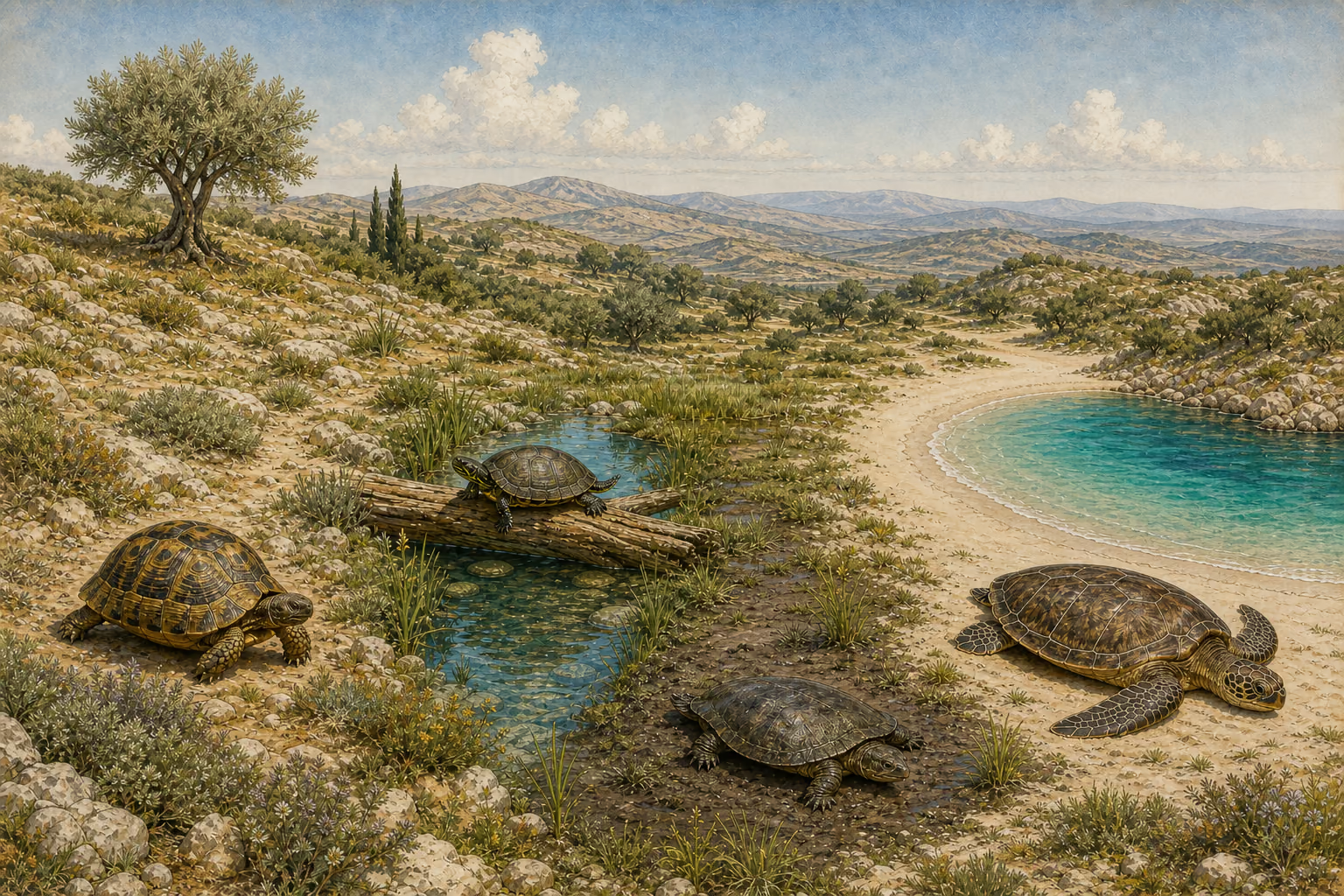
Geminus similiter victus in aquis terraque et testudinum effectusque par, honore habendo vel proptes excellens in usu pretium figuraeque proprietatem. sunt ergo testudinum genera terrestres, marinae, lutariae et quae in dulci aqua vivunt. has quidam e Graecis emydas appellant.
Terrestrium carnes suffitionibus propriae magicisque artibus refutandis et contra venena salutares produntum plurimae in Africa. hae ibi amputato capite pedibusque pro antidoto dari dicuntur et e iure in cibo sumptae stru mas discutere, lienes tollere, item comitiales morbos sanguis earum claritatem visus facit, discutit suffusiones oculorum. et contra serpentium omnium et araneorum ac simlilium et ranarum venena auxiliatur servato san guine in farina pilulis factis et, cum opus sit, in vino datis. felle testudinum cum Attico melle glaucomata in ungui prodest. scorpionum plagae instillant. tegiment cinis vino et oleo subactus pedum rimas ulceraque sanat squamae e summa parte derasae et in potu datae vene rem cohibent. eo magis hoc mirum, quoniam totius tegimenti farina accendere traditur libidinem. urinam aliter earum quam in vesica dissectarum inveniri posse non arbitror et inter ea esse hoc quoque, quae portentose Magi demonstrant, adversus aspidum ictus singularem, efficaciorem tamen, ut aiunt, cimicibus admixtis. ova durata inlinuntur strumis et ulceribus frigore aut adustione factis. sorbentur in stomachi doloribus.
Marinarum carnes admixtae ranarum carnibus contra salamandras praeclare auxiliantur, neque est testudine aliud salamandrae adversius. sanguine alopeciarum inanitas et porrigo omniaque capitis ulcera curantur; inarescere eum oportet lenteque ablui. instillatur et dolori aurium cum lacte mulierum. adversus morbos comitiales manditur cum polline frumenti, miscetur autem sanguinis heminis III aceti hemina. datur et suspiriosis, sed tum hemina vini additur; his et cum hordeacea farina, aceto quoque admixto, ut sit quod devoretur fabae magnitudine; et haec singula et matutina et vespera dantur, dein post aliquot dies bina vespera. comitialibus instillatur ore diducto; iis, qui modice corripiantur spasmo, cum castoreo clystere infunditur. quod si dentes ter annis colluantus testudinum sanguine, immunes a dolore fiant. et anheli tus discutit quasque orthopnoeas vocant; ad has in po lenta datur. fel testudinum claritatem oculorum facit cicatrices extenuat, tonsillas sedat et anginas et omnia oris vitia, privatim nomas ibi, item testium. naribus in litum comitiales erigit attollitque. idem cum vernatione anguium aceto admixto unice purulentis auribus prodest quidam bubulum fel admiscent decoctarum carnium testudinis suco, addita aeque vernatione anguium; sed vino testudinem excocunt. oculorum utique vitia omnia fel inunctum cum melle emendat, suffusiones etiam marinae fel cum fluviatilis sanguine et lacte. capillus mulierum inficitur felle. contra salamandras vel sucum decoctae bibisse satis est.
Tertium genus testudinum est in caeno et paludibus viventium. latitudo his et in dorso pectori similis nec convexo curvata calice, ingrata visu. ex hac quoque tamen aliqua contingunt auxilia. tres namque in succensa sarmenta coiectae dividentibus se tegumentis rapiuntur, tum evolsae carnes earum cocuntur in congio aquae sale modice addito; ita decoctarum ad tertias partes sucus paralysim et articularios morbos sentientibus bibitur. detrahit idem fel pituitas sanguinemque vitiatum. sistitur ab eo remedio alvus aquae frigidae potu.
E quarto genere testudinum, quae sunt in amnibus, divolsarum pinguia cum aizoo herba tunsa admixto unguento et semine lili, si ante accessiones perunguantur aegri praeter caput, mox convoluti calidam aquam bibant, quartanis liberare dicuntur. hanc testudinem XV luna capi oportere, ut plus pinguium reperiatur, verum aegrum XVI luna perungui. ex eodem genere testudinum sanguis instillatus cerebro capitis dolores sedat, item strumas. sunt qui testudinum sanguinem cultro aereo supinarum capitibus praecisis excipi novo fictili iubeant, ignem sacrum cuiuscumque generis sanguine inlini, item capitis ulcera manantia, verrucas. iidem promittunt testudinum omnium fimo panos discuti; et, quod incredibile dictu sit, aliqui tradunt tardius ire navigia testudinis pedem dextrum vehentia.
Hinc deinde in morbos digeremus aquatilia, non quia ignoremus gratiorem esse universitatem animalium maiorisque miraculi, sed hoc utilius est vitae, contributa habere remedia, cum aliud alii prosit, aliud alibi facilius inveniatur.
English · Bostock & Riley 1855–57
The tortoise, too, is an animal that is equally amphibious with the beaver, and possessed of medicinal properties as strongly developed; in addition to which, it claims an equal degree of notice for the high price which luxury sets upon its shell, and the singularity of its conformation. Of tortoises, there are various kinds, land tortoises, sea tortoises, tortoises which live in muddy waters, and tortoises which live in fresh; these last being known to some Greek authors by the name of “emydes.” The flesh of the land-tortoise is employed for fumigations more particularly, and we find it asserted that it is highly salutary for repelling the malpractices of magic, and for neutralizing poisons. These tortoises are found in the greatest numbers in Africa; where the head and feet being first cut off, it is said, they are given to persons by way of antidote. Eaten, too, in a broth made from them, they are thought to disperse scrofula, diminish the volume of the spleen, and effect the cure of epilepsy. The blood of the land-tortoise improves the eyesight, and removes cataract: it is kept also, made up with meal into pills, which are given with wine when necessary, to neutralize the poison of all kinds of serpents, frogs, spiders, and similar venomous animals. It is found a useful plan, too, in cases of glaucoma, to anoint the eyes with gall of tortoises, mixed with Attic honey, and, for the cure of injuries inflicted by scorpions, to drop the gall into the wound.
Ashes of tortoiseshell, kneaded up with wine and oil, are used for the cure of chaps upon the feet, and of ulcerations. The shavings of the surface of the shell, administered in drink, act as an antaphrodisiac: a thing that is the more surprising, from the fact that a powder prepared from the whole of the shell has the reputation of being a strong aphrodisiac. As to the urine of the land-tortoise, I do not think that it can be obtained otherwise than by opening it and taking out the bladder; this being one of those substances to which the adepts in magic attribute such marvellous properties. For the sting of the asp, they say, it is wonderfully effectual; and even more so, if bugs are mixed with it. The eggs of the tortoise, hardened by keeping, are applied to scrofulous sores and ulcers arising from burns or cold: they are taken also for pains in the stomach.
The flesh of the sea-tortoise, mixed with that of frogs, is an excellent remedy for injuries caused by the salamander; indeed there is nothing that is a better neutralizer of the secretions of the salamander than the sea-tortoise. The blood of this animal reproduces the hair when lost through alopecy, and is curative of porrigo and all kinds of ulcerations of the head; the proper method of using it being to let it dry, and then gently wash it off. For the cure of ear-ache, this blood is injected with woman’s milk, and for epilepsy it is eaten with fine wheaten flour, three heminæ of the blood being mixed with one hemina of vinegar. It is prescribed also for the cure of asthma; but in this case in combination with one hemina of wine. Sometimes, too, it is taken by asthmatic patients, with barley-meal and vinegar, in pieces about the size of a bean; one of these pieces being taken each morning and evening at first, but after some days, two in the evening. In cases of epilepsy, the mouth of the patient is opened and this blood introduced. For spasmodic affections, when not of a violent nature, it is injected, in combination with castoreum, as a clyster. If a person rinses his teeth three times a year with blood of tortoises, he will be always exempt from tooth-ache. This blood is also a cure for asthmatic affections, and for the malady called “orthopnœa,” being administered for these purposes in polenta.
The gall of the tortoise improves the eye-sight, effaces scars, and cures affections of the tonsillary glands, quinsy, and all kinds of diseases of the mouth, cancers of that part more particularly, as well as cancer of the testes. Applied to the nostrils it dispels epilepsy, and sets the patient on his feet: incorporated in vinegar with the slough of a snake, it is a sovereign remedy for purulent discharges from the ears. Some persons add ox-gall and the broth of boiled tortoise-flesh, with an equal proportion of snake’s slough; but in such case, care must be taken to boil the tortoise in wine. Applied with honey, this gall is curative of all diseases of the eyes; and for the cure of cataract, gall of the sea-tortoise is used, in combination with blood of the river-tortoise and milk. The hair, too, of females, is dyed with this gall. For the cure of injuries inflicted by the salamander, it will be quite sufficient to drink the broth of boiled tortoise-flesh.
There is, again, a third kind of tortoise, which inhabits mud and swampy localities: the shell on its back is flat and broad, like that upon the breast, and the callipash is not arched and rounded, the creature being altogether of a repulsive appearance. However, there are some remedial medicaments to be derived even from this animal. Thus, for instance, three of them are thrown into a fire made with wood cuttings, and the moment their shells begin to separate they are taken off: the flesh is then removed, and boiled with a little salt, in one congius of water. When the water has boiled down to one third, the broth is used, being taken by persons apprehensive of paralysis or of diseases of the joints. The gall, too, is found very useful for carrying off pituitous humours and corrupt blood: taken in cold water, it has an astringent effect upon the bowels.
There is a fourth kind of tortoise, which frequents rivers. When used for its remedial properties, the shell of the animal is removed, and the fat separated from the flesh and beaten up with the plant aizoüm, in combination with unguent and lily seed: a preparation highly effectual, it is said, for the cure of quartan fevers, the patient being rubbed with it all over, the head excepted, just before the paroxysms come on, and then well wrapped up and made to drink hot water. It is stated also, that to obtain as much fat as possible, the tortoise should be taken on the fifteenth day of the moon, the patient being anointed on the sixteenth. The blood of this tortoise, dropt, by way of embrocation, upon the region of the brain, allays head-ache; it is curative also of scrofulous sores. Some persons recommend that the tortoise should be laid upon its back and its head cut off with a copper knife, the blood being received in a new earthen vessel; and they assure us that the blood of any kind of tortoise, when thus obtained, will be an excellent liniment for the cure of erysipelas, running ulcers upon the head, and warts. Upon the same authority, too, we are assured that the dung of any kind of tortoise is good for the removal of inflammatory tumours. Incredible also as the statement is, we find it asserted by some, that ships make way more slowly when they have the right foot of a tortoise on board.
We will now proceed to classify the various remedies derived from the aquatic animals, according to the several diseases; not that we are by any means unaware that an exposition of all the properties of each animal at once, would be more to the reader’s taste, and more likely to excite his admiration; but because we consider it more conducive to the practical benefit of mankind to have the various recipes thus grouped and classified; seeing that this thing may be good for one patient, that for another, and that some of these remedies may be more easily met with in one place and some in another.