LIBER XXXII · CAPUT 5
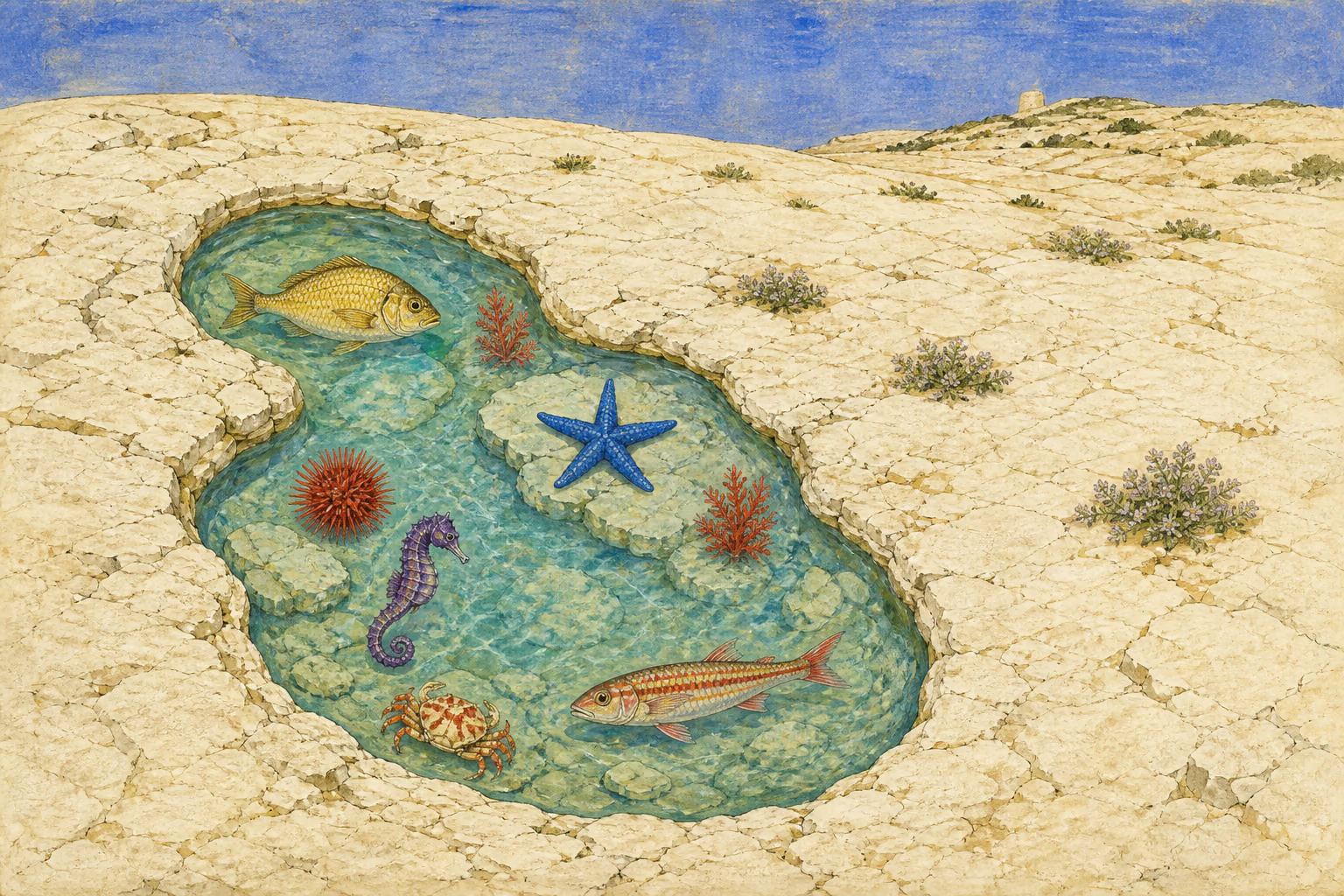
REMEDIES FOR POISONS, AND FOR NOXIOUS SPELLS. THE DORADE: FOUR REMEDIES. THE SEA-STAR: SEVEN REMEDIES
Latine · Mayhoff 1906
Venenatum mel diximus ubi nasceretur. auxilio est piscis aurata in cibo. vel si ex melle sincero fastidium cruditasve, quae fit gravissima, incidat testudinem circumcisis pedibus, capite, cauda decoctam antidotum esse auctor est Pelops, scincum Apelles, quid esset scincus diximus, saepius vero quantum vene ficii in menstruis mulierum. contra ea omnia auxiliatur, ut diximus, mullus, item contra pastinacam et scor piones terrestres marinosque et dracones, phalangia in litus sumptusve in cibo, eiusdem recentis e capite cinis contra omnia venena, privatim contra fungos. mala medio camenta inferri negant posse aut certe nocere stella marina volpino sanguine inlita et adfixa limini superiori aut clavo aereo ianuae. draconis marini scorpionumque ictus carnibus earum inpositis, item araneorum morsus sanan tur. in summa contra omnia venena vel potu vel ictu ve morsu noxia sucus earum e iure decoctarum efficacissi mus habetur.
Sunt et servatis piscibus medicinae, salsamentorumque cibus prodest a serpente percussis et contra bestiarum ictus mero subinde hausto ita, ut per satiem cibus vomitione reddatur, peculiariter a chalcide, ceraste aut quas sepas vocant aut elope, dipsade percussis. contra scorpionem largius sumi, sed non evomi, salsamenta prodest ita, ut sitis toleretur; et inponere plagis eadem convenit. contra crocodilorum quidem morsus non aliud praesentius habetur. privatim contra presteris morsum sarda prodest. inponuntur salsamenta et contra canis rabiosi; vel si non sint ferro ustae plagae corporaque clysteribus exinanita, hoc per se sufficit. et contra draconem marinum ex aceto inponuntur. idem et cybio effectus. draco quidem marinus ad spinae suae, qua ferit, venenum ipse inpositus vel cerebro poto prodest.
Ranarum marinarum ex vino et aceto decoctarum sucus contra venena bibitur, et contra ranae rubetae venenum et contra salamandras vel e fluviatilibus; si carnes edantur iusve decoctarum sorbeatur, prosunt et contra leporem marinum et contra serpentes supra dictos, contra scorpiones ex vino. Democritus quidem tradit, si quis extrahat ranae viventi linguam, nulla alia corporis parte adhaerente, ipsaque dimissa in aquam inponat supra cordis palpitationem mulieri dormienti, quaecumque interrogaverit, vera responsuram. addunt etiamnum alia Magi, quae si vera sint, multo utiliores vitae existumentur ranae quam leges; namque harundine transfixis a natura per os si surculus in menstruis defigatur a marito, adulterorum taedium fieri. carnibus earum vel in hamum additis praecipue purpuras adlici certum est. iocur ranae geminum esse dicunt abicique formicis oportere; eam partem, quam adpetant, contra venena omnia esse pro antidoto. sunt quae in vepribus tantum vivunt, ob id rubetarum nomine, ut diximus, quas Graeci φρύνους vocant, grandissimae cunctarum, geminis veluti cornibus, plenae veneficiorum. mira de iis certatim tradunt auctores: inlatis in populum silentium fieri; ossiculo, quod sit in dextro latere, in aquam ferventem deiecto refrigerari vas nec postea fervere nisi exempto, id inveniri abiecta rana formicis carnibusque erosis, singula in oleum addi; esse in sinistro latere quo deiecto fervere videatur, apocynon vocari, canum impetus eo cohiberi, amorem concitari et iurgia addito in potionem, venerem adalligato stimulari, rursus e dextro latere refrigerari ferventia; hoc et quartanas sanari adalligato in pellicula agnina recenti aliasque febris, amorem inhiberi. ex isdem his ranis lien contra venena, quae fiant ex ipsis, auxiliatur, iocur vero etiam efficacius.
Est colubra in aqua vivens. huius adipem et fel habentes qui crocodilos venentur mire adiuvari dicunt, nihil contra belua audente, efficacius etiamnum, si herba potamogiton misceatur.—Cancri fluviatiles triti potique ex aqua recentes seu cinere adservato contra venena omnia prosunt, privatim contra scorpionum ictus cum lacte asinino, si n sit, caprino aut quocumque; addi et vinum oportet. necant eos triti cum ocimo admoti. eadem vis contra venenatorum omnium morsus, privatim scytalen et angues et contra leporem marinum ac ranam rubetam. cinis eorum servatus prodest pavore potus periclitantibus ex canis rabiosi morsu. quidam adiciunt Gentianam et dant in vino, et si iam pavor occupaverit, pastillos vino subactos devorandos ita praecipiunt. decem vero cancris cum ocimi manipulo adligatis omnes, qui ibi sint, scorpiones ad eum locum coituros Magi dicunt, et cum ocimo ipsos cineremve eorum percussis inponunt. minus in omnibus his marini prosunt. Thrasyllus auctor est nihil aeque adversari serpentibus quam cancros; sues percussas hoc pabulo sibi mederi; cum sol sit in cancro, serpentes torqueri.—Ictibus scorpionum carnes et fluviatilium coclearum resistunt crudae vel coctae. quidam ob id salsas quoque adservant. inponunt et plagis ipsis.—Coracini pisces Nilo quidem peculiares sunt, sed nos haec omnibus terris demonstramus. carnes eorum adversus scorpiones valent inpositae.—Inter venena piscium sunt porci marini spinae in dorso, cruciatu magno laesorum. remedio est limus ex reliquiis piscium eorum corporis.
Canis rabidi morsibus potum expavescentibus faciem perungunt adipe vituli marini, efficacius, si medulla hyaenae et oleum e lentisco et cera misceantur. murenae morsus ipsarum capitis cinere sanantur. et pastinaca contra suum ictum remedio est cinere suo ex aceto inlito vel alterius. cibi causa extrahi debet ex dorso eius quidquid croco simile est caputque totum; et hanc autem et omnia testacea modice colluunt cibis, quia saporis gratia perit. e lepore marino veneficium restingunt poti hippocampi. contra dorycnium echini maxime prosunt, et iis, qui sucum carpathi biberint, praecipue e iure sumpti. et cancri marini decocti ius contra dorycnium efficax habetur, peculiariter vero contra leporis marini venena.
English · Bostock & Riley 1855–57
We have already stated in what country the honey is venomous: the fish known as the dorade is an antidote to its effects. Honey, even in a pure state, is sometimes productive of surfeit, and of fits of indigestion, remarkable for their severity; the best remedy in such case, according to Pelops, is to cut off the feet, head, and tail, of a tortoise, and boil and eat the body; in place, however, of the tortoise, Apelles mentions the scincus, an animal which has been described elsewhere. We have already mentioned too, on several occasions, how highly venomous is the menstruous fluid: the surmullet, as already stated, entirely neutralizes its effects. This last fish, too, either applied topically or taken as food, acts as an antidote to the venom of the pastinaca, the land and sea scorpion, the dragon, and the phalangium. The head of this fish, taken fresh and reduced to ashes, is an active neutralizer of all poisons, that of fungi more particularly.
It is asserted also, that if the fish called the sea-star is smeared with a fox’s blood, and then nailed to the upper lintel of the door, or to the door itself, with a copper nail, no noxious spells will be able to obtain admittance, or, at all events, to be productive of any ill effects.
Stings inflicted by the sea-dragon or by the sea-scorpion, are cured by an application of the flesh of those animals to the wound; the bites, too, of spiders are healed by the same means. In fine, as an antidote to every kind of poison, whether taken internally or acting through the agency of a sting or bite, there is considered to be nothing in existence more effectual than a decoction of the sea-dragon and sea-scorpion.
There are also certain remedies of this nature derived from preserved fish. Persons, for instance, who have received injuries from serpents, or have been bitten by other venomous animals, are recommended to eat salt fish, and to drink undiluted wine every now and then, so as, through its agency, to bring up the whole of the food again by vomit: this method being particularly good in cases where injuries have been received from the lizard called “chalcis,” the cerastes, the reptile known as the “seps,” the elops, or the dipsas. For the sting of the scorpion, salted fish should be taken in larger quantities, but not brought up again, the patient submitting to any amount of thirst it may create: salt fish, too, should be applied, by way of plaster, to the wound. For the bite of the crocodile there is no more efficient remedy known. For the sting of the serpent called “prester,” the sarda is particularly good. Salt fish is employed also as a topical application for the bite of the mad dog; and even in cases where the wound has not been cauterized with hot iron, this is found to be sufficiently effectual as a remedy. For injuries, also, inflicted by the sea-dragon, an application is made of salt fish steeped in vinegar. Cybium, too, is productive of similar effects. As a cure for the venomous sting inflicted with its stickle by the sea-dragon, the fish itself is applied topically to the wound, or else its brain, extracted whole.
The broth prepared from sea-frogs, boiled in wine and vinegar, is taken internally as a neutralizer of poisons and of the venom of the bramble-frog, as also for injuries inflicted by the salamander. For the cure of injuries caused by the sea-hare and the various serpents above mentioned, it is a good plan to eat the flesh of river-frogs, or to drink the liquor in which they have been boiled: as a neutralizer, too, of the venom of the scorpion, river-frogs are taken in wine. Democritus assures us that if the tongue is extracted from a live frog, with no other part of the body adhering to it, and is then applied—the frog being first replaced in the water—to a woman while asleep, just at the spot where the heart is felt to palpitate, she will be sure to give a truthful answer to any question that may be put to her.
To this the Magi add some other particulars, which, if there is any truth in them, would lead us to believe that frogs ought to be considered much more useful to society than laws. They say, for instance, that if a man takes a frog and transfixes it with a reed, entering the body at the sexual parts and coming out at the mouth, and then dips the reed in the menstrual discharge of his wife, she will be sure to conceive an aversion for all paramours. That the flesh of frogs, attached to the kype or hook, as the case may be, makes a most excellent bait, for purples more particularly, is a well-known fact. Frogs, they say, have a double liver; and of this liver, when exposed to the attacks of ants, the part that is most eaten away is thought to be an effectual antidote to every kind of poison.
There are some frogs, again, which live only among brakes and thickets, for which reason they have received the name of “rubetæ,” or “bramble-frogs,” as already stated. The Greeks call them “phryni:” they are the largest in size of all the frogs, have two protuberances like horns, and are full of poison. Authors quite vie with one another in relating marvellous stories about them; such, for instance, as that if they are brought into the midst of a concourse of people, silence will instantly prevail; as also that by throwing into boiling water a small bone that is found in their right side, the vessel will immediately cool, and the water refuse to boil again until it has been removed. This bone, they say, may be found by exposing a dead bramble-frog to ants, and letting them eat away the flesh: after which the bones must be put into the vessel, one by one.
On the other hand, again, in the left side of this reptile there is another bone, they say, which, thrown into water, has all the appearance of making it boil, and the name given to which is “apocynon.” This bone, it is said, has the property of assuaging the fury of dogs, and, if put into the drink, of conciliating love and ending discord and strife. Worn, too, as an amulet, it acts as an aphrodisiac, we are told. The bone, on the contrary, which is taken from the right side, acts powerfully as a refrigerative upon boiling liquids, it is said: attached to the patient in a piece of fresh lamb’s-skin, it has the repute of assuaging quartan and other fevers, and of checking amorous propensities. The spleen of these frogs is used as an antidote to the various poisons that are prepared from them; and for all these purposes the liver is considered still more efficacious.
There is also a snake which lives in the water, the fat and gall of which, carried about them by persons when in pursuit of the crocodile, are said to be marvellously efficacious, the beast not venturing, in such case, to make an attack upon them. As such preservative, they are still more effectual if mixed with the herbaceous plant known as potamogiton. River-crabs, taken fresh and beaten up and drunk in water, or the ashes of them, kept for the purpose, are useful in all cases of poisoning, as a counter-poison: taken with asses’ milk they are particularly serviceable as a neutralizer of the venom of the scorpion; goats’ milk or any other kind of milk being substituted where asses’ milk cannot be procured. Wine, too, should also be used in all such cases. River-crabs, beaten up with ocimum, and applied to scorpions, are fatal to them. They are possessed of similar virtues, also, for the bites of all other kinds of venomous animals, the scytale in particular, adders, the sea-hare, and the bramble-frog. The ashes of them, preserved, are good for persons who give symptoms of hydrophobia after being bitten by a mad dog, some adding gentian as well, and administering the mixture in wine. In cases, too, where hydrophobia has already appeared, it is recommended that these ashes should be kneaded up into boluses with wine, and swallowed. If ten of these crabs are tied together with a handful of ocimum, all the scorpions in the neighbourhood, the magicians say, will be attracted to the spot. They recommend, also, that to wounds inflicted by the scorpion, these crabs, or the ashes of them, should be applied, with ocimum. For all these purposes, however, sea-crabs, it should be remembered, are not so useful. Thrasyllus informs us that there is nothing so antagonistic to serpents as crabs; that swine, when stung by a serpent, cure themselves by eating them; and that, while the sun is in the sign of Cancer, serpents suffer the greatest tortures.
The flesh, too, of river-snails, eaten either raw or boiled, is an excellent antidote to the venom of the scorpion, some persons keeping them salted for the purpose. These snails are applied, also, topically to the wound.
The coracinus is a fish peculiar to the river Nilus, it is true, but the particulars we are here relating are for the benefit of all parts of the world: the flesh of it is most excellent as an application for the cure of wounds inflicted by scorpions. In the number of the poisonous fishes we ought to reckon the sea-pig, a fish which causes great suffering to those who have been pierced with the pointed fin upon its back: the proper remedy in such case is the slime taken from the other parts of the body of the fish.
In cases of hydrophobia resulting from the bite of the mad dog, the practice is to rub the patient’s face with the fat of the sea-calf; an application rendered still more efficacious by the admixture of hyæna’s marrow, oil of mastich, and wax. Bites inflicted by the muræna are cured by an application of the head of that fish, reduced to ashes. The pastinaca, also, is remedial for its own bite, the ashes of the same fish, or of another of the same genus, being applied to the wound with vinegar. When this fish is intended for food, every portion of the back that is of a saffron colour should be removed, as well as the whole of the head: care, too, should be taken not to wash it over much; an observation equally applicable to all kinds of shell-fish, when intended for food, the flavour being deteriorated thereby.
The hippocampus, taken in drink, neutralizes the poison of the sea-hare. As a counter-poison to dorycnium, sea-urchins are remarkably useful; as also in cases where persons have taken juice of carpathum internally; more particularly if the urchins are used with the liquor in which they are boiled. Boiled sea-crabs, too, are looked upon as highly efficacious in cases of poisoning by dorycnium; and as a neutralizer of the venom of the sea-hare they are particularly good.