LIBER XXXIII · CAPUT 1
METALS
Latine · Mayhoff 1906
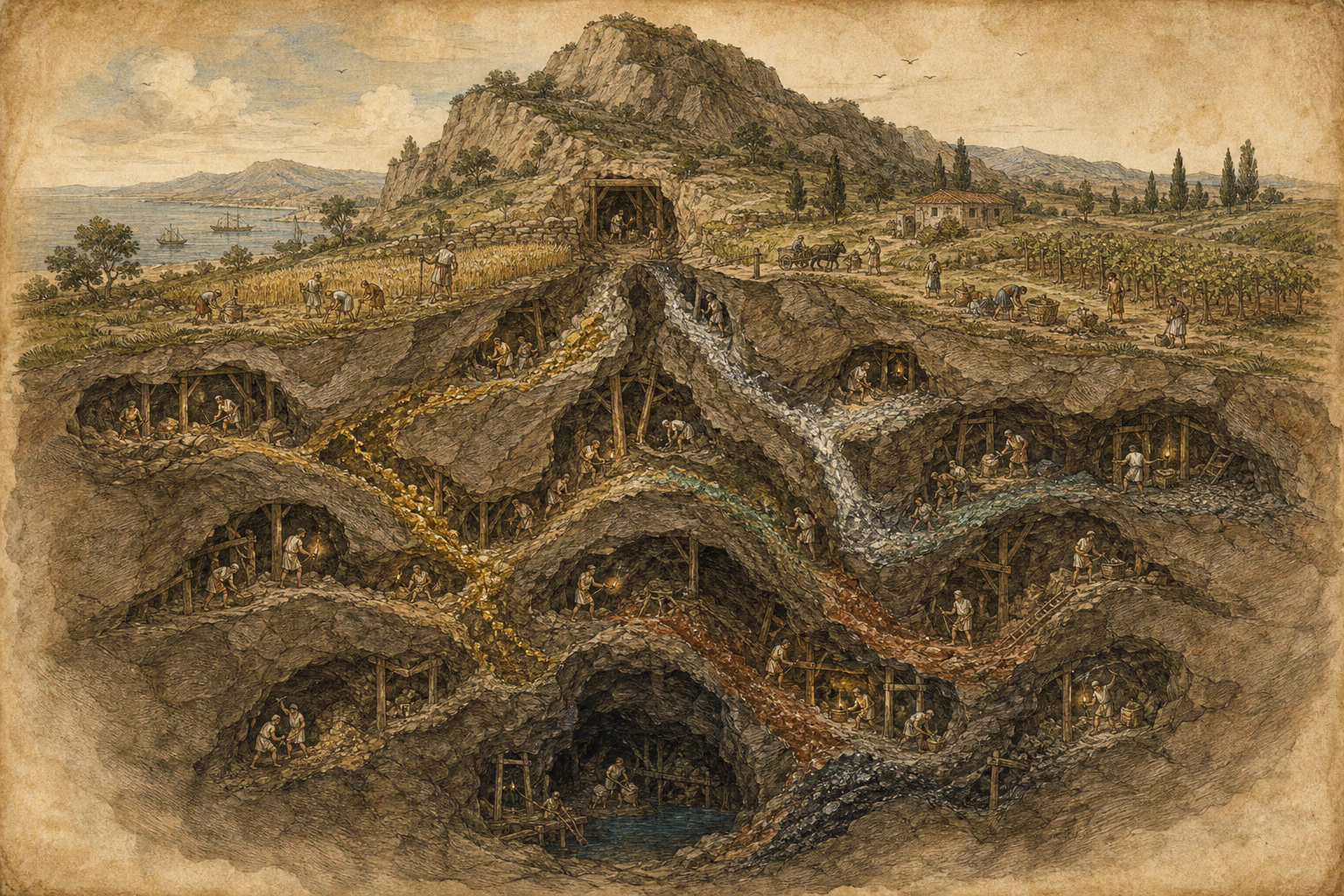
Metalla nunc ipsaeque opes et rerum pretia dicentur, tellurem intus exquirente cura multiplici modo, quippe alibi divitiis foditur quaerente vita aurum, argentum, electrum, aes, alibi deliciis gemmas et parietum lig norumque pigmenta, alibi temeritati ferrum, auro etiam gratius inter bella caedesque. persequimur omnes eius fibras vivimusque super excavatam, mirantes dehiscere aliquando aut intremescere illam, ceu vero non hoc indignatione sacrae parentis exprimi possit. imus in viscera et in sede manium opes quaerimus, tamquam parum benigna fertilique qua calcatur. et inter haec minimum remediorum gratia scrutamur, quoto enim cuique fodiendi causa medicina est? quamquam et hoc summa sui parte tribuit ut fruges, larga facilisque in omnibus, quaecumque prosunt. illa nos peremunt, illa nos ad inferos agunt, quae occultavit atque demersit, illa, quae non nascuntur repente, ut mens ad inane evolans reputet, quae deinde futura sit finis omnibus saeculis exhauriendi earn, quo usque penetratura avaritia. quam innocens, quam beata, immo vero etiam delicata esset vita, si nihil aliunde quam supra terras concupisceret, breviterque, nisi quod secum est!
Eruitur aurum et chrysocolla iuxta, ut pretiosior videatur, nomen ex auro custodiens. parum enim erat unam vitae invenisse pestem, nisi in pretio esset auri etiam sanies. quaerebat argentum avaritia; boni consuluit interim invenisse minium rubentisque terrae excogitavit usum. heu prodiga ingenia, quot modis auximus pretia rerum! accessit ars picturae, et aurum argentumque caelando carius fecimus. didicit homo naturam provocare. auxere et artem vitiorum inritamenta; in poculis libidines caelare iuvit ac per obscenitates bibere. abiecta deinde sunt haec ac sordere coepere, ut auri argentique nimium fuit. murrina ex eadem tellure et crystallina effodimus, quibus pretium faceret ipsa fragilitas. hoc argumentum opum, haec vera luxuriae gloria existimata est, habere quod posset statim perire totum. nec hoc fuit satis. turba gemmarum potamus et zmaragdis teximus calices, ac temulentiae causa tenere Indiam iuvat. aurum iam accessio est,
utinamque posset e vita in totum abdicari [sacrum fame, ut celeberrimi auctores dixere] proscissum conviciis ab optimis quibusque et ad perniciem vitae repertum, quanto feliciore aevo, cum res ipsae permutabantur inter sese, sicut et Troianis temporibus factitatum Homero credi convenit! ita enim, ut opinor, commercia victus gratia invecta. alios coriis bourn, alios ferro captivisque res emptitasse tradit. Quare, quamquam ipse iam mirator auri, pecore aestimationes rerum ita fecit, ut C boum arma aurea permutasse Glaucum diceret cum Diomedis armis VIIII bourn. ex qua consuetudine multa legum antiquarum pecore constat etiam Romae.
Pessimum vitae scelus fecit qui primus induit digitis, nec hoc quis fecerit traditur. nam de Prometheo omnia fabulosa arbitror, quamquam illi quoque ferreum anulum dedit antiquitas vinculumque id, non gestamen, intellegi voluit. Midae quidem anulum, quo circumacto habentem nemo cerneret, quis non etiam fabulosiorem fateatur? manus et prorsus sinistrae maximam auctoritatem conciliavere auro, non quidem Romanae, quarum in more ferrei erantut virtutis bellicae insigne. de regibus Romanis non facile dixerim. nullum habet Romuli in Capitolio statua nec praeter Numae Serviique Tullii alia ac ne Lucii quidem Bruti. hoc in Tarquiniis maxime miror, quorum e Graecia fuit origo, unde hic anulorum usus venit, quamquam etiam nunc Lacedaemone ferreo utuntur. sed a Prisco Tarquinio omnium primo filium, cum in praetextae annis occidisset hosted, bulla aurea donatum constat, unde mos bullae duravit, ut eorum, qui equo meruissent, filii insigne id haberent, ceteri lorum; et ideo miror Tarquinii eius statuam sine anulo esse. quamqmqua et de nomine ipso ambigi video. Graeci a digitis appellavere, apud nos prisci ungulum vocabant, postea et Graeci et nostri symbolum. longo certe tempore ne senatum quidem Romanum habuisse aureos manifestum est, siquidem iis tantum, qui legati ad exteras gentes ituri essent, anuli publice dabantur, credo, quoniam ita exterorum honoratissimi intellegebantur. neque aliis uti mos fuit quam qui ex ea causa publice accepissent, volgoque sic triumphabant et, cum corona ex auro Etrusca sustineretur a tergo, anulus tamen in digito ferreus erat aeque triumphantis et servi prae se coronam sustinentis. sic triumphavit de lugurtha C. Marius aureumque non ante tertium consulatum sumpsisse traditur. ii quoque, qui ob legationem acceperant aureos, in publico tantum utebantur iis, intra domos vero ferreis, quo argumento etiam nunc sponsae muneris vice ferreus anulus mittitur, isque sine gemma. equidem nec Iliacis temporibus ullos fuisse anulos video. nusquam certe Homerus dicit, cum et codicillos missitatos epistularum gratia indicet et conditas arcis vestes ac vasa aurea argenteaque et eas colligatas nodi, non anuli, nota. sortiri quoque contra provocationes duces non anulis tradit, fabricae etiam deum fibulas et alia muliebris cultus, sicut inaures, in primordio factitasse, sine mentione anulorum. et quisquis primus instituit, cunctanter id fecit: laevis manibus latentibusque induit, cum, si honos securus fuisset, dextra fuerit ostentandus. quodsi inpedimentum potuit in eo aliquod intellegi, etiam serioris usus argumentum esset: mains in laeva fuisset, qua scutum capitur. est quidem apud eundem Homerum virorum crinibus aurum inplexum; ideo nescio an prior usus feminis coeperit.
Romae ne fuit quidem aurum nisi admodum exiguum longo tempore. certe cum a Gallis capta urbe pax emeretur, non plus quam mille pondo effici potuere. nec ignoro MM pondo auri perisse Pompeii III consulatu e Capitolini lovis solio a Camillo ibi condita, et ideo a plerisque existimari MM pondo collata. sed quod accessit, ex Gallorum praeda fuit detractumque ab iis in parte captae urbis delubris—Gallos cum auro pugnare solitos Torquatus indicio est—; apparet ergo Gallorum templorumque tantundem nec amplius fuisse. quod quidem in augurio intellectum est, cum Capitolinus duplum reddidisset. illud quoque obiter indicari convenit—etiam de anulis sermonem repetivimus—, aedituum custodiae eius conprehensum fracta in ore anuli gemma statim expirasse et indicium ita extinctum. ergo ut maxime MM tantum pondo, cum capta est Roma, anno CCCLXIIII fuere, cum iam capitum liberorum censa essent CLII DLXXIII. in eadem post annos CCCVII quod ex Capitolinae aedis incendio ceterisque omnibus delubris C. Marius filius Praeneste detulerat, XIIII pondo, quae sub eo titulo in triumpho transtulit Sulla et argenti VI. idem ex reliqua omni victoria pridie transtulerat auri pondo XV, argenti p. CXV.
Frequentior autem usus anulorum non ante Cn. Flavium Anni filium deprehenditur. hic namque publicatis diebus fastis, quos populus a paucis principum cotidie petebat, tantam gratiam plebei adeptus est—libertino patre alioqui genitus et ipse scriba Appi Caeci, cuius hortatu exceperat eos dies consultando adsidue sagaci ingenio promulgaratque—, ut aedilis curulis crearetur cum Q. Anicio Praenestino, qui paucis ante annis hostis fuisset, praeteritis C. Poetilio et Domitio, quorum patres consules fuerant. additum Flavio, ut simul et tribunus plebei esset, quo facto tanta indignatio exarsit, ut anulos abiectos in antiquissimis reperiatur analibus. fallit plerosque quod tum et equestrem ordinem id fecisse arbitrantur; etenim adiectum hoc quoque sed et phaleras positas propterque nomen equitum adiectum est, anulosque depositos a nobilitate in annales relatum est, non a senatu universe. hoc actum P. Sempronio L. Sulpicio cos. Flavius vovit aedem Concordiae, si populo reconciliasset ordines, et, cum ad id pecunia publice non decerneretur, ex multaticia faeneratoribus condemnatis aediculam aeream fecit in Graecostasi, quae tune supra comitium erat, inciditque in tabella aerea factam eam aedem CCIIII annis post Capitolinam dedicatam. id a. CCCCXXXXVIIII a condita urbe gestum est et primum anulorum vestigium extat; promiscui autem usus alterum secundo Punico bello, neque enim aliter potuisset trimodia anulorum ilia Carthaginem ab Hannibale mitti. inter Caepionem quoque et Drusum ex anulo in auctione venali inimicitiae coepere, unde origo socialis belli et exitia rerum. ne tune quidem omnes senatores habuere, utpote cum memoria avorum multi praetura quoque functi in ferreo consenuerint— sicut Calpurnium et Manilium, qui legatus C. Marii fuerit Iugurthino bello, Fenestella tradit, et multi L. Fufidium ilium, ad quem Scaurus de vita sua scripsit—, in Quintiorum vero familia aurum ne feminas quidem habere mos fuerit, nullosque omnino maior pars gentium hominumque, etiam qui sub imperio nostro degunt, hodieque habeat. non signat oriens aut Aegyptus etiam nunc litteris contenta solis.
Multis hoc modis, ut cetera omnia, luxuria variavit gemmas addendo exquisiti fulgoris censuque opimo digitos onerando, sicut dicemus in gemmarum volumine mox et effigies varias caelando, ut alibi ars, alibi materia esset in pretio. alias dein gemmas violari nefas putavit ac, ne quis signandi causam in anulis esse intellegeret, solidas induit. quasdam vero neque ab ea parte, qua digito occultantur, auro clusit aurumque millis lapillorum vilius fecit. contra vero multi nullas admittunt gemmas auroque ipso signant. id Claudii Caesaris principatu repertum. nec non et servitia iam ferrum auro cingunt— alia per sese mero auro decorant—, cuius licentiae origo nomine ipso in Samothrace id institutum declarat.
Singulis primo digitis geri mos fuerat, qui sunt minimis proximi. sic in Numae et Servi Tullii statuis videmus. postea pollici proximo induere, etiam in deorum simulacris, dein iuvit et minimo dare. Galliae Brittanniaeque medio dicuntur usae. hic nunc solus excipitur, ceteri omnes onerantur, atque etiam privatim articuli minoribus aliis. sunt qui uni tantum minimo congerant, alii vero et huic tantum unum, quo signantem signent. conditus ille, ut res rara et iniuria usus indigna, velut e sacrario promitur, ut et unum in minimo digito habuisse pretiosioris in recondite supellectilis ostentatio sit. iam alii pondera eorum ostentant. aliis plures quam unum gestare labor est, alii bratteas infercire leviore materia propter casum tutius gemmarum sollicitudini putant, alii sub gemmis venena cludunt, sicut Demosthenes summus Graeciae orator, anulosque mortis gratia habent. denique vel plurima opum scelera anulis fiunt. quae fuit illa vita priscorum, qualis innocentia, in qua nihil signabatur! nunc cibi quoque ac potus anulo vindicantur a rapina. hoc profecere mancipiorum legiones, in domo turba externa ac iam servorum quoque causa nomenclator adhibendus. aliter apud antiquos singuli Marcipores Luciporesve dominorum gentiles omnem victum in promiscuo habebant, nec ulla domi a domesticis custodia opus erat. nunc rapiendae conparantur epulae pariterque qui rapiant eas, et claves quoque ipsas signasse non est satis. gravatis somno aut morientibus anuli detrahuntur, maiorque vitae ratio circa hoc instrumentum esse coepit. incertum a quo tempore, videmur tamen posse in externis auctoritatem eius rei intellegere circa Polycraten Sami tyrannum, cui dilectus ille anulus in mare abiectus capto relatus est pisce, ipso circiter ccxxx urbis nostrae annum interfecto. celebratior quidem usus cum faenore coepisse debet. argumento est consuetudo volgi, ad sponsiones etiamnum anulo exiliente, tracta ab eo tempore, quo nondum erat arra velocior, ut plane adfirmare possimus nummos ante apud nos, mox anulos coepisse. de nummis paulo post dicetur.
Anuli distinxere alterum ordinem a plebe, ut semel coeperant esse celebres, sicut tunica ab anulis senatum. quamquam et hoc sero, vulgoque purpura latiore tunicae usos invenimus etiam praecones, sicut patrem L. Aelii Stilonis Praeconini ob id cognominati. sed anuli plane tertium ordinem mediumque plebei et patribus inseruere, ac quod antea militares equi nomen dederant, hoc nunc pecuniae indices tribuunt. nec pridem id factum. divo Augusto decurias ordinante maior pars iudicum in ferreo anulo fuit iique non equites sed indices vocabantur. equitum nomen subsistebat in turmis equorum publicorum. iudicum quoque non nisi quattuor decuriae fuere primo, vixque singula milia in decuriis inventa sunt, nondum provinciis ad hoc munus admissis, servatumque in hodiernum est, ne quis e novis civibus in iis iudicaret.
English · Bostock & Riley 1855–57
We are now about to speak of metals, of actual wealth, the standard of comparative value, objects for which we diligently search, within the earth, in numerous ways. In one place, for instance, we undermine it for the purpose of obtaining riches, to supply the exigencies of life, searching for either gold or silver, electrum or copper. In another place, to satisfy the requirements of luxury, our researches extend to gems and pigments, with which to adorn our fingers and the walls of our houses: while in a third place, we gratify our rash propensities by a search for iron, which, amid wars and carnage, is deemed more acceptable even than gold. We trace out all the veins of the earth, and yet, living upon it, undermined as it is beneath our feet, are astonished that it should occasionally cleave asunder or tremble: as though, forsooth, these signs could be any other than expressions of the indignation felt by our sacred parent! We penetrate into her entrails, and seek for treasures in the abodes even of the Manes, as though each spot we tread upon were not sufficiently bounteous and fertile for us!
And yet, amid all this, we are far from making remedies the object of our researches: and how few in thus delving into the earth have in view the promotion of medicinal knowledge! For it is upon her surface, in fact, that she has presented us with these substances, equally with the cereals, bounteous and ever ready, as she is, in supplying us with all things for our benefit! It is what is concealed from our view, what is sunk far beneath her surface, objects, in fact, of no rapid formation, that urge us to our ruin, that send us to the very depths of hell. As the mind ranges in vague speculation, let us only consider, proceeding through all ages, as these operations are, when will be the end of thus exhausting the earth, and to what point will avarice finally penetrate! How innocent, how happy, how truly delightful even would life be, if we were to desire nothing but what is to be found upon the face of the earth; in a word, nothing but what is provided ready to our hands!
Gold is dug out of the earth, and, in close proximity to it, chrysocolla, a substance which, that it may appear all the more precious, still retains the name which it has borrowed from gold. It was not enough for us to have discovered one bane for the human race, but we must set a value too upon the very humours of gold. While avarice, too, was on the search for silver, it congratulated itself upon the discovery of minium, and devised a use to be made of this red earth.
Alas for the prodigal inventions of man! in how many ways have we augmented the value of things! In addition to the standard value of these metals, the art of painting lends its aid, and we have rendered gold and silver still more costly by the art of chasing them. Man has learned how to challenge both Nature and art to become the incitements to vice! His very cups he has delighted to engrave with libidinous subjects, and he takes pleasure in drinking from vessels of obscene form! But in lapse of time, the metals passed out of fashion, and men began to make no account of them; gold and silver, in fact, became too common. From this same earth we have extracted vessels of murrhine and vases of crystal, objects the very fragility of which is considered to enhance their value. In fact, it has come to be looked upon as a proof of opulence, and as quite the glory of luxury, to possess that which may be irremediably destroyed in an instant. Nor was even this enough;—we now drink from out of a mass of gems, and we set our goblets with smaragdi; we take delight in possessing the wealth of India, as the promoter of intoxication, and gold is now nothing more than a mere accessory.
Would that gold could have been banished for ever from the earth, accursed by universal report, as some of the most celebrated writers have expressed themselves, reviled by the reproaches of the best of men, and looked upon as discovered only for the ruin of mankind. How much more happy the age when things themselves were bartered for one another; as was the case in the times of the Trojan war, if we are to believe what Homer says. For, in this way, in my opinion, was commerce then carried on for the supply of the necessaries of life. Some, he tells us, would make their purchases by bartering ox-hides, and others by bartering iron or the spoil which they had taken from the enemy: and yet he himself, already an admirer of gold, was so far aware of the relative value of things, that Glaucus, he informs us, exchanged his arms of gold, valued at one hundred oxen, for those of Diomedes, which were worth but nine. Proceeding upon the same system of barter, many of the fines imposed by ancient laws, at Rome even, were levied in cattle, [and not in money].
The worst crime against mankind was committed by him who was the first to put a ring upon his fingers: and yet we are not informed, by tradition, who it was that first did so. For as to all the stories told about Prometheus, I look upon them as utterly fabulous, although I am aware that the ancients used to represent him with a ring of iron: it was their intention, however, to signify a chain thereby, and not an ornament. As to the ring of Midas, which, upon the collet being turned inwards, conferred invisibility upon the wearer, who is there that must not admit, perforce, that this story is even still more fabulous? It was the hand, and a sinister hand, too, in every sense, that first brought gold into such high repute: not a Roman hand, however, for upon that it was the practice to wear a ring of iron only, and solely as an indication of warlike prowess.
As to the usage followed by the Roman kings, it is not easy to pronounce an opinion: the statue of Romulus in the Capitol wears no ring, nor does any other statue—not that of L. Brutus even—with the sole exception of those of Numa and Servius Tullius. I am surprised at this absence of the ring, in the case of the Tarquinii more particularly, seeing that they were originally from Greece, a country from which the use of gold rings was first introduced; though even at the present day the people of Lacedæmon are in the habit of wearing rings made of iron. Tarquinius Priscus, however, it is well known, was the first who presented his son with the golden bulla, on the occasion of his slaying an enemy before he had laid aside the prætexta; from which period the custom of wearing the bulla has been continued, a distinction confined to the children of those who have served in the cavalry, those of other persons simply wearing a leather thong. Such being the case, I am the more surprised that the statue of this Tarquinius should be without a ring.
And yet, with reference to the very name of the ring, I find that there has been considerable uncertainty. That given to it originally by the Greeks is derived from the finger; while our ancestors styled it “ungulus;” and in later times both Greeks and Latins have given it the name of “symbolum.” For a great length of time, it is quite clear, not even the Roman senators wore rings of gold: for rings were given, and at the public expense, to those only who were about to proceed on an embassy to foreign nations, the reason being, I suppose, because men of highest rank among foreign nations were perceived to be thus distinguished. Nor was it the practice for any person to wear these rings, except those who for this reason had received them at the public expense; and in most instances, it was without this distinction that the Roman generals celebrated their public triumphs. For whereas an Etruscan crown of gold was supported from behind over the head of the victor, he himself, equally with the slave probably, who was so supporting the crown, had nothing but a ring of iron upon his finger. It was in this manner that C. Marius celebrated his triumph over Jugurtha; and he never assumed the golden ring, it is said, until the period of his third consulship. Those, too, who had received golden rings on the occasion of an embassy, only wore them when in public, resuming the ring of iron when in their houses. It is in pursuance of this custom that even at the present day, an iron ring is sent by way of present to a woman when betrothed, and that, too, without any stone in it.
For my own part, I do not find that any rings were used in the days of the Trojan War; at all events, Homer nowhere makes mention of them; for although he speaks of the practice of sending tablets by way of letter, of clothes and gold and silver plate being kept laid up in chests, still he gives us to understand that they were kept secure by the aid of a knot tied fast, and not under a seal impressed by a ring. He does not inform us too, that when the chiefs drew lots to ascertain which one of them should reply to the challenge of the enemy, they made any use of rings for the purpose; and when he enumerates the articles that were manufactured at the forge of the gods, he speaks of this as being the origin of fibulæ and other articles of female ornament, such as ear-rings for example, but does not make any mention of rings. Whoever it was that first introduced the use of rings, he did so not without hesitation; for he placed this ornament on the left hand, the hand which is generally concealed, whereas, if he had been sure of its being an honourable distinction, it would have been made more conspicuous upon the right. And if any one should raise the objection that this would have acted as an impediment to the right hand, I can only say that the usage in more recent times fortifies my opinion, and that the inconvenience of wearing rings on the left hand would have been still greater, seeing that it is with the left hand that the shield is held. We find mention made too, in Homer, of men wearing gold plaited with the hair; and hence it is that I am at a loss to say whether the practice first originated with females.
At Rome, for a long period of time, the quantity of gold was but very small. At all events, after the capture of the City by the Gauls, when peace was about to be purchased, not more than one thousand pounds’ weight of gold could be collected. I am by no means unaware of the fact that in the third consulship of Pompeius there was lost from the throne of Jupiter Capitolinus two thousand pounds’ weight of gold, originally placed there by Camillus; a circumstance which has led most persons to suppose, that two thousand pounds’ weight was the quantity then collected. But in reality, this excess of one thousand pounds was contributed from the spoil taken from the Gauls, amplified as it was by the gold of which they had stripped the temples, in that part of the City which they had captured.
The story of Torquatus, too, is a proof that the Gauls were in the habit of wearing ornaments of gold when engaged in combat; from which it would appear that the sum taken from the Gauls themselves, and the amount of which they had pillaged the temples, were only equal to the amount of gold collected for the ransom, and no more; and this is what was really meant by the response given by the augurs, that Jupiter Capitolinus had rendered again the ransom twofold. As we were just now speaking on the subject of rings, it may be as well to add, by way of passing remark, that upon the officer in charge of the Temple of Jupiter Capitolinus being arrested, he broke the stone of his ring between his teeth, and expired upon the spot, thus putting an end to all possibility of discovering the perpetrator of the theft.
It appears, therefore, that in the year of the City 364, when Rome was captured by the Gauls, there was but two thousand pounds’ weight of gold, at the very most; and this, too, at a period when, according to the returns of the census, there were already one hundred and fifty-two thousand five hundred and seventy-three free citizens in it. In this same city, too, three hundred and seven years later, the gold which C. Marius the younger conveyed to Præsneste from the Temple of the Capitol when in flames, and all the other shrines, amounted to thirteen thousand pounds’ weight, such being the sum that figured in the inscriptions at the triumph of Sylla; on which occasion it was displayed in the procession, as well as six thousand pounds’ weight of silver. The same Sylla had, the day before, displayed in his triumph fifteen thousand pounds’ weight of gold, and one hundred and fifteen thousand pounds’ weight of silver, the fruit of all his other victories.
It does not appear that rings were in common use before the time of Cneius Flavius, the son of Annius. This Flavius was the first to publish a table of the days for pleading, which till then the populace had to ascertain each day from a few great personages. The son of a freedman only, and secretary to Appius Cæcus, (at whose request, by dint of natural shrewdness and continual observation, he had selected these days and made them public), he obtained such high favour with the people, that he was created curule ædile; in conjunction with Quintus Anicius Prænestinus, who a few years before had been an enemy to Rome, and to the exclusion of C. Pœtilius and Domitius, whose fathers respectively were of consular rank. The additional honour was also conferred on Flavius, of making him tribune of the people at the same time, a thing which occasioned such a degree of indignation, that, as we find stated in the more ancient Annals, “the rings were laid aside!”
Most persons, however, are mistaken in the supposition that on this occasion the members of the equestrian order did the same: for it is in consequence of these additional words, “the phaleræ, too, were laid aside as well,” that the name of the equestrian order was added. These rings, too, as the Annals tell us, were laid aside by the nobility, and not by the whole body of the senate. This event took place in the consulship of P. Sempronius and P. Sulpicius. Flavius made a vow that he would consecrate a temple to Concord, if he should succeed in reconciling the privileged orders with the plebeians: and as no part of the public funds could be voted for the purpose, he accordingly built a small shrine of brass in the Græcostasis, then situate above the Comitium, with the fines which had been exacted for usury. Here, too, he had an inscription engraved upon a tablet of brass, to the effect that the shrine was dedicated two hundred and three years after the consecration of the Capitol. Such were the events that happened four hundred and forty-nine years after the foundation of the City, this being the earliest period at which we find any traces of the common use of rings.
A second occasion, however, that of the Second Punic War, shows that rings must have been at that period in very general use; for if such had not been the case, it would have been impossible for Hannibal to send the three modii of rings, which we find so much spoken of, to Carthage. It was through a dispute, too, at an auction about the possession of a ring, that the feud first commenced between Cæpio and Drusus, a dispute which gave rise to the Social War, and the public disasters which thence ensued. Not even in those days, however, did all the senators possess gold rings, seeing that, in the memory of our grandsires, many personages who had even filled the prætorship, wore rings of iron to the end of their lives; Calpurnius, for example, as Fenestella tells us, and Manilius, who had been legatus to Caius Marius in the Jugurthine War. Many historians also state the same of L. Fufidius, he to whom Scaurus dedicated the history of his life.
In the family of the Quintii, it is the usage for no one, not the females even, ever to wear a ring; and even at the present day, the greater part of the nations known to us, peoples who are living under the Roman sway, are not in the habit of wearing rings. Neither in the countries of the East, nor in Egypt, is any use made of seals, the people being content with simple writing only.
In this, as in every other case, luxury has introduced various fashions, either by adding to rings gems of exquisite brilliancy, and so loading the fingers with whole revenues, as we shall have further occasion to mention in our Book on Gems; or else by engraving them with various devices: so that it is in one instance the workmanship, in another the material, that constitutes the real value of the ring. Then again, in the case of other gems, luxury has deemed it no less than sacrilege to make a mark even upon them, and has caused them to be set whole, that no one may suppose that the ring was ever intended to be employed as a signet. In other instances, luxury has willed that certain stones, on the side even that is concealed by the finger, should not be closed in with gold, thus making gold of less account than thousands of tiny pebbles. On the other hand again, many persons will admit of no gems being set in their rings, but impress their seal with the gold itself, an invention which dates from the reign of Claudius Cæsar. At the present day, too, the very slaves even, incase their iron rings with gold (while other articles belonging to them, they decorate with pure gold), a licence which first originated in the Isle of Samothrace, as the name given to the invention clearly shows.
It was the custom at first to wear rings on a single finger only, the one, namely, that is next to the little finger; and this we see the case in the statues of Numa and Servius Tullius. In later times, it became the practice to put rings on the finger next to the thumb, even in the case of the statues of the gods; and more recently, again, it has been the fashion to wear them upon the little finger as well. Among the peoples of Gallia and Britannia, the middle finger, it is said, is used for this purpose. At the present day, however, among us, this is the only finger that is excepted, all the others being loaded with rings, smaller rings even being separately adapted for the smaller joints of the fingers. Some there are who heap several rings upon the little finger alone; while others, again, wear but one ring upon this finger, the ring that sets a seal upon the signet-ring itself, this last being kept carefully shut up as an object of rarity, too precious to be worn in common use, and only to be taken from the cabinet as from a sanctuary. And thus is the wearing of a single ring upon the little finger no more than an ostentatious advertisement that the owner has property of a more precious nature under seal at home!
Some, too, make a parade of the weight of their rings, while to others it is quite a labour to wear more than one at a time: some, in their solicitude for the safety of their gems, make the hoop of gold tinsel, and fill it with a lighter material than gold, thinking thereby to diminish the risks of a fall. Others, again, are in the habit of inclosing poisons beneath the stones of their rings, and so wear them as instruments of death; Demosthenes, for instance, that greatest of the orators of Greece. And then, besides, how many of the crimes that are stimulated by cupidity, are committed through the instrumentality of rings! How happy the times, how truly innocent, in which no seal was ever put to anything! At the present day, on the contrary, our very food even and our drink have to be preserved from theft through the agency of the ring: a result owing to those legions of slaves, those throngs of foreigners which are introduced into our houses, multitudes so numerous that we require the services of a nomenclator even, to tell us the names of our own servants. Very different was it in the times of our forefathers, when each person possessed a single servant only, one of his master’s own lineage, called Marcipor or Lucipor, from his master’s name, as the case might be, and taking all his meals with him in common; when, too, there was no occasion for taking precautions at home by keeping a watch upon the domestics. But at the present day, we not only procure dainties which are sure to be pilfered, but hands to pilfer them as well; and so far is it from being sufficient to have the very keys sealed, that the signet-ring is often taken from off the owner’s finger while he is overpowered with sleep or lying on his death-bed.
Indeed the most important transactions of life are now made to depend upon this instrument, though at what period this first began to be the case, I am at a loss to say. It would appear, however, so far as foreign nations are concerned, that we may admit the importance attached to it, from the days of Polycrates, the tyrant of Samos, whose favourite ring, after being thrown in the sea, was recovered from a fish that was caught; and this Polycrates, we know, was put to death about the year of our City, 230. The use of the ring must, of necessity, have become greatly extended with the increase of usury; one proof of which is, the usage still prevalent among the lower classes, of whipping off the ring the moment a simple contract is made; a practice which takes its date, no doubt, from a period when there was no more expeditious method of giving an earnest on closing a bargain. We may therefore very safely conclude, that though money was first introduced among us, the use of rings was introduced very shortly after. Of money, I shall shortly have occasion to speak further.
Rings, as soon as they began to be commonly worn, distinguished the second order from the plebeians, in the same manner as the use of the tunic distinguished the senate from those who only wore the ring. Still, however, this last distinction was introduced at a later period only, and we find it stated by writers that the public heralds even were formerly in the habit of wearing the tunic with the purple laticlave; the father of Lucius Ælius Stilo, for instance, from whom his son received the cognomen of “Præconinus,” in consequence of his father’s occupation as a herald. But the use of rings, no doubt, was the distinguishing mark of a third and intermediate order, between the plebeians and the senators; and the title of “eques,” originally derived from the possession of a war-horse, is given at the present day as an indication of a certain amount of income. This, however, is of comparatively recent introduction; for when the late Emperor Augustus made his regulations for the decuries, the greater part of the members thereof were persons who wore iron rings, and these bore the name, not of “equites,” but of “judices,” the former name being reserved solely for the members of the squadrons furnished with war-horses at the public charge.
Of these judices, too, there were at first but four decuries only, and in each of these decuries there was hardly one thousand men to be found, the provinces not having been hitherto admitted to the office; an observance which is still in force at the present day, no one newly admitted to the rights of citizenship being allowed to perform the duties of judex as a member of the decuries.