LIBER XXXV · CAPUT 10
VARIOUS OTHER KINDS OF PAINTING
Latine · Mayhoff 1906
descendisse hic in certamen cum Zeuxide traditur et, cum ille detulisset uvas pictas tanto successu, ut in scaenam aves advolarent, ipse detulisse linteum pictum ita veritate repraesentata, ut Zeuxis alitum iudicio tumens flagitaret tandem remoto linteo ostendi picturam atque intellecto errore concederet palmam ingenuo pudore, quoniam ipse volucres fefelliset, Parrhasius autem se artificem. fertur et postea Zeuxis pinxisse puerum uvas ferentem, ad quas cum advolassent aves, eadem ingenuitate processit iratus operi et dixit: uvas melius pinxi quam puerum, nam si et hoc consummassem, aves timere debuerant. fecit et figlina opera, quae sola in Ambracia relicta sunt, cum inde Musas Fulvius Nobilior Romam transferret. Zeuxidis manu Romae Helena est in Philippi porticibus, et in Concordiae delubro Marsyas religatus.
Parrhasius Ephesi natus et ipse multa contulit. primus symmetrian picturae dedit, primus argutias voltus, elegantiam capilli, venustatem oris, confessione artificum in liniis extremis palmam adeptus. haec est picturae summa suptilitas. corpora enim pingere et media rerum est quidem magni operis, sed in quo multi gloriam tulerint; extrema corporum facere et desinentis picturae modum includere rarum in successu artis invenitur. ambire enim se ipsa debet extremitas et sic desinere, ut promittat alia et post se ostendatque etiam quae occultat. hanc ei gloriam concessere Antigonus et Xenocrates, qui de pictura scripsere, praedicantes quoque, non solum confitentes; et alias multa graphidis vestigia exstant in tabulis ac membranis eius, ex quibus proficere dicuntur artifices. minor tamen videtur sibi comparatus in mediis corporibus exprimendis. pinxit demon Atheniensium argumento quoque ingenioso. ostendebat namque varium: iracundum iniustum inconstantem, eundem exorabilem clementem misericordem; gloriosum...., excelsum humilem, ferocem fugacemque et omnia pariter. idem pinxit et Thesea, quae Romae in Capitolio fuit, et nauarchum thoracatum, et in una tabula, quae est Rhodi, Meleagrum, Herculem, Persea; haec ibi ter fulmine ambusta neque obliterata hoc ipso miraculum auget. pinxit et archigallum, quam picturam amavit Tiberius princeps atque, ut auctor est Deculo, HS |LX| aestimatam cubiculo suo inclusit. pinxit et Thressam nutricem infantemque in manibus eius et Philiscum et Liberum patrem adstante Virtute, et pueros duos, in quibus spectatur securitas aetatis et simplicitas, item sacerdotem adstante puero cum acerra et corona. sunt et duae picturae eius nobilissimae, hoplites in certamine ita decurrens, ut sudare videatur, alter arma deponens, ut anhelare sentiatur. laudantur et Aeneas Castorque ac Pollux in eadem tabula, item Telephus, Achilles, Agamemnon, Ulixes. fecundus artifex, sed quo nemo insolentius usus sit gloria artis, namque et cognomina usurpavit habrodiaetum se appellando aliisque versibus principem artis et eam ab se consummatam, super omnia Apollinis se radice ortum et Herculem, qui est Lindi, talem a se pictum, qualem saepe in quiete vidisset, et,cum magnis suffragiis superatus a Timanthe esset Sami in Aiace armorumque iudicio, herois nomine se moleste ferre dicebat, quod iterum ab indigno victus esset.—(Pinxit et minoribus tabellis libidines, eo genere petulantis ioci se reficiens).—
Nam Timanthi vel plurimum adfuit ingenii. eius enim est Iphigenia oratorum laudibus celebrata, qua stante ad aras peritura cum maestos pinxisset omnes praecipueque patruum et tristitiae omnem imaginem consumpsisset, patris ipsius voltum velavit, quem digne non poterat ostendere. sunt et alia ingenii eius exempla, veluti Cyclops dormiens in parvola tabella, cuius et sic magnitudinem exprimere cupiens pinxit iuxta Satyros thyrso pollicem eius metientes. atque in unius huius operibus intellegitur plus semper quam pingitur et, cum sit ars summa, ingenium tamen ultra artem est. pinxit et heroa absolutissimi operis, artem ipsam complexus viros pingendi, quod opus nunc Romae in templo Pacis est.
Euxinidas hac aetate docuit Aristiden, praeclarum artificem, Eupompus Pamphilum, Apellis praeceptorem. est Eupompi victor certamine gymnico palmam tenens. ipsius auctoritas tanta fuit, ut diviserit picturam: genera, quae ante eum duo fuere—Helladicum et Asiaticum appellabant —, propter hunc, qui erat Sicyonius, diviso Helladico tria facta sunt, lonicum, Sicyonium, Atticum. Pamphili cognatio et proelium ad Phliuntem ac victoria Atheniensium, item Ulixes in rate. ipse Macedo natione, sed.... primus in pictura omnibus litteris eruditus, praecipue arithmetica et geometria, sine quibus negabat artem perfici posse, docuit neminem talento minoris— annuis $X$ D—, quam mercedem et Apelles et Melanthius dedere ei. huius auctoritate effectum est Sicyone primum, deinde in tota Graecia, ut pueri ingenui omnia ante graphicen, hoc est picturam in buxo, docerentur recipereturque ars ea in primum gradum liberalium. semper quidem honos ei fruit, ut ingenui eam exercerent, mox ut honesti, perpetuo interdicto ne servitia docerentur. ideo neque in hac neque in toreutice ullius, qui servierit, opera celebrantur.
Clari et centesima septima olympiade exstitere Aetion ac Therimachus. Aetionis sunt nobiles picturae Liber pater, item Tragoedia et Comoedia, Semiramis ex ancilla regnum apiscens, anus lampadas praeferens et nova nupta verecundia notabilis.
Verum omnes prius genitos futurosque postea superavit Apelles Cous olympiade centesima duodecima. picturae plura solus prope quam ceteri omnes contulit, voluminibus etiam editis, quae doctrinam eam continent. praecipua eius in arte venustas fuit, cum eadem aetate maximi pictores essent; quorum opera cum admiraretur, omnibus conlaudatis deesse illam suam venerem dicebat, quam Graeci χάριτα vocant; cetera omnia contigisse, sed hac sola sibi neminem parem. et aliam gloriam usurpavit, cum Protogenis opus inmensi laboris ac curae supra modum anxiae miraretur; dixit enim omnia sibi cum illo paria esse aut illi meliora, sed uno se praestare, quod manum de tabula sciret tollere, memorabili praecepto nocere saepe nimiam diligentiam. fuit autem non minoris simplicitatis quam artis. Melanthio dispositione cedebat, Asclepiodoro de mensuris, hoc est quanto quid a quoque distare deberet.
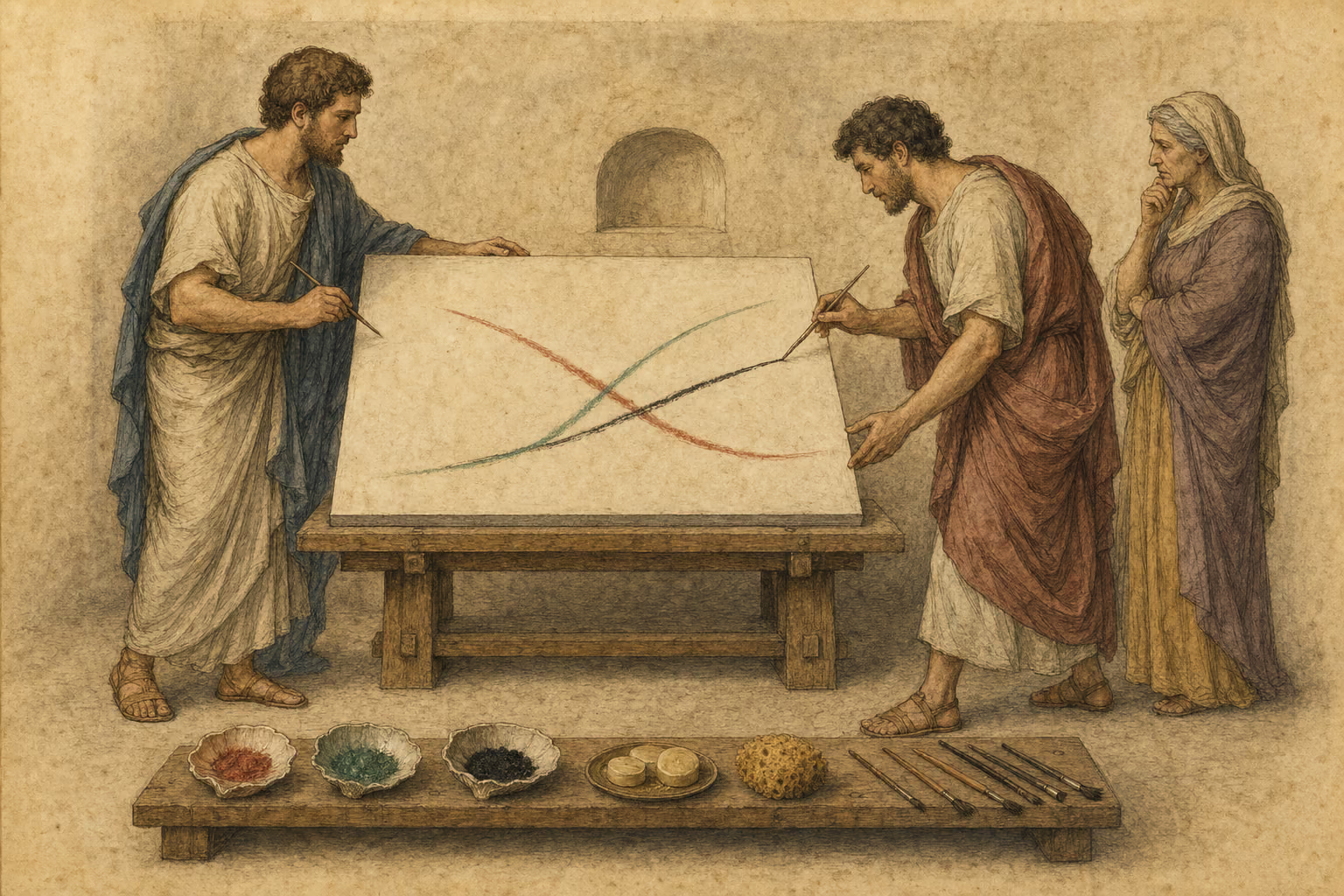
Scitum inter Protogenen et eum quod accidit. ille Rhodi vivebat, quo cum Apelles adnavigasset, avidus cognoscendi opera eius fama tantum sibi cogniti, continuo officinam petiit. aberat ipse, sed tabulam amplae magnitudinis in machina aptatam una custodiebat anus. haec foris esse Protogenen respondit interrogavitque, a quo quaesitum diceret. ab hoc, inquit Apelles adreptoque penicillo lineam ex colore duxit summae tenuitatis per tabulam. et reverso Protogeni quae gesta erant anus indicavit. ferunt artificem protinus contemplatum subtilitatem dixisse Apellen venisse, non cadere in alium tam absolutum opus; ipsumque alio colore tenuiorem lineam in ipsa illa duxisse abeuntemque praecepisse, si redisset ille, ostenderet adiceretque hunc esse quem quaereret. atque ita evenit. revertit enim Apelles et vinci erubescens tertio colore lineas secuit nullum relinquens amplius subtilitati locum. at Protogenes victum se confessus in portum devolavit hospitem quaerens, placuitque sic eam tabulam posteris tradi omnium quidem, sed artificum praecipuo miraculo. consumptam eam priore incendio Caesaris domus in Palatio audio, spectatam Rhodi ante, spatiose nihil aliud continentem quam lineas visum effugientes, inter egregia multorum opera inani similem et eo ipso allicientem omnique opere nobiliorem.
Apelli fuit alioqui perpetua consuetudo numquam tam occupatum diem agendi, ut non lineam ducendo exerceret artem, quod ab eo in proverbium venit. idem perfecta opera proponebat in pergula transeuntibus atque, ipse post tabulam latens, vitia quae notarentur auscultabat, vulgum diligentiorem iudicem quam se praeferens; feruntque reprehensum a sutore, quod in crepidis una pauciores intus fecisset ansas, eodem postero die superbo emendatione pristinae admonitionis cavillante circa crus, indignatum prospexisse denuntiantem, ne supra crepidam sutor iudicaret, quod et ipsum in proverbium abiit. fuit enim et comitas illi, propter quam gratior Alexandro Magno frequenter in officinam ventitanti—nam, ut diximus, ab alio se pingi vetuerat edicto—, sed in officina imperite multa disserenti silentium comiter suadebat, rideri eum dicens a pueris, qui colores tererent. tantum erat auctoritati iuris in regem alioqui iracundum. quamquam Alexander honorem ei clarissimo perhibuit exemplo. namque cum dilectam sibi e pallacis suis praecipue, nomine Pancaspen, nudam pingi ob admirationem formae ab Apelle iussisset eumque, dum paret, captum amore sensisset, dono dedit ei, magnus animo, maior imperio sui nec minor hoc facto quam victoria alia, quia ipse se vicit, nec torum tantum suum, sed etiam adfectum donavit artifici, ne dilectae quidem respectu motus, cum modo regis ea fuisset, modo pictoris -esset. sunt qui Venerem anadyomenen ab illo pictam exemplari putent. Apelles et in aemulis benignus Protogeni dignationem primus Rhodi constituit. sordebat suis, ut plerumque domestica, percontantique, quanti liceret opera effecta, parvum nescio quid dixerat, at ille quinquagenis talentis poposcit famamque dispersit, se emere, ut pro suis venderet. ea res concitavit Rhodios ad intellegendum artificem, nec nisi augentibus pretium cessit.
Imagines adeo similitudinis indiscretae pinxit, ut— incredibile dictu—Apio grammaticus scriptum reliquerit, quendam ex facie hominum divinantem a (del.V2) diuinamtem V. addiuinantem Rdhv.a.S., quos metoposcopos vocant, ex iis dixisse aut futurae mortis annos aut praeteritae vitae. non fuerat ei gratia in comitatu Alexandri cum Ptolemaeo, quo regnante Alexandriam vi tempestatis expulsus, subornato fraude aemulorum piano regio invitatus, ad cenam venit indignantique Ptolemaeo et vocatores suos ostendenti, ut diceret, a quo eorum invitatus esset, arrepto carbone extincto e foculo imaginem in pariete delineavit, adgnoscente voltum plani rege inchoatum protinus. pinxit et Antigoni regis imaginem altero lumine orbati primus excogitata ratione vitia condendi; obliquam namque fecit, ut, quod deerat corpori, picturae deesse potius videretur, tantumque eam partem e facie ostendit, quam totam poterat ostendere. sunt inter opera eius et exspirantium imagines. quae autem nobilissima sint, non est facile dictu. Venerem exeuntem e maria divus Augustus dicavit in delubro patris Caesaris, quae anadyomene vocatur, versibus Graecis tantopere dum laudatur, aevis victa, sed inlustrata. cuius inferiorem partem corruptam qui reficeret non potuit reperiri, verum ipsa iniuria cessit in gloriam artificis. consenuit haec tabula carie, aliamque pro ea substituit Nero in principatu suo Dorothei manu. Apelles inchoaverat et aliam Venerem Coi, superaturus etiam illam suam priorem. invidit mors peracta parte, nec qui succederet operi ad praescripta liniamenta inventus est. pinxit et Alexandrum Magnum fulmen tenentem in templo Ephesiae Dianae viginti talentis auri. digiti eminere videntur et fulmen extra tabulam esse—legentes meminerint omnia ea quattuor coloribus facta—; manipretium eius tabulae in nummo aureo mensura accepit, non numero. pinxit et megabyzi, sacerdotis Dianae Ephesiae, pompam, Clitum cum equo ad bellum festinantem, galeam poscenti armigerum porrigentem. Alexandrum et Philippum quotiens pinxerit, enumerare supervacuum est. mirantur eius Habronem Sami; Menandrum, regem Cariae, Rhodi, item Antaeum; Alexandreae Gorgosthenen tragoedum; Romae Castorem et Pollucem cum Victoria et Alexandro Magno, item Belli imaginem restrictis ad terga manibus, Alexandro in curru triumphante. quas utrasque tabulas divus Augustus in fori sui celeberrimis partibus dicaverat simplicitate moderata; divus Claudius pluris existimavit utrisque excisa Alexandri facie divi Augusti imagines addere. eiusdem arbitrantur manu esse et in Dianae templo Herculem aversum, ut, quod est difficillimum, faciem eius ostendat verius pictura quam promittat. pinxit et heroa nudum eaque pictura naturam ipsam provocavit. est et equus eius, sive fuit, pictus in certamine, quo iudicium ad mutas quadripedes provocavit ab hominibus. namque ambitu praevalere aemulos sentiens singulorum picturas inductis equis ostendit: Apellis tantum equo adhinnivere, idque et postea semper evenit, ut experimentum artis illud ostentaretur. fecit et Neoptolemum ex equo adversus Persas, Archelaum cum uxore et filia, Antigonum thoracatum cum equo incedentem. peritiores artis praeferunt omnibus eius operibus eundem regem sedentem in equo et Dianam sacrificantium virginum choro mixtam, quibus vicisse Homeri versus videtur id ipsum describentis. pinxit et quae pingi non possunt, tonitrua, fulgetra fulguraque; Bronten, Astrapen et Ceraunobolian appellant.—Inventa eius et ceteris profuere in arte; unum imitari nemo potuit, quod absoluta opera atramento inlinebat ita tenui, ut id ipsum, cum repercussum claritatis colorumomnium excitaret custodiretque a pulvere et sordibus, ad manum intuenti demum appareret, sed et luminum ratione magna, ne claritas colorum aciem offenderet veluti per lapidem specularem intuentibus et e longinquo eadem res nimis floridis coloribus austeritatem occulte daret.
Aequalis eius fuit Aristides Thebanus. is omnium primus animum pinxit et sensus hominis expressit, quae vocant Graeciἤθη, item perturbationes, durior paulo in coloribus. huius opera.... oppido capto ad matris morientis ex volnere mammam adrepens infans, intellegiturque sentire mater et timere, ne emortuo e lacte sanguinem lambat. quam tabulam Alexander Magnus transtulerat Pellam in patriam suam. idem pinxit proelium cum Persis, centum homines tabula ea conplexus pactusque in singulos mnas denas a tyranno Elatensium Mnasone. pinxit et currentes quadrigas et supplicantem paene cum voce et venatores cum captura et Leontion Epicuri et anapauomenen propter fratris amorem, item Liberum et Ariadnen spectatos Romae in aede Cereris, tragoedum et puerum in Apollinis, cuius tabulae gratia interiit pictoris inscitia, cui tergendam eam mandaverat M. Iunius praetor sub die ludorum Apollinarium. spectata est et in aede Fidei in Capitolio senis cum lyra puerum docentis. pinxit et aegrum sine fine laudatum tantumque arte valuit, ut Attalus rex unam tabulam eius centum talentis emisse tradatur.
Simul, ut dictum est, et Protogenes floruit. patria ei Caunus, gentis Rhodiis subiectae. summa paupertas initio artisque summa intentio et ideo minor fertilitas. quis eum docuerit, non putant constare; quidam et naves pinxisse usque ad quinquagensimum annum; argumentum esse, quod cum Athenis celeberrimo loco Minervae delubri propylon pingeret, ubi fecit nobilem Paralum et Hammoniada, quam quidam Nausicaan vocant, adiecerit parvolas naves longas in iis, quae pictores parergia appellant, ut appareret, a quibus initiis ad arcem ostentationis opera sua pervenissent. palmam habet tabularum eius Ialysus, qui est Romae dicatus in templo Pacis. cum pingeret eum, traditur madidis lupinis vixisse, quoniam sic simul et famem sustineret et sitim nec sensus nimia dulcedine obstrueret. huic picturae quater colorem induxit ceu tria subsidia iniuriae et vetustatis, ut decedente superiore inferior succederet. est in ea canis mire factus, ut quem pariter et casus pinxerit. non iudicabat se in eo exprimere spumam anhelantis, cum in reliqua parte omni, quod difficillimum erat, sibi ipse satisfecisset. displicebat autem ars ipsa: nec minui poterat et videbatur nimia ac longius a veritate discedere, spumaque pingi, non ex ore nasci. anxio animi cruciatu, cum in pictura verum esse, non verisimile vellet, absterserat saepius mutaveratque penicillum, nullo modo sibi adprobans. postremo iratus arti, quod intellegeretur, spongeam inpegit inviso loco tabulae. et illa reposuit ablatos colores qualiter cura optaverat, fecitque in picture fortuna naturam. hoc exemplo eius similis et Nealcen successus spumae equi similiter spongea inpacta secutus dicitur, cum pingeret poppyzonta retinentem eum. ita Protogenes monstravit et fortunam. propter hunc Ialysum, ne cremaret tabulam, Demetrius rex, cum ab ea parte sola posset Rhodum capere, non incendit, parcentemque picturae fugit occasio victoriae. erat tunc Protogenes in suburbano suo hortulo, hoc est Demetrii castris, neque interpellatus proeliis incohata opera intermisit omnino nisi accitus a rege, interrogatusque, qua fiducia extra muros ageret, respondit scire se cum Rhodiis illi bellum esse, non cum artibus. disposuit rex in tutelam eius stationes, gaudens quod manus servaret, quibus pepercerat, et, ne saepius avocaret, ultro ad eum venit hostis relictisque victoriae suae votis inter arma et murorum ictus spectavit artificem; sequiturque tabulam illius temporis haec fama, quod eam Protogenes sub gladio pinxerit: Satyrus hic est, quem anapauomenon vocant, ne quid desit temporis eius securitati, tenentem tibias. fecit et Cydippenet Tlepolemum, Philiscum, tragoediarum scriptorem, meditantem et athletam et Antigonum regem, matrem Aristotelis philosophi, qui ei suadebat, ut Alexandri Magni opera pingeret propter aeternitatem rerum—impetus animi et quaedam artis libido in haec potius eum tulere—; novissime pinxit Alexandrum ac Pana. fecit et signa ex aere, ut diximus.
Eadem aetate fuit Asclepiodorus, quem in symmetria mirabatur Apelles. huic Mnaso tyrannus pro duodecim diis dedit in singulos mnas tricenas, idemque Theomnesto in singulos heroas vicenas.
His adnumerari debet et Nicomachus, Aristidis filius ac discipulus. pinxit raptum Proserpinae, quae tabula fuit in Capitolio in Minervae delubro supra aediculam Iuventatis, et in eodem Capitolio, quam Plancus imperator posuerat, Victoria quadrigam in sublime rapiens. Ulixi primus addidit pilleum. pinxit et Apollinem ac Dianam, deumque matrem in leone sedentem, item nobiles Bacchas obreptantibus Satyris, Scyllamque, quae nunc est Romae in templo Pacis. nec fuit alius in ea arte velocior. tradunt namque conduxisse pingendum ab Aristrato, Sicyoniorum tyranno, quod is faciebat Telesti poetae monimentum praefinito die, intra quem perageretur, nec multo ante venisse, tyranno in poenam accenso, paucisque diebus absolvisse et celeritate et arte mira.—Discipulos habuit Aristonem fratrem et Aristiden filium et Philoxenum Eretrium, cuius tabula nullis postferenda, Cassandro regi picta, continuit Alexandri proelium cum Dario. idem pinxit et lasciviam, in qua tres Sileni comissantur. hic celeritatem praeceptoris secutus breviores etiamnum quasdam picturae conpendiarias invenit.—Adnumeratur his et Nicophanes, elegans ac concinnus ita, ut venustate ei pauci conparentur; cothurnus et gravitas artis multum a Zeuxide et Apelle abest.—(Apellis discipulus Perseus, ad quem de hac arte scripsit, huius fuerat aetatis).—Aristidis Thebani discipuli fuerunt et filii Niceros et Ariston, cuius est Satyrus cum scypho coronatus, discipuli Antorides et Euphranor, de quo mox dicemus.
Namque subtexi par est minoris picturae celebres in penicillo, e quibus fuit Piraeicus arte paucis postferendus: proposito nescio an distinxerit se, quoniam humilia quidem secutus humilitatis tamen summam adeptus est gloriam. tonstrinas sutrinasque pinxit et asellos et obsonia ac similia, ob haec cognominatus rhyparographos, in iis consummatae voluptatis, quippe eae pluris veniere quam maximae multorum. e diverso Maeniana, inquit Varro, omnia operiebat Serapionis tabula sub Veteribus. hic scaenas optime pinxit, sed hominem pingere non potuit. contra Dionysius nihil aliud quam homines pinxit, ob id anthropographos cognominatus. parva et Callicles fecit, item Calates comicis tabellis, utraque Antiphilus. namque et Hesionam nobilem pinxit et Alexandrum ac Philippum cum Minerva, qui sunt in schola in Octaviae porticibus, et in Philippi Liberum patrem, Alexandrum puerum, Hippolytum tauro emisso expavescentem, in Pompeia vero Cadmum et Europen. idem iocosis nomine Gryllum deridiculi habitus pinxit, unde id genus picturae grylli vocantur. ipse in Aegypto natus didicit a Ctesidemo.
Decet non sileri et Ardeatis templi pictorem, praesertim civitate donatur ibi et carmine, quod est in ipsa pictura his versibus: Dignis digna. Loco picturis condecoravitreginae Iunonis supremi coniugis templumPlautius Marcus, duet Asia lata esse oriundus,quem nunc et post semper ob artem hanc Ardea laudat, eaque sunt scripta antiquis litteris Latinis, non fraudanda et Studio divi Augusti aetate, qui primus instituit amoenissimam parietum picturam, villas et porticus ac topiaria opera, lucos, nemora, colles, piscinas, euripos, amnes, litora, qualia quis optaret, varias ibi obambulantium species aut navigantium terraque villas adeuntium asellis aut vehiculis, iam piscantes, aucupantes aut venantes aut etiam vindemiantes. sunt in eius exemplaribus nobiles palustri accessu villae, succollatis sponsione mulieribus labantes, trepidis quae feruntur, plurimae praeterea tales argutiae facetissimi salis. idem subdialibus maritimas urbes pingere instituit, blandissimo aspectu minimoque inpendio. sed nulla gloria artificum est nisi qui tabulas pinxere. eo venerabilior antiquitatis prudentia apparet. non enim parietes excolebant dominis tantum nec domos uno in loco mansuras, quae ex incendiis rapi non possent. casa Protogenes contentus erat in hortulo suo; nulla in Apellis tectoriis pictura erat. nondum libebat parietes totos tinguere; omnium eorum ars urbibus excubabat, pictorque res communis terrarum erat.—Fuit et Arellius Romae celeber paulo ante divum Augustum, ni flagitio insigni corrupisset artem, semper ei lenocinans feminae, cuius amore flagraret, et ob id deas pingens, sed dilectarum imagine. itaque in pictura eius scorta numerabantur. fuit et nuper gravis ac severus idemque floridis tumidus pictor Famulus. huius erat Minerva spectantem spectans, quacumque aspiceretur. paucis diei horis pingebat, id quoque cum gravitate, quod semper togatus, quamquam in machinis. carcer eius artis domus aurea fuit, e.t ideo non extant exempla alia magnopere. post eum fuere in auctoritate Cornelius Pinus et Attius Priscus, qui Honoris et Virtutis aedes Imperatori Vespasiano Augusto restituenti pinxerunt, Priscus antiquis similior.—
English · Bostock & Riley 1855–57
This last, it is said, entered into a pictorial contest with Zeuxis, who represented some grapes, painted so naturally that the birds flew towards the spot where the picture was exhibited. Parrhasius, on the other hand, exhibited a curtain, drawn with such singular truthfulness, that Zeuxis, elated with the judgment which had been passed upon his work by the birds, haughtily demanded that the curtain should be drawn aside to let the picture be seen. Upon finding his mistake, with a great degree of ingenuous candour he admitted that he had been surpassed, for that whereas he himself had only deceived the birds, Parrhasius had deceived him, an artist.
There is a story, too, that at a later period, Zeuxis having painted a child carrying grapes, the birds came to peck at them; upon which, with a similar degree of candour, he expressed himself vexed with his work, and exclaimed—“I have surely painted the grapes better than the child, for if I had fully succeeded in the last, the birds would have been in fear of it.” Zeuxis executed some figures also in clay, the only works of art that were left behind at Ambracia, when Fulvius Nobilior transported the Muses from that city to Rome. There is at Rome a Helena by Zeuxis, in the Porticos of Philippus, and a Marsyas Bound, in the Temple of Concord there.
Parrhasius of Ephesus also contributed greatly to the progress of painting, being the first to give symmetry to his figures, the first to give play and expression to the features, elegance to the hair, and gracefulness to the mouth: indeed, for contour, it is universally admitted by artists that he bore away the palm. This, in painting, is the very highest point of skill. To paint substantial bodies and the interior of objects is a great thing, no doubt, but at the same time it is a point in which many have excelled: but to make the extreme outline of the figure, to give the finishing touches to the painting in rounding off the contour, this is a point of success in the art which is but rarely attained. For the extreme outline, to be properly executed, requires to be nicely rounded, and so to terminate as to prove the existence of something more behind it, and thereby disclose that which it also serves to hide.
Such is the merit conceded to Parrhasius by Antigonus and Xenocrates, who have written on the art of painting; and in this as well as in other points, not only do they admit his excellence, but enlarge upon it in terms of the highest commendation. There are many pen sketches by him still in existence, both upon panel and on parchment, from the study of which, even artists, it is said, may greatly profit.
Notwithstanding these points of excellence, however, Parrhasius seems comparatively inferior to himself in giving the proper expression to the middle of the body. In his allegorical picture of the People of Athens, he has displayed singular ingenuity in the treatment of his subject; for in representing it, he had to depict it as at once fickle, choleric, unjust, and versatile; while, again, he had equally to show its attributes of implacability and clemency, compassionateness and pride, loftiness and humility, fierceness and timidity—and all these at once. He painted a Theseus also, which was formerly in the Capitol at Rome, a Naval Commander wearing a cuirass, and, in one picture, now at Rhodes, figures of Meleager, Hercules, and Perseus. This last painting, though it has been thrice struck by lightning, has escaped being effaced, a circumstance which tends to augment the admiration which it naturally excites. He painted an Archigallus also, a picture which the Emperor Tiberius greatly admired. According to Deculo, that prince had it shut up in his chamber, the price at which it was valued being six hundred thousand sesterces.
Parrhasius also painted a Thracian Nurse, with an Infant in her arms, a Philiscus, a Father Liber attended by Virtue, Two Children, in which we see pourtrayed the careless simplicity of childhood, and a Priest attended by a Boy, with a censer and chaplet. There are also two most noble pictures by him; one of which represents a Runner contending for the prize, completely armed, so naturally depicted that he has all the appearance of sweating. In the other we see the Runner taking off his armour, and can fancy that we hear him panting aloud for breath. His Æneas, Castor, and Pollux, all represented in the same picture, are highly praised; his Telephus also, and his Achilles, Agamemnon, and Ulysses.
Parrhasius was a most prolific artist, but at the same time there was no one who enjoyed the glory conferred upon him by his talent with greater insolence and arrogance. It was in this spirit, that he went so far as to assume certain surnames, and to call himself “Habrodiætus;” while in some other verses he declared himself to be the “prince of painters,” and asserted that in him the art had arrived at perfection. But above all things, it was a boast with him that he had sprung from the lineage of Apollo, and that he had painted his Hercules, a picture now at Lindos, just as he had often seen him in his sleep. It was in this spirit, too, that upon being defeated by Timanthes, at Samos, by a great majority of votes, the subject of the picture being Ajax and the Award of the Arms, he declared, in the name of his hero, that he felt himself quite disgraced on thus seeing himself a second time defeated by an unworthy opponent. He painted also some smaller pictures of an immodest nature, indulging his leisure in such prurient fancies as these.
As to Timanthes, he was an artist highly gifted with genius, and loud have some of the orators been in their commendations of his Iphigenia, represented as she stands at the altar awaiting her doom. Upon the countenance of all present, that of her uncle in particular, grief was depicted; but having already exhausted all the characteristic features of sorrow, the artist adopted the device of veiling the features of the victim’s father, finding himself unable adequately to give expression to his feelings. There are also some other proofs of his genius, a Sleeping Cyclops, for instance, which he has painted upon a small panel; but, being desirous to convey an idea of his gigantic stature, he has painted some Satyrs near him measuring his thumb with a thyrsus. Indeed, Timanthes is the only one among the artists in whose works there is always something more implied by the pencil than is expressed, and whose execution, though of the very highest quality, is always surpassed by the inventiveness of his genius. He has also painted the figure of a Hero, a master-piece of skill, in which he has carried the art to the very highest pitch of perfection, in the delineation of the warrior: this last-mentioned work is now at Rome, in the Temple of Pence.
It was at this period, too, that Euxinidas had for his pupil Aristides, who became a most illustrious artist; and that Eupompus instructed Pamphilus, who afterwards became the instructor of Apelles. There is by Eupompus, a Victor in a gymnastic contest, holding a palm. So high was the reputation of this artist, that he established a school of painting, and so divided the art into three styles; whereas till then there had been but two, known respectively as the Helladic and the Asiatic. In honour of him, a native of Sicyon by birth, the Helladic school was divided into two, and from this period there were three distinct styles recognized, the Ionic, the Sicyonian, and the Attic.
We have, by Pamphilus, a picture representing the Alliance and the Battle that was fought at Phlius; the Victory also that was gained by the Athenians, and a representation of Ulysses in his ship. He was a Macedonian by birth, but was the first painter who was also skilled in all the other sciences, arithmetic and geometry more particularly, without the aid of which he maintained that the pictorial art could not attain perfection. He gave instruction to no one for a smaller sum than one talent, at the rate of five hundred denarii per annum, and this fee both Apelles and Melanthius paid. It was through his influence that, first at Sicyon, and then throughout the whole of Greece, all children of free birth were taught the graphic art, or in other words, the art of depicting upon boxwood, before all others; in consequence of which this came to be looked upon as the first step in the liberal arts. It is the fact, however, that this art has always been held in high estimation, and cultivated by persons of free birth, and that, at a more recent period, men of rank even began to pursue it; it having always been forbidden that slaves should receive instruction in it. Hence it is, that neither in painting nor in the toreutic art has there been any celebrated work executed by a slave.
In the hundred and seventh Olympiad, flourished Aëtion and Therimachus. By the former we have some fine pictures; a Father Liber, Tragedy and Comedy, Semiramis from the rank of a slave elevated to the throne, an Old Woman bearing torches, and a New-made Bride, remarkable for the air of modesty with which she is pourtrayed.
But it was Apelles of Cos, in the hundred and twelfth Olympiad, who surpassed all the other painters who either preceded or succeeded him. Single-handed, he contributed more to painting than all the others together, and even went so far as to publish some treatises on the principles of the art. The great point of artistic merit with him was his singular charm of gracefulness, and this too, though the greatest of painters were his contemporaries. In admiring their works and bestowing high eulogiums upon them, he used to say that there was still wanting in them that ideal of beauty so peculiar to himself, and known to the Greeks as “Charis;” others, he said, had acquired all the other requisites of perfection, but in this one point he himself had no equal. He also asserted his claim to another great point of merit: admiring a picture by Protogenes, which bore evident marks of unbounded laboriousness and the most minute finish, he remarked that in every respect Protogenes was fully his equal, or perhaps his superior, except in this, that he himself knew when to take his hand off a picture—a memorable lesson, which teaches us that overcarefulness may be productive of bad results. His candour too, was equal to his talent; he acknowledged the superiority of Melanthius in his grouping, and of Asclepiodorus in the niceness of his measurements, or, in other words, the distances that ought to be left between the objects represented.
A circumstance that happened to him in connection with Protogenes is worthy of notice. The latter was living at Rhodes, when Apelles disembarked there, desirous of seeing the works of a man whom he had hitherto only known by reputation. Accordingly, he repaired at once to the studio; Protogenes was not at home, but there happened to be a large panel upon the easel ready for painting, with an old woman who was left in charge. To his enquiries she made answer, that Protogenes was not at home, and then asked whom she should name as the visitor. “Here he is,” was the reply of Apelles, and seizing a brush, he traced with colour upon the panel an outline of a singularly minute fineness. Upon his return, the old woman mentioned to Protogenes what had happened. The artist, it is said, upon remarking the delicacy of the touch, instantly exclaimed that Apelles must have been the visitor, for that no other person was capable of executing anything so exquisitely perfect. So saying, he traced within the same outline a still finer outline, but with another colour, and then took his departure, with instructions to the woman to show it to the stranger, if he returned, and to let him know that this was the person whom he had come to see. It happened as he anticipated; Apelles returned, and vexed at finding himself thus surpassed, he took up another colour and split both of the outlines, leaving no possibility of anything finer being executed. Upon seeing this, Protogenes admitted that he was defeated, and at once flew to the harbour to look for his guest. He thought proper, too, to transmit the panel to posterity, just as it was, and it always continued to be held in the highest admiration by all, artists in particular. I am told that it was burnt in the first fire which took place at Cæsar’s palace on the Palatine Hill; but in former times I have often stopped to admire it. Upon its vast surface it contained nothing whatever except the three outlines, so remarkably fine as to escape the sight: among the most elaborate works of numerous other artists it had all the appearance of a blank space; and yet by that very fact it attracted the notice of every one, and was held in higher estimation than any other painting there.
It was a custom with Apelles, to which he most tenaciously adhered, never to let any day pass, however busy he might be, without exercising himself by tracing some outline or other; a practice which has now passed into a proverb. It was also a practice with him, when he had completed a work, to exhibit it to the view of the passers-by in some exposed place; while he himself, concealed behind the picture, would listen to the criticisms that were passed upon it; it being his opinion that the judgment of the public was preferable to his own, as being the more discerning of the two. It was under these circumstances, they say, that he was censured by a shoemaker for having represented the shoes with one shoe-string too little. The next day, the shoemaker, quite proud at seeing the former error corrected, thanks to his advice, began to criticize the leg; upon which Apelles, full of indignation, popped his head out, and reminded him that a shoemaker should give no opinion beyond the shoes, a piece of advice which has equally passed into a proverbial saying. In fact, Apelles was a person of great amenity of manners, a circumstance which rendered him particularly agreeable to Alexander the Great, who would often come to his studio. He had forbidden himself, by public edict, as already stated, to be represented by any other artist. On one occasion, however, when the prince was in his studio, talking a great deal about painting without knowing anything about it, Apelles quietly begged that he would quit the subject, telling him that he would get laughed at by the boys who were there grinding the colours: so great was the influence which he rightfully possessed over a monarch, who was otherwise of an irascible temperament. And yet, irascible as he was, Alexander conferred upon him a very signal mark of the high estimation in which he held him; for having, in his admiration of her extraordinary beauty, engaged Apelles to paint Pancaste undraped, the most beloved of all his concubines, the artist while so engaged, fell in love with her; upon which, Alexander, perceiving this to be the case, made him a present of her, thus showing himself, though a great king in courage, a still greater one in self-command, this action redounding no less to his honour than any of his victories. For in thus conquering himself, not only did he sacrifice his passions in favour of the artist, but even his affections as well; uninfluenced, too, by the feelings which must have possessed his favourite in thus passing at once from the arms of a monarch to those of a painter. Some persons are of opinion that Pancaste was the model of Apelles in his painting of Venus Anadyomene.
It was Apelles too, who, courteous even to his rivals, first established the reputation of Protogenes at Rhodes. Held as he was in little estimation by his own fellow-countrymen, a thing that generally is the case, Apelles enquired of him what price he set upon certain finished works of his, which he had on hand. Upon Protogenes mentioning some very trifling sum or other, Apelles made him an offer of fifty talents, and then circulated a report that he was buying these works in order to sell them as his own. By this contrivance, he aroused the Rhodians to a better appreciation of the merits of their artist, and only consented to leave the pictures with them upon their offering a still larger price.
He painted portraits, too, so exactly to the life, that a fact with which we are made acquainted by the writings of Apion the grammarian seems altogether incredible. One of those persons, he says, who divine events by the traits of the features, and are known as “metoposcopi,” was enabled, by an examination of his portraits, to tell the year of their death, whether past or future, of each person represented. Apelles had been on bad terms with Ptolemæus in former times, when they formed part of the suite of Alexander. After Ptolemæus had become king of Egypt, it so happened that Apelles was driven by the violence of a tempest to Alexandria. Upon this, some of his rivals fraudulently suborned a jester, who was attached to the court, to carry him an invitation to dine with the king. Accordingly, Apelles attended; upon which Ptolemæus was highly indignant, and, summoning before him his stewards of the household, requested that the artist would point out the one that had given him the invitation. Thus challenged, Apelles seized a piece of quenched charcoal that lay in the fire-place, and traced a likeness upon the wall, with such exactness, that the king, the moment he began it, recognized the features as those of the jester. He also painted a portrait of King Antigonus; and as that monarch was blind of one eye, he invented a method of concealing the defect. With this object, he painted him in profile, in order that what in reality was wanting to the person might have the semblance of being wanting to the picture rather, he making it his care to show that side of the face only which he could show without any defect. Among his works, too, there are some figures representing persons at the point of death; but it is not easy to say which of his productions are of the highest order of excellence.
His Venus Rising from the Sea, known as the Venus Anadyomene, was consecrated by the late Emperor Augustus in the Temple of his father Cæsar; a work which has been celebrated in certain Greek lines, which, though they have outlived it, have perpetuated its fame. The lower part of the picture having become damaged, no one could be found to repair it; and thus did the very injury which the picture had sustained, redound to the glory of the artist. Time, however, and damp at last effaced the painting, and Nero, in his reign, had it replaced by a copy, painted by the hand of Dorotheus. Apelles also commenced another Venus for the people of Cos, which would have outshone even the former one; but death invidiously prevented its completion, nor could any one be found to complete the work in conformity with the sketches of the outline. He painted also, in the Temple of Diana at Ephesus, Alexander the Great wielding the Thunderbolts, a picture for which he received twenty talents of gold. The fingers have all the appearance of projecting from the surface, and the lightning seems to be darting from the picture. And then, too, let the reader bear in mind that all these works were executed by the aid of four colours only. The price paid in golden coin for this picture was ascertained by weight, there being no specific sum agreed upon.
He also painted a Procession of the Megabyzus, the priest of Diana at Ephesus; and a Clitus on Horseback, hastening to the combat, his Armour-bearer handing him his helmet at his command. How many times he painted Alexander and Philip, it would be quite superfluous to attempt to enumerate. At Samos, there is a Habron by him, that is greatly admired; at Rhodes a Menander, king of Caria, and an Ancæus; at Alexandria, a Gorgosthenes, the Tragedian; and at Rome, a Castor and Pollux, with figures of Victory and Alexander the Great, and an emblematical figure of War with her hands tied behind her, and Alexander seated in a triumphal car; both of which pictures the late Emperor Augustus, with a great degree of moderation and good taste, consecrated in the most frequented parts of his Forum: the Emperor Claudius, however, thought it advisable to efface the head of Alexander in both pictures, and substitute likenesses of his predecessor Augustus. It is by his hand too, it is generally supposed, that the Hercules, with the face averted, now in the Temple of Anna, was painted; a picture in which, one of the greatest difficulties in the art, the face, though hidden, may be said to be seen rather than left to the imagination. He also painted a figure of a naked Hero, a picture in which he has challenged Nature herself.
There exists too, or did exist, a Horse that was painted by him for a pictorial contest; as to the merits of which, Apelles appealed from the judgment of his fellow-men to that of the dumb quadrupeds. For, finding that by their intrigues his rivals were likely to get the better of him, he had some horses brought, and the picture of each artist successively shown to them. Accordingly, it was only at the sight of the horse painted by Apelles that they began to neigh; a thing that has always been the case since, whenever this test of his artistic skill has been employed. He also painted a Neoptolemus on horse-back, fighting with the Persians; an Archeläus, with his Wife and Daughter; and an Antigonus on foot, with a cuirass on, and his horse led by his side. Connoisseurs in the art give the preference, before all other works of his, to his paintings of King Archeläus on horseback, and of Diana in the midst of a throng of Virgins performing a sacrifice; a work in which he would appear to have surpassed the lines of Homer descriptive of the same subject. He also portrayed some things, which in reality do not admit of being portrayed—thunder, lightning, and thunderbolts, in pictures which are known by the respective names of Bronte, Astrape, and Ceraunobolia.
His inventions, too, in the art of painting, have been highly serviceable to others; but one thing there was in which no one could imitate him. When his works were finished, he used to cover them with a black varnish, of such remarkable thinness, that while by the reflection it gave more vivacity to the colours, and preserved them from the contact of dust and dirt, its existence could only be detected by a person when close enough to touch it. In addition to this, there was also this other great advantage attending it: the brightness of the colours was softened thereby, and harmonized to the sight, looking as though they had been viewed from a distance, and through a medium of specular-stone; the contrivance, by some indescribable means, giving a sombreness to colours which would otherwise have been too florid.
One of the contemporaries of Apelles was Aristides of Thebes; the first of all the painters to give full expression to the mind and passions of man, known to the Greeks as ἤθη, as well as to the mental perturbations which we experience: he was somewhat harsh, however, in his colours. There is a picture by him of a Captured City, in which is represented an infant crawling toward the breast of its wounded mother, who, though at the point of death, has all the appearance of being aware of it, and of being in dread lest the child should suck blood in place of milk from her exhausted breast: this picture Alexander the Great ordered to be transferred to Pella, his native place. Aristides also painted a Battle with the Persians, a picture which contained one hundred figures, for each of which he was paid at the rate of ten minæ by Mnason, the tyrant of Elatea. He also painted Chariots with four horses in full career; a Suppliant, which almost speaks, Huntsmen with game; Leontion, the mistress of Epicurus; the Anapauomene, a damsel pining to death from love for her brother; a Father Liber also, and an Artamene, two fine pictures now to be seen in the Temple of Ceres at Rome; a Tragedian and a Child, in the Temple of Apollo, a picture which has lost its beauty, owing to the unskilfulness of the painter to whom M. Junius, the prætor, entrusted the cleaning of it, about the period of the Apollinarian Games. There was also to be seen, in the Temple of Faith, in the Capitol, a picture of his, representing an Aged Man giving instructions to a Child on the lyre. He executed also a painting of an Invalid, upon which endless encomiums have been lavished. Indeed, so great was the excellence of this artist, that King Attalus, it is said, purchased one picture of his at the price of one hundred talents.
At the same period flourished Protogenes, as already stated. He was a native of Caunus, a place held in subjection by the Rhodians. Great poverty in his early days, and extreme application to his art, were the causes of his comparative unproductiveness. It is not known with certainty from whom he received his instruction in the art: indeed some say that he was only a ship-decorator down to his fiftieth year; a proof of which, it is asserted, is the fact, that in decorating the Propylæum of the Temple of Minerva, situate in one of the most celebrated spots in Athens, where he has painted the fine picture of Paralus and Hammonias, known by some as the Nausicaa, he has added in the side pieces of the picture, by painters called “parerga,” several small ships of war; wishing thereby to show in what department that skill had first manifested itself which had thus reached the citadel of Athens, the scene of his glory. Of all his compositions, however, the palm has been awarded to his Ialysus, now at Rome, consecrated in the Temple of Peace there. So long as he was at work upon it, he lived, it is said, upon nothing but soaked lupines; by which means he at once appeased both hunger and thirst, and avoided all risk of blunting his perception by too delicate a diet. In order to protect this picture against the effects of ill-usage and old age, he painted it over four times, so that when an upper coat might fail, there would be an under one to succeed it. There is in this picture the figure of a dog, which was completed in a very remarkable manner, inasmuch as accident had an equal share with design in the execution of it. The painter was of opinion that he had not given the proper expression to the foam at the mouth of the animal, panting for breath, as it was represented; while, with all other parts of the picture, a thing extremely difficult with him, he was perfectly satisfied. The thing that displeased him was, the evident traces of art in the execution of it, touches which did not admit of any diminution, and yet had all the appearance of being too laboured, the effect produced being far removed from his conception of the reality: the foam, in fact, bore the marks of being painted, and not of being the natural secretion of the animal’s mouth. Vexed and tormented by this dilemma, it being his wish to depict truth itself, and not something that only bore a semblance of truth, he effaced it again and again, changed his pencil for another, and yet by no possibility could satisfy himself. At last, quite out of temper with an art, which, in spite of him, would still obtrude itself, he dashed his sponge against the vexatious spot; when behold! the sponge replaced the colours that it had just removed, exactly in accordance with his utmost wishes, and thus did chance represent Nature in a painting.
Following his example, Nealces, it is said, succeeded in representing the foam at a horse’s mouth; for on one occasion, when engaged in painting a man holding in a pair of horses and soothing them with his voice, he also dashed his sponge against the picture, with the view of producing a like effect.
It was on account of this Ialysus, which he was apprehensive of destroying, that King Demetrius forbore to set fire to the only side of the city of Rhodes by which it was capable of being taken; and thus, in his anxiety to spare a picture, did he lose his only opportunity of gaining a victory. The dwelling of Protogenes at this period was situate in a little garden in the suburbs, or in other words, in the midst of the camp of Demetrius. The combats that were taking place made no difference whatever to the artist, and in no way interrupted his proceeding with the works which he had commenced; until at last he was summoned before the king, who enquired how he could have the assurance thus to remain without the walls. “Because I know,” was his answer, “that you are waging war with the Rhodians, and not with the arts.” Upon this, the king, delighted at having the opportunity of protecting the hand which he had thus spared, ordered a guard to be placed at his disposal for the especial purpose of his protection. In order, too, that he might not distract the artist’s attention by sending for him too often, he would often go, an enemy albeit, to pay him a visit, and, abandoning his aspirations for victory, in the midst of arms and the battering down of walls, would attentively examine the compositions of the painter. Even to this day, the story is still attached to the picture which he was then engaged upon, to the effect, that Protogenes painted it beneath the sword. It is his Satyr, known as the “Anapauomenos;” in whose hand, to mark the sense of security that he felt, the painter has placed a pair of pipes.
Protogenes executed also, a Cydippe; a Tlepolemus; a portrait of Philiscus, the tragic poet, in an attitude of meditation; an Athlete; a portrait of King Antigonus, and one of the mother of Aristotle. It was this philosopher too, who advised him to paint the exploits of Alexander the Great, as being certain to be held in everlasting remembrance. The impulse, however, of his natural disposition, combined with a certain artistic caprice, led him in preference to adopt the various subjects which have just been mentioned. His last works were representations of Alexander and the god Pan. He also executed some figures in bronze, as already stated.
At the same period also, lived Asclepiodorus, who was greatly admired by Apelles for his proportions. The tyrant Mnason paid him, for his picture of the Twelve Gods, at the rate of thirty minæ for each divinity. This same Mnason also paid Theomnestus twenty minæ for each of his Heroes.
In addition to these, it is only proper to mention Nicomachus, the son and disciple of Aristiæus. He painted a Rape of Proserpina, a picture that was formerly in the Temple of Minerva in the Capitol, above the shrine of Juventas. Another picture of his was to be seen also in the Capitol, placed there by the Roman general Plancus, a Victory soaring aloft in a chariot: he was the first painter who represented Ulysses wearing the pileus. He painted also an Apollo and Diana; the Mother of the Gods seated on a Lion; the fine picture of the Bacchantes, with Satyrs moving stealthily towards them; and a Scylla, now at Rome in the Temple of Peace. No painter ever worked with greater rapidity than Nicomachus; indeed it is said, that on one occasion having entered into an engagement with Aristratus, the tyrant of Sicyon, to paint within a given time the monument which he was raising to the memory of the poet Telestis, the artist only arrived a few days before the expiration of the term; upon which, the tyrant was so angry that he threatened to punish him: however, in the few days that were left, Nicomachus, to the admiration of all, completed the work, with equal promptitude and success. Among his pupils, were his brother Ariston, his son Aristides, and Philoxenus of Eretria, who painted for King Cassander a picture representing one of the battles between Alexander and Darius, a work which may bear comparison with any. He also painted a picture in grotesque, representing Three Sileni at their revels. Imitating the celerity of execution displayed by his master, he introduced a more sketchy style of painting, executed in a comparatively off-hand manner.
To these artists Nicophanes has also been added, an elegant and finished painter, to whom for gracefulness few can be compared, but for a severe and tragic style far inferior to Zeuxis or Apelles. Perseus also belongs to this period, a pupil of Apelles, who dedicated to him his work on painting. Aristides of Thebes had for pupils his sons Niceros and Ariston. By the latter of these artists, there is a Satyr crowned with a chaplet and holding a goblet: two of his pupils were Antorides and Euphranor, of the latter of whom we shall have to make mention again.
We must now, however, make some mention of those artists who acquired fame by the pencil in an inferior style of painting. Among these was Piræicus, inferior to few of the painters in skill. I am not sure that he did not do injustice to himself by the choice of his subjects, seeing that, although he adopted an humble walk, he still attained in that walk the highest reputation. His subjects were barbers’ shops, cobblers’ stalls, jackasses, eatables, and the like, and to these he was indebted for his epithet of “Rhyparographos.” His paintings, however, are exquisitely pleasing, and have sold at higher prices than the very largest works of many masters.
On the other hand again, as Varro tells us, a single picture by Serapio covered the whole space of the balustrades, beneath the Old Shops, where it was exhibited. This artist was very successful in painting stage-scenery, but was unable to depict the human form. Dionysius, on the contrary, painted nothing but men, and hence it was that he had the surname of “Anthropographos.” Callicles also painted some small pictures, and Calates executed some small works in the comic style. Both of these styles were adopted by Antiphilus; who painted a very fine Hesione, and a Philip and Alexander with Minerva, now in the School of the Porticos of Octavia. In the Portico of Philippus, also, there is a Father Liber by him; an Alexander when a child; and an Hippolytus alarmed at the Bull, which is rushing upon him: and in the Portico of Pompeius we have his Cadmus and Europa. On the other hand, again, he painted a figure in a ridiculous costume, known jocosely as the Gryllus; and hence it is that pictures of this class are generally known as “Grylli.” Antiphilus was a native of Egypt, and received instruction in the art from Ctesidemus.
It would not be right to pass in silence the painter of the Temple at Ardea, the more particularly as he was honoured with the citizenship at that place, and with the following inscription in verse upon one of the paintings which he executed there:
“These paintings, worthy of this worthy place, Temple of Juno, queen, and wife of Jove, Plautius Marcus, from Alalia, made. May Ardea now and ever praise him for his skill.”
These lines are written in ancient Latin characters.
Ludius too, who lived in the time of the late Emperor Augustus, must not be allowed to pass without some notice; for he was the first to introduce the fashion of covering the walls of our houses with most pleasing landscapes, representing villas, porticos, ornamental gardening, woods, groves, hills, fishponds, canals, rivers, sea-shores, and anything else one could desire; varied with figures of persons walking, sailing, or proceeding to their villas, on asses or in carriages. Then, too, there are others to be seen fishing, fowling, or gathering in the vintage. In some of his decorations there are fine villas to be seen, and roads to them across the marshes, with women making bargains to be carried across on men’s shoulders, who move along slipping at every step and tottering beneath their load; with numberless other subjects of a similar nature, redolent of mirth and of the most amusing ingenuity. It was this artist, too, who first decorated our uncovered edifices with representations of maritime cities, a subject which produces a most pleasing effect, and at a very trifling expense.
But as for fame, that has been reserved solely for the artists who have painted pictures; a thing that gives us all the more reason to venerate the prudence displayed by the men of ancient times. For with them, it was not the practice to decorate the walls of houses, for the gratification of the owners only; nor did they lavish all their resources upon a dwelling which must of necessity always remain a fixture in one spot, and admits of no removal in case of conflagration. Protogenes was content with a cottage in his little garden; Apelles had no paintings on the plaster of his walls; it not being the fashion in their day to colour the party-walls of houses from top to bottom. With all those artists, art was ever watchful for the benefit of whole cities only, and in those times a painter was regarded as the common property of all.
Shortly before the time of the late Emperor Augustus, Arellius was in high esteem at Rome; and with fair reason, had he not profaned the art by a disgraceful piece of profanity; for, being always in love with some woman or other, it was his practice, in painting goddesses, to give them the features of his mistresses; hence it is, that there were always some figures of prostitutes to be seen in his pictures. More recently, lived Amulius, a grave and serious personage, but a painter in the florid style. By this artist there was a Minerva, which had the appearance of always looking at the spectators, from whatever point it was viewed. He only painted a few hours each day, and then with the greatest gravity, for he always kept the toga on, even when in the midst of his implements. The Golden Palace of Nero was the prison-house of this artist’s productions, and hence it is that there are so few of them to be be seen elsewhere.
Next in repute to him were Cornelius Pinus and Attius Priscus, who painted the Temple of Honour and that of Virtue, on their restoration by the Emperor Vespasianus Augustus. Priscus approaches more closely to the ancient masters.