LIBER XXXV · CAPUT 11
AN EFFECTUAL WAY OF PUTTING A STOP TO THE SINGING OF BIRDS
Latine · Mayhoff 1906
Non est omittenda in picturae mentione celebris circa Lepidum fabula, siquidem in triumviratu quodam loco deductus a magistratibus in nemorosum hospitium minaciter cum iis postero die expostulavit somnum ademptum sibi volucrum concentu; at illi draconem in longissima membrana depictum circumdedere luco, eoque terrore aves tune siluisse narratur et postea posse compesci.
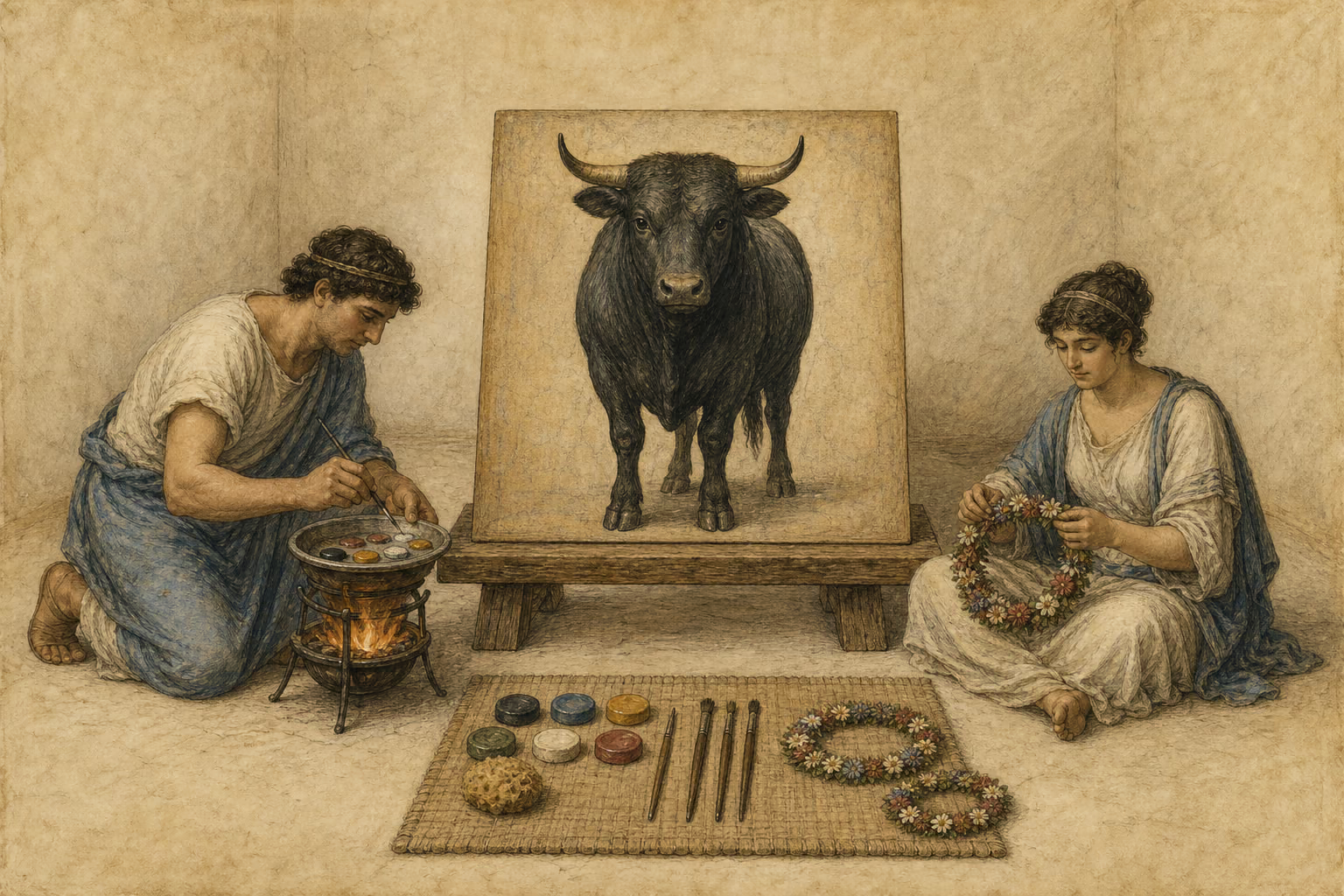
Ceris pingere ac picturam inurere quis primus excogitaverit, non constat. quidam Aristidis inventum putant, postea consummatum a Praxitele; sed aliquanto vetustiores encaustae picturae exstitere, ut Polygnoti et Nicanoris, Mnesilai Pariorum. Elasippus quoque Aeginae picturae suae inscripsit ἐνέκαεν, quod profecto non fecisset nisi encaustica inventa. Pamphilus quoque, Apellis praeceptor, non pinxisse solum encausta, sed etiam docuisse traditur Pausian Sicyonium, primum in hoc genere nobilem. Bryetis filius hic fuit eiusdemque primo discipulus. pinxit et ipse penicillo parietes Thespiis, cum reficerentur quondam a Polygnoto picti, multumque comparatione superatus existimabatur, quoniam non suo genere certasset. idem et lacunaria primus pingere instituit nec camaras ante eum taliter adornari mos fuit; parvas pingebat tabellas maximeque pueros. hoc aemuli interpretabantur facere eum, quoniam tarda picturae ratio esset illa. quam ob rem daturus ei celeritatis famam absolvit uno die tabellam, quae vocata est hemeresios, puero picto. amavit in iuventa Glyceram municipem suam, inventricem coronarum, certandoque imitatione eius ad numerosissimam florum varietatem perduxit artem illam. postremo pinxit et ipsam sedentem cum corona, quae e nobilissimis tabula est, appellata stephanoplocos, ab aliis stephanopolis, quoniam Glycera venditando coronas sustentaverat paupertatem. huius tabulae exemplar, quod apographon vocant, L. Lucullus duobus talentis emit.... Dionysius Athenis. Pausias autem fecitet grandes tabulas, sicut spectatam in Pompei porticu boum immolationem. eam primus invenit picturam, quam postea imitati sunt multi, aequavit nemo. ante omnia, cum longitudinem bovis ostendi vellet, adversum eum pinxit, non traversum, et abunde intellegitur amplitude. dein, cum omnes, quae volunt eminentia videri, candicanti faciant colore, quae condunt, nigro, hic totum bovem atri coloris fecit umbraeque corpus ex ipsa dedit, magna 20 prorsus arte in aequo extantia ostendente et in confracto solida omnia. Sicyone et hic vitam egit, diuque illa fuit patria picturae. tabulas inde e publico omnes propter aes alienum civitatis addictas Scauri aedilitas Romam transtulit.
Post eum eminuit longe ante omnes Euphranor Isthmius olympiade CIIII, idem qui inter fictores dictus est nobis. fecit et colossos et marmorea et typos scalpsit, docilis ac laboriosus ante omnes et in quocumque genere excellens ac sibi aequalis. hic primus videtur expressisse dignitates heroum et usurpasse symmetrian, sed fuit in universitate corporum exilior et capitibus articulisque grandior. volumina quoque composuit de symmetria et coloribus. opera eius sunt equestre proelium, XII dei, Theseus, in quod dixit eundem apud Parrhasium rosa pastum esse, suum vero carne. nobilis eius tabula Ephesi est, Ulixes simulata insania bovem cum equo iungens et palliati cogitantes, dux gladium condens.
Eodem tempore fuere Cydias, cuius tabulam Argonautas HS CXXXXIIII Hortensius orator mercatus est eique aedem fecit in Tusculano suo, Euphranoris autem discipulus Antidotus. huius est clipeo dimicans Athenis et luctator tubicenque inter pauca laudatus. ipse diligentior quam numerosior et in coloribus severus maxime inclaruit discipulo Nicia Atheniense, qui diligentissime mulieres pinxit. lumen et umbras custodiit atque ut eminerent e tabulis picturae maxime curavit. operum eius Nemea advecta ex Asia Romam a Silano, quam in curia diximus positam, item Liber pater in aede Concordiae, Hyacinthus, quem Caesar Augustus delectatus eo secum deportavit Alexandrea capta, et ob id Tiberius Caesar in templo eius dicavit hanc tabulam et Danaen, Ephesi vero est megabyzi, sacerdotis Ephesiae Dianae, sepulchrum, Athenis necyomantea Homeri. hanc vendere Attalo regi noluit talentis LX potiusque patriae suae donavit abundans opibus. fecit et grandes picturas, in quibus sunt Calypso et Io et Andromeda; Alexander quoque in Pompei porticibus praecellens et Calypso sedens huiceidem adscribuntur. quadripedum prosperrime canes expressit. hic est Nicias, de quo dicebat Praxiteles interrogatus, quae maxime opera sua probaret in marmoribus: quibus Nicias manum admovisset; tantum circumlitioni eius tribuebat. non satis discernitur, alium eodem nomine an hunc eundem quidam faciant olympiade CXII.
Niciae conparatur et aliquando praefertur Athenion Maronites, Glaucionis Corinthii discipulus, austerior colore et in austeritate iucundior, ut in ipsa pictura eruditio eluceat. pinxit in templo Eleusine phylarchum et Athenis frequentiam, quam vocavere syngenicon, item Achillem virginis habitu occultatum Ulixe deprendente et in una tabula VI signa, quaque maxime inclaruit, agasonem cum equo. quod nisi in iuventa obiiset, nemo compararetur.
Est nomen et Heraclidi Macedoni. initio naves pinxit captoque Perseo rege Athenas commigravit. ubi eodem tempore erat Metrodorus, pictor idemque philosophus, in utraque scientia magnae auctoritatis. itaque cum L. Paulus devicto Perseo petiisset ab Atheniensibus, ut ii sibi quam probatissimum philosophum mitterent ad erudiendos liberos, item pictorem ad triumphum excolendum, Athenienses Metrodorum elegerunt, professi eundem in utroque desiderio praestantissimum, quod ita Paulus quoque iudicavit.
Timomachus Byzantius Caesaris dictatoris aetate Aiacem et Mediam pinxit, ab eo in Veneris Genetricis aede positas, LXXX talentis venundatas. talentum Atticum $X$ VI taxat M. Varro. Timomachi aeque laudantur Orestes, Iphigenia in Tauris et Lecythion, agilitatis exercitator, cognatio nobilium, palliati, quos dicturos pinxit, alterum stantem, alterum sedentem. praecipue tamen ars ei favisse in Gorgone visa est.
Pausiae filius et discipulus Aristolaus e severissimis pictoribus fuit, cuius sunt Epaminondas, Pericles, Media, Virtus, Theseus, imago Atticae plebis, boum immolatio.— Sunt quibus et Nicophanes, eiusdem Pausiae discipulus, placeat diligentia, quam intellegant soli artifices, alias durus in coloribus et sile multus. nam Socrates iure omnibus placet; tales sunt eius cum Aesculapio filiae Hygia, Aegle, Panacea, Iaso et piger, qui appellatur Ocnos, spartum torquens, quod asellus adrodit.
Hactenus indicatis proceribus in utroque genere non silebuntur et primis proximi: Aristoclides, qui pinxit aedem Apollinis Delphis. Antiphilus puero ignem conflante laudatur ac pulchra alias domo splendescente ipsiusque pueri ore, item lanificio, in quo properant omnium mulierum pensa, Ptolemaeo venante, sed nobilissimo Satyro cum pelle pantherina, quem aposcopeuonta appellant, Aristophon Ancaeo vulnerato ab apro cum socia doloris Astypal aea numerosaque tabula, in qua sunt Priamus, Helena, Credulitas, Ulixes, Deiphobus, Dolus. Androbius pinxit Scyllum ancoras praecidentem Persicae classis, Artemon Danaen mirantibus eam praedonibus, reginam Stratonicen, Herculem et Deianiram, nobilissimas autem, quae sunt in Octaviae operibus, Herculem ab Oeta monte Doridos exusta mortalitate consensu deorum in caelum euntem, Laomedontis circa Herculem et Neptunum historiam; Alcimachus Dioxippum, qui pancratio Olympiae citra pulveris iactum, quod vocant ἀκονιτί, vicit; Coenus stemmata. Ctesilochus, Apellis discipulus, petulanti pictura innotuit, love Liberum parturiente depicto mitrato et muliebriter ingemescente inter obstetricia dearum, Cleon Cadmo, Ctesidemus Oechaliae expugnatione, Laodamia, Ctesicles reginae Stratonices iniuria. nullo enim honore exceptus ab ea pinxit volutantem cum piscatore, quem reginam amare sermo erat, eamque tabulam in portu Ephesi proposuit, ipse velis raptus. regina tolli vetuit, utriusque similitudine mire expressa. Cratinus comoedos Athenis in pompeo pinxit; Eutychides bigam: regit Victoria. Eudorus scaena spectatur—idera et ex aere signa fecit—, Hippys Neptuno et Victoria. Habron amicam et Concordiam pinxit et deorum simulacra, Leontiscus Aratum victorem cum tropaeo, psaltriam, Leon Sappho, Nearchus Venerem inter Gratias et Cupidines, Herculem tristem insaniae paenitentia, Nealces Venerem, ingeniosus et sollers,.... ime siquidem, cum proelium navale Persarum et Aegyptiorum pinxisset, quod in Nilo [cuius est aqua maris similis] factum volebat intellegi, argumento declaravit quod arte non poterat: asellum enim bibentem in litore pinxit et crocodilum insidiantem ei; Oenias syngenicon, Philiscus officinam pictoris ignem conflante puero, Phalerion Scyllam, Simonides Agatharchum et Mnemosynen, Simus iuvenem requiescentem, officinam fullonis quinquatrus celebrantem, idemque Nemesim egregiam, Theorus se inungentem, idem ab Oreste matrem et Aegisthum interfici, bellumque Iliacum pluribus tabulis, quod est Romae in Philippi porticibus, et Cassandram, quae est in Concordiae delubro, Leontium Epicuri cogitantem, Demetrium regem, Theon Orestis insaniam, Thamyram citharoedum, Tauriscus discobolum, Clytaemestram, Paniscon, Polynicen regnum repetentem et Capanea.
Non omittetur inter hos insigne exemplum. namque Erigonus, tritor colorum Nealcae pictoris, in tantum ipse profecit, ut celebrem etiam discipulum reliquerit Pasiam, fratrem Aeginetae fictoris. illud vero perquam rarum ac memoria dignum est, suprema opera artificum inperfectasque tabulas, sicut Irim Aristidis, Tyndaridas Nicomachi, Mediam Timomachi et quam diximus Venerem Apellis, in maiore admiratione esse quam perfecta, quippe in iis liniamenta reliqua ipsaeque cogitationes artificum spectantur, atque in lenocinio commendationis dolor est manus, cum id ageret, exstinctae.
Sunt etiamnum non ignobiles quidem, in transcursu tamen dicendi Aristocydes, Anaxander, Aristobulus Syrus, Arcesilas, Tisicratis filius, Coroebus, Nicomachi discipulus, Charmantides Euphranoris, Dionysodorus Colophonius, Dica eogenes, qui cum Demetrio rege vixit, Euthymides, Heraclides Macedo, Milon Soleus, Pyromachi statuarii discipuli, Mnasitheus Sicyonius, Mnasitimus, Aristonidae filius et discipulus, Nessus, Habronis filius, Polemon Alexandrinus, Theodorus Samius et Stadios, Nicosthenis discipuli, Xenon, Neoclis discipulus, Sicyonius.
Pinxere et mulieres: Timarete, Miconis filia, Dianam, quae in tabula Ephesi est antiquissimae picturae; Irene, Cratini pictoris filia et discipula, puellam, quae est Eleusine, Calypso, senem et praestigiatorem Theodorum, Alcisthenen saltatorem; Aristarete, Nearchi filia et discipula, Aesculapium. laia Cyzicena, perpetua virgo, M. Varronis iuventa Romae et penicillo pinxit et cestro in ebore imagines mulierum maxime et Neapoli anum in grandi tabula, suam quoque imaginem ad speculum. nec ullius velocior in pictura manus fuit, artis vero tantum, ut multum manipretiis antecederet celeberrimos eadem aetate imaginum pictores Sopolim et Dionysium, quorum tabulae pinacothecas inplent. pinxit et quaedam Olympias, de qua hoc solum memoratur, discipulum eius fuisse Autobulum.
Encausto pingendi duo fuere antiquitus genera, cera et in ebore cestro, id est vericulo, donec classes pingi coepere. hoc tertium accessit resolutis igni ceris penicillo utendi, quae pictura navibus nec sole nec sale ventisve corrumpitur.
Pingunt et vestes in Aegypto, inter pauca mirabili genere, candida vela, postquam attrivere, inlinentes non coloribus, sed colorem sorbentibus medicamentis. hoc cum fecere, non apparet in velis, sed in cortinam pigmenti ferventis mersa post momentum extrahuntur picta. mirumque, cum sit unus in cortina colos, ex illo alius atque alius fit in veste accipientis medicamenti qualitate mutatus, nec postea ablui potest. ita cortina, non dubie confusura colores, si pictos acciperet, digerit ex uno pingitque, dum coquit, et adustae eae vestes firmiores usibus fiunt quam si non urerentur.—
English · Bostock & Riley 1855–57
I must not omit here, in reference to painting, a celebrated story that is told about Lepidus. During the Triumvirate, when he was entertained by the magistrates of a certain place, he had lodgings given him in a house that was wholly surrounded with trees. The next day, he complained to them in a threatening tone, that he had been unable to sleep for the singing of the birds there. Accordingly, they had a dragon painted, on pieces of parchment of the greatest length that could possibly be obtained, and surrounded the grove with it; a thing that so terrified the birds, it is said, that they became silent at once; and hence it was that it first became known how this object could be attained.
It is not agreed who was the inventor of the art of painting in wax and in encaustic. Some think that it was a discovery of the painter Aristides, and that it was afterwards brought to perfection by Praxiteles: but there are encaustic paintings in existence, of a somewhat prior date to them, those by Polygnotus, for example, and by Nicanor and Arcesilaüs, natives of Paros. Elasippus too, has inscribed upon a picture of his at Ægina, the word ἐνέκαεν; a thing that he certainly could not have done, if the art of encaustic painting had not been then invented.
It is said, too, that Pamphilus, the instructor of Apelles, not only painted in encaustic, but also instructed Pausias of Sicyon in the art, the first who rendered himself distinguished in this branch. Pausias was the son of Bryetes, by whom he was originally instructed in the art of painting. He retouched also with the pencil some walls at Thespiæ, then undergoing repair, which had formerly been painted by Polygnotus. Upon instituting a comparison, however, it was considered that he was greatly inferior, this kind of painting not being in his line. It was he, too, who first thought of painting ceilings: nor had it been the practice before his day to use this kind of decoration for arched roofs. He painted many small pictures also, miniatures of children more particularly; a thing which, according to the interpretation put upon it by his rivals, was owing to the peculiarly slow process of encaustic painting. The consequence was, that being determined to give a memorable proof of his celerity of execution, he completed a picture in the space of a single day, which was thence called the “Hemeresios,” representing the portrait of a child.
In his youth, he was enamoured of Glycera, his fellow-townswoman, the first inventor of chaplets; and in his rivalry of the skill shown by her, he achieved so much success in the encaustic art, as to reproduce the almost numberless tints displayed by flowers. At a later period, he painted her, seated, with a chaplet on, and thus produced one of the very finest of his pictures; known as the “Stephaneplocos” by some, and as the “Stephanopolis” by others; from the circumstance that Glycera had supported herself in her poverty by selling these chaplets. A copy of this picture, usually known as an “apographon,” was purchased by L. Lucullus at Athens, during the festival of the Dionysia, at the price of two talents.
Pausias also painted some large pictures, a Sacrifice of Oxen, for instance, which used to be seen in the Portico of Pompeius. In this painting he invented several improvements, which many artists have since imitated, but none with the same success. Although in the picture it was particularly his desire to give an impression of the length of the ox, he painted it with a front view and not sideways, and still has caused the large dimensions of the animal to be fully understood. And then too, whereas all other painters colour in white such parts as they wish to have the appearance of being prominent, and in black such portions as are intended to remain in the back-ground, he has painted the whole of the ox of a black colour, and has shown the dimensions of the body which throws the shadow by the medium of the shadow itself; thus evincing a wonderful degree of skill in showing relief upon a coat painted with a single colour, and conveying an impression of uniform solidity upon a broken ground. It was at Sicyon also that Pausias passed his life, a city which for a long time continued to be the native place of painting. Ultimately, all the paintings belonging to that place were sold by public auction for the discharge of the debts owing by the city, and were transferred to Rome in the ædileship of Scaurus.
Next to him, in the hundred and fourth Olympiad, Euphranor, the Isthmian, distinguished himself far beyond all others, an artist who has been already mentioned in our account of the statuaries. He executed some colossal figures also, and some statues in marble, and he chased some drinking-vessels; being studious and laborious in the highest degree, excellent in every branch, and at all times equal to himself. This artist seems to have been the first to represent heroes with becoming dignity, and to have paid particular attention to symmetry. Still, however, in the generality of instances, he has made the body slight in proportion to the head and limbs. He composed some treatises also upon symmetry and colours. His works are, an Equestrian Combat; the Twelve Gods; and a Theseus; with reference to which he remarked that the Theseus of Parrhasius had been fed upon roses, but his own upon beef. There are also at Ephesus some famous pictures by him; an Ulysses, in his feigned madness, yoking together an ox and a horse; Men, in an attitude of meditation, wearing the pallium; and a Warrior, sheathing his sword.
At the same time, also, flourished Cydias; for whose picture of the Argonautæ the orator Hortensius paid one hundred and forty-four thousand sesterces, and had a shrine constructed expressly for its reception on his estate at Tusculum. There was also Antidotus, a pupil of Euphranor, by whom there is, at Athens, a Combatant armed with a shield; a Wrestler, also; and a Trumpeter, a work which has been considered a most exquisite production.
Antidotus, as a painter, was more careful in his works than prolific, and his colouring was of a severe style. His principal glory was his having been the instructor of Nicias of Athens; who was a most careful painter of female portraits, and a strict observer of light and shade, making it his especial care that the figures in his pictures should appear in the boldest relief. His works are, a Nemea, which was brought from Asia to Rome by Silanus, and was placed in the Curia, as already stated; a Father Liber, in the Temple of Concord; a Hyacinthus, which the Emperor Augustus was so delighted with, that he took it away with him after the capture of Alexandria; for which reason also it was consecrated in the Temple of Augustus by the Emperor Tiberius; and a Danaë. At Ephesus, there is a tomb by him of a megabyzus, or priest of the Ephesian Diana; and at Athens a representation of the Necyomantea of Homer; which last he declined to sell to King Attalus for sixty talents, and in preference, so rich was he, made a present of it to his own native place. He also executed some large pictures, among which there are a Calypso, an Io, an Andromeda, a very fine Alexander, in the Porticos of Pompeius, and a Calypso, seated. To this painter also there are some pictures of cattle attributed, and in his dogs he has been remarkably successful. It was this Nicias, with reference to whom, Praxiteles, when asked with which of all his works in marble he was the best pleased, made answer, “Those to which Nicias has set his hand,” so highly did he esteem the colouring of that artist. It has not been satisfactorily ascertained whether it is this artist or another of the same name that some writers have placed in the hundred and twelfth Olympiad.
With Nicias has been compared, and indeed sometimes preferred to him, Athenion of Maronea, a pupil of Glaucion of Corinth. In his colouring he is more sombre than Nicias, and yet, with all his sombreness, more pleasing; so much so indeed, that in his paintings shines forth the extensive knowledge which he possessed of the art. He painted, in the Temple at Eleusis, a Phylarchus; and at Athens, a family group, which has been known as the “Syngenicon;” an Achilles also, concealed in a female dress, and Ulysses detecting him; a group of six whole-length figures, in one picture; and, a work which has contributed to his fame more than any other, a Groom leading a Horse. Indeed, if he had not died young, there would have been no one comparable to Athenion in painting.
Heraclides, too, of Macedon, had some repute as an artist. At first he was a painter of ships, but afterwards, on the capture of King Perseus, he removed to Athens; where at the same period was also Metrodorus, who was both a painter and a philosopher, and of considerable celebrity in both branches. Hence it was, that when L. Paulus Æmilius, after the conquest of Perseus, requested the Athenians to send him the most esteemed philosopher for the education of his children, and a painter to represent his triumph, they made choice of Metrodorus, declaring that he was eminently suited for either purpose; a thing which Paulus admitted to be the case.
Timomachus of Byzantium, in the time of the Dictator Cæsar, painted an Ajax and a Medea, which were placed by Cæsar in the Temple of Venus Genetrix, having been purchased at the price of eighty talents; the value of the Attic talent being, according to M. Varro, equivalent to six thousand denarii. An Orestes, also by Timomachus, an Iphigenia in Tauris, and a Lecythion, a teacher of gymnastics, are equally praised; a Noble Family also; and Two Men clothed in the pallium, and about to enter into conversation, the one standing, the other in a sitting posture. It is in his picture, however of the Gorgon, that the art appears to have favoured him most highly.
Aristolaüs, the son and pupil of Pausias, was one of the painters in a more severe style: there are by him an Epaminondas, a Pericles, a Medea, a Theseus, an emblematical picture of the Athenian People, and a Sacrifice of Oxen. Some persons, too, are pleased with the careful style of Nicophanes, who was also a pupil of Pausias; a carefulness, however, which only artists can appreciate, as in other respects he was harsh in his colours, and too lavish of sil; as in his picture, for example, of Æsculapius with his daughters, Hygia, Ægle, and Panacea, his Jason, and his Sluggard, known as the “Ocnos,” a man twisting a rope at one end as an ass gnaws it at the other. As to Socrates, his pictures are, with good reason, universally esteemed.
Having now mentioned the principal painters in either branch, I must not pass in silence those who occupy the next rank. Aristoclides decorated the Temple of Apollo at Delphi. Antiphilus is highly praised for his picture of a Boy blowing a Fire, which illumines an apartment handsomely furnished, and throws a light upon the features of the youth; a Spinning-room, with women plying their respective tasks; and a King Ptolemæus hunting. But his most famous picture is his Satyr, clad in a panther’s skin, and known as the “Aposcopeuon.” Aristophon has painted an Ancæus wounded by the Boar, with Astypale, the sharer of his grief; and a picture with numerous figures, representing Priam, Helena, Credulity, Ulysses, Deiphobus, and Guile. Androbius has painted a Scyllus cutting away the anchors of the Persian fleet: and Artemon a Danaë, with Robbers in admiration; a Queen Stratonice; and a Hercules and Deianira. But the finest of all this artist’s works are those now in the buildings of Octavia; a Hercules ascending to heaven, with the sanction of the gods, from his funeral pile upon Mount Œta in Doris; and the story of Laomedon and his bargain with Hercules and Neptune. Alcimachus has painted Dioxippus, who was victorious in the pancratium at Olympia, without raising the dust; a victory known to the Greeks as being gained “aconiti.” Cœnus painted pedigrees.
Ctesilochus, a pupil of Apelles, was famous for a burlesque picture of his representing Jupiter in labour with Bacchus, with a mitra on his head, and crying like a woman in the midst of the goddesses, who are acting as midwives. Cleon distinguished himself by his Cadmus; and Ctesidemus, by his Capture of Œchalia and his Laodamia.
Ctesicles became notorious for the insult which he offered to Queen Stratonice; for, upon failing to meet with an honourable reception from her, he painted her, romping with a fisherman, for whom, according to common report, she had conceived an ardent affection. After exhibiting this picture in the harbour at Ephesus, he at once set sail and escaped: the queen, however, would not allow of its removal, the likenesses of the two figures being so admirably expressed. Cratinus, the comic writer, painted at Athens, in the Pompeion there.
Of Eutychides, there is a Victory guiding a chariot drawn by two horses. Eudorus is famous for his dramatic scenery; he executed some statues in bronze also. By Hippys there is a Neptune and Victory. Habron painted a picture of Friendship and Concord, and several figures of divinities; Leontiscus, an Aratus with the trophies of victory, and a Singing-girl; Leon, a portrait of Sappho; and Nearchus, a Venus attended by Cupids and Graces, and a Hercules, sorrowing and repentant at the sad results of his madness. Nealces, a remarkably ingenious and inventive artist, painted a Venus. On one occasion, when he had to represent a naval engagement between the Persians and Egyptians, wishing it to be understood that it took place on the river Nilus, the waters of which are similar in appearance to those of the sea, he employed an emblem to disclose that which would not admit of expression by art; for he painted an ass drinking on the shore, and a crocodile lying in wait for him.
Œnias has painted a Family Group; Philiscus, a Painter’s Studio, with a boy blowing the fire; Phalerion, a Scylla; Simonides, an Agatharchus and a Mnemosyne; Simus, a youth reposing, a Fuller’s Shop, a person celebrating the Quinquatria, and a Nemesis of great merit. By Theorus there is a Man Anointing himself; a picture of the Murder of Ægisthus and Clytæmnestra by Orestes; and a representation of the Trojan War, in a series of paintings, now at Rome, in the Porticos of Philippus: a Cassandra also, in the Temple of Concord; a Leontium, the mistress of Epicurus, in an attitude of meditation; and a King Demetrius. Theon has painted the Frenzy of Orestes, and a Thamyras playing on the lyre; Tauriscus, a Discobolus, a Clytæmnestra, a Pan in miniature, a Polynices claiming the sovereignty, and a Capaneus.
In speaking of these artists, I must not omit to mention one memorable circumstance: Erigonus, who was colour-grinder to the painter Nealces, himself made such progress in the art as to leave a very celebrated pupil, Pasias, the brother of Ægineta, the modeller. It is also a very singular fact, and one well deserving of remark, that the last works of these artists, their unfinished paintings, in fact, are held in greater admiration than their completed works; the Iris of Aristides, for instance, the Tyndaridæ of Nicomachus, the Medea of Timomachus, and the Venus of Apelles, already mentioned. For in such works as these, we not only see the outline depicted, and the very thoughts of the artist expressed, but have the composition additionally commended to our notice by the regrets which we must necessarily feel on finding the hand that commenced it arrested by death.
There are still some other artists, who, though by no means without reputation, can only be noticed here in a summary manner: Aristocydes; Anaxander; Aristobulus of Syria; Arcesilas, son of Tisicrates; Corœbos, a pupil of Nicomachus; Charmantides, a pupil of Euphranor; Dionysodorus of Colophon; Dicæogenes, a contemporary of King Demetrius; Euthymides; Heraclides of Macedon; Milo of Soli, a pupil of the statuary Pyromachus; Mnasitheus of Sicyon; Mnasitimus, the son and pupil of Aristonidas; Nessus, son of Habron; Polemon of Alexandria; Theodorus of Samos, and Stadieus, pupils of Nicosthenes; and Xeno of Sicyon, a pupil of Neocles.
There have been some female painters also. Timarete, the daughter of Micon, painted a Diana at Ephesus, one of the very oldest panel-paintings known. Irene, daughter and pupil of the artist Cratinus, painted a figure of a girl, now at Eleusis, a Calypso, an Aged Man, the juggler Theodorus, and Alcisthenes the dancer. Aristarete, daughter and pupil of Nearchus, painted an Æsculapius. Iaia of Cyzicus, who always remained single, painted at Rome, in the youth of M. Varro, both with the brush, and with the graver, upon ivory, her subjects being female portraits mostly. At Naples, there is a large picture by her, the portrait of an Old Woman; as also a portrait of herself, taken by the aid of a mirror. There was no painter superior to her for expedition; while at the same time her artistic skill was such, that her works sold at much higher prices than those of the most celebrated portrait-painters of her day, Sopolis namely, and Dionysius, with whose pictures our galleries are filled. One Olympias painted also, but nothing is known relative to her, except that she had Autobulus for a pupil.
In ancient times there were but two methods of encaustic painting, in wax and on ivory, with the cestrum or pointed graver. When, however, this art came to be applied to the painting of ships of war, a third method was adopted, that of melting the wax colours and laying them on with a brush, while hot. Painting of this nature, applied to vessels, will never spoil from the action of the sun, winds, or salt water.
In Egypt, too, they employ a very remarkable process for the colouring of tissues. After pressing the material, which is white at first, they saturate it, not with colours, but with mordents that are calculated to absorb colour. This done, the tissues, still unchanged in appearance, are plunged into a cauldron of boiling dye, and are removed the next moment fully coloured. It is a singular fact, too, that although the dye in the pan is of one uniform colour, the material when taken out of it is of various colours, according to the nature of the mordents that have been respectively applied to it: these colours, too, will never wash out. Thus the dye-pan, which under ordinary circumstances, no doubt, would have made but one colour of several, if coloured tissues had been put into it, is here made to yield several colours from a single dye. At the same moment that it dyes the tissues, it boils in the colour; and it is the fact, that material which has been thus submitted to the action of fire becomes stouter and more serviceable for wear, than it would have been if it had not been subjected to the process.