LIBER XXXV · CAPUT 12
THE INVENTORS OF THE ART OF MODELLING
Latine · Mayhoff 1906
De pictura satis superque. contexuisse his et plasticen conveniat eiusdem operae terrae.
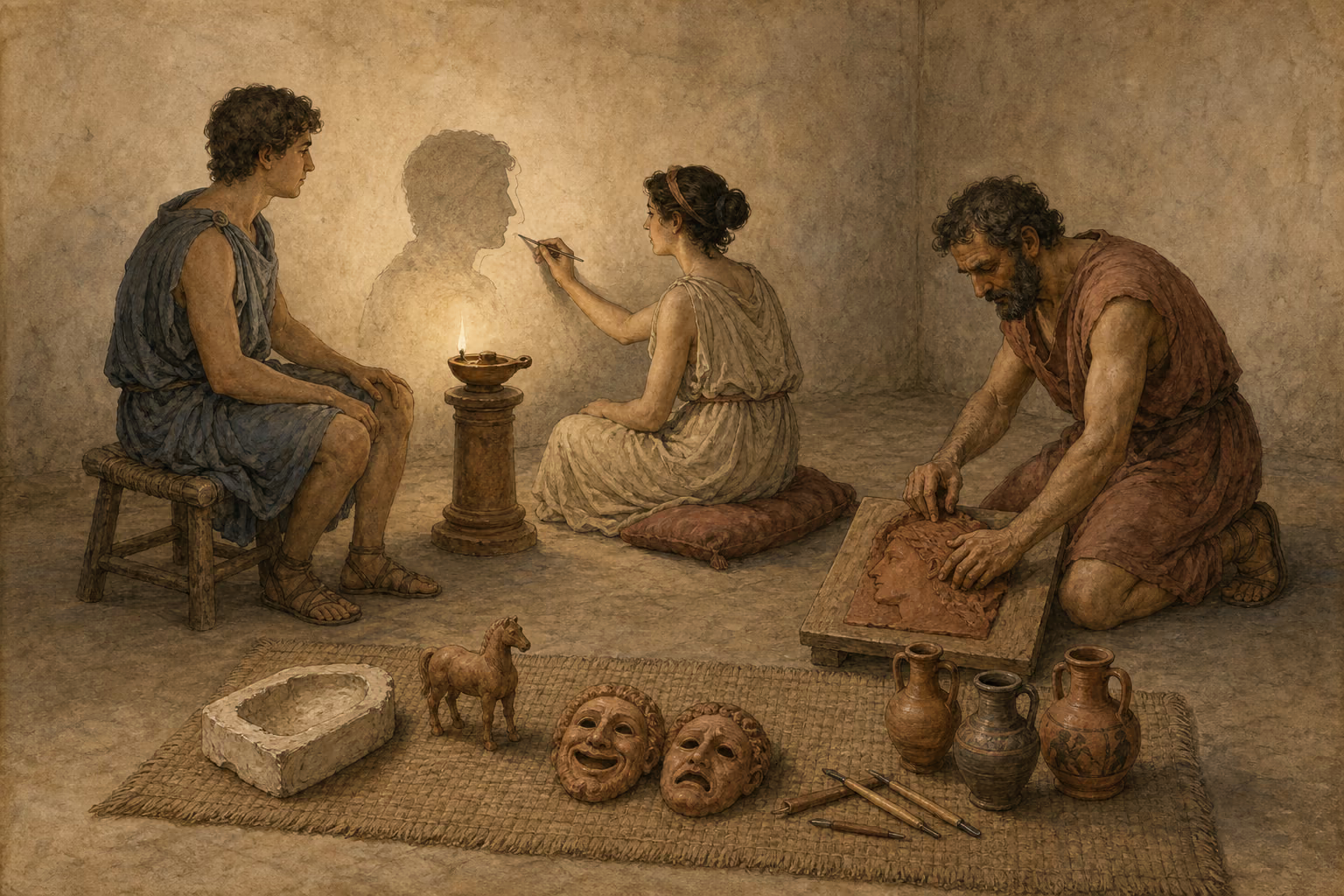
Fingere ex argilla similitudines Butades Sicyonius figulus primus invenit Corinthi filiae opera, quae capta amore iuvenis, abeunte illo peregre, umbram ex facie eius ad lucernam in pariete lineis circumscripsit, quibus pater eius inpressa argilla typum fecit et cum ceteris fictilibus induratum igni proposuit, eumque servatum in Nymphaeo, donec Mummius Corinthum everterit, tradunt. sunt qui in Samo primos omnium plasticen invenisse Rhoecum et Theodorum tradant multo ante Bacchiadas Corintho pulsos, Damaratum vero ex eadem urbe profugum, qui in Etruria Tarquinium regem populi Romani genuit, comitatos fictores Euchira, Diopum, Eugrammum; ab iis Italiae traditam plasticen. Butadis inventum est rubricam addere aut ex rubra creta fingere, primusque personas tegularum extremis imbricibus inposuit, quae inter initia prostypa vocavit; postea idem ectypa fecit. hinc et fastigia templorum orta. propter hunc plastae appellati.
Hominis autem imaginem gypso e facie ipsa primus omnium expressit ceraque in eam formam gypsi infusa emendare instituit Lysistratus Sicyonius, frater Lysippi, de quo diximus. hic et similitudines reddere instituit; ante eum quam pulcherrimas facere studebant. idem et de signis effigies exprimere invenit, crevitque res in tantum, ut nulla signa statuaeve sine argilla fierent. quo apparet antiquiorem hancfuisse scientiam quam fundendi aeris.
Plastae laudatissimi fuere Damophilus et Gorgasus, iidem pictores, qui Cereris aedem Romae ad circum maximum utroque genere artis suae excoluerant, versibus inscriptis Graece, quibus significarent ab dextra opera Damophili esse, ab laeva Gorgasi. ante hanc aedem Tuscanica omnia in aedibus fuisse auctor est Varro, et ex hac, cum reficeretur, crustas parietum excisas tabulis marginatis inclusas esse, item signa ex fastigiis dispersa. fecit et Chalcosthenes cruda opera Athenis, qui locus ab officina eius Ceramicos appellatur. M. Varro tradit sibi cognitum Romae Possim nomine, a quo facta poma et uvas nemo posset aspectu discernere a veris. idem magnificat Arcesilaum, L. Luculli familiarem, cuius proplasmata pluris venire solita artificibus ipsis quam aliorum opera; ab hoc factam Venerem Genetricem in foro Caesaris et, priusquam absolveretur, festinatione dedicandi positam; eidem a Lucullo HS |X???| signum Felicitatis locatum, cui mors utriusque inviderit; Octavio equiti Romano cratera facere volenti exemplar e gypso factum talento. laudat et Pasitelen, qui plasticen matrem caelaturae et statuariae scalpturaeque dixit et, cum esset in omnibus iis summus, nihil umquam fecit ante quam finxit. praeterea elaboratam hanc artem Italiae et maxime Etruriae; Vulcam Veis accitum, cui locaret Tarquinius Priscus lovis effigiem in Capitolio dicandam; fictilem eum fuisse et ideo miniari solitum; fictiles in fastigio templi eius quadrigas, de quibus saepe diximus; ab hoc eodem factum Herculem, qui hodieque materiae nomen in urbe retinet. hae enim tum effigies deorum erant lautissimae, nec paenitet nos illorum, qui tales eos coluere; aurum enim et argentum ne diis quidem conficiebant. durant etiam nunc plerisque in locis talia simulacra; fastigia quidem templorum etiam in urbe crebra et municipiis, mira caelatura et arte suique firmitate, sanctiora auro, certe innocentiora.
In sacris quidem etiam inter has opes hodie non murrinis crystallinisve, sed fictilibus prolibatur simpulis, inenarrabili Terrae benignitate, si quis singula aestimet, etiam ut omittantur in frugum, vini, pomorum, herbarum et fruticum, medicamentorum, metallorum generibus beneficia eius, quae adhuc diximus. neque adsiduitate satiant figlinarum opera, * doliis ad vina excogitatis, ad aquas tubulis, ad balineas mammatis, ad tecta *imbricibus* coctilibus laterculis fundamentisque aut quae rota fiunt, propter quae Numa rex septimum collegium figulorum instituit. quin et defunctos sese multi fictilibus soliis condi maluere, sicut M. Varro, Pythagorio modo in myrti et oleae atque populi nigrae foliis. maior pars hominum terrenis utitur vasis. Samia etiam nunc in esculentis laudantur. retinent hanc nobilitatem et Arretium in Italia et calicum tantum Surrentum, Hasta, Pollentia, in Hispania Saguntum, in Asia Pergamum. habent et Trallis ibi opera sua et in Italia Mutina, quoniam et sic gentes nobilitantur et haec quoque per maria, terras ultro citro portantur, insignibus rotae officinis. Erythris in templo hodieque ostenduntur amphorae duae propter tenuitatem consecratae discipuli magistrique certamine, uter tenuiorem humum duceret. Cois ea laus maxima, Hadrianis firmitas, nonnullis circa hoc severitatis quoque exemplis. Q. Coponium invenimus ambitus damnatum, quia vini amphoram dedisset dono ei, cui suffragi latio erat. atque ut e luxu quoque aliqua contingat auctoritas figlinis: tripatinium, inquit Fenestella, appellabatur summa cenarum lautitia; una erat murenarum, altera luporum, tertia mixti piscis, inclinatis iam scilicet moribus, ut tamen eos praeferre Graeciae etiam philosophis possimus, siquidem in Aristotelis heredum auctione septuaginta patinas venisse traditur. nos cum unam Aesopi tragoediarum histrionis in natura avium diceremus HS C??? stetisse, non dubito indignatos legentes. at, Hercules, Vitellius in principatu suo |X???| Hs condidit patinam, cui faciendae fornax in campis exaedificata erat, quoniam eo pervenit luxuria, ut etiam fictilia pluris constent quam murrina. propter hanc Mucianus altero consulatu suo in conquestione exprobravit patinarum paludes Vitelli memoriae, non illa foediore, cuius veneno Asprenati reo Cassius Severus accusator obiciebat interisse convivas cxxx. nobilitantur his quoque oppida, ut Regium et Cumae. Samia testa Matris deum sacerdotes, qui Galli vocantur, virilitatem amputare nec aliter citra perniciem, M. Caelio credamus, qui linguam sic amputandam obiecit gravi probro, tamquam et ipse iam tune eidem Vitellio malediceret. quid non excogitat vita fractis etiam testis utendo, sic ut firmius durent, tunsis calce addita, quae vocant Signina! quo genere etiam pavimenta excogitavit.
English · Bostock & Riley 1855–57
On painting we have now said enough, and more than enough; but it will be only proper to append some accounts of the plastic art. Butades, a potter of Sicyon, was the first who invented, at Corinth, the art of modelling portraits in the earth which he used in his trade. It was through his daughter that he made the discovery; who, being deeply in love with a young man about to depart on a long journey, traced the profile of his face, as thrown upon the wall by the light of the lamp. Upon seeing this, her father filled in the outline, by compressing clay upon the surface, and so made a face in relief, which he then hardened by fire along with other articles of pottery. This model, it is said, was preserved in the Nymphæum at Corinth, until the destruction of that city by Mummius. Others, again, assert that the first inventors of the plastic art were Rhœcus and Theodorus, at Samos, a considerable period before the expulsion of the Bacchiadæ from Corinth: and that Damaratus, on taking to flight from that place and settling in Etruria, where he became father of Tarquinius, who was ultimately king of the Roman people, was accompanied thither by the modellers Euchir, Diopus, and Eugrammus, by whose agency the art was first introduced into Italy.
Butades first invented the method of colouring plastic compositions, by adding red earth to the material, or else modelling them in red chalk: he, too, was the first to make masks on the outer edges of gutter-tiles upon the roofs of buildings; in low relief, and known as “prostypa” at first, but afterwards in high relief, or “ectypa.” It was in these designs, too, that the ornaments on the pediments of temples originated; and from this invention modellers first had their name of “plastæ.”
The first person who expressed the human features by fitting a mould of plaster upon the face, and then improving it by pouring melted wax into the cast, was Lysistratus of Sicyon, brother of Lysippus, already mentioned. It was he, in fact, who first made it his study to give a faithful likeness; for before his time, artists only thought how to make their portraits as handsome as possible. The same artist, too, was the first who thought of making models for his statues; a method which afterwards became so universally adopted, that there could be neither figure nor statue made without its model in clay. Hence it would appear, that the art of modelling in clay is more ancient than that of moulding in bronze.
The most celebrated modellers were Damophilus and Gorgasus, who were painters as well. These artists adorned with their works, in both kinds, the Temple of Ceres, in the Circus Maximus at Rome; with an inscription in Greek, which stated that the decorations on the right-hand were the workmanship of Damophilus, and those on the left, of Gorgasus. Varro says that, before the construction of this temple, everything was Tuscan in the temples; and that, when the temple was afterwards repaired, the painted coatings of the walls were cut away in tablets and enclosed in frames, but that the figures on the pediments were dispersed. Chalcosthenes, too, executed at Athens some works in unbaked earth, on the spot which, from his manufactory, has since obtained the name of “Ceramicus.”
M. Varro states that he knew an artist at Rome, Possis by name, who executed fruit, grapes, and fish, with such exactness, that it was quite impossible, by only looking at them, to distinguish them from the reality. He speaks very highly also of Arcesilaüs, who was on terms of intimacy with Lucius Lucullus, and whose models in plaster used to sell at a higher rate, among artists themselves, than the works of others. He informs us, also, that it was by this modeller that the Venus Genetrix in the Forum of Cæsar was executed, it having been erected before completion, in the great haste that there was to consecrate it; that the same artist had made an agreement with Lucullus to execute a figure of Felicity, at the price of sixty thousand sesterces, the completion of which was prevented by their death; and that Octavius, a Roman of equestrian rank, being desirous of a model for a mixing-bowl, Arcesilaüs made him one in plaster, at the price of one talent.
Varro praises Pasiteles also, who used to say, that the plastic art was the mother of chasing, statuary, and sculpture, and who, excellent as he was in each of these branches, never executed any work without first modelling it. In addition to these particulars, he states that the art of modelling was anciently cultivated in Italy, Etruria in particular; and that Volcanius was summoned from Veii, and entrusted by Tarquinius Priscus with making the figure of Jupiter, which he intended to consecrate in the Capitol; that this Jupiter was made of clay, and that hence arose the custom of painting it with minium; and that the four-horse chariot, so often mentioned, upon the pediment of the temple, was made of clay as well. We learn also from him, that it was by the same artist that the Hercules was executed, which, even to this day, is named at Rome from the material of which it is composed. Such, in those times, were the most esteemed statues of the gods; and small reason have we to complain of our forefathers for worshipping such divinities as these; for in their day there was no working of gold and silver—no, not even in the service of the gods.
Statues of this nature are still in existence at various places. At Rome, in fact, and in our municipal towns, we still see many such pediments of temples; wonderful too, for their workmanship, and, from their artistic merit and long duration, more deserving of our respect than gold, and certainly far less baneful. At the present day even, in the midst of such wealth as we possess, we make our first libation at the sacrifice, not from murrhine vases or vessels of crystal, but from ladles made of earthenware.
Bounteous beyond expression is the earth, if we only consider in detail her various gifts. To omit all mention of the cereals, wine, fruits, herbs, shrubs, medicaments, and metals, bounties which she has lavished upon us, and which have already passed under our notice, her productions in the shape of pottery alone, would more than suffice, in their variety, to satisfy our domestic wants; what with gutter-tiles of earthenware, vats for receiving wine, pipes for conveying water, conduits for supplying baths, baked tiles for roofs, bricks for foundations, the productions, too, of the potter’s wheel; results, all of them, of an art, which induced King Numa to establish, as a seventh company, that of the makers of earthenware.
Even more than this, many persons have chosen to be buried in coffins made of earthenware; M. Varro, for instance, who was interred, in true Pythagorean style, in the midst of leaves of myrtle, olive, and black poplar; indeed, the greater part of mankind make use of earthen vases for this purpose. For the service of the table, the Samian pottery is even yet held in high esteem; that, too, of Arretium in Italy, still maintains its high character; while for their cups, and for those only, the manufactories of Surrentum, Asta, Pollentia, Saguntum in Spain, and Pergamus in Asia, are greatly esteemed.
The city of Tralles, too, in Asia, and that of Mutina in Italy, have their respective manufactures of earthenware, and even by this branch of art are localities rendered famous; their productions, by the aid of the potter’s wheel, becoming known to all countries, and conveyed by sea and by land to every quarter of the earth. At Erythræ, there are still shown, in a temple there, two amphoræ, that were consecrated in consequence of the singular thinness of the material: they originated in a contest between a master and his pupil, which of the two could make earthenware of the greatest thinness. The vessels of Cos are the most highly celebrated for their beauty, hut those of Adria are considered the most substantial.
In relation to these productions of art, there are some instances of severity mentioned: Q. Coponius, we find, was condemned for bribery, because he made present of an amphora of wine to a person who had the right of voting. To make luxury, too, conduce in some degree to enhance our estimation of earthenware, “tripatinium,” as we learn from Fenestella, was the name given to the most exquisite course of dishes that was served up at the Roman banquets. It consisted of one dish of murænæ, one of lupi, and a third of a mixture of fish. It is clear that the public manners were then already on the decline; though we still have a right to hold them preferable to those of the philosophers even of Greece, seeing that the representatives of Aristotle, it is said, sold, at the auction of his goods, as many as seventy dishes of earthenware. It has been already stated by us, when on the subject of birds, that a single dish cost the tragic actor Æsopus one hundred thousand sesterces; much to the reader’s indignation, no doubt; but, by Hercules! Vitellius, when emperor, ordered a dish to be made, which was to cost a million of sesterces, and for the preparation of which a furnace had to be erected out in the fields! luxury having thus arrived at such a pitch of excess as to make earthenware even sell at higher prices than murrhine vessels. It was in reference to this circumstance, that Mucianus, in his second consulship, when pronouncing one of his perorations, reproached the memory of Vitellius with his dishes as broad as the Pomptine Marsh; not less deserving to be execrated than the poisoned dish of Asprenas, which, according to the accusation brought against him by Cassius Severus, caused the death of one hundred and thirty guests.
These works of artistic merit have conferred celebrity on some cities even, Rhegium for example, and Cumæ. The priests of the Mother of the gods, known as the Galli, deprive themselves of their virility with a piece of Samian pottery, the only means, if we believe M. Cælius, of avoiding dangerous results. He it was, too, who recommended, when inveighing against certain abominable practices, that the person guilty of them should have his tongue cut out, in a similar manner; a reproach which would appear to have been levelled by anticipation against this same Vitellius.
What is there that human industry will not devise? Even broken pottery has been utilized; it being found that, beaten to powder, and tempered with lime, it becomes more solid and durable than other substances of a similar nature; forming the cement known as the “Signine” composition, so extensively employed for even making the pavements of houses.