LIBER XXXVI · CAPUT 12
MARVELLOUS WORKS IN EGYPT. THE PYRAMIDS
Latine · Mayhoff 1906
Dicantur obiter et pyramides in eadem Aegypto, regum pecuniae otiosa ac stulta ostentatio, quippe cum faciendi eas causa a plerisque tradatur, ne pecuniam successoribus aut aemulis insidiantibus praeberent aut ne plebs esset otiosa. multa circa hoc vanitas hominum illorum fuit. vestigia complurium incohatarum extant. una est in Arsinoite nomo, duae in Memphite, non procul labyrintho, de quo et ipso dicemus, totidem ubi fuit Moeridis lacus, hoc est fossa grandis, sed Aegyptiis inter mira ac memoranda narrata. harum cacumina cc cubita extra aquam eminere dicuntur. reliquae tres, quae orbem terrarum inplevere fama, sane conspicuae undique adnavigantibus, sitae sunt in parte Africae monte saxeo sterilique inter Memphim oppidum et quod appellari diximus Delta, a Nilo minus IIII milia passuum, a MemphiVII D, vico adposito quem vocant Busirin; in eo sunt adsueti scandere illas.
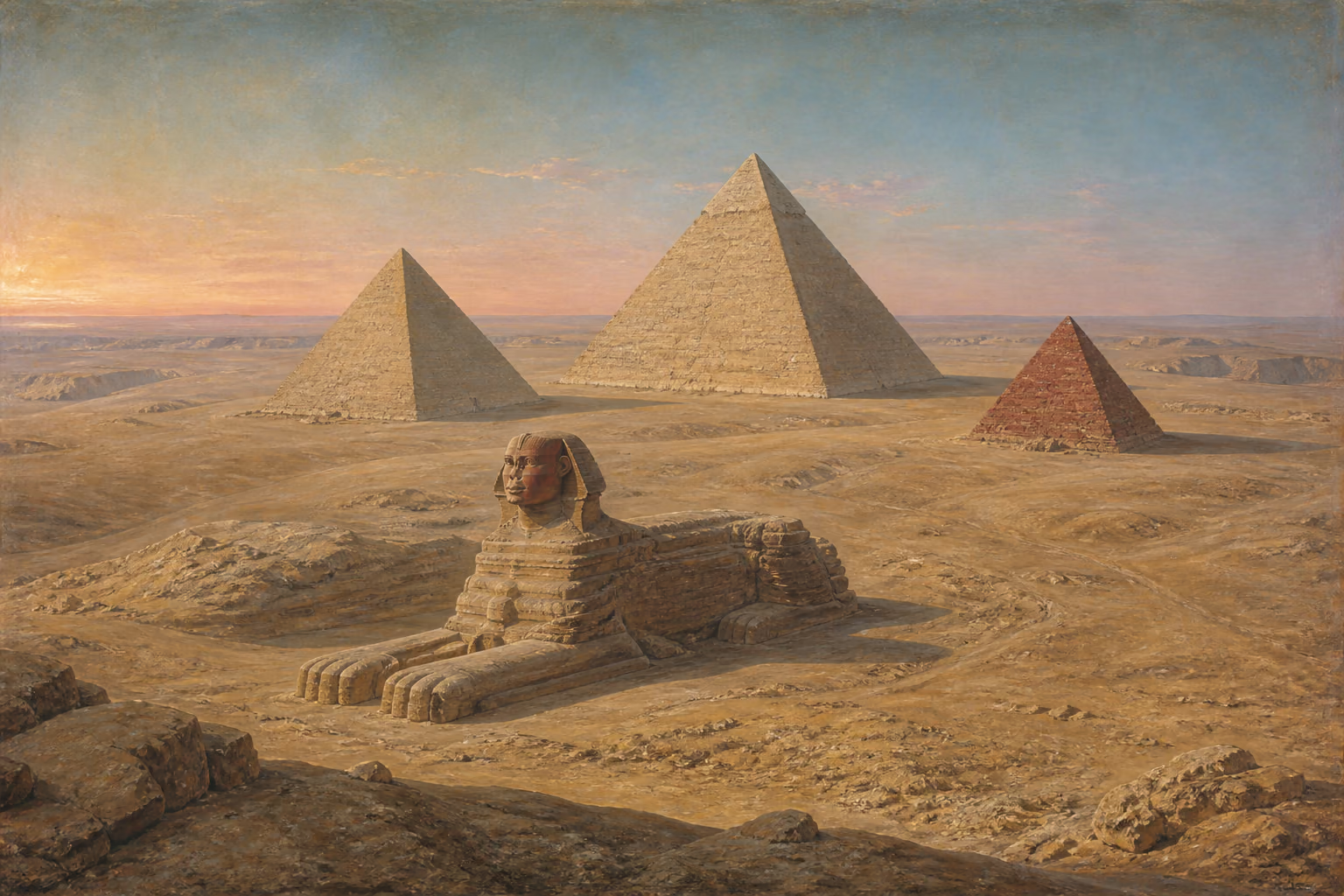
Ante est sphinx vel magis narranda, de qua siluere, numen accolertium. Harmain regem putant in ea conditum et volunt invectam videri; est autem saxo naturali elaborata. rubrica facies monstri colitur. capitis per frontem ambitus centum duos pedes colligit, longitudo pedum CXLIII est, altitudo a ventre ad summam aspidem in capite, LXIS.
Pyramis amplissima ex Arabicis lapicidinis constat. CCCLX milia hominumannis xx eam construxisse produntur. tres vero factae annis LXXXVIII, mensibus IIII. qui de iis scripserint—sunt Herodotus, Euhemerus, Duris Samius, Aristagoras, Dionysius, Artemidorus, Alexander polyhistor, Butoridas, Antisthenes, Demetrius, Demoteles, Apion—, inter omnes eos non constat, a quibus factae sint, iustissimo casu obliteratis tantae vanitatis auctoribus. aliqui ex iis prodiderunt in raphanos et alium ac cepas MDC talenta erogata. amplissima septem iugera optinet soli. quattuor angulorum paribus intervallis DCCLXXXIII pedes singulorum laterum, altitudo a cacumine ad solum pedes DCCXXV colligit, ambitus cacuminis pedes XVIS. alterius intervalla singula per quattuor angulos pedes DCCLVIIS comprehendunt. tertia minor quidem praedictis, sed multo spectatior, Aethiopicis lapidibus adsurgit CCCLXIII pedibus inter angulos. vestigia aedificationum nulla exstant, harena late pura circa, lentis similitudine, qualis in maiore parte Africae. quaestionum summa est, quanam ratione in tantam altitudinem subiecta sint caementa. alii nitro ac sale adaggeratis cum crescente opere et peracto fluminis inrigatione dilutis; alii lateribus e luto factis exstructos pontes, peracto opere lateribus in privatas domos distributis, Nilum enim non putant rigare potuisse multo humiliorem. in pyramide maxima est intus puteus LXXXVI cubitorum; flumen illo admissum arbitrantur. mensuram altitudinis earum omnemque similem deprehendere invenit Thales Milesius umbram metiendo, qua hora par esse corpori solet. haec sunt pyramidum miracula, supremumque illud, ne quis regum opes miretur, minimam ex iis, sed laudatissimam, a Rhodopide meretricula factam. Aesopi fabellarum philosophi conserva quondam et contubernalis haec fuit, maiore miraculo, tantas opes meretricio esse conquisitas
Magnificatur et alia turris a rege facta in insula Pharo portum optinente Alexandriae, quam constitisse DCCC talentis tradunt, magno animo, ne quid omittamus, Ptolemaei regis, quo in ea permiserit Sostrati Cnidii architecti structura ipsa nomen inscribi. usus eius nocturno navium cursu ignes ostendere ad praenuntianda vada portusque introitum, quales iam compluribus locis flagrant, sicut Ostiae ac Ravennae. periculum in continuatione ignium, ne sidus existimetur, quoniam e longinquo similis flammarum aspectus est. hic idem architectus primus omnium pensilem ambulationem Cnidi fecisse traditur.
English · Bostock & Riley 1855–57
We must make some mention, too, however cursorily, of the Pyramids of Egypt, so many idle and frivolous pieces of ostentation of their resources, on the part of the monarchs of that country. Indeed, it is asserted by most persons, that the only motive for constructing them, was either a determination not to leave their treasures to their successors or to rivals that might be plotting to supplant them, or to prevent the lower classes from remaining unoccupied. There was great vanity displayed by these men in constructions of this description, and there are still the remains of many of them in an unfinished state. There is one to be seen in the Nome of Arsinoïtes; two in that of Memphites, not far from the Labyrinth, of which we shall shortly have to speak; and two in the place where Lake Mœris was excavated, an immense artificial piece of water, cited by the Egyptians among their wondrous and memorable works: the summits of the pyramids, it is said, are to be seen above the water.
The other three pyramids, the renown of which has filled the whole earth, and which are conspicuous from every quarter to persons navigating the river, are situate on the African side of it, upon a rocky sterile elevation. They lie between the city of Memphis and what we have mentioned as the Delta, within four miles of the river, and seven miles and a-half from Memphis, near a village known as Busiris, the people of which are in the habit of ascending them.
In front of these pyramids is the Sphinx, a still more wondrous object of art, but one upon which silence has been observed, as it is looked upon as a divinity by the people of the neighbourhood. It is their belief that King Harmaïs was buried in it, and they will have it that it was brought there from a distance. The truth is, however, that it was hewn from the solid rock; and, from a feeling of veneration, the face of the monster is coloured red. The circumference of the head, measured round the forehead, is one hundred and two feet, the length of the feet being one hundred and forty-three, and the height, from the belly to the summit of the asp on the head, sixty-two.
The largest Pyramid is built of stone quarried in Arabia: three hundred and sixty thousand men, it is said, were employed upon it twenty years, and the three were completed in seventy-eight years and four months. They are described by the following writers: Herodotus, Euhemerus, Duris of Samos, Aristagoras, Dionysius, Artemidorus, Alexander Polyhistor, Butoridas, Antisthenes, Demetrius, Demoteles, and Apion. These authors, however, are disagreed as to the persons by whom they were constructed; accident having, with very considerable justice, consigned to oblivion the names of those who erected such stupendous memorials of their vanity. Some of these writers inform us that fifteen hundred talents were expended upon radishes, garlic, and onions alone.
The largest Pyramid occupies seven jugera of ground, and the four angles are equidistant, the face of each side being eight hundred and thirty-three feet in length. The total height from the ground to the summit is seven hundred and twenty-five feet, and the platform on the summit is sixteen feet and a-half in circuit. Of the second Pyramid, the faces of the four sides are each seven hundred and fifty-seven feet and a-half in length. The third is smaller than the others, but far more prepossessing in appearance: it is built of Æthiopian stone, and the face between the four corners is three hundred and sixty-three feet in extent. In the vicinity of these erections, there are no vestiges of any buildings left. Far and wide there is nothing but sand to be seen, of a grain somewhat like a lentil in appearance, similar to that of the greater part of Africa, in fact.
The most difficult problem is, to know how the materials for construction could possibly be carried to so vast a height. According to some authorities, as the building gradually advanced, they heaped up against it vast mounds of nitre and salt; which piles were melted after its completion, by introducing beneath them the waters of the river. Others, again, maintain, that bridges were constructed, of bricks of clay, and that, when the pyramid was completed, these bricks were distributed for erecting the houses of private individuals. For the level of the river, they say, being so much lower, water could never by any possibility have been brought there by the medium of canals. In the interior of the largest Pyramid there is a well, eighty-six cubits deep, which communicates with the river, it is thought. The method of ascertaining the height of the Pyramids and all similar edifices was discovered by Thales of Miletus; he measuring the shadow at the hour of the day at which it is equal in length to the body projecting it.
Such are the marvellous Pyramids; but the crowning marvel of all is, that the smallest, but most admired of them—that we may feel no surprise at the opulence of the kings—was built by Rhodopis, a courtesan! This woman was once the fellow-slave of Æsopus the philosopher and fabulist, and the sharer of his bed; but what is much more surprising is, that a courtesan should have been enabled, by her vocation, to amass such enormous wealth.
There is another building, too, that is highly celebrated; the tower that was built by a king of Egypt, on the island of Pharos, at the entrance to the harbour of Alexandria. The cost of its erection was eight hundred talents, they say; and, not to omit the magnanimity that was shown by King Ptolemæus on this occasion, he gave permission to the architect, Sostratus of Cnidos, to inscribe his name upon the edifice itself. The object of it is, by the light of its fires at night, to give warning to ships, of the neighbouring shoals, and to point out to them the entrance of the harbour. At the present day, there are similar fires lighted up in numerous places, Ostia and Ravenna, for example. The only danger is, that when these fires are thus kept burning without intermission, they may be mistaken for stars, the flames having very much that appearance at a distance. This architect is the first person that built a promenade upon arches; at Cnidos, it is said.