LIBER XXXVI · CAPUT 25
PAVEMENTS. THE ASAROTOS ŒCOS
Latine · Mayhoff 1906
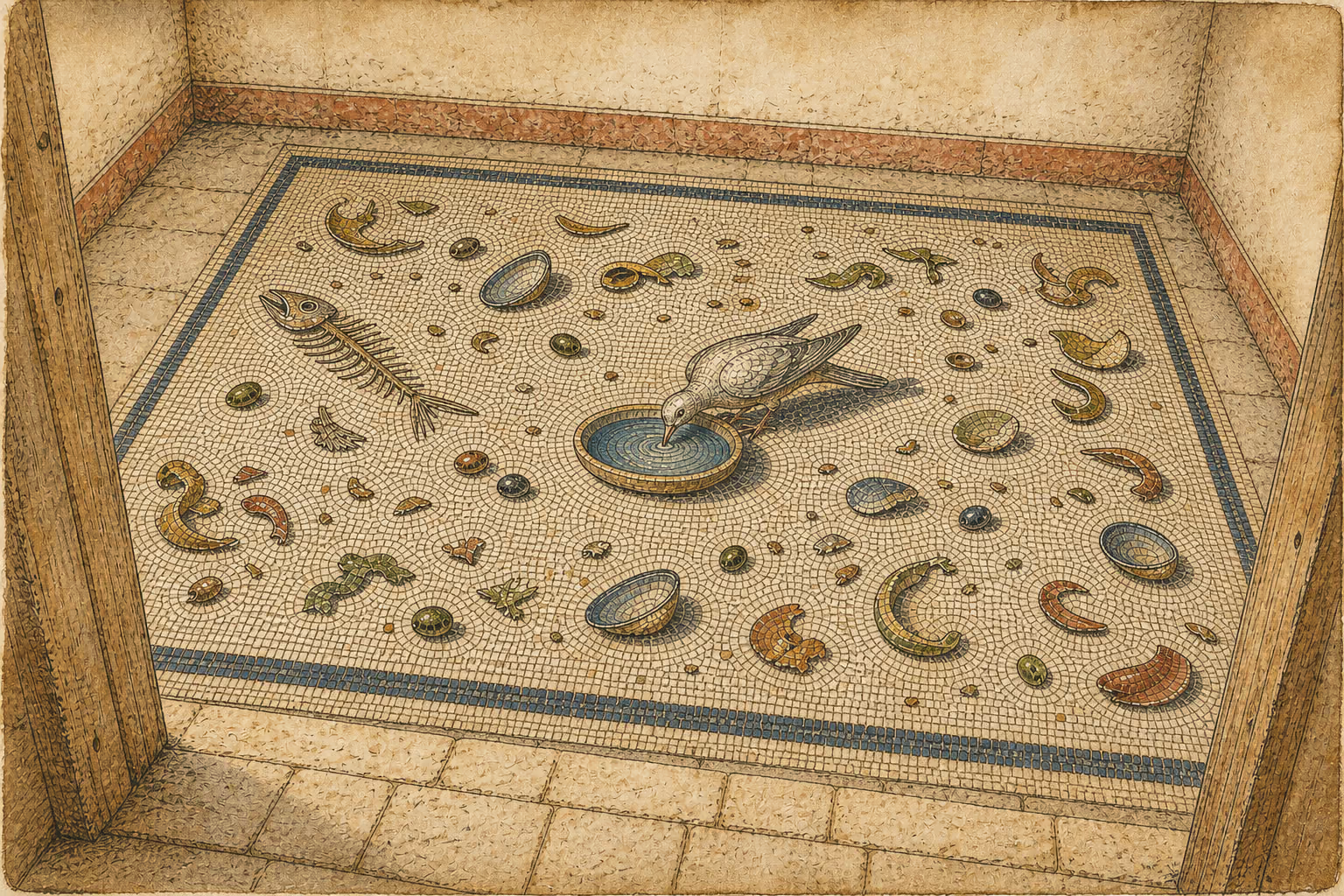
Pavimenta originem apud Graecos habent elaborata arte picturae ratione, done lithostrota expulere eam celeberrimus fuit in hoc genere Sosus, qui Pergami stravit quem vocant asaroton oecon, quoniam purgamenta cenae in pavimentis quaeque everri solent velut relicta fecerat parvis e tessellis tinctisque in varios colores. mirabilis ibi columba bibens et aquam umbra capitis infuscans; apricantur aliae scabentes sese in canthari labro. — Pavimenta credo primumfacta quae nunc vocamus barbarica atque subtegulanea, in Italia festucis pavita. hoc certe ex nomine ipso intellegi potest. Romae scutulatum in Iovis Capitolini aede primum factum est post tertium bellum Punicum initum, frequentata vero pavimenta ante Cimbricum magna gratia animorum indicio est Lucilianus ille versus:
Arte pavimenti atque emblemate vermiculato.
Subdialia Graeci invenere talibus domos contegentes, genus facile tractu tepente, sed fallax ubicumque imbres gelant. necessarium binas per diversum coaxationes substerni et capita earum praefigi, ne torqueantur, et ruderi novo tertiam partem testae tusae addi, dein rudus, in quo II quintae calcis misceantur, pedali crassitudine festucari, tunc nucleo crasso VI digitos induci, tessella grandi non minus alta II digitos strui, fastigium vero servari in pedes denos sescunciae ac diligenter cote despumari. quernis axibus contabulari, quia torquentur, inutile putant, immo et felice aut palea substerni melius esse, quo minor vis calcis perveniat. necessarium et globosum lapidem subici. similiter fiunt spicata testacea.— Non neglegendum est etiamnum unum genus Graecanici: solo festucato inicitur rudus aut testaceum pavimentum, dein spisse calcatis carbonibus inducitur ex sabulo et calce ac favilla mixtis materia crassitudine semipedali, ad regulam et libellam exigitur, et est forma terrena; si vero cote depolitum est, nigri pavimenti usum optinet.
Lithostrota coeptavere iam sub Sulla; parvolis certe crustis exstat hodieque quod in Fortunae delubro Praeneste fecit. pulsa deinde ex humo pavimenta in camaras transiere vitro. novicium et hoc inventum; Agrippa certe in thermis, quas Romae fecit, figlinum opus encausto pinxit in calidis, reliqua albario adornavit, non dubie vitreas facturus camaras, si prius inventum id fuisset aut a parietibus scaenae, ut diximus, Scauri pervenisset in camaras. quam ob rem et vitri natura indicanda est.
English · Bostock & Riley 1855–57
Pavements are an invention of the Greeks, who also practised the art of painting them, till they were superseded by mosaics. In this last branch of art, the highest excellence has been attained by Sosus, who laid, at Pergamus, the mosaic pavement known as the “Asarotos œcos;” from the fact that he there represented, in small squares of different colours, the remnants of a banquet lying upon the pavement, and other things which are usually swept away with the broom, they having all the appearance of being left there by accident. There is a dove also, greatly admired, in the act of drinking, and throwing the shadow of its head upon the water; while other birds are to be seen sunning and pluming themselves, on the margin of a drinking-bowl.
The first pavements, in my opinion, were those now known to us as barbaric and subtegulan pavements, a kind of work that was beaten down with the rammer: at least if we may form a judgment from the name that has been given to them. The first diamonded pavement at Rome was laid in the Temple of Jupiter Capitolinus, after the commencement of the Third Punic War. That pavements had come into common use before the Cimbric War, and that a taste for them was very prevalent, is evident from the line of Lucilius—
“With checquered emblems like a pavement marked.”
The Greeks have also invented terrace-roof pavements, and have covered their houses with them; a thing that may easily be done in the hotter climates, but a great mistake in countries where the rain is apt to become congealed. In making these pavements, the proper plan is to begin with two layers of boards, running different ways, and nailed at the extremities, to prevent them from warping. Upon this planking a rough-work must be laid, one-fourth of which consists of pounded pottery: and upon this, another bed of rough-work, two-fifths composed of lime, a foot in thickness, and well beaten down with the rammer. The nucleus is then laid down, a bed six fingers in depth; and upon that, large square stones, not less than a couple of fingers in thickness; an inclination being carefully observed, of an inch and a half to every ten feet. This done, the surface is well rubbed down with a polishing stone. The general opinion is, that oak should never be used for the planking, it being so very liable to warp; and it is considered a good plan to cover the boards with a layer of fern or chaff, that they may be the better able to resist the action of the lime. It is necessary, too, before putting down the planking, to underset it with a bed of round pebbles. Wheat-ear tesselated pavements are laid down in a similar manner.
We must not omit here one other kind of pavement, that known as the “Græcanic.” The ground is well rammed down, and a bed of rough work, or else broken pottery, is then laid upon it. Upon the top of this, a layer of charcoal is placed, well trodden down with a mixture of sand, lime, and ashes; care being taken, by line and rule, to give it a uniform thickness of half a foot. The surface then presents the ordinary appearance of the ground; but if it is well rubbed with the polishing-stone, it will have all the appearance of a black pavement.
Mosaic pavements were first introduced in the time of Sylla; at all events, there is still in existence a pavement, formed of small segments, which he ordered to be laid down in the Temple of Fortune, at Præneste. Since his time, these mosaics have left the ground for the arched roofs of houses, and they are now made of glass. This, however, is but a recent invention; for there can be no doubt that, when Agrippa ordered the earthenware walls of the hot baths, in the Thermæ which he was building at Rome, to be painted in encaustic, and had the other parts coated with pargetting, he would have had the arches decorated with mosaics in glass, if the use of them had been known; or, at all events, if from the walls of the Theatre of Scaurus, where it figured, as already stated, glass had by that time come to be used for the arched roofs of apartments. It will be as well, therefore, to give some account, also, of glass.