LIBER XXXVI · CAPUT 26
THE ORIGIN OF GLASS
Latine · Mayhoff 1906
Pars Syriae, quae Phoenice vocatur, finitima Iudaeae intra montis Carmeli radices paludem habet, quae vocatur Candebia. ex ea creditur nasci Belus amnis quinque milium passuum spatio in mare perfluens iuxta Ptolemaidem coloniam. lentus hic cursu, insaluber potu, sed caerimoniis sacer, limosus, vado profundus, non nisi refuso mari harenas fatetur; fluctibus enim volutatae nitescunt detritis sordibus. tunc et marino creduntur adstringi morsu, non prius utiles. quingentorum est passuum non amplius litoris spatium, idque tantum multa per saecula gignendo fuit vitro. fama est adpulsa nave mercatorum nitri, cum sparsi per litus epulas pararent nec esset cortinis attollendis lapidum occasio, glaebas nitri e nave subdidisse, quibus accensis, permixta harena litoris, tralucentes novi liquoris fluxisse rivos, et hanc fuisse originem vitri. mox, ut est ingeniosa sollertia, non fuit contenta nitrum miscuisse; coeptus addi et magnes lapis, quoniam in se liquorem vitri quoque ut ferrum trahere creditur. simili modo et calculi splendentes multifariam coepti uri, dein conchae ac fossiles harenae. auctores sunt in India et crystallo fracta fieri et ob id nullum conparari Indico. levibus autem aridisque lignis coquitur addito cyproac nitro, maxime Aegyptio. continuis fornacibus ut aes liquatur, massaeque fiunt colore pingui nigricantes. acies tanta est quacumque, ut citra sensum ullum ad ossa consecet quidquid adflaverit corporis. ex massis rursus funditur in officinis tinguiturque, et aliud flatu figuratur, aliud torno teritur, aliud argenti modo caelatur, Sidone quondam his officinis nobili, siquidem etiam specula excogitaverat.
Haec fuit antiqua ratio vitri. iam vero et in Volturno amne Italiae harena alba nascens sex milium passuum litore inter Cumas atque Liternum, qua mollissima est, pila molave teritur. dein miscetur III partibus nitri pondere vel mensura ac liquata in alias fornaces transfunditur. ibi fit massa, quae vocatur hammonitrum, atque haec recoquitur et fit vitrum purum ac massa vitri candidi. iam vero et per Gallias Hispaniasque simili modo harena temperatur. ferunt Tiberio principe excogitato vitri temperamento, ut flexile esset, totam officinam artificis eius abolitam, ne aeris,, argenti, auri metallis pretia detraherentur, eaque fama crebrior diu quam certior fuit. sed quid refert, Neronis principatu reperta vitri arte, quae modicos calices duos, quos appellabant petrotos, HS VI venderet?
In genere vitri et obsiana numerantur ad similitudinem lapidis, quem in Aethiopia invenit Obsius, nigerrimi coloris, aliquando et tralucidi, crassiore visu atque in speculis parietum pro imagine umbras reddente. gemmas multi ex eo faciunt; vidimus et solidas imagines divi Augusti capaci materia huius crassitudinis, dicavitque ipse pro miraculo in templo Concordiae obsianos IIII elephantos. remisit et Tiberius Caesar Heliopolitarum caerimoniis repertam in hereditate Sei eius, qui praefuerat Aegypto, obsianam imaginem Menelai, ex qua apparet antiquior materiae origo, nunc vitri similitudine interpolata. Xenocrates obsianum lapidem in India et in Samnio Italiae et ad oceanum in Hispania tradit nasci. fit et tincturae genere obsianum ad escaria vasa et totum rubens vitrum atque non tralucens, haematinum appellatum. fit et album et murrina aut hyacinthos sappirosque imitatum et omnibus aliis coloribus, neque est alia. nunc sequacior materia aut etiam picturae accommodatior. maximus tamen honos in candido tralucentibus, quam proxima crystalli similitudine.usus eorum ad potandum argenti metalla et auri pepulit. est autem caloris inpatiens, ni praecedat frigidus liquor, cum addita aqua vitreae pilae sole adverso in tantum candescant, ut vestes exurant. fragmenta teporata adglutinantur tantum, rursus tota fundi non queunt praeterquam abruptas sibimet in guttas, veluti cum calculi fiunt, quos quidam ab oculis appellant, aliquos et pluribus modis versicolores.—Vitrum sulpuri concoctum feruminatur in lapidem.
Et peractis omnibus, quae constant ingenio arte naturam faciente, succurrit mirari nihil paene non igni perfici.
English · Bostock & Riley 1855–57
In Syria there is a region known as Phœnice, adjoining to Judæa, and enclosing, between the lower ridges of Mount Carmelus, a marshy district known by the name of Cendebia. In this district, it is supposed, rises the river Belus, which, after a course of five miles, empties itself into the sea near the colony of Ptolemaïs. The tide of this river is sluggish, and the water unwholesome to drink, but held sacred for the observance of certain religious ceremonials. Full of slimy deposits, and very deep, it is only at the reflux of the tide that the river discloses its sands; which, agitated by the waves, separate themselves from their impurities, and so become cleansed. It is generally thought that it is the acridity of the sea-water that has this purgative effect upon the sand, and that without this action no use could be made of it. The shore upon which this sand is gathered is not more than half a mile in extent; and yet, for many ages, this was the only spot that afforded the material for making glass.
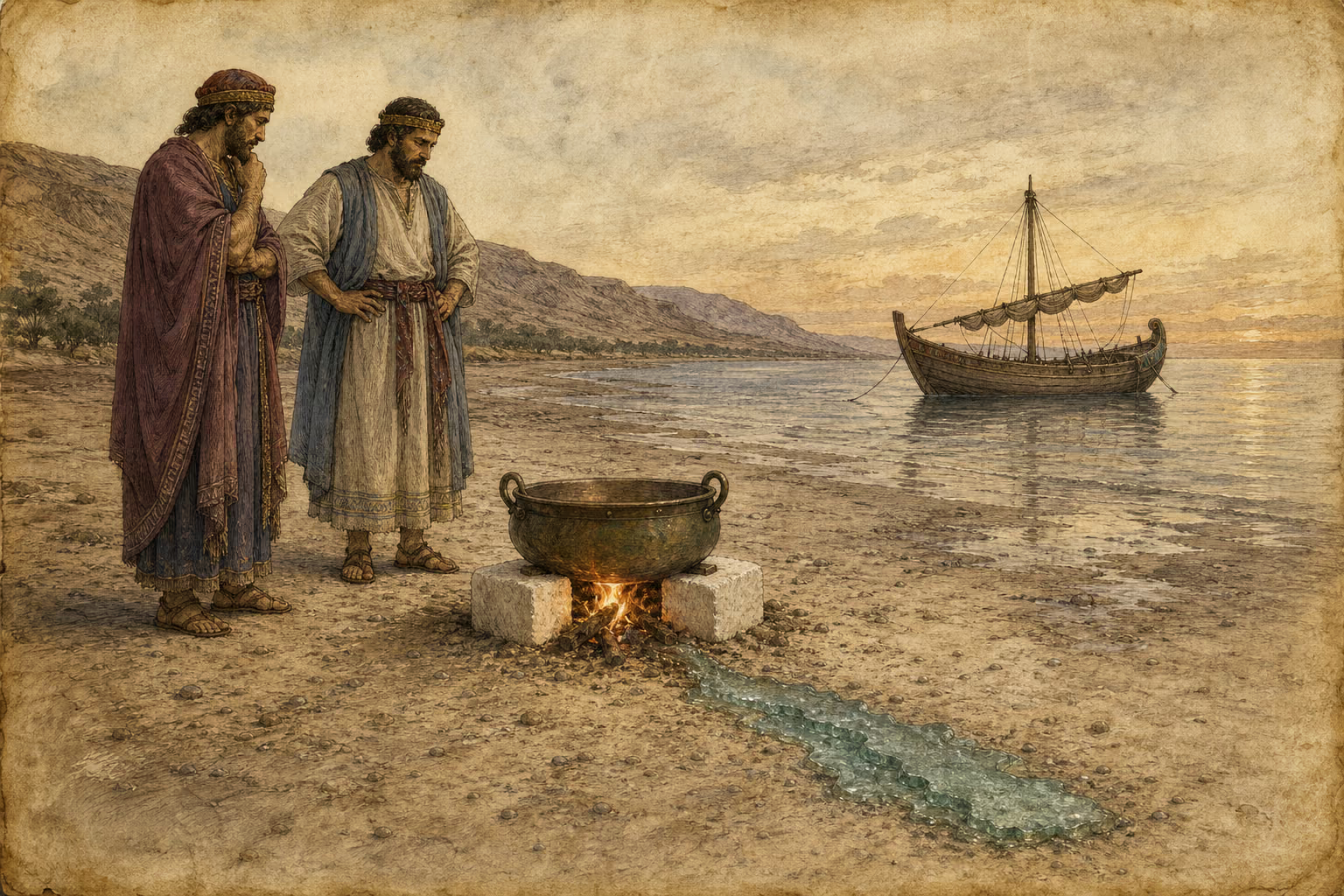
The story is, that a ship, laden with nitre, being moored upon this spot, the merchants, while preparing their repast upon the sea-shore, finding no stones at hand for supporting their cauldrons, employed for the purpose some lumps of nitre which they had taken from the vessel. Upon its being subjected to the action of the fire, in combination with the sand of the sea-shore, they beheld transparent streams flowing forth of a liquid hitherto unknown: this, it is said, was the origin of glass.
In process of time, as human industry is ingenious in discovering, it was not content with the combination of nitre, but magnet-stone began to be added as well; from the impression that it attracts liquefied glass as well as iron. In a similar manner, too, brilliant stones of various descriptions came to be added in the melting, and, at last, shells and fossil sand. Some authors tell us, that the glass of India is made of broken crystal, and that, in consequence, there is none that can be compared to it.
In fusing it, light and dry wood is used for fuel, Cyprian copper and nitre being added to the melting, nitre of Ophir more particularly. It is melted, like copper, in contiguous furnaces, and a swarthy mass of an unctuous appearance is the result. Of such a penetrating nature is the molten glass, that it will cut to the very bone any part of the body which “it may come near, and that, too, before it is even felt. This mass is again subjected to fusion in the furnace, for the purpose of colouring it; after which, the glass is either blown into various forms, turned in a lathe, or engraved like silver. Sidon was formerly famous for its glass-houses, for it was this place that first invented mirrors.
Such was the ancient method of making glass: but, at the present day, there is found a very white sand for the purpose, at the mouth of the river Volturnus, in Italy. It spreads over an extent of six miles, upon the sea-shore that lies between Cumæ and Liternum, and is prepared for use by pounding it with a pestle and mortar; which done, it is mixed with three parts of nitre, either by weight or measure, and, when fused, is transferred to another furnace. Here it forms a mass of what is called “hammonitrum;” which is again submitted to fusion, and becomes a mass of pure, white, glass. Indeed, at the present day, throughout the Gallic and Spanish provinces even, we find sand subjected to a similar process. In the reign of Tiberius, it is said, a combination was devised which produced a flexible glass; but the manufactory of the artist was totally destroyed, we are told, in order to prevent the value of copper, silver, and gold, from becoming depreciated. This story, however, was, for a long time, more widely spread than well authenticated. But be it as it may, it is of little consequence; for, in the time of the Emperor Nero, there was a process discovered, by which two small glass cups were made, of the kind called “petroti,” the price of which was no less than six thousand sesterces!
Among the various kinds of glass, we may also reckon Obsian glass, a substance very similar to the stone which Obsius discovered in Æthiopia. This stone is of a very dark colour, and sometimes transparent; but it is dull to the sight, and reflects, when attached as a mirror to walls, the shadow of the object rather than the image. Many persons use it for jewellery, and I myself have seen solid statues in this material of the late Emperor Augustus, of very considerable thickness. That prince consecrated, in the Temple of Concord, as something marvellous, four figures of elephants made of Obsian stone. Tiberius Cæsar, too, restored to the people of Heliopolis, as an object of ceremonial worship, an image in this stone, which had been found among the property left by one of the præfects of Egypt. It was a figure of Menelaüs; a circumstance which goes far towards proving that the use of this material is of more ancient date than is generally supposed, confounded as it is at the present day with glass, by reason of its resemblance. Xenocrates says that Obsian stone is found in India also, and in Samnium in Italy; and that it is a natural product of Spain, upon the coasts which border on the Ocean.
There is an artificial Obsian stone, made of coloured glass for services for the table; and there is also a glass that is red all through, and opaque, known as “hæmatinum.” A dead white glass, too, is made, as also other kinds in imitation of murrhine colour, hyacinthine, sapphire, and every other tint: indeed, there is no material of a more pliable nature than this, or better suited for colouring. Still, however, the highest value is set upon glass that is entirely colourless and transparent, as nearly as possible resembling crystal, in fact. For drinking-vessels, glass has quite superseded the use of silver and gold; but it is unable to stand heat unless a cold liquid is poured in first. And yet, we find that globular glass vessels, filled with water, when brought in contact with the rays of the sun, become heated to such a degree as to cause articles of clothing to ignite. When broken, too, glass admits of being joined by the agency of heat; but it cannot be wholly fused without being pulverized into small fragments, as we see done in the process of making the small checquers, known as “abaculi,” for mosaic work; some of which are of variegated colours, and of different shapes. If glass is fused with sulphur, it will become as hard as stone.