LIBER XXXVII · CAPUT 13
THE METHODS OF TESTING PRECIOUS STONES
Latine · Mayhoff 1906
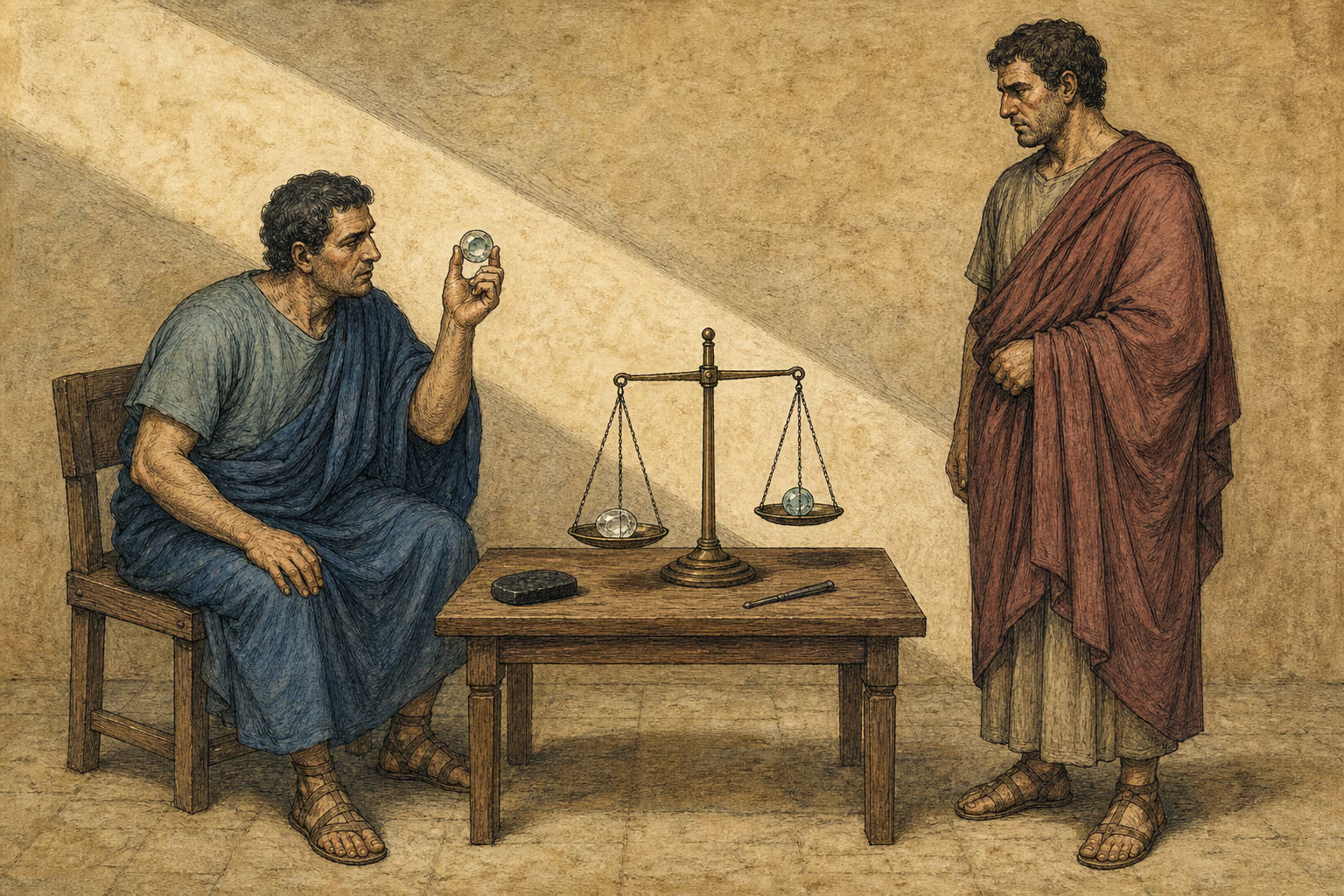
nos contra rationem deprendendi falsas demonstrabimus, quando etiam luxuriam adversus fraudes muniri deceat. igitur praeter illa, quae in principatu cuiusque generis privatim diximus, tralticentes matutino probari censent aut, si necesse est, in quartam horam; postea vetant. experimenta pluribus modis constant: primum pondere, graviores enim sunt verae; dein frigore, eaedem namque in ore gelidiores sentiuntur; post haec corpore. ficticiis pusula e profundo apparet, scabritia in cute et capillamenta, fulgoris inconstantia, priusquam ad oculos perveniat, desinens nitor. decussi fragmenti, quod in lamina ferrea uratur, efficacissimum experimentum excusate mangones gemmarum recusant, similiter et limae probationem. obsianae fragmenta veras gemmas non scariphant, in ficticiis scariphatio omnis candicat. iam tanta differentia est, ut aliae ferro scalpi non possint, aliae non nisi retuso, omnes autem adamante. plurimum vero in iis terebrarum proficit fervor.
Gemmiferi amnes sunt Acesinus et Ganges, terrarum autem omnium maxime India. etenim peractis omnibus naturae operibus discrimen quoddam rerum ipsarum atque terrarum facere conveniet.
Ergo in toto orbe, quacumque caeli convexitas vergit, pulcherrima omnium est iis rebus, quae merito principatum naturae optinent, Italia, rectrix parensque mundi altera, viiis feminis, ducibus militibus, servitiis, artium praestantia, ingeniorum claritatibus, iam situ ac salubritate caeli atque temperie, accessu cunctarum gentium facili, portuosis litoribus, benigno ventorum adflatu. quod contingit positione procurrentis in partem utilissimam et inter ortus occasusque mediam, aquarum copia, nemorum salubritate, montium articulis, ferorum animalium innocentia, soli fertilitate, pabuli ubertate. quidquid est quo carere vita non debeat, nusquam est praestantius: fruges, vinum, oleum, vellera, lina, vestes, iuvenci. ne equos quidem in trigariis ullos vernaculis praeferunt. metallis auri, argenti, aeris, ferri, quamdiu licuit exercere, nullis cessit terris et nunc intra se gravida pro omni dote varios sucos et frugum pomorumque sapores fundit. ab ea exceptis Indiae fabulosis proximam equidem duxerim Hispaniam quacumque ambitur mari, quamquam squalidam ex parte, verum, ubi gignit, feracem frugum, olei, vini, equorum metallorumque omnium generum, ad haec pari Gallia. verum desertis suis sparto vincit Hispania et lapide speculari, pigmentorum etiam deliciis, laborum excitatione, servorum exercitio, corporum humanorum duritia, vehementia cordis.
Rerum autem ipsarum maximum est pretium in mari nascentium margaritis; extra tellurem crystallis, intra adamanti, smaragdis, gemmis, myrrinis; e terra vero exeuntibus in cocco, lasere, in fronde nardo, Sericis vestibus, in arbore citro, in frutice cinnamo, casia, amomo, arboris aut fruticis suco in sucino, opobalsamo, murra, ture, in radicibus costo; ex iis, quae spirare convenit, animalibus in terra maximum dentibus elephantorum, in mari testudinum cortici; in tergore pellibus, quas Seres inficiunt, et Arabiae caprarum villo, quod ladanum vocavimus; ex iis, quae terrena et maris, conchyliis, purpurae. volucrum naturae praeter conos bellicos et Commagenum anserum adipem nullum adnotatur insigne. non praetereundum est auro, circa quod omnes mortales insaniunt, decumum vix esse in pretio locum, argento vero, quo aurum emitur, paene vicensimum.
Salve, parens rerum omnium Natura, teque nobis Quiritium solis celebratam esse numeris omnibus tuis fave.
English · Bostock & Riley 1855–57
On the contrary, we will make it our business to point out the methods of detecting these false stones, seeing that it is only proper to put luxury even on its guard against fraud. In addition to the particulars which we have already given, when treating of each individual kind of precious stone, it is generally agreed that transparent stones should be tested by a morning light, or even, if necessary, so late as the fourth hour, but never after that hour. The modes of testing stones are numerous: first, by their weight, the genuine stone being the heavier of the two; next, by their comparative coolness, the genuine stone being cooler than the other to the mouth; and, next to that, by their substance; there being blisters perceptible in the body of the fictitious stone, as well as a certain roughness on the surface; filaments, too, an unequal brilliancy, and a brightness that falls short before it reaches the eye. The best mode of testing is to strike off a fragment with an iron saw; but this is a thing not allowed by the dealers, who equally refuse to let their gems be tested by the file. Dust of Obsian stone will not leave a mark upon the surface of a genuine stone: but where the gem is artificial, every mark that is made will leave a white scratch upon it. In addition to this, there is such a vast diversity in their degrees of hardness, that some stones do not admit of being engraved with iron, and others can only be cut with a graver blunted at the edge. In all cases, however, precious stones may be cut and polished by the aid of adamas an operation which may be considerably expedited by heating the graver. The rivers which produce precious stones, are the Acesinus and the Ganges; and, of all countries, India is the most prolific of them.
Having now treated of all the works of Nature, it will be as well to take a sort of comparative view of her several productions, as well as the countries which supply them. Throughout the whole earth, then, and wherever the vault of heaven extends, there is no country so beautiful, or which, for the productions of Nature, merits so high a rank as Italy, that ruler and second parent of the world; recommended as she is by her men, her women, her generals, her soldiers, her slaves, her superiority in the arts, and the illustrious examples of genius which she has produced. Her situation, too, is equally in her favour; the salubrity and mildness of her climate; the easy access which she offers to all nations; her coasts indented with so many harbours; the propitious breezes, too, that always prevail on her shores; advantages, all of them, due to her situation, lying, as she does, midway between the East and the West, and extended in the most favourable of all positions. Add to this, the abundant supply of her waters, the salubrity of her groves, the repeated intersections of her mountain ranges, the comparative innocuousness of her wild animals, the fertility of her soil, and the singular richness of her pastures.
Whatever there is that the life of man ought not to feel in want of, is nowhere to be found in greater perfection than here; the cereals, for example, wine, oil, wool, flax, tissues, and oxen. As to horses, there are none, I find, preferred to those of Italy for the course; while, for mines of gold, silver, copper, and iron, so long as it was deemed lawful to work them, Italy was held inferior to no country whatsoever. At the present day, teeming as she is with these treasures, she contents herself with lavishing upon us, as the whole of her bounties, her various liquids, and the numerous flavours yielded by her cereals and her fruits. Next to Italy, if we except the fabulous regions of India, I would rank Spain, for my own part, those districts, at least, that lie in the vicinity of the sea. She is parched and sterile in one part, it is true; but where she is at all productive, she yields the cereals in abundance, oil, wine, horses, and metals of every kind. In all these respects, Gaul is her equal, no doubt; but Spain, on the other hand, outdoes the Gallic provinces in her spartum and her specular stone, the products of her desert tracts, in her pigments that minister to our luxuries, in the ardour displayed by her people in laborious employments, in the perfect training of her slaves, in the robustness of body of her men, and in their general resoluteness of character.
As to the productions themselves, the greatest value of all, among the products of the sea, is attached to pearls: of objects that lie upon the surface of the earth, it is crystals that are most highly esteemed: and of those derived from the interior, adamas, smaragdus, precious stones, and murrhine, are the things upon which the highest value is placed. The most costly things that are matured by the earth, are the kermes-berry and laser; that are gathered from trees, nard and Seric tissues; that are derived from the trunks of trees, logs of citrus -wood; that are produced by shrubs, cinnamon, cassia, and amomum; that are yielded by the juices of trees or of shrubs, amber, opobalsamum, myrrh, and frankincense; that are found in the roots of trees, the perfumes derived from costus. The most valuable products furnished by living animals, on land, are the teeth of elephants; by animals in the sea, tortoise-shell; by the coverings of animals, the skins which the Seres dye, and the substance gathered from the hair of the she-goats of Arabia, which we have spoken of under the name of “ladanum;” by creatures that are common to both land and sea, the purple of the murex. With reference to the birds, beyond plumes for warriors’ helmets, and the grease that is derived from the geese of Commagene, I find no remarkable product mentioned. We must not omit, too, to observe, that gold, for which there is such a mania with all mankind, hardly holds the tenth rank as an object of value, and silver, with which we purchase gold, hardly the twentieth!
Hail to thee, Nature, thou parent of all things! and do thou deign to show thy favour unto me, who, alone of all the citizens of Rome, have, in thy every department, thus made known thy praise.