LIBER XXXVII · CAPUT 2
AT WHAT PERIOD MURRHINE VESSELS WERE FIRST INTRODUCED AT ROME. INSTANCES OF LUXURY IN REFERENCE TO THEM
Latine · Mayhoff 1906
id uti planius noscatur, verba ex ipsis Pompei triumphorum actis subiciam. ergo tertio triumpho, quem de piratis, Asia, Ponto gentibusque et regibus in VII volumine operis huius indicatis M. Pisone M. Messala cos. pr. k. Octobres natali suo egit, transtulit alveum cum tesseris lusorium e gemmis duabus latum pedes tres, longum pedes quattuor —ne quis effetas res dubitet nulla gemmarum magnitudine hodie prope ad hanc amplitudinem accedente, in eo fuit luna aurea pondo XXX—, lectos tricliniares tres, vasa ex auro et gemmis abacorum novem, signa aurea tria Minervae, Martis, Apollinis, coronas ex margaritis XXXIII, montem aureum quadratum cum cervis et leonibus et pomis omnis generis circumdata vite aurea, musaeum ex margaritis, in cuius fastigio horologium. erat et imago Cn. Pompei e margaritis, illo relicino honore grata, illius probi oris venerandique per cunctas gentes, ficta ex margaritis, ita severitate victa et veriore luxuriae triumpho! numquam profecto inter illos viros durasset cognomen Magni, si prima victoria sic triumphasset! e margaritis, Magne, tam prodiga re et feminis reperta, quas gerere te fas non sit, fieri tuos voltus? sic te pretiosum videri? non ergo illa tua similior est imago, quam Pyrenaei iugis inposuisti? grave profecto, foedum probrun erat, ni verius saevum irae deorum ostentum id credi oporteret clareque intellegi posset iam tum illud caput orientis opibus sine reliquo corpore ostentatum. cetera triumphi eius quam virilia! HS |MM| r. p. data, legatis et quaestoribus, qui oras maris defendissent, HS |M???|, militibus singulis HS sena milia. tolerabiliorem tamen causam fecit C. principis, qui super cetera muliebria soccos induebat e margaritis, aut Neronis principis, qui sceptra et personas et cubilia viatoria unionibus construebat. quin. immo etiam ius videmur perdidisse corripiendi gemmata potoria et varia supellectilis genera, anulos translucentes. quae enim non luxuria innocentior existimari possit?
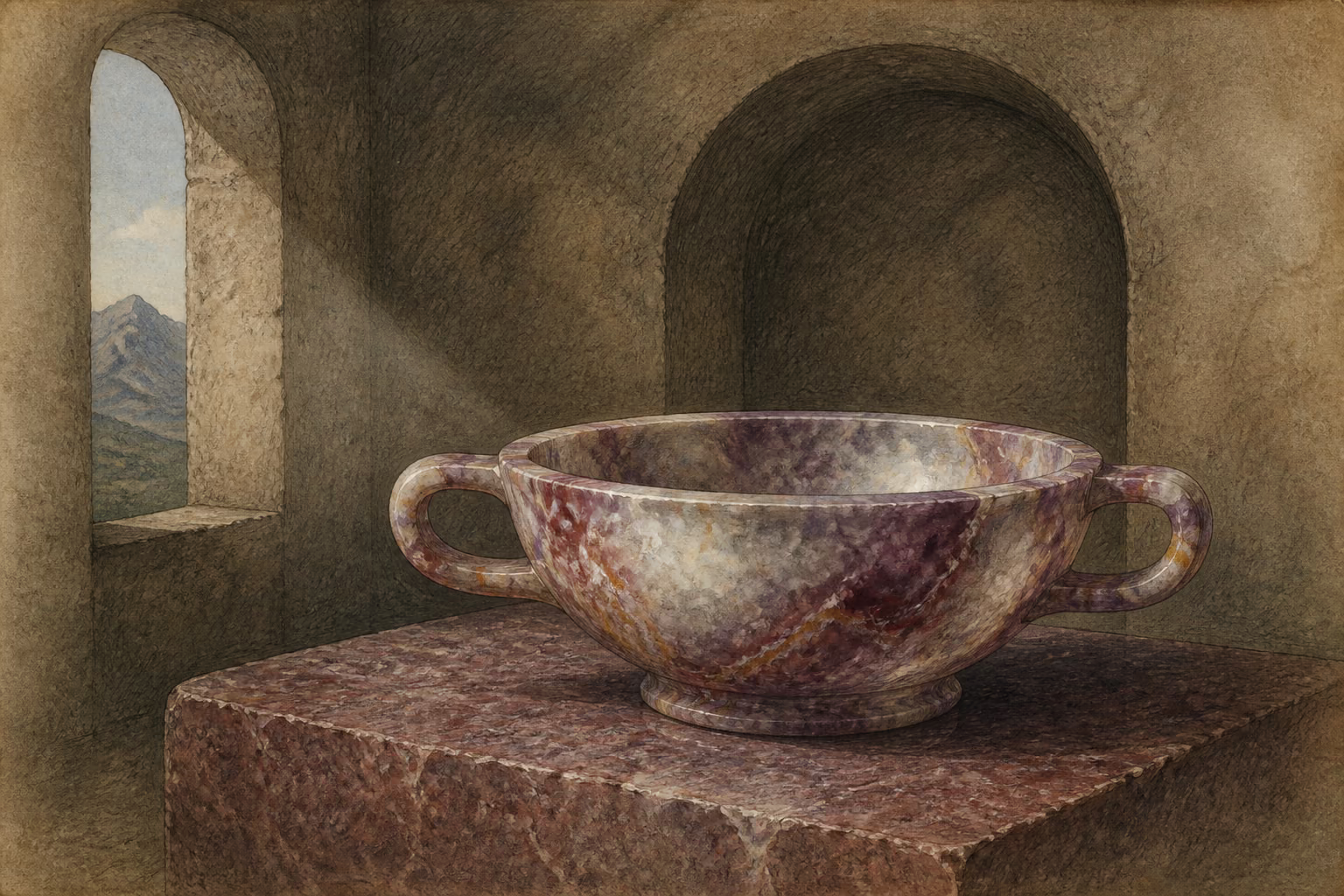
Eadem victoria primum in urbem myrrhina invexit, primusque Pompeius capides et pocula ex eo triumph Capitolino Iovi dicavit. quae protinus ad hominum usum transiere, abacis etiam escariisque vasis expetitis; et crescit in dies eius luxuria. myrrhinoLXX HS empto, capaci plane ad sextarios tres calice, potavit...anus consularis, ob amorem adroso margine eius, ut tamen iniuria ilia pretium augeret; neque est hodie myrrhini alterius praestantior indicatura. idem in reliquis generis eius quantum voraverit, licet aestimare ex multitudine, quae tanta fuit, ut auferente liberis eius Nerone exposita occuparent theatrum peculiare trans Tiberim in hortis, quod a populo impleri canente se, dum Pompeiano proludit, etiam Neroni satis erat. vidi tunc adnumerari unius scyphi fracti membra, quae'in dolorem, credo, saeculi invidiamque Fortunae tamquam Alexandri Magni corpus in conditorio servari, ut ostentarentur, placebat. T. Petronius consularis moriturus invidia Neronis, ut mensam eius exheredaret, trullam myrrhinam HsCCC emptam fregit; sed Nero, ut par erat principem, vicit omnes HS |X???| capidem unam parando. memoranda res tanti imperatorem patremque patriae bibisse!
Oriens myrrhina mittit. inveniuntur ibi pluribus locis nec insignibus, maxime Parthici regni, praecipua tamen in Carmania. umorem sub terra putant calore densari. amplitudine numquam parvos excedunt abacos, crassitudine raro quanta dicta sunt potoria. splendor estiis sine viribus nitorque verius quam splendor. sed in pretio varietas colorum subinde circumagentibus se maculis in purpuram candoremque et tertium ex utroque, ignescente veluti per transitum coloris purpura aut rubescente lacteo. sunt qui maxime in iis laudent extremitates et quosdam colorum repercussus, quales in caelesti arcu spectantur. iam aliis maculae pingues placent— tralucere quicquam aut pallere vitium est—itemque sales verrucaeque non eminentes, sed, ut in corpore etiam, plerumque sessiles. aliqua et in odore commendatio est.
Contraria huic causa crystallum facit, gelu vehementiore concrete non aliubi certe reperitur quam ubi maxime hibernae nives rigent, glaciemque esse certum est, unde nomen Graeci dedere. oriens et hanc mittit, quoniam Indicae nulla praefertur. nascitur et in Asia, vilissima circa Alabanda et Orthosiam finitimisque, item in Cypro, sed laudata in Europa Alpium iugis. Iuba auctor est et in quadam insula Rubri maris ante Arabiam sita nasci, quae Necron vocetur, et in ea, quae iuxta gemmam topazum ferat, cubitalemque effossam a Pythagora Ptolemaei praefecto; Cornelius Bocchus et in Lusitania perquam mirandi ponderis in Ammaeensibus iugis, depressis ad libramentum aquae puteis. hoc mirum, quod Xenocrates Ephesius tradit, aratro in Asia et Cypro excitari; non enim reperiri in terreno nec nisi inter cautes creditum fuerat. similius veri est, quod idem Xenocrates tradit, et torrentibus saepe deportari. Sudines negat nisi ad neridiem spectantibus locis nasci. quod certum est, non reperitur in aquosis, quamquam in regione praegelida, vel si ad vada usque glacientur amnes. e caelesti umore puraque nive id fieri necesse est; ideo caloris inpatiens nisi in frigido potu abdicatur. quare nascatur sexangulis lateribus, non facile ratio iniri potest, eo magis quod neque in mucronibus eadem species est et ita absolutus laterum levor est, ut nulla id arte possit aequari.
Magnitudo amplissima adhuc visa nobis erat quam in Capitolio Livia Augusti dicaverat, librarum circiter CL. Xenocrates idem auctor est vas amphorale visum, et aliqui ex India sextariorum quattuor.—(Nos liquido adfirmare possumus in cautibus Alpium nasci adeo inviis plerumque, ut fune pendentes eam extrahant.)—peritis signa et indicia nota sunt. infestantur plurimis vitiis, scabro ferumine, maculosa nube, occulta aliquando vomica, praeduro fragilique centro, item sale appellate. est et rufa aliquis robigo, aliis capillamentum rimae simile. hoc artifices caelatura occultant. quae vero sine vitio sint, pura esse malunt, acenteta appellantes, nec spumei coloris, sed limpidae aquae. postrema auctoritas in pondere est. invenio apud medicos, quae sint urenda corporum, non aliter utilius uri putari quam crystallina pila adversis opposita solis radiis. alius et in his furor, HS centum quinquaginta milibus trullam unam non ante multos annos mercata matre familias nec divite. Nero amissarum rerum nuntio accepto duos calices crystallinos in suprema ira fregit inlisos. haec fuit ultio saeculum suum punientis, ne quis alius iis biberet. fragmenta sarciri nullo modo queunt. mire his ad similitudinem accessere vitrea, sed prodigii modo, ut suum pretium auxerint, crystalli non deminuerint.
Proximum locum in deliciis, feminarum tamen adhuc tantum, sucina optinent, eandemque omnia haec quam gemmae auctoritatem; sane priora illa aliquis de causis, crystallina frigido potu, myrrhina utroque; in sucinis causam ne deliciae quidem adhuc excogitare potuerunt.
Occasio est vanitatis Graecorum detegendae: legentes modo aequo perpetiantur animo, cum hoc quoque intersit vitae scire, non quidquid illi prodidere mirandum. Phaethontis fulmine icti sorores luctu mutatas in arbores populos lacrimis electrum omnibus annis fundere iuxta Eridanum amnem, quem Padum vocavimus, electrum appellatum, quoniam sol vocitatus sit Elector, plurimi poëtae dixere primique, ut arbitror, Aeschylus, Philoxenus, Euripides, Nicander, Satyrus. quod esse falsum Italiae testimonio patet. diligentiores eorum Electridas insulas in mari. Hadriatico esse dixerunt, ad quas delaberetur Pado. qua appellatione nullas umquam ibi fuisse certum est, nec vero ullas ita positas esse, in quas quidquam cursu Padi devehi posset. nam quod Aeschylus in Hiberia [hoc est in Hispania] Eridanum esse dixit eundemque appellari Rhodanum, Euripides rursus et Apollonius in Hadriatico litore confluere Rhodanum et Padum, faciliorem veniam facit ignorati sucini tanta ignorantia orbis. modestiores, sed aeque falsum, prodidere in extremis Hadriatici sinus inviis rupibus arbores stare, quae canis ortu hanc effunderent cummim. Theophrastus effodi in Liguria dixit, Chares vero Phaëthontem in Aethiopia ῞ἅμμωνος νήσῳ obisse, ibi et delubrum eius esse atque oraculum electrumque gigni. Philemon fossile esse et in Scythia erui duobus locis, candidum atque cerei coloris quod vocaretur electrum, in alio fulvum quod appellaretur sualiternicum. Demostratus lyncurium vocat et fieri ex urina lyncum bestiarum, e maribus fulvum et igneum, e feminis languidius atque candidum; alios id dicere langurium et esse in Italia bestias languros. Zenothemis langas vocat easdem et circa Padum iis vitam adsignat, Sudines arborem, quae gignat in Liguria, vocari lynca. in eadem sententia et Metrodorus fuit. Sotacus credidit in Brittannia petris effluere, quas electridas vocavit, Pytheas Guionibus, Germaniae genti, accoli aestuarium oceani Metuonidis nomine spatio stadiorum sex milium; ab hoc diei navigatione abesse insulam Abalum; illo per ver fluctibus advehi et esse concreti maris purgamentum; incolas pro ligno ad ignem uti eo proximisque Teutonis vendere. huic et Timaeus credidit, sed insulam Basiliam vocavit. Philemon negavit flammam ab electro reddi. Nicias solis radiorum sucum intellegi voluit hoc; circa occasum vehementiores in terram actos pinguem sudorem in ea relinquere, oceani deinde aestibus in Germanorum litora eici. in Aegypto nasci simili modo—vocari sacal—, item in India gratiusque et ipso ture esse Indis; in Syria quoque feminas verticillos inde facere et vocare harpaga, quia folia paleasque et vestium fimbrias rapiat. Theochrestus oceano id exaestuante ad Pyrenaei promunturiaadpelli, quod et Xenocrates credidit, qui de his nuperrime scripsit vivitque adhuc. Asarubas tradit iuxta Atlanticum mare esse lacum Cephisida, quem Mauri vocent Electrum. hunc sole excalfactum e limo reddere electrum fluitans. Mnaseas Africae locum Sicyonem appellat et Crathin amnem in oceanum effluentem e lacu, in quo aves, quas meleagridas et penelopas vocat, vivere; ibi nasci ratione eadem qua supra dictum est. Theomenes Syrtim iuxta magnam hortum Hesperidon esse et stagnum Electrum, ibi arbores populos, quarum e cacuminibus in stagnum cadat; colligi autem ab virginibus Hesperidum. Ctesias in Indis flumen esse Hypobarum, quo vocabulo significetur omnia bona eum ferre; fluere a septentrione in exortivum oceanum iuxta montem silvestrem arboribus electrum ferentibus. arbores eas psitthachoras vocari, qua appellatione significetur praedulcis suavitas. Mithridates in Carmaniae litoribus insulam esse, quam vocari Seritam, cedri genere silvosam, inde defluere in petras. Xenocrates non sucinum tantum in Italia, sed et thium vocari, a Scythis vero sacrium, quoniam et ibi nascatur; alios putare in Numidia ex limo gigni. super omnes est Sophocles poeta tragicus, quod equidem miror, cum tanta gravitas ei cothurni sit, praeterea vitae fama alias principi loco genito Athenis et rebus gestis et exercitu ducto. hic ultra Indiam fieri dixit e lacrimis meleagridum avium Meleagrum deflentium. quod credidisse eum aut sperasse aliis persuaderi posse quis non miretur? quamve pueritiam tam inperitam posse reperiri, quae avium ploratus annuos credat lacrimasve tam grandes avesve, quae a Graecia, ubi Meleager periit, ploratum adierint Indos? quid ergo? non multa aeque fabulosa produnt poetae? sed hoc in ea re, quae cotidie invehatur atque abundet ac mendacium coarguat, serio quemquam dixisse summa hominum contemptio est et intoleranda mendaciorum inpunitas.
English · Bostock & Riley 1855–57
To prove more fully that this was the case, I will here give the very words of the public Registers with reference to the triumphs of Pompeius Magnus. On the occasion of his third triumph, over the Pirates and over the Kings and nations of Asia and Pontus that have been already enumerated in the Seventh Book of this work, M. Fiso and M. Messala being consuls, on the day before the calends of October, the anniversary of his birth, he displayed in public, with its pieces, a chess-board, made of two precious stones, three feet in width by two in length—and to leave no doubt that the resources of Nature do become exhausted, I will here observe, that no precious stones are to be found at the present day, at all approaching such dimensions as these; as also that there was upon this board a moon of solid gold, thirty pounds in weight!—three banquetting-couches; vessels for nine waiters, in gold and precious stones; three golden statues of Minerva, Mars, and Apollo; thirty-three crowns adorned with pearls; a square mountain of gold, with stags upon it, lions, and all kinds of fruit, and surrounded with a vine of gold; as also a musæum, adorned with pearls, with an horologe upon the top of it.
There was a likeness also in pearls of Pompeius himself, his noble countenance, with the hair thrown back from the forehead, delighting the eye. Yes, I say, those frank features, so venerated throughout all nations, were here displayed in pearls! the severity of our ancient manners being thus subdued, and the display being more the triumph of luxury than the triumph of conquest. Never, most assuredly, would Pompeius have so long maintained his surname of “Magnus” among the men of that day, if on the occasion of his first conquest his triumph had been such as this. Thy portrait in pearls, O Magnus! those resources of prodigality, that have been discovered for the sake of females only! Thy portrait in pearls, refinements in luxury, which the Roman laws would not have allowed thee to wear even! And was it in this way that thy value must be appreciated? Would not that trophy have given a more truthful likeness of thee which thou hadst erst erected upon the Pyrenæan mountain heights? Assuredly such a portrait as this had been no less than a downright ignominy and disgrace, were we not bound to behold in it a menacing presage of the anger of the gods, and to see foreshadowed thereby the time when that head, now laden with the wealth of the East, was to be displayed, severed from the body.
But in other respects, how truly befitting the hero was this triumph! To the state, he presented two thousand millions of sesterces; to the legati and quæstors who had exerted themselves in defence of the sea coast, he gave one thousand millions of sesterces; and to each individual soldier, six thousand sesterces. He has rendered, however, comparatively excusable the Emperor Caius, who, in addition to other feminine luxuries, used to wear shoes adorned with pearls; as also the Emperor Nero, who used to adorn his sceptres with masks worked in pearls, and had the couches, destined for his pleasures, made of the same costly materials. Nay, we have no longer any right, it would seem, to censure the employment of drinking-cups adorned with precious stones, of various other articles in daily use that are similarly enriched, and of rings that sparkle with gems: for what species of luxury can there be thought of, that was not more innocent in its results than this on the part of Pompeius?
It was the same conquest, too, that first introduced murrhine vessels at Rome; Pompeius being the first to dedicate, at the conclusion of this triumph, vases and cups, made of this material, in the Temple of Jupiter Capitolinus: a circumstance which soon brought them into private use, waiters, even, and eating-utensils made of murrhine being in great request. This species of luxury, too, is daily on the increase, a single cup, which would hold no more than three sextarii, having been purchased at the price of seventy thousand sesterces. A. person of consular rank, who some years ago used to drink out of this cup, grew so passionately fond of it, as to gnaw its edges even, an injury, however, which has only tended to enhance its value: indeed there is now no vessel in murrhine that has ever been estimated at a higher figure than this. We may form some opinion how much money this same personage swallowed up in articles of this description, from the fact that the number of them was so great, that, when the Emperor Nero deprived his children of them, and they were exposed to public view, they occupied a whole theatre to themselves, in the gardens beyond the Tiber; a theatre which was found sufficiently large even, for the audience that attended on the occasion when Nero rehearsed his musical performances before his appearance in the Theatre of Pompeius. It was at this exhibition, too, that I saw counted the broken fragments of a single cup, which it was thought proper to preserve in an urn and display, I suppose, with the view of exciting the sorrows of the world, and of exposing the cruelty of fortune; just as though it had been no less than the body of Alexander the Great himself!
T. Petronius, a personage of consular rank, intending, from his hatred of Nero, to disinherit the table of that prince, broke a murrhine basin, which had cost him no less than three hundred thousand sesterces. But Nero himself, as it was only proper for a prince to do, surpassed them all, by paying one million of sesterces for a single cup: a fact well worthy of remembrance, that an emperor, the father of his country, should have drunk from a vessel of such costly price!
Murrhine vessels come from the East, in numerous localities of which, remarkable for nothing else, they are to be found. It is in the empire of the Parthians, more particularly, that they are met with, though those of the very finest quality come to us from Carmania. It is generally thought that these vessels are formed of a moist substance, which under ground becomes solidified by heat. In size they never exceed a small waiter, and, as to thickness, they rarely admit of being used as drinking-cups, so large as those already mentioned. The brightness of them is destitute of strength, and it may be said that they are rather shining than brilliant. But the chief merit of them is the great variety of their colours, and the wreathed veins, which, every here and there, present shades of purple and white, with a mixture of the two; the purple gradually changing, as it were, to a fiery red, and the milk-white assuming a ruddy hue. Some persons praise the edges of these vessels more particularly, with a kind of reflection in the colours, like those beheld in the rain-bow. Others, again, are more pleased with them when quite opaque, it being considered a demerit when they are at all transparent, or of a pallid hue. The appearance, too, of crystals in them is highly prized, and of spots that look like warts; not prominent, but depressed, as we mostly see upon the human body. The perfume, too, of which they smell, is looked upon as an additional recommendation.
It is a diametrically opposite cause to this that produces crystal, a substance which assumes a concrete form from excessive congelation. At all events, crystal is only to be found in places where the winter snow freezes with the greatest intensity; and it is from the certainty that it is a kind of ice, that it has received the name which it bears in Greek. The East, too, sends us crystal, there being none preferred to the produce of India. It is to be found, also, in Asia, that of the vicinity of Alabanda, Orthosia, and the neighbouring mountains, being held in a very low degree of esteem. In Cyprus, also, there is crystal, but that found upon the Alpine heights in Europe is, in general, more highly valued. According to Juba, there is crystal in a certain island of the Red Sea, opposite the coast of Arabia, called “Necron;” as, also, in another neighbouring island which produces the precious stone known as the “topazus;” where a block of crystal was extracted, he says, by Pythagoras, the præfect of King Ptolemæus, no less than a cubit in length.
Cornelius Bocchus informs us that in Lusitania, there have been blocks of crystal found, of extraordinary weight, in sinking shafts in the Ammiensian mountains there, to a water-level for the supply of wells. It is a marvellous fact, stated by Xenocrates of Ephesus, that in Asia and in the Isle of Cyprus, crystal is turned up by the plough; it having been the general belief that it is never to be found in terreous soils, and only in rocky localities. That is much more probable which the same Xenocrates tells us, when he says that the mountain streams often bring down with them fragments of crystal. Sudines says, that crystal is only to be found in localities that face the south, a thing that is known to be really the fact: indeed, it is never found in humid spots, however cold the climate may be, even though the rivers there freeze to the very bottom. Rain-water and pure snow are absolutely necessary for its formation, and hence it is, that it is unable to endure heat, being solely employed for holding liquids that are taken cold. From the circumstance of its being hexagonal and hexahedral, it is not easy to penetrate this substance; and the more so, as the pyramidal terminations do not always have the same appearance. The polish on its faces is so exquisite, that no art can possibly equal it.
The largest block of crystal that has ever been beheld by us, is the one that was consecrated by Julia Augusta in the Capitol, and which weighed about one hundred and fifty pounds. Xenocrates speaks of having seen a vase of crystal, which held one amphora, and we find other writers mentioning a vessel from India which held four sextarii. For my own part, I can positively say, that there is crystal amid the crags of the Alps, so difficult of access, that it is usually found necessary to be suspended by ropes in order to extract it. Persons who are experienced in the matter detect its presence by certain signs and indications.
Crystal is subject to numerous defects, sometimes presenting a rough, solder-like, substance, or else clouded by spots upon it; while occasionally it contains some hidden humour within, or is traversed by hard and brittle knurrs, which are known as “salt grains.” Some crystal, too, has a red rust upon it, while, in other instances, it contains filaments that look like flaws, a defect which artists conceal by engraving it. But where crystals are entirely free from defect, they are preferred uncut; in which case, they are known as “acenteta,” and have the colour, not of foam, but of limpid water. In the last place, the weight of crystals is a point which is taken into consideration.
I find it stated by medical men that the very best cautery for the human body is a ball of crystal acted upon by the rays of the sun. This substance, too, has been made the object of a mania; for, not many years ago, a mistress of a family, who was by no means very rich, gave one hundred and fifty thousand sesterces for a single basin made of crystal. Nero, on receiving tidings that all was lost, in the excess of his fury, dashed two cups of crystal to pieces; this being his last act of vengeance upon his fellow-creatures, preventing any one from ever drinking again from these vessels. Crystal, when broken, cannot by any possibility be mended. Vessels in glass have been brought to a marvellous degree of resemblance to crystal; and yet, wonderful to say, they have only tended to enhance the value of crystal, and in no way to depreciate it.
Next in rank among the objects of luxury, we have amber; an article which, for the present, however, is in request among women only. All these three last-mentioned substances hold the same rank, no doubt, as precious stones; the two former for certain fair reasons; crystal, because it is adapted for taking cool drinks, and murrhine vessels, for taking drinks that are either hot or cold. But as for amber, luxury has not been able, as yet, to devise any justification for the use of it. This is a subject which affords us an excellent opportunity of exposing some of the frivolities and falsehoods of the Greeks; and I beg that my readers will only have patience with me while I do so, it being really worth while, for our own practical improvement, to become acquainted with the marvellous stories which they have promulgated respecting amber.
After Phaëthon had been struck by lightning, his sisters, they tell us, became changed into poplars, which every year shed their tears upon the banks of the Eridanus, a river known to us as the “Padus.” To these tears was given the name of “electrum,” from the circumstance that the Sun was usually called “elector.” Such is the story, at all events, that is told by many of the poets, the first of whom were, in my opinion, Æschylus, Philoxenus, Euripides, Satyrus, and Nicander; and the falsity of which is abundantly proved upon the testimony of Italy itself. Those among the Greeks who have devoted more attention to the subject, have spoken of certain islands in the Adriatic Sea, known as the “Electrides,” and to which the Padus, they say, carries down electrum. It is the fact, however, that there never were any islands there so called, nor, indeed, any islands so situate as to allow of the Padus carrying down anything in its course to their shores. As to Æschylus placing the Eridanus in Iberia, or, in other words, in Spain, and giving it the name of Rhodanus; and as to Euripides and Apollonius representing the Rhodanus and the Padus as discharging themselves by one common mouth on the shores of the Adriatic; we can forgive them all the more readily for knowing nothing about amber when they betray such monstrous ignorance of geography.
Other writers, again, who are more guarded in their assertions, have told us, though with an equal degree of untruthfulness, that, at the extremity of the Adriatic Gulf, upon certain inaccessible rocks there, there are certain trees which shed their gum at the rising of the Dog-Star. Theophrastus has stated that amber is extracted from the earth in Liguria; Chares, that Phaëthon died in the territory of Hammon, in Æthiopia, where there is a temple of his and an oracle, and where amber is produced; Philemon, that it is a fossil substance, and that it is found in two different localities in Scythia, in one of which it is of a white and waxen colour, and is known as “electrum;” while in the other it is red, and is called “sualiternicum.” Demostratus calls amber “lyncurion,” and he says that it originates in the urine of the wild beast known as the “lynx;” that voided by the male producing a red and fiery substance, and that by the female an amber of a white and less pronounced colour: he also informs us that by some persons it is called “langurium,” and that in Italy, there are certain wild beasts known as “languri.” Zeuothemis, however, calls these wild beasts “langæ,” and gives the banks of the river Padus as their locality. Sudines says, that it is a tree in reality, that produces amber, and that, in Etruria, this tree is known by the name of “lynx;” an opinion which is also adopted by Metrodorus. Sotacus expresses a belief that amber exudes from certain stones in Britannia, to which he gives the name of “electrides.” Pytheas says that the Gutones, a people of Germany, inhabit the shores of an estuary of the Ocean called Mentonomon, their territory extending a distance of six thousand stadia; that, at one day’s sail from this territory, is the Isle of Abalus, upon the shores of which, amber is thrown up by the waves in spring, it being an excretion of the sea in a concrete form; as, also, that the inhabitants use this amber by way of fuel, and sell it to their neighbours, the Teutones. Timæus, too, is of the same belief, but he has given to the island the name of Basilia.
Philemon says that electrum does not yield a flame. Nicias, again, will have it, that it is a liquid produced by the rays of the sun; and that these rays, at the moment of the sun’s setting, striking with the greatest force upon the surface of the soil, leave upon it an unctuous sweat, which is carried off by the tides of the Ocean, and thrown up upon the shores of Germany. He states, also, that in Egypt it is similarly produced, and is there called “sacal;” that it is found in India, too, where it is held as a preferable substitute for frankincense; and that in Syria the women make the whirls of their spindles of this substance, and give it the name of “harpax,” from the circumstance that it attracts leaves towards it, chaff, and the light fringe of tissues. According to Theochrestus, amber is thrown up by the tides of the Ocean, at the foot of the Pyrenæan range; an opinion adopted also by Xenocrates. Asarubas, who has written the most recently upon these subjects, and is still living, informs us, that near the shores of the Atlantic is Lake Cephisis, known to the Mauri by the name of “Electrum;” and that when this lake is dried up by the sun, the slime of it produces amber, which floats upon the surface. Mnaseas speaks of a locality in Africa called Sicyon, and of a river Crathis there, which discharges itself from a lake into the Ocean, the banks of which are frequented by birds which he calls “meleagrides” and “penelopes:” it is here that, according to him, electrum is produced, in manner above mentioned. Theomenes says that near the Greater Syrtis are the Gardens of the Hesperides, and Lake Electrum: on the banks, he says, are poplars, from the summits of which amber falls into the water below, where it is gathered by the maidens of the Hesperides.
Ctesias asserts that there is in India a river called Hypobarus, a word which signifies “bearer of all good things;” that this river flows from the north into the Eastern Ocean, where it discharges itself near a mountain covered with trees which produce electrum; and that these trees are called “siptachoræ,” the meaning of which is “intense sweetness.” Mithridates says, that off the shores of Germany there is an island called “Serita,” covered with a kind of cedar, from which amber falls upon the rocks. According to Xenocrates, this substance is called, in Italy, not only “succinum,” but “thieum” as well, the Scythian name of it, for there also it is to be found, being “sacrium:” others, he says, are of opinion that it is a product of Numidia. But the one that has surpassed them all is Sophocles, the tragic poet; a thing that indeed surprises me, when I only consider the surpassing gravity of his lofty style, the high repute that he enjoyed in life, his elevated position by birth at Athens, his various exploits, and his high military command. According to him, amber is produced in the countries beyond India, from the tears that are shed for Meleager, by the birds called “meleagrides!” Who can be otherwise than surprised that he should have believed such a thing as this, or have hoped to persuade others to believe it? What child, too, could possibly be found in such a state of ignorance as to believe that birds weep once a year, that their tears are so prolific as this, or that they go all the way from Greece, where Meleager died, to India to weep? “But then,” it will be said, “do not the poets tell many other stories that are quite as fabulous?” Such is the fact, no doubt, but for a person seriously to advance such an absurdity with reference to a thing so common as amber, which is imported every day and so easily proves the mendacity of this assertion, is neither more nor less than to evince a supreme contempt for the opinions of mankind, and to assert with impunity an intolerable falsehood.