LIBER XXXVII · CAPUT 5
TWELVE VARIETIES OF THE SMARAGDUS
Latine · Mayhoff 1906
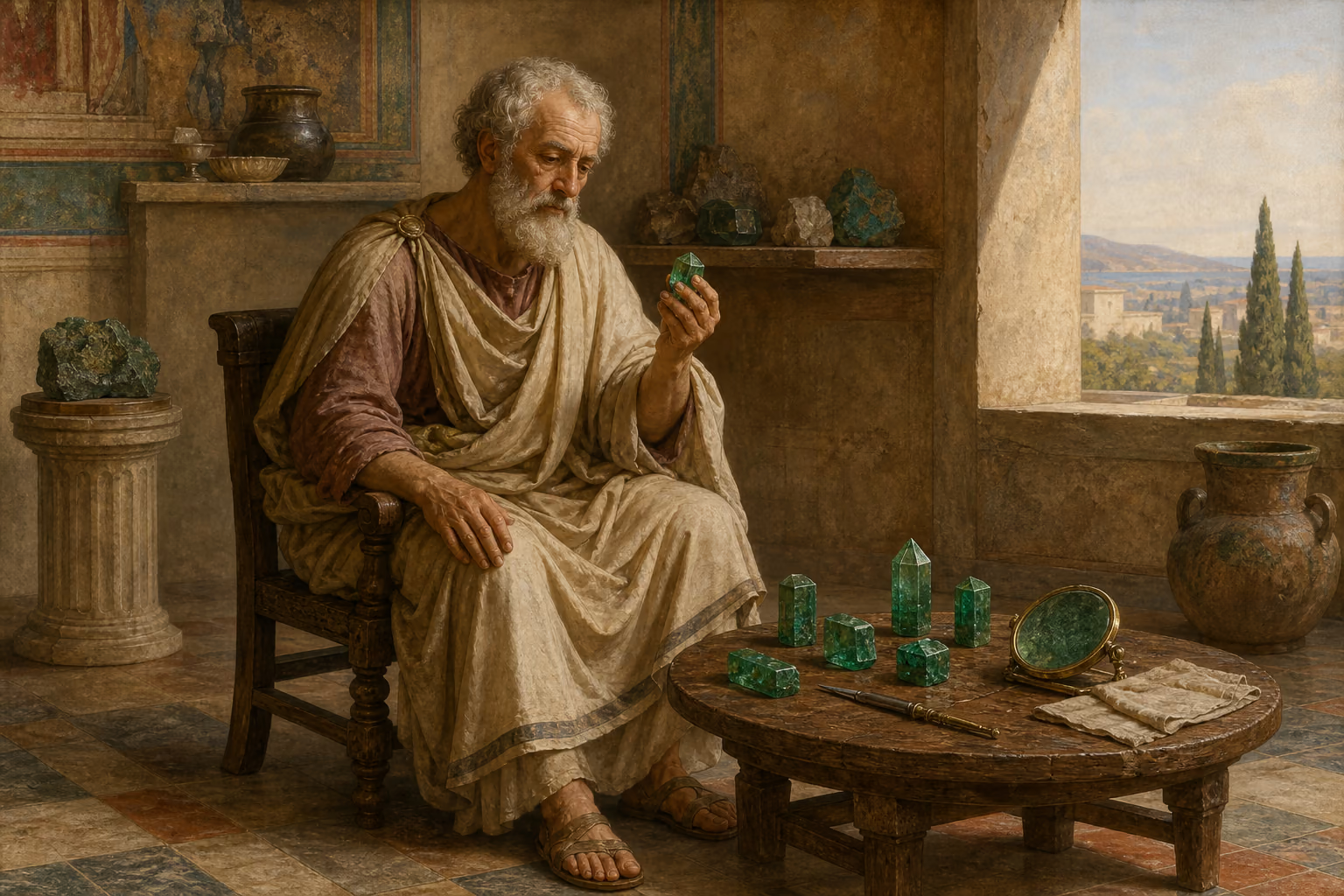
Tertia auctoritas smaragdis perhibetur pluribus de causis, quippe nullius coloris aspectus incundior est. nam herbas quoque silentes frondesque avide spectamus, smaragdos vero tanto libentius, quoniam nihil omnino viridius comparatum illis viret. praeterea soli gemmarum contuitu inplent oculos nec satiant. quin et ab intentione alia aspectu smaragdi recreatur acies, scalpentibusque gemmas non alia gratior oculorum refectio est: ita viridi lenitate lassitudinem mulcent. praeterea longinquo amplificantur visu inficientes circa se repercussum aëra, non sole mutati, non umbra, non lucernis, semperque sensim radiantes et visum admittentes ad crassitudinem sui facilitate tralucida, quod etiam in aquis nos iuvat. iidem plerumque concavi, ut visum conligant. quam ob rem decreto hominum iis parcitur scalpi vetitis. quamquam Scythicorum Aegyptiorumque duritia tanta est, ut non queant volnerari. quorum vero corpus extentum est, eadem qua specula ratione supini rerum imagines reddunt. Nero princeps gladiatorum pugnas spectabat in smaragdo.
Genera eorum duodecim: nobilissimi Scythici, ab ea gente, in qua reperiuntur, appellati. nullis maior austeritas nec minus vitii; quantum smaragdi a gemmis distant, tantum Scythicus a ceteris smaragdis. proximam laudem habent, sicut et sedem, Bactriani. in commissuris saxorum colligere eos dicuntur etesiis flantibus; tunc enim tellure deoperta internitent, quia iis ventis harenae maxime moventur. sed hos minores multo Scythicis esse tradunt. tertium locum Aegyptii habent. eruuntur circa Copton, oppidum Thebaidis, collibus excavatis.
Reliqua genera in metallis aerariis inveniuntur, quapropter principatum ex iis optinent Cyprii. dos eorum est in colore liquido nec diluto, verum ex umido pingui quaque perspicitur imitante tralucidum maris, pariterque ut traluceat et niteat [hoc est ut colorem expellat, aciem recipiat]. ferunt in ea insula tumulo reguli Hermiae iuxta cetarias marmoreo leoni fuisse inditos oculos e smaragdis ita radiantibus etiam in gurgitem, ut territi thynni refugerent, diu mirantibus novitatem piscatoribus, done mutavere oculis gemmas. — Sed et vitia demonstrari convenit in tam prodigis pretiis. sunt quidem omnium eadem, quaedam tamen nationum peculiaria, sicut in homine. ergo Cyprii, varie glauci magisque ac minus in eodem smaragdo aliis partibus, tenorem illum Scythicae austeritatis non semper custodiunt. ad hoc quibusdam intercurrit umbra, surdusque fit colos, qui inprobatur etiam dilutior. hinc genera distinguntur, ut sint aliqui obscuri, quos vocant caecos, alii densi nec e liquido tralucidi, quidam varii, quidam nubecula obducti. aliud est haec quam umbra, de qua diximus. nubecula albicantis est vitium, cum viridis non pertransit aspectus, sed aut intus occurrit aut excipit in fine visum candor. haec coloris sunt vitia, item corporis capillamentum, sal, plumbago, quae communia fere sunt.
Ab his Aethiopici laudantur ab Copto dierum itinere, ut auctor est luba, xxv, acriter virides, sed non facile puri aut concolores. Democritus in hoc genere ponit Thermiaeos et Persicos, illos intumescentes pinguiter, Persicos vero non tralucidos, sed iucundi tenoris visum inplere, quem non admittant, felium pantherarumque oculis similes, namque et illos radiare nec perspici, eosdem in sole hebetari, in umbra refulgere et longius quam ceteros nitere. omnium horum etiamnum vitium, quod fellis colorem aut acris olei habent, dilucidi quidem ac liquidi, sed non virides. haec vitia in Atticis maxime sentiuntur in argentariis metallis repertorum. in loco, qui Thoricos vocatur, semper minus pingues, sed ex longinquo speciosiores. frequens est in his et plumbago, hoc est ut in sole plumbei videantur. illud peculiare, quod quidam ex his senescunt, paulatim viriditate evanida, et sole quoque laeduntur. post hos Medici plurimum habent varietatis, interdum aliquid et e sappiro. hi sunt fluctuosi ac rerum imagines complexi, papaverum verbi gratia aut avium catulorumque vel pinnarum. quidam tamen virides nasci videntur, quoniam oleo meliores fiunt, neque est aliorum amplitudo maior. Calchedonii—nescio an in totum—exoleverunt, postquam metalla aeris ibi defecerunt, et semper tamen vilissimi fuere minimique, iidem fragiles et coloris incerti et virentium in caudis pavonum columbarumque e collo plumis similiter ad inclinationem magis aut minus lucidi, venosi iidem squamosique. erat et peculiare in iis vitium sarcion appellatum, hoc est quaedam gemmae caro. mons est iuxta Calchedonem, in quo legebantur, Smaragdites vocatus. Iuba auctor est smaragdum, quam chloran vocent, in Arabia aedificiorum ornamentis includi et lapidem, quem alabastriten Aegyptii vocent, complures vero e proximis et in Taygeto monte erui Medicis similes et alios in Sicilia.
Inseritur smaragdis et quae vocatur tanos e Persis veniens gemma, ingrate viridis atque intus sordida, itidem chalcosmaragdos e Cypro, turbida aereis venis. Theophrastus tradit in Aegyptiorum commentariis reperiri regi eorum a rege Babylonio muneri missum smaragdum quattuor cubitorum longitudine ac trium latitudine, et fuisse apud eos in lovis delubro obeliscum e quattuor smaragdis quadraginta cubitorum longitudine, latitudine vero in parte quattuor, in parte duorum, se autem scribente esse in Tyro Herculis templo stelen amplam e smaragdo, nisi potius pseudosmaragdus sit, nam et hoc genus reperiri, et in Cypro inventum ex dimidia parte smaragdum, ex dimidia iaspidem, nondum umore in totum transfigurato. Apion cognominatus Plistonices paulo ante scriptum reliquit esse etiam nunc in labyrintho Aegypti colosseum Serapim e smaragdo novem cubitorum.
Eandem multis naturam aut certe similem habere berulli videntur. India eos gignit, raro alibi repertos. poliuntur omnes sexangula figura artificum ingeniis, quoniam hebes unitate surda color repercussu angulorum excitetur. aliter politi non habent fulgorem. probatissimi ex iis sunt qui viriditatem maris puri imitantur, proximi qui vocantur chrysoberulli, paulo pallidiores, sed in aureum colorem exeunte fulgore. vicinum huic genus est, sed pallidius et a quibusdam proprii generis existimatum vocatumque chrysoprasum. quarto loco numerantur hyacinthizontes, quinto quos aëroidis vocant, postea cerini ac deinde oleagini, hoc est colore olei, postremi crystallo similes. hi fere capillamenta habent sordesque, alioqui evanidi, quae sunt omnia vitia. Indi mire gaudent longitudine eorum solosque gemmarum esse praedicant, qui carere auro malint; ob id perforatos elephantorum saetis subligant. convenit non oportere perforari quorum sit absoluta bonitas, umbilicis tantum ex auro capita conprehendentibus. ideo cylindros ex iis malunt facere quam gemmas, quoniam est summa commendatio in longitudine. quidam et angulosos statim putant nasci et perforatos gratiores fieri medulla candoris exempta additoque auri repercussu aut omnino castrata perspicuitati crassitudine. vitia praeter iam dicta eadem fere, quae in smaragdis, et pterygia. in nostro orbe aliquando circa Pontum inveniri putantur. Indi et alias quidem gemmas crystallum tinguendo adulterare invenerunt, sed praecipue berullos.
English · Bostock & Riley 1855–57
The third rank, for many reasons, has been given to the smaragdus. Indeed there is no stone, the colour of which is more delightful to the eye; for whereas the sight fixes itself with avidity upon the green grass and the foliage of the trees, we have all the more pleasure in looking upon the smaragdus, there being no green in existence of a more intense colour than this. And then, besides, of all the precious stones, this is the only one that feeds the sight without satiating it. Even when the vision has been fatigued with intently viewing other objects, it is refreshed by being turned upon this stone; and lapidaries know of nothing that is more gratefully soothing to the eyes, its soft green tints being wonderfully adapted for assuaging lassitude, when felt in those organs.
And then, besides, when viewed from a distance, these stones appear all the larger to the sight, reflecting as they do, their green hues upon the circumambient air. Neither sunshine, shade, nor artificial light effects any change in their appearance; they have always a softened and graduated brilliancy; and transmitting the light with facility, they allow the vision to penetrate their interior; a property which is so pleasing, also, with reference to water. In form they are mostly concave, so as to re-unite the rays of light and the powers of vision: and hence it is, that it is so universally agreed upon among mankind to respect these stones, and to forbid their surface to be engraved. In the case, however, of the stones of Scythia and Egypt, their hardness is such, that it would be quite impossible to penetrate them. When the surface of the smaragdus is flat, it reflects the image of objects in the same manner as a mirror. The Emperor Nero used to view the combats of the gladiators upon a smaragdus.
Of this stone there are no less than twelve different kinds; of which the finest is the Scythian smaragdus, so called from the country where it is found. None of them has a deeper colour than this, or is more free from defects: indeed, in the same degree that the smaragdus is superior to other precious stones, the Scythian smaragdus is superior to the other varieties. Next in esteem to this, as also in locality, is the smaragdus of Bactriana. These stones are collected, it is said, in the fissures of rocks, when the Etesian winds prevail; a period at which the earth that covers them is removed, and the stones are detected by their brightness, the sands being greatly agitated by the action of the winds. These last, however, are much inferior, they say, to those of Scythia in size. The third rank is held by the stones of Egypt, which are extracted from the hills in the vicinity of Coptos, a city of Thebais.
All the other kinds are found in copper-mines, and hence it is that, of these varieties, the smaragdus of Cyprus holds the highest rank. The merit of them consists in their clear colour, which has nothing thin or diluted in it, but presents a rich and humid transparency, closely resembling the tints of the sea, in fact. Hence it is that these stones are at once diaphanous and shining, or, in other words, reflect their colours and allow the vision to penetrate within. They say that in this island, upon the tomb of a petty king named Hermias, near the fisheries there, there was formerly a lion in marble, with eyes made of smaragdi; the brilliancy of which penetrated the sea to such a degree, as to alarm the tunnies and put them to flight: a novel circumstance, which for a long time excited wonder in the fishermen, till at last the stones in the statue were changed for others.
It will be only proper, too, seeing that the prices of these stones are so exorbitant, to point out their defects. Some defects, no doubt, are common to all of them, while others, again, like those found in the human race, are peculiar only to those of a certain country. Thus, for example, the stones of Cyprus are not all green alike, and in the same smaragdus some parts are more or less so than others, the stone not always preserving that uniform deep tint which characterizes the smaragdus of Scythia. In other instances, a shadow runs through the stone, and the colour becomes dulled thereby; the consequence of which is, that its value is depreciated; and even more so, when the colour is thin and diluted.
In consequence of the defects in these stones, they have been divided into several classes. Some of them are obscure, and are then known as “blind” stones; some have a certain density, which impairs their transparency; others, again, are mottled, and others covered with a cloud. This cloud, however, is altogether different from the shadow above mentioned; for it is a defect which renders the stone of a whitish hue, and not of a transparent green throughout; presenting, as it does, in the interior or upon the surface, a certain degree of whiteness which arrests the vision. Other defects, again, in these stones, are filaments, salt-like grains, or traces of lead ore, faults which are mostly common to them all.
Next after the kinds above described, the smaragdus of Æthiopia is held in high esteem; being found, as Juba tells us, at a distance of twenty-five days’ journey from Coptos. These are of a bright green, but are seldom to be met with perfectly clear or of an uniform colour. Democritus includes in this class the stones that are known as “herminei,” and as “Persian” stones; the former of which are of a convex, massive shape, while the latter are destitute of transparency, but have an agreeable, uniform colour, and satisfy the vision without allowing it to penetrate them; strongly resembling, in this respect, the eyes of cats and of panthers, which are radiant without being diaphanous. In the sun, he says, they lose their brilliancy, but they are radiant in the shade, the brightness of them being seen at a greater distance than in the case of other stones. One other fault, too, in all these stones is, that they often have a colour like that of honey or rancid oil, or else are clear and transparent, but not green.
These defects exist in the smaragdi of Attica, more particularly, which are found in the silver-mines there, at a place known by the name of Thoricos. These last are never so massive as the others, and are always more pleasing to the sight when viewed from a distance: lead ore, too, is often to be detected in them, or, in other words, they have a leaden appearance when looked at in the sun. One peculiarity in them is, that some of them become impaired by age, gradually lose their green colour, and are even deteriorated by exposure to the sun. Next to the stones of Attica come those of Media, a variety which presents the most numerous tints of all, and sometimes approaches sapphiros in colour. These stones are wavy, and represent various natural objects, such as poppy-heads, for example, birds, the young of animals, and feathers: all of them appear naturally of a green colour, but become improved by the application of oil. No stones of this species are of a larger size than these.
I am not aware that any of these stones are still in existence at Chalcedon, the copper mines of that locality being now exhausted: but be this as it may, they were always the smallest in size and the most inferior in value. Brittle, and of a colour far from distinctly pronounced, they resembled in their tints the feathers that are seen in the tail of the peacock or on the necks of pigeons. More or less brilliant, too, according to the angle at which they were viewed, they presented an appearance like that of veins and scales. There was another defect, also, peculiar to these stones, known as “sarcion,” from the circumstance that a kind of flesh appeared to attach itself to the stone. The mountain near Chalcedon, where these stones were gathered, is still known by the name of “Smaragdites.” Juba informs us that a kind of smaragdus, known as “cloras,” is used in Arabia as an ornament for buildings, as also the stone which by the people of Egypt is called “alabastrites.” On the same authority, too, we learn that there are several varieties of the smaragdus in the neighbouring mountains, and that stones like those of Media are found in Mount Taygetus, as also in Sicily.
Among the smaragdi is also included the precious stone known as “tanos.” It comes from Persia, and is of an unsightly green, and of a soiled colour within. There is the chalcosmaragdos also, a native of Cyprus, the face of which is mottled with coppery veins. Theophrastus relates that he had found it stated in the Egyptian histories, that a king of Babylon once sent to the king of Egypt a smaragdus four cubits in length by three in breadth. He informs us, also, that in a temple of Jupiter in Egypt there was an obelisk made of four smaragdi, forty cubits in length, and four in breadth at one extremity, and two at the other. He says, too, that at the period at which he wrote, there was in the Temple of Hercules at Tyrus a large column made of a single smaragdus; though very possibly it might only be pseudo-smaragdus, a kind of stone not uncommonly found in Cyprus, where a block had been discovered, composed, one half of smaragdus, and one half of jasper, and the liquid in which had not as yet been entirely transformed. Apion, surnamed “Plistonices,” has left a very recent statement, that there was still in existence, in his time, in the Labyrinth of Egypt, a colossal statue of Serapis made of a single smaragdus, nine cubits in height.
Beryls, it is thought, are of the same nature as the smaragdus, or at least closely analogous. India produces them, and they are rarely to be found elsewhere. The lapidaries cut all beryls of an hexagonal form; because the colour, which is deadened by a dull uniformity of surface, is heightened by the reflection resulting from the angles. If they are cut in any other way, these stones have no brilliancy whatever. The most esteemed beryls are those which in colour resemble the pure green of the sea; the chrysoberyl being next in value, a stone of a somewhat paler colour, but approaching a golden tint. Closely allied to this last in its brilliancy, but of a more pallid colour, and thought by some to constitute a separate genus, is chrysoprasus. In the fourth rank are reckoned the hyacinthine beryls; and in the fifth, those known as “aëroides.” Next, we have the wax-coloured beryls, and, after them, the oleaginous beryls, so called from the resemblance of their colour to that of oil. Last of all, there are the stones which closely resemble crystal in appearance; mostly disfigured by spots and filaments, and of a poor, faint, colour as well; all of them so many imperfections in the stone.
The people of India are marvellously fond of beryls of an elongated form, and say that these are the only precious stones they prefer wearing without the addition of gold: hence it is that, after piercing them, they string them upon the bristles of the elephant. It is generally agreed, however, that those stones should not be perforated which are of the finest quality; and in this case they only enclose the extremities of them in studs of gold. They prefer, too, cutting the beryls in a cylindrical form, instead of setting them as precious stones; an elongated shape being the one that is most highly esteemed. Some are of opinion that beryls are naturally angular, and that when pierced they become improved in colour; the white substance being thus removed that lies within, and their brilliancy heightened by the reflection of the gold in which they are set; or, at all events, their transparency being increased by this diminution in their thickness. In addition to the defects already mentioned, and which are pretty nearly the same as those to which the smaragdus is subject, beryls are affected with cloudy spots, like those on the finger-nails in appearance. In our own part of the world, it is thought that they are sometimes found in the countries that lie in the vicinity of Pontus. The people of India, by colouring crystal, have found a method of imitating various precious stones, beryls in particular.