LIBER XXXVII · CAPUT 7
CARBUNCULUS: TWELVE VARIETIES OF IT
Latine · Mayhoff 1906
Principatum habent carbunculi a similitudine ignium appellati, cum ipsi non sentiant ignes, a quibusdam ob hoc acaustoe appellati. horum genera Indici et Garamantici, quos et Carchedonios vocavere propter opulentiam Carthaginis Magnae. adiciunt Aethiopicos et Alabandicos in Orthosia Cariae nascentes, sed qui perficiantur Alabandis. praeterea in omni genere masculi appellantur acriores et feminae languidius refulgentes. in masculis quoque observant liquidiores aut flammae nigrioris et quosdam ex alto lucidos ac magis ceteris in sole flagrantes, optimos vero amethystizontas, hoc est quorum extremus igniculus in amethysti violam exeat, proximos illis, quos vocant syrtitas, pinnato fulgore radiantes. inveniri autem ubi maxime sit solis repercussus. Satyrus Indicos non esse claros dicit ac plerumque sordidos ac semper fulgoris retorridi, Aethiopicos pingues lucemque non fundentes convoluto igne flagrare. Callistratus fulgorem carbunculi debere candidum esse, ut positus extremo visu nubilante sit, si attollatur, exardescente fulgore—ob id plerique hunc carbunculum candidum vocavere, eum, qui languidius lucet, lignyzontem—; Carchedonios multo minores esse, Indicos etiam sextarii unius mensura cavari. Archelaus Carchedonios nigrioris aspectus esse, sed igni vel sole et inclinatione acrius quam ceteros excitari; eosdem obumbrante tecto purpureos videri, sub caelo flammeos, contra radios solis scintillare, ceras signantibus his liquescere, quamvis in opaco. multi Indicos Carchedoni is candidiores esse et e diverso inclinatione hebetari scripsere, etiamnum in Carchedoniis maribus stellam intus ardere, feminas fulgorem universum fundere extra se, Alabandicos nigriores ceteris esse scabrosque. et circa Miletum nascuntur in terra coloris eiusdem, ignem minime sentientes. Theophrastus auctor est et in Orchomeno Arcadiae inveniri et in Chio, illos nigriores, e quibus et specula fieri; esse et Troezenios varios intervenientibus maculis albis, item Corinthios, sed pallidiores e candido; a Massilia quoque inportari. Bocchus et in Olisiponensi erui scripsit, magno labore ob argillam soli adusti.— Nec est aliud difficilius quam discernere haec genera; tanta est in iis occasio artis, subditis per quae tralucere cogantur. aiunt hebetiores, in aceto maceratos XIII diebus, nitescere totidem mensibus durante fulgore. adulterantur vitro simillime, sed cote deprehenduntur, sicut aliae gemmae; fictis enim mollior materia fragilisque est. centrosas cote deprehendunt et pondere, quod minus est in vitreis, aliquando et pusulis argenti modo relucentibus.
Est et anthracitis appellata, in Thesprotia fossilis, carbonibus similis. falsum arbitror quod et in Liguria nasci prodiderunt, nisi forte tunc nascebantur. esse in iis et praecinctas candida vena tradunt. harum igneus color ut superiorum, sed peculiare quod tactu velut intermortuae extinguntur, contra aquis perfusae exardescunt.
Cognata est et sandastros, proxima natura eius, quam aliqui Garamanticam vocant. nascitur in Indis loco eiusdem nominis. gignitur et in Arabia ad meridiem versa. commendatio summa quod veluti in tralucido ignis optentus stellantibus fulget intus aureis guttis, semper in corpore, numquam in cute. accedit et religio narrata siderum cognatione, quoniam fere pliadum hyadumque dispositione ac numero stellantur, ob id Chaldaeis in caerimoniis habitae. et hic mares austeritas distinguat et quidam vigor adposita tinguens; Indicae quidem etiam hebetare visus dicuntur. blandior feminis flamma, allucens magis quam accendens. sunt qui praeferant Arabicas Indicis fumidaeque chrysolitho similes illas dicant. Ismenias negat poliri sandastros propter teneritatem, et ob id magno venire. sunt qui has sandrisitas vocent. inter omnes constat, quantum numero stellarum accedat, tantum et pretio accedere. —Adfert aliquando errorem similitudo nominis sandaresi. Nicander sandaserion vocat, alii sandareson, quidam vero hanc sandastrum, illam sandaresum, in India nascentem illam quoque et loci nomen custodientem, mali colore aut olei viridis, omnibus inprobatam.
Ex eodem genere ardentium est lychnis appellata a lucernarum adsensu, tum praecipuae gratiae. nascitur circa Orthosiam totaque Caria ac vicinis locis, sed probatissima in Indis. quidam remissiorem carbunculum esse dixerunt, secundam bonitate quae similis esset Iovis appellatis floribus. et alias invenio differentias: unam quae purpuram radiet, alteram quae coccum; has sole excalfactas aut attritu digitorum paleas et chartarum fila ad se rapere. — Hoc idem et Carchedonia facere dicitur, quamquam multo vilior praedictis. nascitur apud Nasamonas in montibus, ut incolae putant, imbre divino. inveniuntur ad repercussum lunae maxime plenae, Carthaginem quondam deportabantur. Archelaus et in Aegypto circa Thebas nasci tradit fragiles, venosas, morienti carboni similes. potoria ex hac et ex lychnide factitata invenio, omnia autem haec genera contumaciter scalpturae resistunt partemque in signo cerae tenent.
E diverso ad haec sarda utilissima, quae nomenl cum sardonyche communicavit. ipsa volgaris et primum Sardibus reperta est; laudatissimae circa Babylona. cum lapicidinae quaedam aperiantur, haerentes in saxo cordis modo reperiuntur. hoc metallum apud Persas defecisse tradunt, sed inveniuntur compluribus aliis locis, ut in Paro et Asso; in India trium generum: rubrae et quas pionias vocant ab pinguitudine; tertium genus est quod argenteis bratteis sublinunt. Indicae perlucent, crassiores sunt Arabicae. inveniuntur et circa Leucada Epiri et in Aegypto quae brattea aurea sublinuntur. et in his autem mares excitatius fulgent, feminae pigriores et crassius nitent. nec fuit alia gemma apud antiquos usu frequentior —hac certe apud Menandrum et Philemonem fabulae superbiunt—, nec ullae tralucentium tardius subfusae umore hebetantur, oleoque magis quam alio liquore. damnantur ex iis melleae ac validius testaceae.
English · Bostock & Riley 1855–57
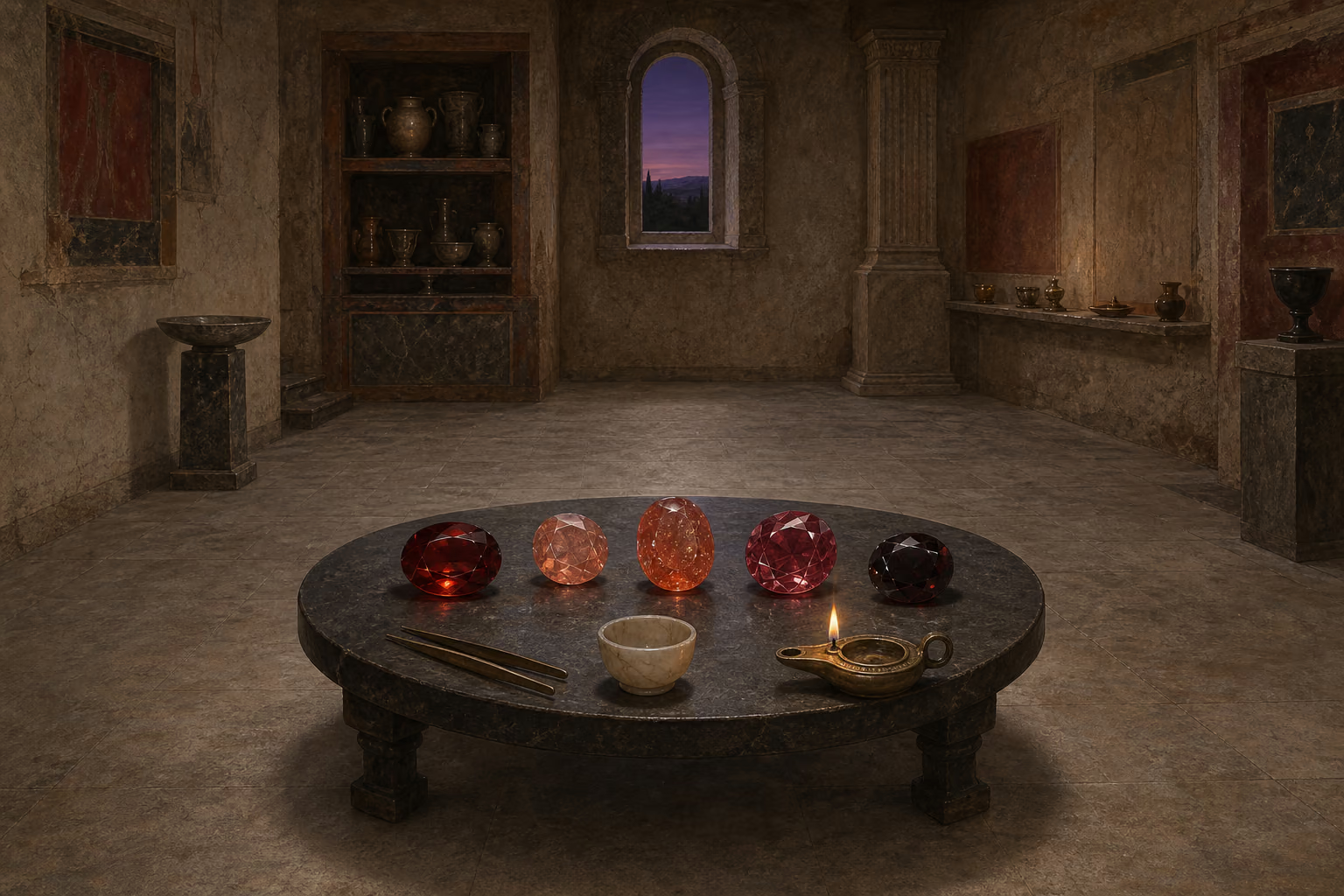
In the first rank among these is carbunculus, so called from its resemblance to fire; though in reality it is proof against the action of that element: hence it is that some persons call these stones “acaustoi.” There are various kinds of carbunculus, the Indian and the Garamantic, for example, which last has been also called the Carchedonian, in compliment to the former opulence of Great Carthage. To these are added the Æthiopian and the Alabandic stones, the latter of which are found at Orthosia in Caria, but are cut and polished at Alabanda. In addition to this, each kind is subdivided into the male carbunculus and the female, the former of which is of a more striking brilliancy, the brightness of the latter being not so strong. In the male varieties too, we see some in which the fire is clearer than in others; while some, again, are of a darker hue, or else have their brilliancy more deeply seated, and shine with a more powerful lustre than others when viewed in the sun.
The most highly esteemed, however, is the amethyst-coloured stone, the fire at the extremity of which closely approaches the violet tint of amethystos: next in value to which, are the stones known as “syrtites,” radiant with a wavy, feathery, refulgence. They are found more particularly, it is said, where the reflection is most powerful of the rays of the sun. Satyrus says that the carbunculus of India has no lustre, that it is mostly soiled, and that in all cases its brilliancy is of a tawny complexion. The Æthiopian stones, he says, are dense, emit no lustre, and burn with a concentrated flame. According to Callistratus, the refulgence of this stone should be of a whitish hue, and, when placed upon a table, it should heighten by its lustre other stones placed near it that are clouded at the edge. Hence it is, that many writers speak of this stone as the white carbunculus, while the Indian stone, with its comparatively feeble lustre, is known by the name of “lignyzon.” The Carchedonian stones, they say, are of much smaller size than the others; but those of India admit of being hollowed out, and making vessels that will hold as much as one sextarius even.
According to Archelaüs, the Carchedonian carbunculus is of a more swarthy appearance than the others, but, when exposed to the light of the fire or sun, and viewed obliquely, the brilliancy of it is much more intense than that of the rest. He says, too, that this stone, when overshadowed by a roof, has a purple tint; that when viewed in the open air, it is of a flame colour; and that, when exposed to the rays of the sun, it scintillates. He states also that wax, if sealed with these stones, in the shade even, will melt. Many authors have asserted that the Indian stones are paler than the Carchedonian, and that, quite the converse of these last, they are all the less brilliant when viewed obliquely; as also, that in the male Carchedonian stone there are luminous points like stars within, while, in the case of the female stone, the whole of its refulgence is thrown beyond it. The stones of Alabanda too, it is said, are darker than the other kinds, and rough on the surface. In the vicinity also of Miletus, there are stones of this description found in the earth, resembling those of Alabanda in colour, and proof against the action of fire.
According to Theophrastus, these stones are to be found also at Orchomenus in Arcadia and in the Isle of Chios; the former of which are of a darker hue, and are used for making mirrors. He says too, that at Trœzen they are found of various colours and mottled with white spots, those found at Corinth being of a more pallid, whitish, hue. He states also, that they are sometimes imported from Massilia. Bocchus informs us in his writings, that these stones are extracted from the ground at Olisipo; at the cost of great labour, however, in consequence of the parched, argillaceous, nature of the soil.
Nothing is more difficult than to distinguish the several varieties of this stone, so great an opportunity do they afford to artistic skill of compelling them to reflect the colours of substances placed beneath. It is possible, they say, to heighten the brilliancy of dull stones, by steeping them for fourteen days in vinegar, this adventitious lustre being retained by them as many months. They are counterfeited, too, with great exactness in glass; but the difference may be detected with the touchstone; the same being the case also with other artificial stones, as the material is always of a softer nature and comparatively brittle. When thus tested by the stone, hard knots, too, are detected in them; and the weight of the glass counterfeit is always less. In some cases, too, they present small blisters within, which shine like silver.
There is also a fossil stone found in Thesprotia, known as “anthracitis,” and resembling a burning coal in appearance. Those who have stated that it is a native also of Liguria, are mistaken, in my opinion, unless perhaps it was to be found there in their time. Some of these stones, they say, are surrounded with a vein of white. Like those which we have mentioned above, they have a fiery colour, but there is this peculiarity in them, that when thrown into the fire they have all the appearance of becoming quenched and deadened; while, on the other hand, if they are drenched with water, they become doubly glowing.
Of a kindred nature, too, is sandastros, known as “garamantites” by some: it is found in India, at a place of that name, and is a product also of the southern parts of Arabia. The great recommendation of it is, that it has all the appearance of fire placed behind a transparent substance, it burning with star-like scintillations within, that resemble drops of gold, and are always to be seen in the body of the stone, and never upon the surface. There are certain religious associations, too, connected with this stone, in consequence of the affinity which it is supposed to bear with the stars; these scintillations being mostly, in number and arrangement, like the constellations of the Pleiades and Hyades; a circumstance which had led to the use of it by the Chaldæi in the ceremonials which they practise.
Here, too, the male stones are distinguished from the female, by their comparative depth of colour and the vigorousness of the tints which they impart to objects near them: indeed the stones of India, it is said, quite dim the sight by their brilliancy. The flame of the female sandastros is of a more softened nature, and may be pronounced to be lustrous rather than brilliant. Some prefer the stone of Arabia to that of India, and say that this last bears a considerable resemblance to a smoke-coloured chrysolithos. Ismenias asserts that sandastros, in consequence of its extreme softness, will not admit of being polished, a circumstance which makes it sell all the dearer: other writers, again, call these stones “sandrisitæ.” One point upon which all the authorities are agreed is, that the greater the number of stars upon the stone, the more costly it is in price.
The similarity of the name has sometimes caused this stone to be confounded with that known as “sandaresos,” and which Nicander calls “sandaserion,” and others “sandaseron.” Some, again, call this last-mentioned stone “sandastros,” and the former one “sandaresos.” The stone that is thus mentioned by Nicander, is a native of India as well as the other, and likewise takes its name from the locality where it is found. The colour of it is that of an apple, or of green oil, and no one sets any value on it.
To the same class of flame-coloured stones belongs that known as “lychnis;” so called from its lustre being heightd by the light of the lamp, under which circumstances its tints are particularly pleasing. It is found in the vicinity of Orthosia, throughout the whole of Caria, and in the neighbouring localities; but the most approved stones are those that come from India. Some writers have given the name of “deadened” carbunculus to a lychnis of second-rate quality, and similar in colour to the flower known as the “flower of Jove.” I find other varieties also mentioned, one with a purple radiance, and another of a scarlet tint. It is asserted, too, that these stones, when heated or rubbed between the fingers, will attract chaff and filaments of paper.
Carchedonia, too, is said to have the same property, though far inferior in value to the stones already mentioned. It is found in the mountains among the Nasamones, being produced, the natives think, by showers sent for the purpose from heaven. These stones are found by the light of the moon, more particularly when at full: in former days, Carthage was the entrepôt for them. Archelaüs speaks of a brittle variety being found in the vicinity of Thebes also, in Egypt, full of veins, and similar to dying embers in appearance. I find it stated, too, that in former times, drinking-vessels used to be made of this stone and of lychnis: all these kinds of stone, however, offer the most obstinate resistance to the graver, and, if used for seals, are apt to bring away a part of the wax.
Sarda, on the other hand, is remarkably useful for this purpose; a stone which shares its name, in part, with sardonyx. It is a common stone, and was first found at Sardes, but the most esteemed kind is that of the vicinity of Babylon. When certain quarries are being worked, these stones are found, adhering, like a kind of heart, to the interior of the rock. This mineral, however, is said to be now extinct in Persia; though it is to be found in numerous other localities, Paros and Assos, for example.
In India there are three varieties of this stone; the red sarda, the one known as “pionia,” from its thickness, and a third kind, beneath which they place a ground of silver tinsel. The Indian stones are transparent, those of Arabia being more opaque. There are some found also in the vicinity of Leucas in Epirus, and in Egypt, which have a ground placed beneath them of leaf gold. In the case of this stone, too, the male stone shines with a more attractive brilliancy than the female, which is of a thicker substance, and more opaque. Among the ancients there was no precious stone in more common use than this; at all events, it is this stone that is made so much parade of in the comedies of Menander and Philemon. No one, too, among the transparent stones is tarnished more speedily by exposure to moisture than this; though of all liquids, it is oil that acts the most readily upon it. Those stones which are like honey in colour, are generally disapproved of, and still more so, when they have the complexion of earthenware.