LIBER XXXVII · CAPUT 8
TOPAZOS: TWO VARIETIES OF IT
Latine · Mayhoff 1906
Egregia etiam nunc sua topazo gloria est, e virenti genere et, cum primum reperta est, praelatae omnibus. accidit in Arabiae insula, quae Cytis vocabatur, in quam devenerant Trogodytae praedones fame et tempestate fessi, ut, cum herbas radicesque foderent, eruerent topazon. haec Archelai sententia est. Iuba Topazum insulam in Rubro mari a continenti stadiis CCC abesse dicit; nebulosam et ideo quaesitam saepius navigantibus nomen ex ea causa accepisse, topazin enim Trogodytarum lingua significationem habere quaerendi. ex hac primum inportatam Berenicae reginae, quae fuit mater sequentis Ptolemaei, ab Philone praefecto; regi mire placuisse et inde factam statuam Arsinoae Ptolemaei uxori quattuor cubitorum, sacratam in delubro, quod Arsinoeum cognominabatur. recentissimi auctores et circa Thebaidis Alabastrum oppidum nasci dicunt et duo genera eius faciunt, prasoides atque chrysopteron, simile chrysopraso. tota enim similitudo ad porri sucum derigitur. est autem amplissima gemmarum. eadem sola nobilium limam sentit, ceterae Naxio et cotibus poliuntur. haec et usu atteritur.
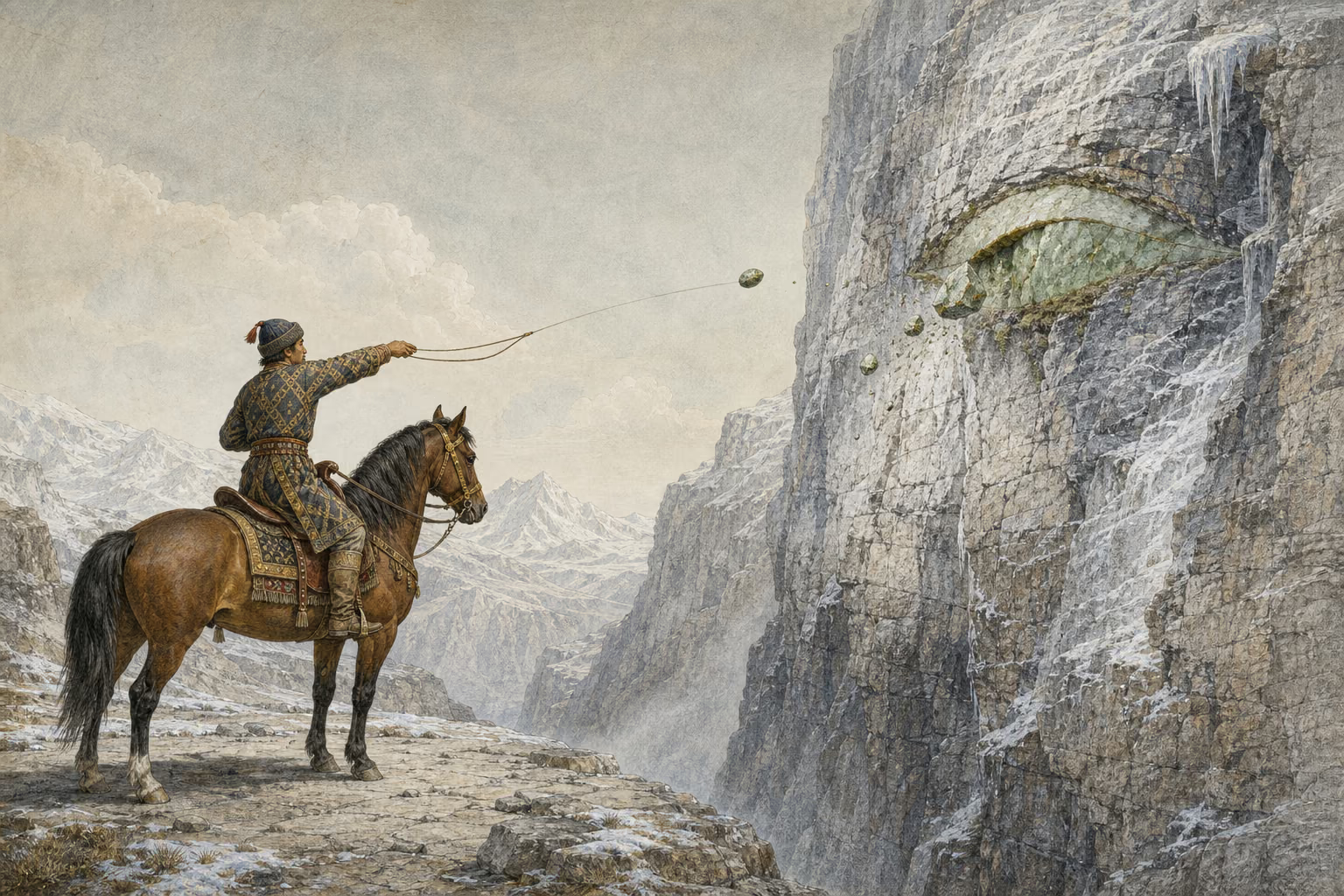
Comitatur eam similitudine propior quam auctoritate callaina, e viridi pallens. nascitur post aversa Indiae apud incolas Caucasi montis, Hyrcanos, Sacas, Dahas, amplitudine conspicua, sed fistulosa ac sordium plena, sincerior praestantiorque multo in Carmania, utrobique autem in rupibus inviis et gelidis, oculi figura extuberans leviterque adhaerescens nec ut adnata petris, sed ut adposita. quam ob rem scandere ad eas pigritia pedum equestres populos taedet, simul et periculum terret; ergo fundis e longinquo incessunt et cum toto musco excutiunt. hoc vectigal, hoc gestamen in cervice, digitis gratissimum norunt, hinc census, haec gloria a pueritia deiectum numerum praedicantium; in quo varia fortuna quidam ictu primo cepere praeclaras, multi ad senectam nullas. et venatus quidem callainis talis est. sectura inde formantur, alias faciles. optimis color smaragdi, ut tamen appareat alienum esse quod placeat. inclusae decorantur auro, aurumque nullae magis decent. quae sunt earum pulchriores, oleo, unguento, etiam mero colorem deperdunt, viliores constantius repraesentant, neque est imitabilior alia mendacio vitri. sunt qui in Arabia inveniri eas dicant in nidis avium, quas melancoryphos vocant.
Viridantium et alia plura sunt genera. vilioris turbae prasius, cuius alterum genus sanguineis punctis abhorret, tertium virgulis tribus distinctum candidis. praefertur his chrysoprasos porri sucum et ipsa referens, sed haec paulum declinantem a topazo in aurum. huic et amplitudo ea est, ut cymbia etiam ex ea fiant, cylindri quidem et creberrime. — India et has generat et nilion, fulgore ab ea distantem brevi et, cum intueare, fallaci. Sudines dicit et in Sibero Atticae flumine nasci. est autem color fumidae topazi aut aliquando melleae. Iuba in Aethiopia gigni tradit in litoribus amnis, quem Nilum vocamus, et inde nomen trahere.— non tralucet molochitis; spissius viret ab colore malvae nomine accepto, reddendis laudata signis et infantum custodia quodamque innato contra pericula medicamine.— Viret et saepe tralucet iaspis, etiam victa multis antiquitatis gloriam retinens. plurimae ferunt eam gentes, smaragdo similem Indi, Cypros duram glaucoque pingui, Persae aëri similem, quae ob id vocatur aërizusa; talis et Caspia est. caerulea est circa Thermodontem amnem, in Phrygia purpurea et in Cappadocia ex purpura caerulea, tristis atque non refulgens. Amisos Indicae similem mittit, Calchedon turbidam. sed minus refert nationes quam bonitates distinguere. optima quae purpurae aliquid habet, secunda quae rosae, tertia quae smaragdi. singulis Graeci nomina ex argumento dedere. quarta apud eos vocatur boria, caelo autumnali matutino similis; haec erit illa, quae aërizusa dicitur. [similis est et sardae, imitata et violas]. non minus multae species reliquae sunt, sed omnes in vitium caeruleae, ut crystallo similis aut myxis, item terebinthizusa. quam ob rem praestantiores funda cluduntur, ut sint patentes ab utraque parte nec praeter margines quicquam auro amplectente. vitium in iis est et brevis nitor nec longe splendescens et sal et quae ceteris omnia. et vitro adulterantur, quod manifestum fit, cum extra fulgorem spargunt atque non in se continent. reliquas sphragidas vocant, publico gemmarum nomine his tantum dato [quoniam optime signent].
English · Bostock & Riley 1855–57
Topazos is a stone that is still held in very high estimation for its green tints: indeed, when it was first discovered, it was preferred to every other kind of precious stone. It so happened that some Troglodytic pirates, suffering from tempest and hunger, having landed upon an island off the coast of Arabia known as Cytis, when digging there for roots and grass, discovered this precious stone: such, at least, is the opinion expressed by Archelaüs. Juba says that there is an island in the Red Sea called “Topazos,” at a distance of three hundred stadia from the main land; that it is surrounded by fogs, and is often sought by navigators in consequence; and that, owing to this, it received its present name, the word “topazin” meaning “to seek,” in the language of the Troglodytæ. He states also, that Philon, the king’s præfect, was the first to bring these stones from this island; that, on his presenting them to Queen Berenice, the mother of the second Ptolemæus, she was wonderfully pleased with them; and that, at a later period, a statue, four cubits in height, was made of this stone, in honour of Arsinoë, the wife of Ptolemæus Philadelphus, it being consecrated in the temple known as the “Golden Temple.”
The most recent writers say that this stone is found also in the vicinity of Alabastrum, a city of Thebais, and they distinguish two varieties of it, the prasoïdes and the chrysopteron; which last is similar to chrysoprasus, all the shades of it tending, more or less, to resemble the colouring principle of the leek. Topazos is the largest of all the precious stones, and is the only one among those of high value that yields to the action of the file, the rest being polished by the aid of stone of Naxos. It admits, too, of being worn by use.
With this stone we must also couple another, which resembles it more closely in appearance than in value, the stone known as “callaina,” and of a pale green colour. It is found in the countries that lie at the back of India, among the Phycari, namely, who inhabit Mount Caucasus, the Sacæ, and the Dahæ. It is remarkable for its size, but is covered with holes and full of extraneous matter; that, however, which is found in Carmania is of a finer quality, and far superior. In both cases, however, it is only amid frozen and inaccessible rocks that it is found, protruding from the surface, like an eye in appearance, and slightly adhering to the rock; not as though it formed an integral part of it, but with all the appearance of having been attached to it. People so habituated as they are to riding on horseback, cannot find the energy and dexterity requisite for climbing the rocks to obtain the stones, while, at the same time, they are quite terrified at the danger of doing so. Hence it is, that they attack the stones with slings from a distance, and so bring them down, moss and all. It is with this stone that the people pay their tribute, and this the rich look upon as their most graceful ornament for the neck. This constitutes the whole of their wealth, with some, and it is their chief glory to recount how many of these stones they have brought down from the mountain heights since the days of their childhood. Their success, however, is extremely variable; for while some, at the very first throw, have brought down remarkably fine specimens, many have arrived at old age without obtaining any.
Such is the method of procuring these stones; their form being given them by cutting, a thing that is easily effected. The best of them have just the colour of smaragdus, a thing that proves that the most pleasing property in them is one that belongs of right to another stone. Their beauty is heightened by setting them in gold, and there is no stone to which the contrast of the gold is more becoming. The finest of them lose their colour by coming in contact with oil, unguents, or undiluted wine even; whereas those of a poorer quality preserve their colour better. There is no stone, too, that is more easily counterfeited in glass. Some writers say, that this stone is to be found in Arabia also, in the nest of the bird known as the “melancoryphus.”
There are numerous other kinds also of green stones. To the more common class belongs prasius; one variety of which is disfigured with spots like blood, while another kind is marked with three streaks of white. To all these stones chrysoprasus is preferred, which is also similar to the colouring matter of the leek, but varies in tint between topazos and gold. This stone is found of so large a size as to admit of drinking-boats even being made of it, and is cut into cylinders very frequently.
India, which produces these stones, produces nilion also, a stone that differs from the last in its dull, diminished lustre, which, when steadily looked upon, soon fades from the sight. Sudines says that it is to be found also in the Siberus, a river of Attica. In appearance it resembles a smoke-coloured topazos, or, in some cases, a topazos with a tint like honey. According to Juba, Æthiopia produces it, upon the shores of the river known to us as the Nilus; to which circumstance, he says, it owes its name.
Molochitis is not transparent, being of a deeper green, and more opaque than smaragdus; its name is derived from the mallow, which it resembles in colour. It is highly esteemed for making seals, and it is endowed by Nature with medicinal properties which render it a preservative for infants against certain dangers which menace them. This stone is a native of Arabia.
Iaspis, too, is green, and often transparent; a stone which, if surpassed by many others, still retains the renown which it acquired in former times. Many countries produce this stone: that of India is like smaragdus in colour; that of Cyprus is hard, and of a full sea-green; and that of Persia is sky-blue, whence its name, “aërizusa.” Similar to this last is the Caspian iaspis. On the banks of the river Thermodon the iaspis is of an azure colour; in Phrygia, it is purple; and in Cappadocia of an azure purple, sombre, and not refulgent. Amisos sends us an iaspis like that of India in colour, and Chalcedon, a stone of a turbid hue.
But it is of less consequence to distinguish the several localities that furnish it, than it is to remark upon the degrees of excellence which they present. The best kind is that which has a shade of purple, the next best being the rose-coloured, and the next the stone with the green colour of the smaragdus; to each of which the Greeks have given names according to their respective tints. A fourth kind, which is called by them “boria,” resembles in colour the sky of a morning in autumn; this, too, will be the same that is known as “aërizusa.” There is an iaspis also which resembles sarda in appearance, and another with a violet tint. Not less numerous, too, are the other kinds that are left undescribed; but they are all blue to a fault, or else resemble crystal in appearance, or the tints of the myxa plum. There is the terebenthine -coloured iaspis also; improperly so called, in my opinion, as it has all the appearance of being a composition of numerous gems of this description.
The best of these stones are set in an open bezel, the gold of which only embraces the margins of the stone, leaving the upper and lower surfaces uncovered. One great defect in them is a subdued lustre, and a want of refulgence when viewed from a distance. Grains also like salt appear within the stone, and all the other defects which are common to precious stones in general. Sometimes they are imitated in glass; a fraud, however, which may be easily detected, from the material throwing out its refulgence, instead of concentrating it within itself. To this class also belongs the stone called “sphragis,” which is only reckoned as belonging to the domain of precious stones, from the circumstance that it is the best of all for making signets.