LIBER IV · CAPUT 13
GERMANY
Latine · Mayhoff 1906
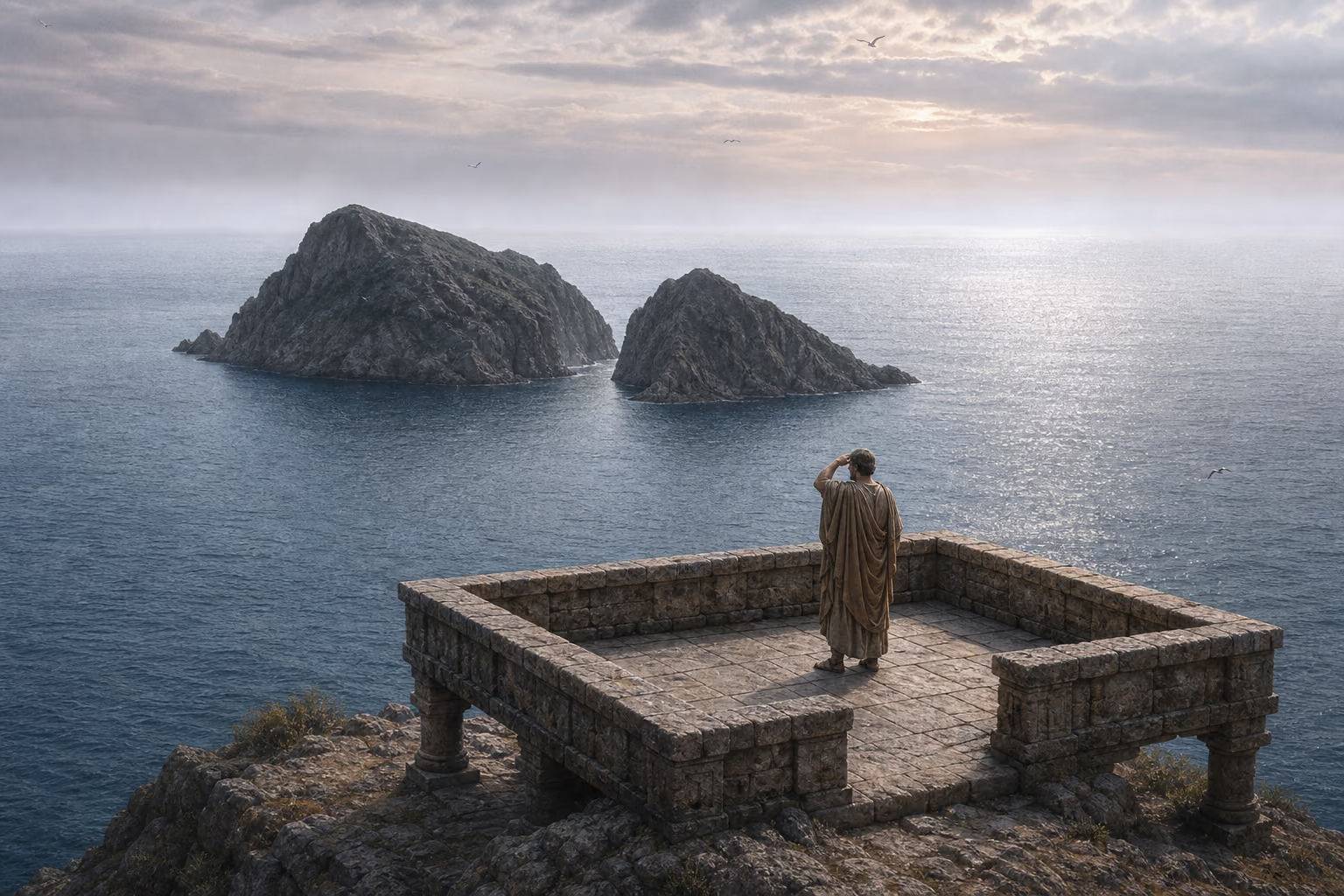
Hellespontus insulas non habet in Europa dicendas. in Ponto duae, M.D ab Europa, XIIII ab ostio, Cyaneae, ab aliis Symplegades appellatae traditaeque fabulis inter se concucurrisse, quoniam parvo discretae intervallo ex adverso intrantibus geminae cernebantur paulumque deflexa acie coeuntium speciem praebebant. citra Histrum Apolloniatarum una, LXXX p. a Bosporo Thracio, ex qua M. Lucullus Capitolinum Apollinem advexit. inter ostia Histri quae essent diximus. ante Borysthenen Achillea est supra dicta, eadem Leuce et Macaron appellata. hanc temporum horum demonstratio a Borysthene CXL ponit, a Tyra CXX, a Peuce insula L???; cingitur circiter X??? p. reliquae in Carcinite sinu Cephalonesos, Spodusa, Macra. non est omittenda multorum opinio, priusquam digrediamur a Ponto, qui maria omnia interiora illo capite nasci, non Gaditano freto, existimavere, haut inprobabili argumento, quoniam aestus semper e Ponto profluens numquam reciprocet.
Exeundum deinde est, ut extera Europae dicantur, transgressisque Ripaeos montes litus oceani septentrionalis in laeva, donec perveniatur Gadis, legendum. insulae complures sine nominibus eo situ traduntur, ex quibus ante Scythiam quae appellatur Baunonia unam abesse diei cursu, in quam veris tempore fluctibus electrum eiciatur, Timaeus prodidit. reliqua litora incerta. signata fama septentrionalis oceani. Amalchium eum Hecataeus appellat a Parapaniso amne, qua Scythiam adluit, quod nomen eius gentis lingua significat congelatum. Philemon Morimarusam a Cimbris vocari, hoc est mortuum mare, inde usque ad promunturium Rusbeas, ultra deinde Cronium. Xenophon Lampsacenus a litore Scytharum tridui navigatione insulam esse inmensae magnitudinis Balciam tradit, eandem Pytheas Basiliam nominat. feruntur et Oeonae, in quibus ovis avium et avenis incolae vivant, aliae, in quibus equinis pedibus homines nascantur, Hippopodes appellati, Phanesiorum aliae, in quibus nuda alioqui corpora praegrandes ipsorum aures tota contegant.
Incipit deinde clarior aperiri fama ab gente Inguaeonum, quae est prima in Germania. mons Saevo ibi, inmensus nec Ripaeis iugis minor, inmanem ad Cimbrorum usque promunturium efficit sinum, qui Codanus vocatur, refertus insulis, quarum clarissima est Scatinavia, inconpertae magnitudinis, portionem tantum eius, quod notum sit, Hillevionum gente quingentis incolente pagis: quare alterum orbem terrarum eam appellant. nec minor est opinione Aeningia. quidam haec habitari ad Vistlam usque fluvium a Sarmatis, Venedis, Sciris, Hirris tradunt, sinum Cylipenum vocari et in ostio eius insulam Latrim, mox alterum sinum Lagnum, conterminum Cimbris. promunturium Cimbrorum excurrens in maria longe paeninsulam efficit, quae Tastris appellatur. XXIII inde insulae Romanis armis cognitae. earum nobilissimae Burcana, Fabaria nostris dicta a frugis multitudine sponte provenientis, item Glaesaria a sucino militiae appellata, barbaris Austeravia, praeterque Actania.
Toto autem mari ad Scaldim usque fluvium Germaniae accolunt gentes, haud explicabili mensura: tam inmodica prodentium discordia est. Graeci et quidam nostri |XXV| oram Germaniae tradiderunt, Agrippa cum Raetia et Norico longitudinem DCXXXVI, latitudinem CCXLVIII,
English · Bostock & Riley 1855–57
The Hellespont has no islands belonging to Europe that are worthy of mention. In the Euxine there are, at a distance of a mile and a half from the European shore, and of fourteen from the mouth of the Strait, the two Cyanæan islands, by some called the Symplegades, and stated in fabulous story to have run the one against the other; the reason being the circumstance that they are separated by so short an interval, that while to those who enter the Euxine opposite to them they appear to be two distinct islands, but if viewed in a somewhat oblique direction they have the appearance of becoming gradually united into one. On this side of the Ister there is the single island of the Apolloniates, eighty miles from the Thracian Bosporus; it was from this place that M. Lucullus brought the Capitoline Apollo. Those islands which are to be found between the mouths of the Ister we have already mentioned. Before the Borysthenes is Achillea previously referred to, known also by the names of Leuce and Macaron. Researches which have been made at the present day place this island at a distance of 140 miles from the Borysthenes, of 120 from Tyra, and of fifty from the island of Peuce. It is about ten miles in circumference. The remaining islands in the Gulf of Carcinites are Cephalonnesos, Rhosphodusa, and Macra. Before we leave the Euxine, we must not omit to notice the opinion expressed by many writers that all the interior seas take their rise in this one as the principal source, and not at the Straits of Gades. The reason they give for this supposition is not an improbable one—the fact that the tide is always running out of the Euxine and that there is never any ebb.
We must now leave the Euxine to describe the outer portions of Europe. After passing the Riphæan mountains we have now to follow the shores of the Northern Ocean on the left, until we arrive at Gades. In this direction a great number of islands are said to exist that have no name; among which there is one which lies opposite to Scythia, mentioned under the name of Raunonia, and said to be at a distance of the day’s sail from the mainland; and upon which, according to Timæus, amber is thrown up by the waves in the spring season. As to the remaining parts of these shores, they are only known from reports of doubtful authority. With reference to the Septentrional or Northern Ocean; Hecatæus calls it, after we have passed the mouth of the river Parapanisus, where it washes the Scythian shores, the Amalchian sea, the word ‘Amalchian’ signifying in the language of these races, frozen. Philemon again says that it is called Morimarusa or the “Dead Sea” by the Cimbri, as far as the Promontory of Rubeas, beyond which it has the name of the Cronian Sea. Xenophon of Lampsacus tells us that at a distance of three days’ sail from the shores of Scythia, there is an island of immense size called Baltia, which by Pytheas is called Basilia. Some islands called Oönæ are said to be here, the inhabitants of which live on the eggs of birds and oats; and others again upon which human beings are produced with the feet of horses, thence called Hippopodes. Some other islands are also mentioned as those of the Panotii, the people of which have ears of such extraordinary size as to cover the rest of the body, which is otherwise left naked.
Leaving these however, we come to the nation of the Ingævones, the first in Germany; at which we begin to have some information upon which more implicit reliance can be placed. In their country is an immense mountain called Sevo, not less than those of the Riphæan range, and which forms an immense gulf along the shore as far as the Promontory of the Cimbri. This gulf, which has the name of the ‘Codanian,’ is filled with islands; the most famous among which is Scandinavia, of a magnitude as yet unascertained: the only portion of it at all known is inhabited by the nation of the Hilleviones, who dwell in 500 villages, and call it a second world: it is generally supposed that the island of Eningia is of not less magnitude. Some writers state that these regions, as far as the river Vistula, are inhabited by the Sarmati, the Venedi, the Sciri, and the Hirri, and that there is a gulf there known by the name of Cylipenus, at the mouth of which is the island of Latris, after which comes another gulf, that of Lagnus, which borders on the Cimbri. The Cimbrian Promontory, running out into the sea for a great distance, forms a peninsula which bears the name of Cartris. Passing this coast, there are three and twenty islands which have been made known by the Roman arms: the most famous of which is Burcana, called by our people Fabaria, from the resemblance borne by a fruit which grows there spontaneously. There are those also called Glæsaria by our soldiers, from their amber; but by the barbarians they are known as Austeravia and Actania.
The whole of the shores of this sea as far as the Scaldis, a river of Germany, is inhabited by nations, the dimensions of whose respective territories it is quite impossible to state, so immensely do the authors differ who have touched upon this subject. The Greek writers and some of our own countrymen have stated the coast of Germany to be 2500 miles in extent, while Agrippa, comprising Rhætia and Noricum in his estimate, makes the length to be 686 miles, and the breadth 148.