LIBER V · CAPUT 5
CYRENAICA
Latine · Mayhoff 1906
Cyrenaica, eadem Pentapolitana regio, inlustratur Hammonis oraculo, quod a Cyrenis abest CCCC p., fonte Solis, urbibus maxime quinque, Berenice, Arsinoe, Ptolemaide, Apollonia ipsaque Cyrene. Berenice in Syrtis extimo cornu est, quondam vocata Hesperidum supra dic- tarum, vagantibus Graeciae fabulis. nec procul ante oppidum fluvius Lethon, lucus sacer, ubi horti memorantur. abest ab LeptiCCCLXXV. ab ea Arsinoe, Teuchira vocitata, XLIII et deinde Ptolemais, antiquo nomine Barce, XXII. mox XL promunturium Phycuus per Creticum mare excurrit, distans CCCL p. a Taenaro Laconicae promunturio, a Creta vero ipsa CXXV. post id Cyrene, ab maria XI passuum, a Phycunte ApolloniamXXIIII, ad Cherronesum LXXXVIII, unde Catabathmum CCXVI. accolunt Marmaridae, a Paraetoni ferme regione ad Syrtim Maiorem usque porrecti. post eos Acrauceles ac iam in ora Syrtis Nasamones, quos antea Mesammones Grai appellavere ab argumento loci, medios inter harenas sitos. Cyrenaicus ager XV p. latitudine a litore et arhoribus fertilis habetur, intus eodem spatio frugibus tantum, mox XXX latitudine et CCL longitudine lasere modo. post Nasamonas Asbytae et Macae vivunt; ultra eos Amantes XI dierum itinere a Syrtibus Maioribus ad occidentem et ipsi versus harenis circumdati, puteos tamen haut difficile binum ferme cubitorum altitudine inveniunt ibi restagnantibus Mauretaniae aquis. domos sale montibus suis exciso ceu lapide construunt. ab iis ad Trogodytas hiberni occasus plaga dierum septem iter, cum quibus commercium gemmae tantum, quam carhunculum vocamus, ex Aethiopia invectae. intervenit ad solitudines Africae super Minorem Syrtim dictas versa Phazania, ubi gentem Phazaniorum urbesque Alelen et Cillibam subegimus, item Cidamum e regione Sabratae. ab iis mons longo spatio in occasum ab ortu tendit, Ater nostris dictus a natura, adusto similis aut solis repercussu accenso. ultra eum deserta, Mathelgae oppidum Garamantum itemque Debris adfuso fonte a medio die ad mediam noctem aquis ferventibus totidemque horis ad medium diem rigentibus, clarissimumque Garama, caput Garamantum, omnia armis Romanis superata et a Cornelio Balbo triumphata, unius omnium curru externo et Quiritium iure donato; quippe Gadibus genito civitas Romana cum maiore Balbo patruo data est. et hoc mirum, supra dicta oppida ab eo capta auctores nostros prodidisse, ipsum in triumpho praeter Cidamum et Garamam omnium aliarum gentium urbiumque nomina ac simulacra duxisse, quae iere hoc ordine: Tabudium oppidum, Niteris natio, Miglis Gemella oppidum, Bubeium natio vel oppidum, Enipi natio, Thuben oppidum, mons nomine Niger, Nitibrum, Rapsa oppida, Viscera natio, Decri oppidum, flumen Nathabur, Thapsagum oppidum, Tamiagi natio, Boin oppidum, Pege oppidum, flumen Dasibari, mox oppida continua Baracum, Buluba, Alasit, Galsa, Balla, Maxalla, Cizania, mons Gyri, in quo gemmas nasci titulus praecessit. ad Garamantas iter inexplicabile adhuc fuit, latronibus gentis eius puteos - qui sunt non alte fodiendi, si locorum notitia adsit — harenis operientibus. proxumo bello, quod cum Oeensibus gessere initiis Vespasiani Imperatoris, conpendium viae quadridui deprehensum est. hoc iter vocatur Praeter Caput Saxi. finis Cyrenaicus Catabathmos appellatur, oppidum et vallis repente convexa. ad eum terminum Cyre- naica Africa a Syrti Minore X???.LX in longitudinem patet, in latitudinem, qua cognitum est, DCCCCX.
English · Bostock & Riley 1855–57
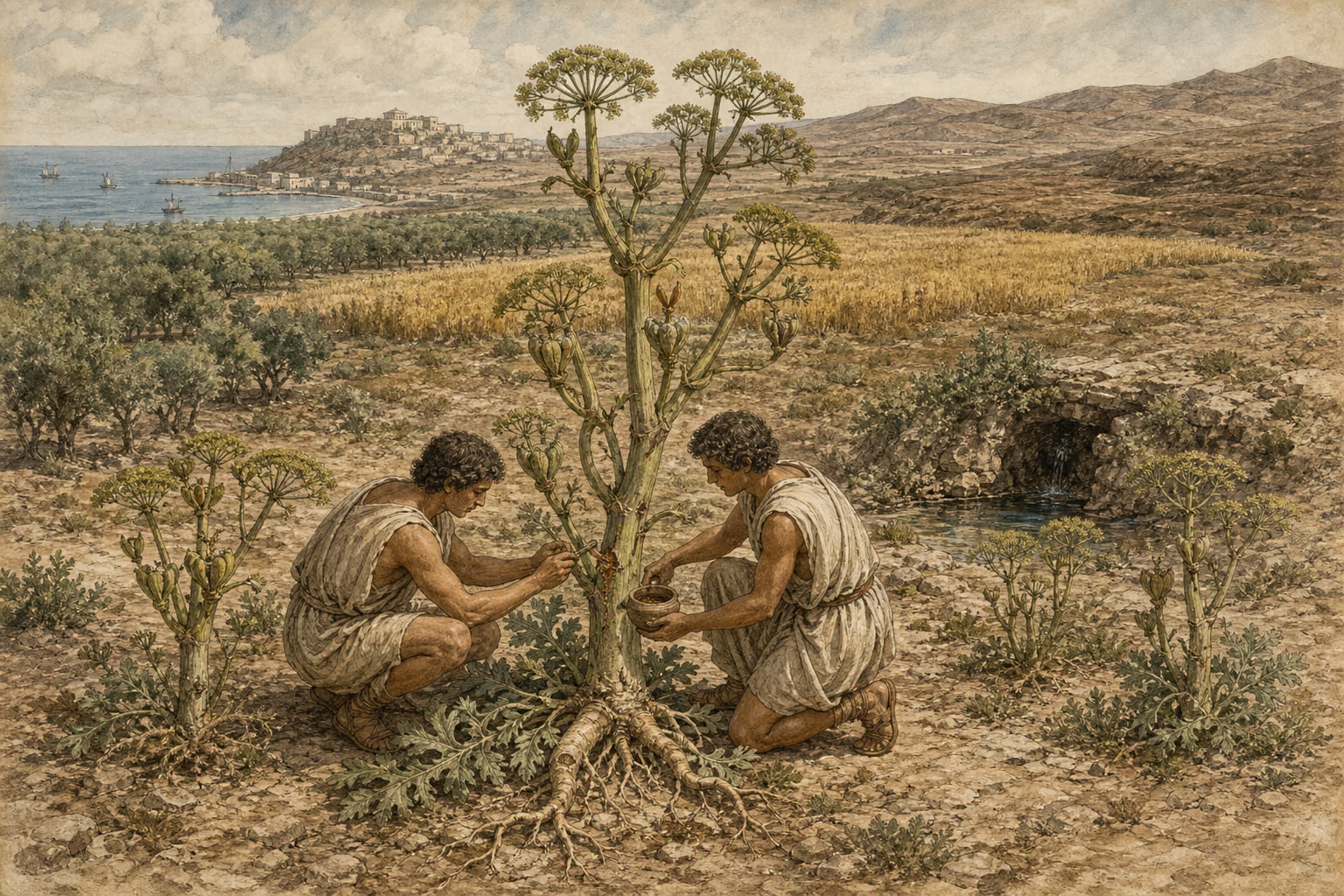
The region of Cyrenaica, also called Pentapolis, is rendered famous by the oracle of Hammon, which is distant 400 miles from the city of Cyrene; also by the Fountain of the Sun there, and five cities in especial, those of Berenice, Arsinoë, Ptolemais, Apollonia, and Cyrene itself. Berenice is situate upon the outer promontory that bounds the Syrtis; it was formerly called the city of the Hesperides (previously mentioned ), according to the fables of the Greeks, which very often change their localities. Not far from the city, and running before it, is the river Lethon, and with it a sacred grove, where the gardens of the Hesperides are said to have formerly stood; this city is distant from Leptis 375 miles. From Berenice to Arsinoë, commonly called Teuchira, is forty-three miles; after which, at a distance of twenty-two, we come to Ptolemais, the ancient name of which was Barce; and at a distance of forty miles from this last the Promontory of Phycus, which extends far away into the Cretan Sea, being 350 miles distant from Tænarum, the promontory of Laconia, and from Crete 225. After passing this promontory we come to Cyrene, which stands at a distance of eleven miles from the sea. From Phycus to Apollonia is twenty-four miles, and from thence to the Chersonesus eighty-eight; from which to Catabathmos is a distance of 216 miles. The Marmaridæ inhabit this coast, extending from almost the region of Parætonium to the Greater Syrtis; after them the Ararauceles, and then, upon the coasts of the Syrtis, the Nasamones, whom the Greeks formerly called Mesammones, from the circumstance of their being located in the very midst of sands. The territory of Cyrene, to a distance of fifteen miles from the shore, is said to abound in trees, while for the same distance beyond that district it is only suitable for the cultivation of corn: after which, a tract of land, thirty miles in breadth and 250 in length, is productive of nothing but laser [or silphium ].
After the Nasamones we come to the dwellings of the Asbystæ and the Macæ, and beyond them, at eleven days’ journey to the west of the Greater Syrtis, the Amantes, a people also surrounded by sands in every direction. They find water however without any difficulty at a depth mostly of about two cubits, as their district receives the overflow of the waters of Mauritania. They build houses with blocks of salt, which they cut out of their mountains just as we do stone. From this nation to the Troglodytæ the distance is seven days’ journey in a south-westerly direction, a people with whom our only intercourse is for the purpose of procuring from them the precious stone which we call the carbuncle, and which is brought from the interior of Æthiopia. Upon the road to this last people, but turning off towards the deserts of Africa, of which we have previously made mention as lying beyond the Lesser Syrtis, is the region of Phazania; the nation of Phazanii, belonging to which, as well as the cities of Alele and Cilliba, we have subdued by force of arms, as also Cydamus, which lies over against Sabrata. After passing these places a range of mountains extends in a prolonged chain from east to west: these have received from our people the name of the Black Mountains, either from the appearance which they naturally bear of having been exposed to the action of fire, or else from the fact that they have been scorched by the reflection of the sun’s rays. Beyond it is the desert, and then Talgæ, a city of the Garamantes, and Debris, at which place there is a spring, the waters of which, from noon to midnight, are at boiling heat, and then freeze for as many hours until the following noon; Garama too, that most famous capital of the Garamantes; all which places have been subdued by the Roman arms. It was on this occasion that Cornelius Balbus was honoured with a triumph, the only foreigner indeed that was ever honoured with the triumphal chariot, and presented with the rights of a Roman citizen; for, although by birth a native of Gades, the Roman citizenship was granted to him as well as to the elder Balbus, his uncle by the father’s side. There is also this remarkable circumstance, that our writers have handed down to us the names of the cities above-mentioned as having been taken by Balbus, and have informed us that on the occasion of his triumph, besides Cydamus and Garama, there were carried in the procession the names and models of all the other nations and cities, in the following order: the town of Tabudium, the nation of Niteris, the town of Nigligemella, the nation or town of Bubeium, the nation of Enipi, the town of Thuben, the mountain known as the Black Mountain, Nitibrum, the towns called Rapsa, the nation of Discera, the town of Debris, the river Nathabur, the town of Thapsagum, the nation of Nannagi, the town of Boin, the town of Pege, the river Dasibari; and then the towns, in the following order, of Baracum, Buluba, Alasit, Galia, Balla, Maxalla, Zizama, and Mount Gyri, which was preceded by an inscription stating that this was the place where precious stones were produced.
Up to the present time it has been found impracticable to keep open the road that leads to the country of the Garamantes, as the predatory bands of that nation have filled up the wells with sand, which do not require to be dug for to any great depth, if you only have a knowledge of the locality. In the late war however, which, at the beginning of the reign of the Emperor Vespasian, the Romans carried on with the people of Œa, a short cut of only four days’ journey was discovered; this road is known as the “Præter Caput Saxi.” The last place in the territory of Cyrenaica is Catabathmos, consisting of a town, and a valley with a sudden and steep descent. The length of Cyrenean Africa, up to this boundary from the Lesser Syrtis, is 1060 miles; and, so far as has been ascertained, it is 800 in breadth.