LIBER VII · CAPUT 52
PERSONS WHO HAVE COME TO LIFE AGAIN AFTER BEING LAID OUT FOR BURIAL
Latine · Mayhoff 1906
Aviola consularis in rogo revixit et, quoniam subveniri non potuerat praevalente flamma, vivus crematus est. similis causa in L. Lamia praetorio viro traditur. nam C. Aelium Tuberonem praetura functum a rogo relatum Messala Rufus et plerique tradunt. haec est condicio mortalium. ad has et eius modi occasiones fortunae gignimur, uti de homine ne morti quidem debeat credi. reperimus inter exempla Hermotimi Clazomenii animam relicto corpore errare solitam vagamque e longinquo multa adnuntiare, quae nisi a praesente nosci non possent, corpore interim semianimi, donec cremato eo inimici, qui Cantharidae vocabantur, remeanti animae veluti vaginam ademerint; Aristeae etiam visam evolantem ex ore in Proconneso corvi effigie, magna quae sequitur hanc fabulositate. quam equidem et in Gnosio Epimenide simili modo accipio, puerum aestu et itinere fessum in specu septem et quinquaginta dormisse annis, rerum faciem mutationemque mirantem velut postero die experrectum, hinc pari numero dierum senio ingruente, ut tamen in septimum et quinquagesimum atque centesimum vitae duraret annum. feminarum sexus huic malo videtur maxime opportunus conversione volvae, quae si corrigatur, spiritus restituitur, huc pertinet nobile illud apud Graecos volumen Heraclidis septem diebus feminae exanimis ad vitam revocatae. Varro quoque auctor est XXviro se agros dividente Capuae quendam, qui efferretur foro, domum remeasse pedibus. hoc idem Aquini accidisse. Romae quoque Corfidium, materterae suae maritum, funere locato revixisse et locatorem funeris ab eo elatum. adicit miracula, quae tota indicasse conveniat: e duobus fratribus equestris ordinis Corfidiis maiori accidisse ut videretur expirasse, apertoque testamento recitatum heredem minorem funeri institisse; interim eum, qui videbatur exstinctus, plaudendo concivisse ministeria et narrasse a fratre se venisse, commendatam sibi filiam ab eo, demonstratum praeterea quo in loco defodisset aurum nullo conscio, et rogasse ut iis funebribus, quae comparasset, efferretur. hoc eo narrante fratris domestici propere adnuntiavere exanimatum illum, et aurum ubi dixerat repertum est. plena praeterea vita est his vaticiniis, sed non conferenda, cum saepius falsa sint, sicut ingenti exemplo docebimus. bello Siculo Gabienus Caesaris classium fortissimus, captus a Sexto Pompeio, iussu eius incisa cervice et vix cohaerente, iacuit in litore toto die. deinde, cum advesperavisset, gemitu precibusque congregata multitudine petiit uti Pompeius ad se veniret aut aliquem ex arcanis mitteret; se enim ab inferis remissum habere quae nuntiaret. misit plures Pompeius ex amicis, quibus Gabienus dixit inferis dis placere Pompei causas et partes pias; proinde eventum futurum quem optaret: hoc se nuntiare iussum; argumentum fore veritatis quod peractis mandatis protinus expiraturus esset. idque ita evenit. post sepulturam quoque visorum exempla sunt, nisi quod naturae opera, non prodigia, consectamur.
English · Bostock & Riley 1855–57
Aviola, a man of consular rank, came to life again when on the funeral pile; but, by reason of the violence of the flames, no assistance could be rendered him, in consequence of which he was burnt alive. The same thing is said to have happened to L. Lamia, a man of prætorian rank. Messala, Rufus, and many other authors, inform us, that C. Ælius Tubero, who had filled the office of prætor, was also rescued from the funeral pile. Such then is the condition of us mortals: to these and the like vicissitudes of fortune are we born; so much so, that we cannot be sure of any thing, no, not even that a person is dead. With reference to the soul of man, we find, among other instances, that the soul of Hermotinus of Clazomenæ was in the habit of leaving his body, and wandering into distant countries, whence it brought back numerous accounts of various things, which could not have been obtained by any one but a person who was present. The body, in the meantime, was left apparently lifeless. At last, however, his enemies, the Cantharidæ, as they were called, burned the body, so that the soul, on its return, was deprived of its sheath, as it were. It is stated also, that in Proconnesus, the soul of Aristeas was seen to fly out of his mouth, under the form of a raven; a most fabulous story, however, which may be well ranked with the one that follows. It is told of Epimenides of Cnossus, that when he was a boy, being fatigued by heat and walking, he fell asleep in a cave, where he slept for fifty-seven years; and that when he awoke, as though it had been on the following day, he was much astonished at the changes which he saw in the appearance of every thing around him: after this, old age, it is said, came upon him in an equal number of days with the years he had slept, but his life was prolonged to his hundred and fifty-seventh year. The female sex appear more especially disposed to this morbid state, on account of the misplacement of the womb; when this is once corrected, they immediately come to themselves again. The volume of Heraclides on this subject, which is highly esteemed among the Greeks, contains the account of a female, who was restored to life, after having appeared to be dead for seven days.
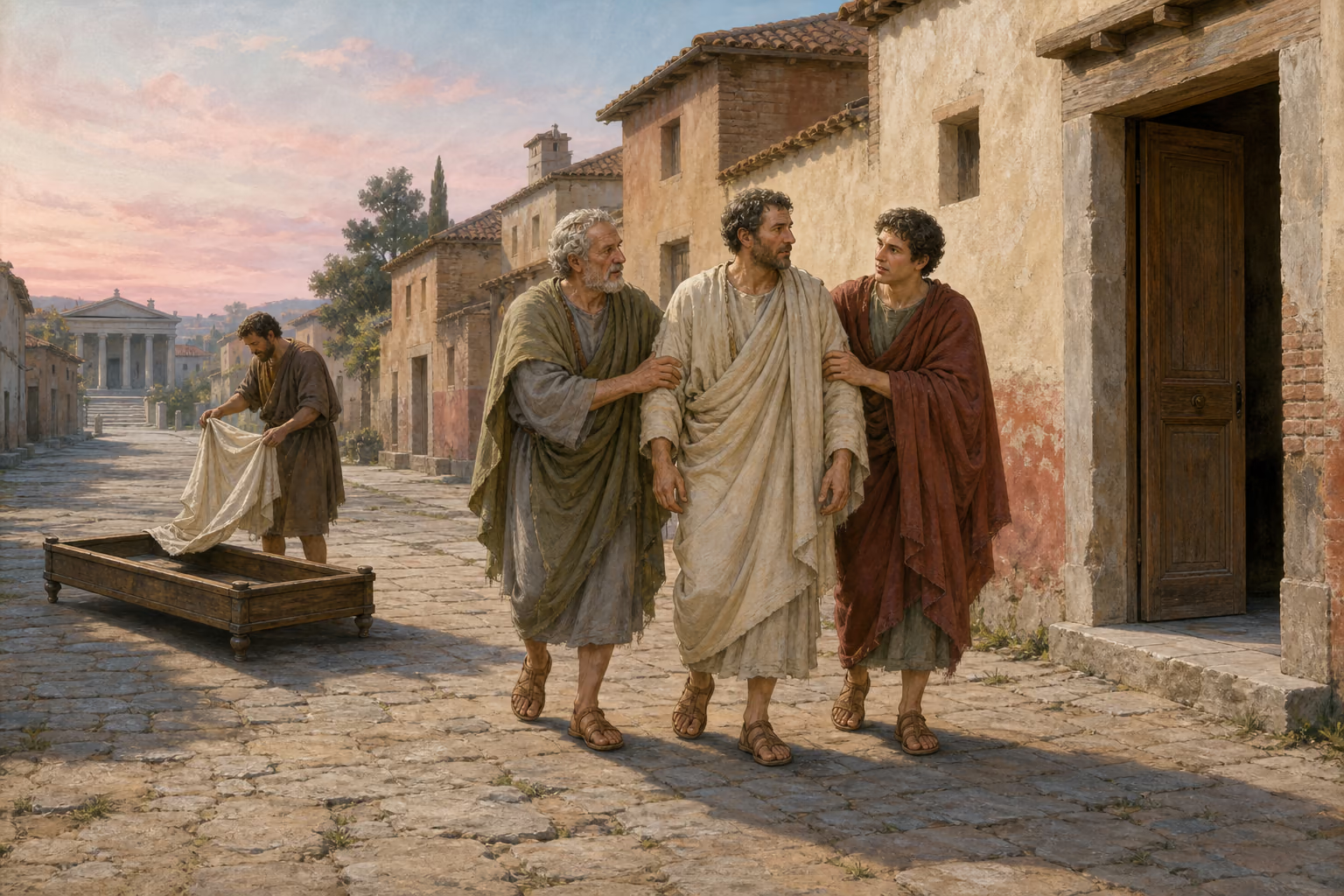
Varro informs us, that when he was one of the “vigintiviri,” or twenty commissioners, appointed to superintend the division of the lands at Capua, a man who had been carried to the funeral pile, returned on foot from the Forum to his own house, and that the very same thing happened also at Aquinum. He states also, that Corfidius, who had married his maternal aunt, came to life again, after the funeral had been all arranged, and that he afterwards attended the funeral of the person who had so arranged his own. He gives in addition some other marvellous relations, the whole of which it may be as well to set forth; he says that there were two brothers, members of the equestrian order, and named Corfidius: it so happened that the elder of these was seen to breathe his last to all appearance, and on opening his will, it was found that he had named his brother his heir, who accordingly ordered his funeral. In the meanwhile, however, he who had been thought to be dead, clapping his hands, summoned the servants, and told them that he was just come from his brother’s house, who had placed his daughter in his charge; in addition to which, he had mentioned to him the place where he had secretly buried some gold, and had requested that the funeral preparations which had been made, might be employed for himself. While he was stating to this effect, the servants of his brother came in the greatest haste, and informed them that he was dead: the gold too, was found in the place just as he had stated. But throughout the whole of our lives we are perpetually hearing of such predictions as these; they are not, however, worth collecting, seeing that they are almost always false, as we shall illustrate by the following remarkable instance.
In the Sicilian war, Gabienus, the bravest of all Cæsar’s naval commanders, was taken prisoner by Sextus Pompeius, who ordered his throat to be cut; after which, his head almost severed from his body, he lay the whole of the day upon the sea-shore. Towards evening, with groans and entreaties, he begged the crowds of people who had assembled, that they would prevail upon Pompeius to come to him, or else send one of his most confidential friends, as he had just returned from the shades below, and had some important news to communicate. Pompeius accordingly sent several of his friends, to whom Gabienus stated that the good cause and virtuous partisans of Pompeius were well pleasing to the infernal deities, and that the event would shortly prove such as he wished: that he had been ordered to announce to this effect, and that, as a proof of its truthfulness, he himself should expire the very moment he had fulfilled his commission; and his death actually did take place.
We have instances also of men who have been seen after their burial; but, for the present, we are treating of the operations of nature, and not of miracles.