LIBER VIII · CAPUT 3
THE DOCILITY OF THE ELEPHANT
Latine · Mayhoff 1906
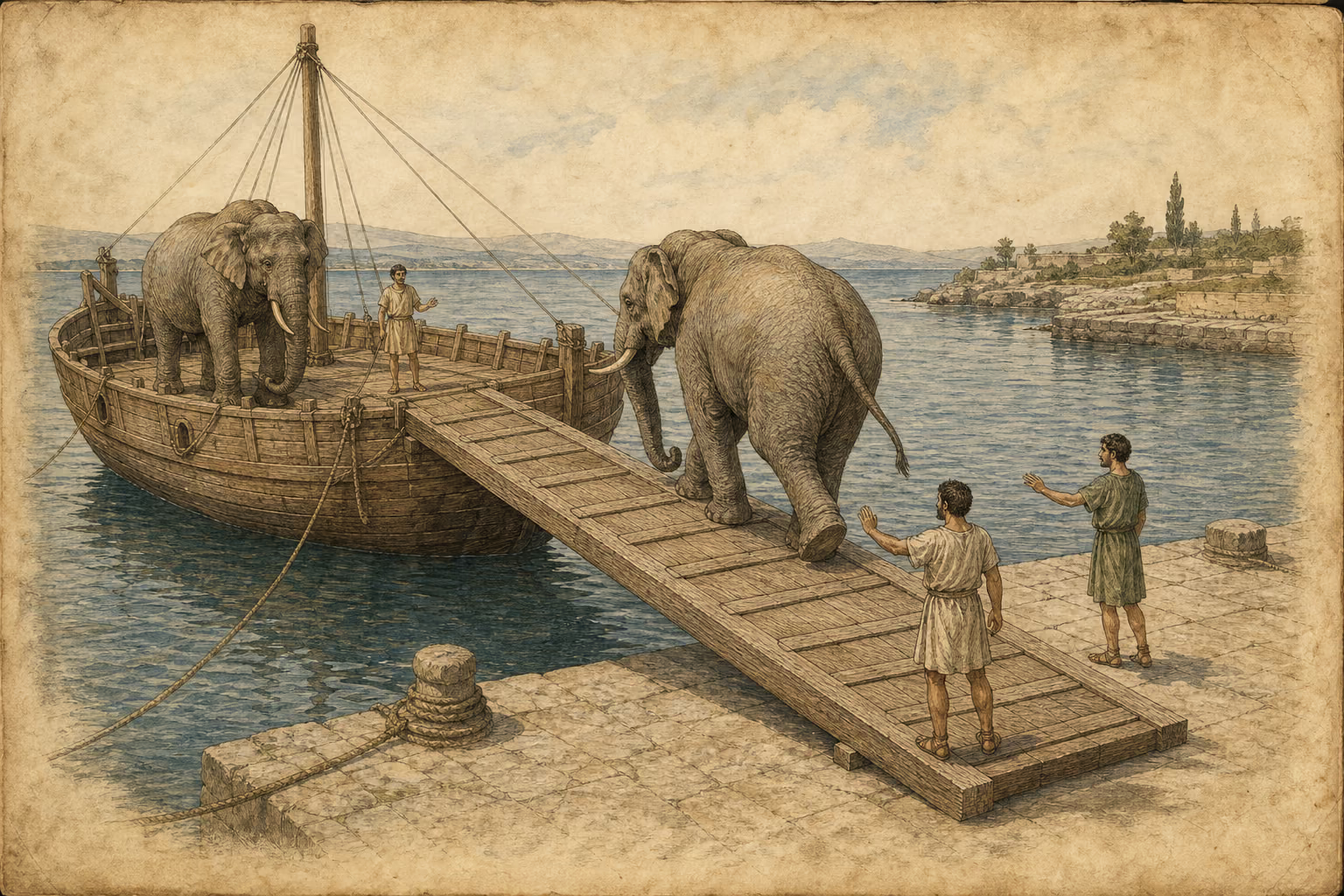
certum est unum tardioris ingeni in accipiendis quae tradebantur, saepius castigatum verberibus, eadem illa meditantem noctu repertum. mirum et adversis quidem funibus subire, sed maxime regredi, utique pronis. Mucianus III consul auctor est aliquem ex iis et litterarum ductus Graecarum didicisse solitumque perscribere eius linguae verbis: Ipse ego haec scripsi et spolia Celtica dicavi, itemque se videute Puteolis, cum advecti e nave egredi cogerentur, territos spatio pontis procul a continente porrecti, ut sese longinquitatis aestimatione fallerent, aversos retrorsus isse.
Praedam ipsi in se expetendam sciunt solam esse in armis suis, quae Iua cornua appellat, Herodotus tanto antiquior et consuetudo melius dentes. quam ob rem deciduos casu aliquo vel senecta defodiunt. hoc solum ebur est; cetero et in his quoque, qua corpus intexit, vilitas ossea. quamquam nuper ossa etiam in laminas secari coepere paenuria: etenim rara amplitude iam dentium praeterquam ex India reperitur; cetera in nostro orbe cessere luxuriae. dentium candore intellegitur iuventa. circa hos beluis summa cura: alterius mucroni parcunt, ne sit proeliis hebes, alterius operario usu fodiunt radices, inpellunt moles; circumventique a venantibus primos constituunt quibus sint minimi, ne tanti proelium putetur, postea fessi inpactos arbori frangunt praedaque se redimunt.
English · Bostock & Riley 1855–57
It is a well-known fact, that one of these animals, who was slower than usual in learning what was taught him, and had been frequently chastised with blows, was found conning over his lesson in the night-time. It is a most surprising thing also, that the elephant is able not only to walk up the tight-rope backwards; but to come down it as well, with the head foremost. Mutianus, who was three times consul, informs us that one of these animals had been taught to trace the Greek letters, and that he used to write in that language the following words: “I have myself written these words, and have dedicated the Celtic spoils.” Mutianus states also, that he himself was witness to the fact, that when some elephants were being landed at Puteoli and were compelled to leave the ship, being terrified at the length of the platform, which extended from the vessel to the shore, they walked backwards, in order to deceive themselves by forming a false estimate of the distance.
These animals are well aware that the only spoil that we are anxious to procure of them is the part which forms their weapon of defence, by Juba, called their horns, but by Herodotus, a much older writer, as well as by general usage and more appropriately, their teeth. Hence it is that, when their tusks have fallen off, either by accident or from old age, they bury them in the earth. These tusks form the only real ivory, and, even in these, the part which is covered by the flesh is merely common bone, and of no value whatever; though, indeed, of late, in consequence of the insufficient supply of ivory, they have begun to cut the bones as well into thin plates. Large teeth, in fact, are now rarely found, except in India, the demands of luxury having exhausted all those in our part of the world. The youthfulness of the animal is ascertained by the whiteness of the teeth. These animals take the greatest care of their teeth; they pay especial attention to the point of one of them, that it may not be found blunt when wanted for combat; the other they employ for various purposes, such as digging up roots and pushing forward heavy weights. When they are surrounded by the hunters, they place those in front which have the smallest teeth, that the enemy may think that the spoil is not worth the combat; and afterwards, when they are weary of resistance, they break off their teeth, by dashing them against a tree, and in this manner pay their ransom.