LIBER IX · CAPUT 15
WHICH OF THE FISHES ARE OF THE LARGEST SIZE
Latine · Mayhoff 1906
Praecipua magnitudine thynni. invenimus talenta XV pependisse, eiusdem caudae latitudinem duo cubita et palmum. fiunt et in quibusdam amnium haut minores, silurus in Nilo, isox in Rheno, attilus in Pado, inertia pinguescens ad mille aliquando libras, catenato captus hamo nec nisi boum iugis extractus. atque hunc minimus, appellatus clupea, venam quandam eius in faucibus mira cupidine appetens morsu exanimat. silurus grassatur, ubicumque est, omne animal appetens, equos innatantes saepe de- mergens. praecipue in Moeno Germaniae amne protelis boum et in Danuvio marris extrahitur, porculo marino simillimus. et in Borysthene memoratur praecipua magnitudo, nullis ossibus spinisve intersitis, carne praedulci. in Gange Indiae platanistas vocant, rostro delphini et cauda, magnitudine autem XVI cubitorum. in eodem esse Statius Sebosus haut modico miraculo adfert vermes, branchiis binis sex cubitorum, caeruleos, qui nomen a facie traxerunt. his tantas esse vires, ut elephantos ad potus venientes mordicus comprehensa manu eorum abstrahant.
Thynni mares sub ventre non habent pinnam. intrant e magno mari Pontum verno tempore gregatim, nec alibi fetificant. cordyla appellatur partus, qui fetas redeuntes in mare autumno comitatur; limosae vero aut e luto pelam ydes incipiunt vocari et, cum annuum excessere tempus, thynni. hi membratim caesi cervice et abdomine commendantur atque clidio, recenti dumtaxat et tum quoque gravi ructu. cetera parte plenis pulpamentis sale adservantur. melandrya vocantur quercus assulis similia. vilissima ex his quae caudae proxima, quia pingui carent, probatissima quae faucibus. at in alio pisce circa caudam exercitatissima. pelamydes in apolectos particulatimque consectae in genera cybiorum dispertiuntur.
Piscium genus omne praecipua celeritate adolescit, 49 maxime in Ponto. causa multitudo amnium dulces inferentium aquas. amiam vocant cuius incrementum singulis diebus intellegitur. cum thynnis haec et pelamydes in Pontum ad dulciora pabula intrant gregatim suis quaeque ducibus, et primi omnium scombri, quibus est in aqua sulpureus color, extra qui ceteris. Hispaniae cetarias hi replent, thynnis non commeantibus.
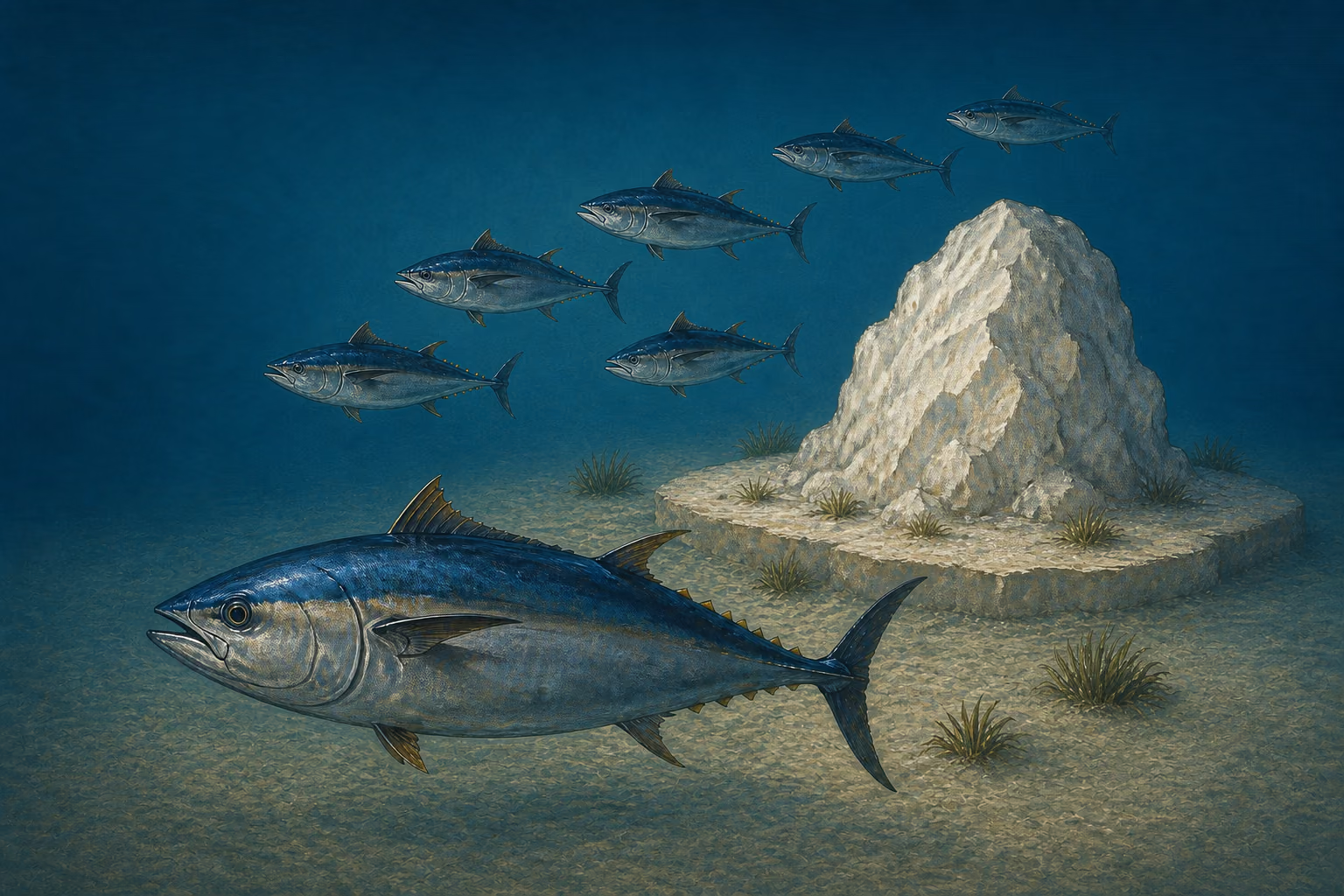
Sed in Pontum nulla intrat bestia piscibus malefica praeter vitulos et parvos delphinos. thynni dextera ripa intrant, exeunt laeva. id accidere existimatur, quia dextro oculo plus cernant, utroque natura hebeti. est in euripo Thracii Bospori, quo Propontis Euxino iungitur, in ipsis Europam Asiamque separantis freti angustiis saxum miri candoris, a vado ad summa perlucens, iuxta Calchedonem in iatere Asiae. huius aspectu repente territi semper adversum Byzantii promunturium, ex ea causa appellatum Aurei Cornus, praecipiti petunt agmine. itaque omnis captura Byzantii est, magna Calchedonis penuria, M passibus medii interfluentis euripi. opperiuntur autem aquilonis flatum, ut secundo fluctu exeant e Ponto, nec nisi intrantes portum Byzantium capiuntur. bruma non vagantur; ubicumque deprehensi, usque ad aequinoctium ibi hibernant. iidem saepe navigia velis euntia comitantes mira quadam dulcedine per aliquot horarum spatia et passuum milia a gubernaculis spectantur, ne tridente quidem in eos saepius iacto territi. quidam eos, qui hoc e thynnis faciant, pompilos vocant. multi in Propontide aestivant, Pontum non intrant; item soleae, cum rhombi intrent, nec saepia est, cum lolligo reperiatur; saxatilium turdus et merula desunt, sicut conchylia, cum ostreae abundent. omnia autem hibernant in Aegaeo. intrantium Pontum soli non remeant trichiae — Graecis enim plerisque nominibus uti par erit, quando aliis atque aliis eosdem diversi appellavere tractus—, sed hi soli in Histrum [mare] subeunt et ex eo subterraneis eius venis in IIadriaticum mare defluunt, itaque et illic descendentes nec umquam subeuntes e mari visuntur.
Thynnorum captura est a vergiliarum exortu ad arcturi occasum. reliquo tempore hiberno latent in gurgitibus imis, nisi tepore aliquo evocati aut pleniluniis. pinguescunt et in tantum, ut dehiscant. vita longissima iis bienni.
Animal est parvum scorpionis effigie, aranei magnitudine. hoc se et thynno et ei qui gladius vocatur, crebro delphini magnitudinem excedenti, sub pinna adfigit aculeo tantoque infestat dolore, ut in naves saepenumero exiliant. quod et alias faciunt aliorum vim timentes mugiles maxime, tam praecipuae velocitatis, ut transversa navigia interim superiaciant.
English · Bostock & Riley 1855–57
Tunnies are among the most remarkable for their size; we have found one weighing as much as fifteen talents, the breadth of its tail being five cubits and a palm. In some of the rivers, also, there are fish of no less size, such, for instance, as the silurus of the Nile, the isox of the Rhenus, and the attilus of the Padus, which, naturally of an inactive nature, sometimes grows so fat as to weigh a thousand pounds, and when taken with a hook, attached to a chain, requires a yoke of oxen to draw it on land. An extremely small fish, which is known as the clupea, attaches itself, with a wonderful tenacity, to a certain vein in the throat of the attilus, and destroys it by its bite. The silurus carries devastation with it wherever it goes, attacks every living creature, and often drags beneath the water horses as they swim. It is also remarkable, that in the Mœnus, a river of Germany, a fish that bears a very strong resemblance to the sea-pig, requires to be drawn out of the water by a yoke of oxen; and, in the Danube, it is taken with large hooks of iron. In the Boryrsthenes, also, there is said to be a fish of enormous size, the flesh of which has no bones or spines in it, and is remarkable for its sweetness.
In the Granges, a river of India, there is a fish found which they call the platanista; it has the muzzle and the tail of the dolphin, and measures sixteen cubits in length. Statius Sebosus says, a thing that is marvellous in no small degree, that in the same river there are fishes found, called worms; these have two gills, and are sixty cubits in length; they are of an azure colour, and have received their name from their peculiar conformation. These fish, he says, are of such enormous strength, that with their teeth they seize hold of the trunks of elephants that come to drink, and so drag them into the water.
The male tunny has no ventral fin; these fish enter the Euxine in large bodies from the main sea, in the spring, and will spawn nowhere else. The young ones, which in autumn accompany the females to the open sea, are known as “cordyla.” In the spring they are called “pelamides,” from πηλὸς, the Greek for “mud,” and after they are a year old, “thynni.” When this fish is cut up into pieces, the neck, the belly, and the throat, are the most esteemed parts; but they must be eaten only when they are quite fresh, and even then they cause severe fits of flatulence; the other parts; with the flesh entire, are preserved in salt. Those pieces, which bear a resemblance to an oaken board, have thence received the name of “melandrya.” The least esteemed among these parts are those which are the nearest to the tail, because they have no fat upon them; while those parts are considered the most delicate, which lie nearest the neck; in other fishes, however, the parts about the tail have the most nutriment in them. The pelamides are cut up into small sections, known as “apolecti;” and these again are divided into cubical pieces, which are thence called “cybia.”
All kinds of fish grow with remarkable rapidity, and more especially those in the Euxine; the reason of which is the vast number of rivers which discharge their fresh water into it. One fish, the growth of which is quite perceptible, day by day, is known as the amia. This fish, and the pelamides, together with the tunnies, enter the Euxine in shoals, for the purpose of obtaining a sweeter nutriment, each under the command of its own leader; but first of all the scomber appears, which is of a sulphureous tint when in the water, but when out of it resembles other fish in colour. The salt-water preserves of Spain are filled with these last fish, but the tunnies do not consort with them.
The Euxine, however, is never entered by any animal that is noxious to fish, with the exception of the sea-calf and the small dolphin. On entering, the tunnies range along the shores to the right, and on departing, keep to those on the left; this is supposed to arise from the fact that they have better sight with the right eye, their powers of vision with either being naturally very limited. In the channel of the Thracian Bosporus, by which the Propontis is connected with the Euxine, at the narrowest part of the Straits which separate Europe from Asia, there is, near Chalcedon, on the Asiatic side, a rock of remarkable whiteness, the whole of which can be seen from the bottom of the sea at the surface. Alarmed at the sudden appearance of this rock, the tunnies always hasten in great numbers, and with headlong impetuosity, towards the promontory of Byzantium, which stands exactly opposite to it, and from this circumstance has received the name of the Golden Horn. Hence it is, that all the fishing is at Byzantium, to the great loss of Chalcedon, although it is only separated from it by a channel a mile in width. They wait, however, for the blowing of the north wind to leave the Euxine with a favourable tide, and are never taken until they have entered the harbour of Byzantium. These fish do not move about in winter; in whatever place they may happen to be surprised by it, there they pass the winter, till the time of the equinox.
Manifesting a wonderful degree of delight, they will often accompany a vessel in full sail, and may be seen from the poop following it for hours, and a distance of several miles. If a fish-spear even is thrown at them ever so many times, they are not in the slightest degree alarmed at it. Some writers call the tunnies which follow ships in this manner, by the name of “pompili.”
Many fishes pass the summer in the Propontis, and do not enter the Euxine; such, for instance, as the sole, while on the other hand, the turbot enters it. The sepia is not found in this sea, although the loligo is. Among the rock-fish, the sea-thrush and the sea-blackbird are wanting, as also purples, though oysters abound here. All these, however, pass the winter in the Ægean Sea; and of those which enter the Euxine, the only ones that do not return are the trichiæ. —It will be as well to use the Greek names which most of them bear, seeing that to the same species different countries have given different appellations.—These last, however, are the only ones that enter the river Ister, and passing along its subterraneous passages, make their way from it to the Adriatic; and this is the reason why they are to be seen descending into the Euxine Sea, but never in the act of returning from it. The time for taking tunnies is, from the rising of the Vergiliæ to the setting of Arcturus: throughout the rest of the winter season, they lie concealed at the bottom of deep creeks, unless they are induced to come out by the warmth of the weather or the full moon. These fish fatten to such an extraordinary degree as to burst. The longest period of their life is two years.
There is a little animal, in appearance like a scorpion, and of the size of a spider. This creature, by means of its sting, attaches itself below the fin to the tunny and the fish known as the sword-fish and which often exceeds the dolphin in magnitude, and causes it such excruciating pain, that it will often leap on board of a ship even. Fish will also do the same at other times, when in dread of the violence of other fish, and mullets more especially, which are of such extraordinary swiftness, that they will sometimes leap over a ship, if lying crosswise.