LIBER IX · CAPUT 17
THE MULLET
Latine · Mayhoff 1906
Mugilum natura ridetur in metu capite abscondito totos se occultari credentium. isdem tam incauta salacitas, ut in Phoenice et in Narbonensi provincia coitus tempore e vivariis marem linea longinqua per os ad branc hias religata emissum in mare eademque linea retractum feminae sequantur ad litus rursusque feminam mares partus tempore.
Apud antiquos piscium nobilissimus habitus acipenser, unus omnium squamis ad os versis contra quam in nando meant, nullo nunc in honore est, quod equidem miror, cum sit rarus inventu. quidam eum elopem vocant.
Postea praecipuam auctoritatem fuisse lupo et asellis Nepos Cornelius et Laberius poeta mimorum tradidere. luporum laudatissimi qui appellantur lanati a candore mollitiaque carnis. asellorum duo genera, callariae minores et bacchi, qui non nisi in alto capiuntur, ideo praelati prioribus. at in lupis in amne capti praeferuntur.
Nunc principatus scaro datur, qui solus piscium dicitur ruminare herbisque vesci atque non aliis piscibus, Carpathio maxime mari frequens. promunturium Troadis Lectum numquam sponte transit. inde advectos Tiberio Claudio principe Optatus e libertis eius praefectus classis inter Ostiensem et Campaniae oram sparsos disseminavit, quinquennio fere cura adhibita, ut capti redderentur mari. postea frequentes inveniuntur Italiae litore, non antea ibi capti, admovetque sibi gula sapores piscibus satis et novum incolam mari dedit, ne quis peregrinas aves Romae parere miretur. proxima est mensa iecori dumtaxat mustelarum, quas, mirum dictu, inter Alpis quoque lacus Raetiae Brigantinus aemulas marinis generat.
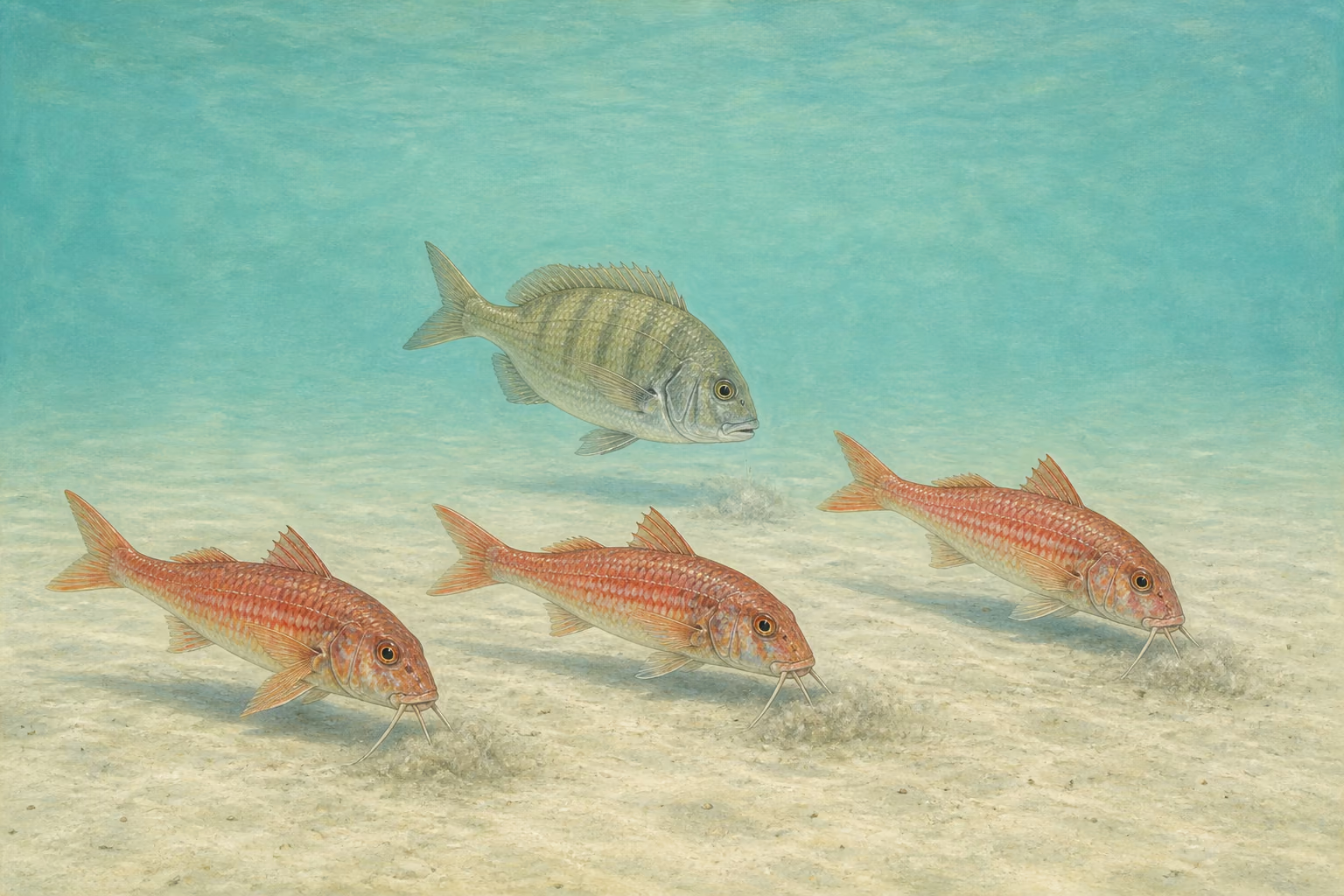
Ex reliqua nobilitate et gratia maxima est et copia mullis, sicut magnitude modica, binasque libras ponderis raro admodum exuperant nec in vivariis piscinisque crescunt. septentrionalis tantum hos et proxima occidentis parte gignit oceanus. cetero genera eorum plura; nam et alga vescuntur et ostreis et limo et aliorum piscium carne, et barba gemina insigniuntur inferiori labro. lutarium ex iis vilissimi generis appellant; hunc semper comitatur sargus nomine alius piscis et caenum fodiente eo excitatum devorat pabulum. nec litorariis gratia. laudatissimi conchylium sapiunt. nomen iis Fenestella a colore mulleorum calciamentorum datum putat. pariunt ter annis; certe totiens fetura apparet. mullum expirantem versicolori quadam et numerosa varietate spectari proceres gulae narrant, rubentium squamarum multiplici mutatione pallescentem, utique si vitro spectetur inclusus. M. Apicius, ad omne luxus ingenium natus, in sociorum garo — nam ea quoque res cognomen invenit— necari eos praecellens putavit atque e iecore eorum allecem excogitare.
Provocavit — id enim est facilius dixisse quam quis vicerit — Asinius Celer e consularibus hoc pisce prodig os omnesGaio principe unum mercatus HSVIII mullum. quae reputatio aufert traversum animum ad contemplationem eorum, qui in conquestione luxus coquos emi singulos pluris quam equos quiritabant. at nunc coci trium horum pretiis parantur et coquorum pisces, nullusque prope iam mortalis aestimatur pluris quam qui peritissime censum domini mergit.
English · Bostock & Riley 1855–57
One singular propensity of the mullet has afforded a subject for laughter; when it is frightened, it hides its head, and fancies that the whole of its body is concealed. Their salacious propensities render them so unguarded, that in Phœnicia and in the province of Gallia Narbonensis, at the time of coupling, a male, being taken from out of the preserves, is fastened to a long line, which is passed through his mouth and gills; he is then let go in the sea, after which he is drawn back again by the line, upon which the females will follow him to the very water’s edge; and so, on the other hand, the male will follow the female, during the spawning season.
Among the ancients, the acipenser was esteemed the most noble fish of all; it is the only one that has the scales turned towards the head, and in a contrary direction to that in which it swims. At the present day, however, it is held in no esteem, which I am the more surprised at, it being so very rarely found. Some writers call this fish the elops.
At a later period, they set the highest value on the lupus and the asellus, as we learn from Cornelius Nepos, and the poet, Laberius, the author of the Mimes. The most approved kinds of the lupus are those which have the name of “lanati,” or “woolly,” in consequence of the extreme whiteness and softness of the flesh. Of the asellus there are two sorts, the callarias, which is the smallest, and the bacchus, which is only taken in deep water, and is hence much preferred to the former. On the other hand, among the varieties of the lupus, those are the most esteemed which are taken in rivers.
At the present day, the first place is given to the scarus, the only fish that is said to ruminate, and to feed on grass and not on other fish. It is mostly found in the Carpathian Sea, and never of its own accord passes Lectum, a promontory of Troas. Optatus Elipertius, the commander of the fleet under the Emperor Claudius, had this fish brought from that locality, and dispersed in various places off the coast between Ostia and the districts of Campania. During five years, the greatest care was taken that those which were caught should be returned to the sea; but since then they have been always found in great abundance off the shores of Italy, where formerly there were none to be taken. Thus has gluttony introduced these fish, to be a dainty within its reach, and added a new inhabitant to the seas; so that we ought to feel no surprise that foreign birds breed at Rome.
The fish that is next in estimation for the table is the mustela, but that is valued only for its liver. A singular thing to tell of—the lake of Brigantia, in Rhætia, lying in the midst of the Alps, produces them to rival even those of the sea.
Of the remaining fish that are held in any degree of esteem, the mullet is the most highly valued, as well as the most abundant of all; it is of only a moderate size, rarely exceeds two pounds in weight, and will never grow beyond that weight in preserves or fish-ponds. These fish are only to be found in the Northern Ocean, exceeding two pounds in weight, and even there in none but the more westerly parts. As for the other kinds, the various species are numerous; some live upon sea-weed, while others feed on the oyster, slime, and the flesh of other fish. The more distinctive mark is a forked beard, that projects beneath the lower lip. The lutarius, or mud-mullet, is held in the lowest esteem of all. This last is always accompanied by another fish, known as the sargus, and where the mullet stirs up the mud, the other finds aliment for its own sustenance. The mullet that is found on the coast is not highly esteemed, and the most esteemed of all have a strong flavour of shell-fish. Fenestella is of opinion, that this fish received its name of mullet mullus from its resemblance to the colour of the red or mullet-coloured shoes. The mullet spawns three times a year: at all events, the fry makes its appearance that number of times. The masters in gastronomy inform us, that the mullet, while dying, assumes a variety of colours and a succession of shades, and that the hue of the red scales, growing paler and paler, gradually changes, more especially if it is looked at enclosed in glass. M. Apicius, a man who displayed a remarkable degree of ingenuity in everything relating to luxury, was of opinion, that it was a most excellent plan to let the mullet die in the pickle known as the “garum of the allies” —for we find that even this has found a surname—and he proposed a prize for any one who should invent a new sauce, made from the liver of this fish. I find it much easier to relate this fact, than to state who it was that gained the prize.
Asinius Celer, a man of consular rank, and remarkable for his prodigal expenditure on this fish, bought one at Rome, during the reign of Caius, at the price of eight thousand sesterces. A reflection upon such a fact as this will at once lead us to turn our thoughts to those who, making loud complaints against luxury, have lamented that a single cook cost more money to buy than a horse; while at the present day a cook is only to be obtained for the same sum that a triumph would cost, and a fish is only to be purchased at what was formerly the price for a cook! indeed, there is hardly any living being held in higher esteem than the man who understands how, in the most scientific fashion, to get rid of his master’s property.