LIBER IX · CAPUT 30
THE VARIOUS KINDS OF POLYPI; THEIR SHREWDNESS
Latine · Mayhoff 1906
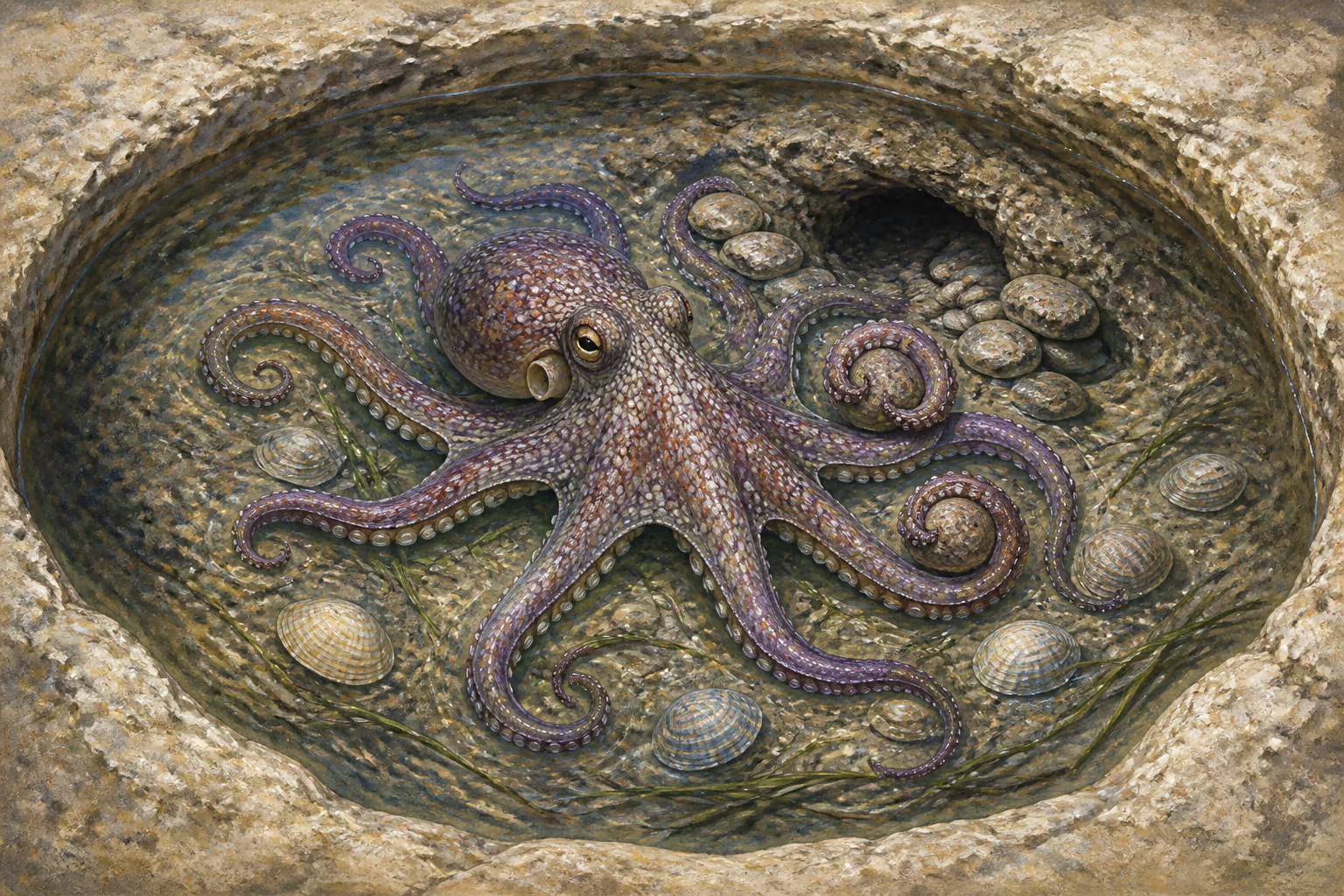
Polyporum generis est ozaena dicta a gravi capitis odore, ob hoc maxime murenis eam consectantibus.
Polypi binis mensibus conduntur. ultra bimatum non vivunt. pereunt autem tabe semper, feminae celerius et fere a partu.
Non sunt praetereunda et L. Lucullo proconsule Baeticae conperta de polypis, quae Trebius Niger e comitibus eius prodidit: avidissimos esse concharum, illas ad tactum conprimi, praecidentes bracchia eorum, ultroque escam ex praedante capere. carent conchae visu omnique sensu alio quam cibi et periculi. insidiantur ergo polypi apertis inpositoque lapillo extra corpus, ne palpitatu eiciatur: ita securi grassantur extrahuntque carnes. illae se contrahunt, sed frustra, discuneatae. tanta sollertia animalium hebetissimis quoque est. praeterea negat ullum atrocius esse animal ad conficiendum hominem in aqua. luctatur enim conplexu et sorbet acetabulis ac numeroso suctu trahit, cum in naufragos urinantesve impetum cepit. sed si invertatur, elanguescit vis; exporrigunt enim se resupinati. cetera, quae idem retulit, monstro propiora possunt videri. Carteiae in cetariis adsuetus exire e mari in lacus eorum apertos atque ibi salsamenta populari — mire omnibus marinis expetentibus odorem quoque eorum, qua de causa et nassis inlinuntur -, convertit in se custodum indignationem adsiduitate furti inmodicam. saepes erant obiectae, sed has transcendebat per arborem nec deprehendi potuit nisi canum sagacitate. hi redeuntem circumvasere noctu, concitique custodes expavere novitatem. primum omnium magnitude inaudita erat, dein colos muria obliti, odore diri. quis ibi polypum exspectasset aut ita cognosceret? cum monstro dimicare sibi videbantur. namque et adflatu terribili canes agebat, nunc extremis crinibus flagellatos, nunc robustioribus brac- chiis clavarum modo incussos, aegreque multis tridentibus confici potuit. ostendere Lucullo caput eius, dolii magnitudine, amphorarum XV capax, atque, ut ipsius Trebi verbis utar, barbas, quas vix utroque bracchio conplecti esset, clavarum modo torosas, longas pedum XXX, acetabulis sive caliculis urnalibus pelvium modo, dentes magnitudini respondentes. reliquiae adservatae miraculo pependere pondo DCC. saepias quoque et lolligines eiusdem magnitudinis expulsas in litus illud idem actor est. in nostro mari lolligines quinum cubitorum capiuntur, saepiae binum. neque his bimatu longior vita.
Navigeram similitudinem et aliam in Propontide visam sibi prodidit Mucianus: concham esse acatii modo carinatam, inflexa puppe, prora rostrata. in hanc condi nauplium, animal saepiae simile, ludendi societate sola. duobus hoc fieri generibus: tranquillo enim vectorem demissis palmulis ferire ut remis; si vero flatus invitet, easdem in usum gubernaculi porrigi pandique buccarum sinus aurae. huius voluptatem esse ut ferat, illius ut regat, simulque eam descendere in duo sensu carentia, nisi forte tristi — id etenim constat — omine navigantium humana calamitas in causa est.
Locustae crusta fragili muniuntur in eo genere quod caret sanguine. latent mensibus quinis. similiter cancri, qui eodem tempore occultantur, et ambo veris principio senectutem anguium more exuunt renovatione tergorum. cetera in undis natant, locustae reptantium modo fluitant, si nullus ingruat metus, recto meatu, cornibus, quae sunt propria rotunditate praepilata, ad latera porrectis; isdem erectis in pavore oblique in latera procedunt. cornibus inter se dimicant. unum hoc animalium, nisi vivum ferventi aqua incoquatur, fluida came non habet callum.
English · Bostock & Riley 1855–57
Belonging to the genus of polypi is the animal known as the ozæna, being so called from the peculiarly strong smell exhaled by the head; in consequence of which, the murænæ pursue it with the greatest eagerness. The polypi keep themselves concealed for two months in the year; they do not live beyond two years, and always die of consumption, the females even sooner, and mostly after bringing forth. I must not omit here the observations which L. Lucullus, the proconsul of Bætica, made with reference to the polypus, and which Trebius Niger, one of his suite, has published. He says that it is remarkably fond of shell-fish, and that these, the moment that they feel themselves touched by it, close their valves, and cut off the feelers of the polypus, thus making a meal at the expense of the plunderer. Shell-fish are destitute of sight, and, indeed, all other sensations but those which warn them of hunger and the approach of danger. Hence it is, that the polypus lies in ambush till the fish opens its shell, immediately upon which, it places within it a small pebble, taking care, at the same time, to keep it from touching the body of the animal, lest, by making some movement, it should chance to eject it. Having made itself thus secure, it attacks its prey, and draws out the flesh, while the other tries to contract itself, but all in vain, in consequence of the separation of the shell, thus effected by the insertion of the wedge. So great is the instinctive shrewdness in animals that are otherwise quite remarkable for their lumpish stupidity.
In addition to the above, the same author states, that there is not an animal in existence, that is more dangerous for its powers of destroying a human being when in the water. Embracing his body, it counteracts his struggles, and draws him under with its feelers and its numerous suckers, when, as often is the case, it happens to make an attack upon a shipwrecked mariner or a child. If, however, the animal is turned over, it loses all its power; for when it is thrown upon the back, the arms open of themselves.
The other particulars, which the same author has given, appear still more closely to border upon the marvellous. At Carteia, in the preserves there, a polypus was in the habit of coming from the sea to the pickling-tubs that were left open, and devouring the fish laid in salt there—for it is quite astonishing how eagerly all sea-animals follow even the very smell of salted condiments, so much so, that it is for this reason, that the fishermen take care to rub the inside of the wicker fish-kipes with them.—At last, by its repeated thefts and immoderate depredations, it drew down upon itself the wrath of the keepers of the works. Palisades were placed before them, but these the polypus managed to get over by the aid of a tree, and it was only caught at last by calling in the assistance of trained dogs, which surrounded it at night, as it was returning to its prey; upon which, the keepers, awakened by the noise, were struck with alarm at the novelty of the sight presented. First of all, the size of the polypus was enormous beyond all conception; and then it was covered all over with dried brine, and exhaled a most dreadful stench. Who could have expected to find a polypus there, or could have recognized it as such under these circumstances? They really thought that they were joining battle with some monster, for at one instant, it would drive off the dogs by its horrible fumes, and lash at them with the extremities of its feelers; while at another, it would strike them with its stronger arms, giving blows with so many clubs, as it were; and it was only with the greatest difficulty that it could be dispatched with the aid of a considerable number of three-pronged fish-spears. The head of this animal was shewn to Lucullus; it was in size as large as a cask of fifteen amphoræ, and had a beard, to use the expressions of Trebius himself, which could hardly be encircled with both arms, full of knots, like those upon a club, and thirty feet in length; the suckers or calicules, as large as an urn, resembled a basin in shape, while the teeth again were of a corresponding largeness: its remains, which were carefully preserved as a curiosity, weighed seven hundred pounds. The same author also informs us, that specimens of the sæpia and the loligo have been thrown up on the same shores of a size fully as large: in our own seas the loligo is sometimes found five cubits in length, and the sæpia, two. These animals do not live beyond two years.
Mucianus also relates that he had seen, in the Propontis, another curious resemblance to a ship in full sail. There is a shell-fish, he says, with a keel, just like that of the vessel which we know by the name of acatium, with the poop curving inwards, and a prow with the beak attached. In this shell-fish there lies concealed also an animal known as the nauplius, which bears a strong resemblance to the sæpia, and only adopts the shell-fish as the companion of its pastimes. There are two modes, he says, which it adopts in sailing; when the sea is calm, the voyager hangs down its arms, and strikes the water with a pair of oars as it were; but if, on the other hand, the wind invites, it extends them, employing them by way of a helm, and turning the mouth of the shell to the wind. The pleasure experienced by the shell-fish is that of carrying the other, while the amusement of the nauplius consists in steering; and thus, at the same moment, is an instinctive joy felt by these two creatures, devoid as they are of all sense, unless, indeed, a natural antipathy to man—for it is a well-known fact, that to see them thus sailing along, is a bad omen, and that it is portentous of misfortune to those who witness it.
The cray-fish, which belongs to that class of animals which is destitute of blood, is protected by a brittle crust. This creature keeps itself concealed for five months, and the same is the case with crabs, which disappear for the same period. At the beginning of spring, however, they both of them, after the manner of snakes, throw off old age, and renew their coverings. While other animals swim on the water, cray-fish float with a kind of action like creeping. They move onwards, if there is nothing to alarm them, in a straight line, extending on each side their horns, which are rounded at the point by a ball peculiar to them; but, on the other hand, the moment they are alarmed, they straighten these horns, and proceed with a sidelong motion. They also use these horns when fighting with each other. The cray-fish is the only animal that has the flesh in a pulpy state, and not firm and solid, unless it is cooked alive in boiling water.