LIBER IX · CAPUT 35
PEARLS; HOW THEY ARE PRODUCED, AND WHERE
Latine · Mayhoff 1906
sed quota haec portio est reputantibus purpuras, conch ylia, margaritas! parum scilicet fuerat in gulas condi maria, nisi manibus, auribus, capite totoque corpore a feminis iuxta virisque gestarentur. quid mari cum vestibus, quid undis fluctibusque cum vellere? non recte recipit haec nos rerum natura nisi nudos? esto, sit tanta ventri cum eo societas: quid tergori? parum est, nisi qui vescimur periculis etiam vestiamur? adeo per totum corpus anima hominis quaesita maxime placent.
Principium ergo columenque omnium rerum pretii margaritae tenent. Indicus maxime has mittit oceanus inter illas beluas tales tantasque, quas diximus, per tot maria venientes, tam longo terrarum tractu et tantis solis ardoribus. atque Indis quoque in insulas petuntur et admodum paucas. fertilissima est Taprobane et Stoidis, ut diximus in circuitu mundi, item Perimula, promunturium Indiae. praecipue autem laudantur circa Arabiam in Persico sinu maris Rubri.
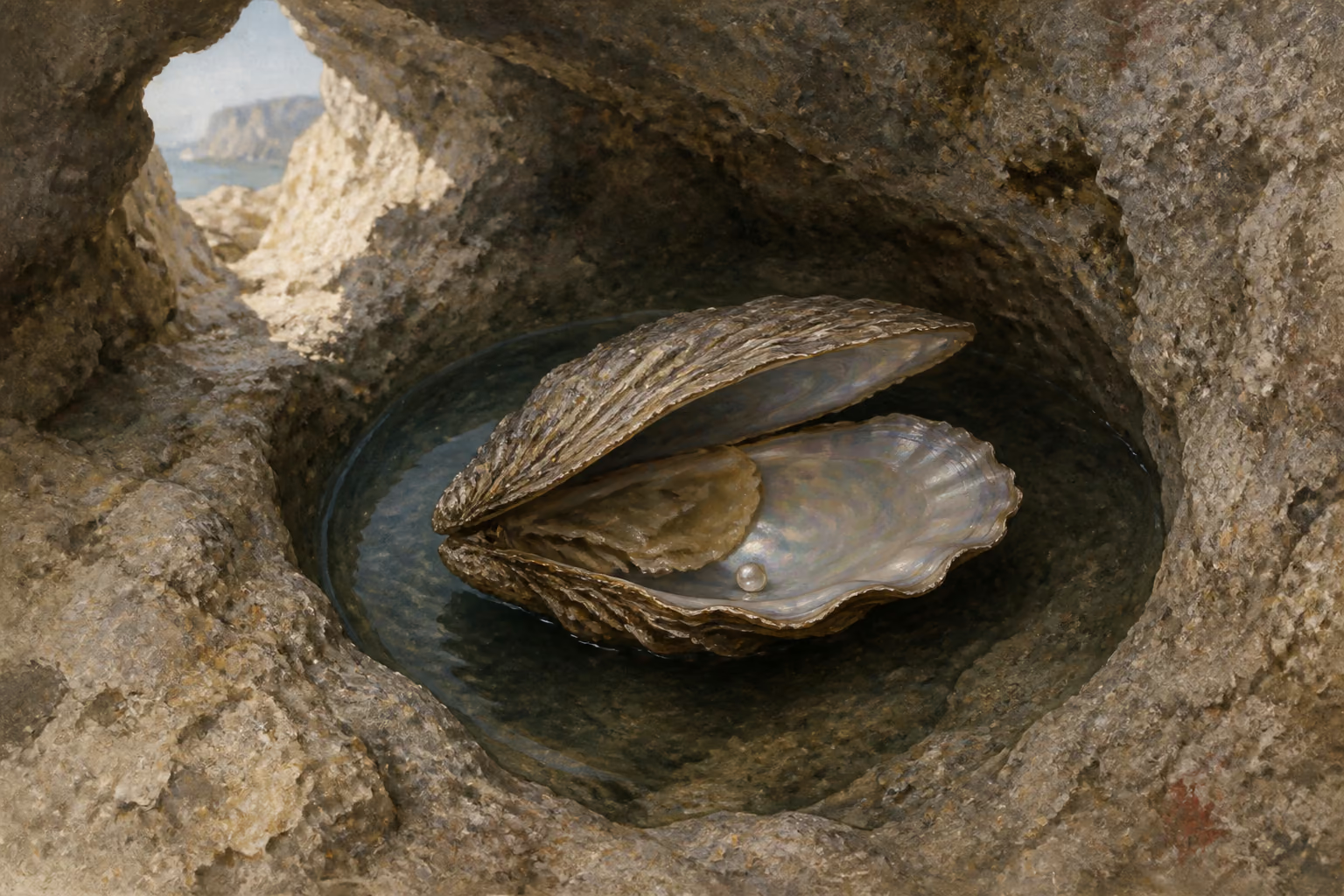
Origo atque genitura conchae sunt, haut multum ostrearum conchis differentes. has ubi genitalis anni stimulant hora, pandentes se quadam oscitatione impleri roscido conceptu tradunt, gravidas postea eniti, partumque concharum esse margaritas pro qualitate roris accepti. si purus influxerit, candorem conspici; si vero turbidus, et fetum sordescere; eundem pallere caelo minante. conceptum ex eo quippe constare, caelique iis maiorem societatem esse quam maris: inde nubilum trahi colorem aut pro claritate matutina serenum. sitempestive satientur, grandescere et partus; si fulguret, conprimi conchas ac pro ieiunii modo minui; si vero etiam tonuerit, pavidas ac repente conpressas quae vocant physemata efficere, specie modo inani inflata sine corpore; hos esse concharum abortus. sani quidem partus multiplici constant cute, non inproprie callum ut existimari corporis possit. itaque et purgantur a peritis. miror ipso tantum eas caelo gaudere, sole rufescere candoremque per-. dere ut corpus humanum. quare praecipuum custodiunt pelagiae, altius mersac quam ut penetrent radii. flavescunt tamen et illae senecta rugisque torpescunt, nec nisi in iuventa constat ille qui quaeritur vigor. crassescunt etiam in senecta conchisque adhaerescunt nec his evelli queunt nisi lima. quibus una tantum est facies et ab ea rotunditas, aversis planities, ob id tympania nominantur. cohaerentes videmus in conchis hac dote unguenta circumferentibus. cetero in aqua mollis unio, exemptus protinus durescit.
Concha ipsa, cum manum vidit, conprimit sese operitque opes suas, gnara propter illas se peti, manumque, Si praeveniat, acie sua abscidat, nulla iustiore poena, et aliis munita suppliciis, quippe inter scopulos maior pars invenitur, in alto quoque comitantibus marinis canibus, nec tamen aures feminarum arcentur. quidam tradunt sicut apibus, ita concharum examinibus singulas magnitudine et vetustate praecipuas esse veluti duces, mirae ad cavendum sollertiae. has urinantium cura peti, illis captis facile ceteras palantes retibus includi, multo deinde obrutas sale in vasis fictilibus; rosa came omni nucleos quosdam corporum, hoc est uniones, decidere in ima.
Vsu atteri non dubium est coloremque indiligentia mutare. dos omnis in candore, magnitudine, orbe, levore, pondere, haut promptis rebus in tantum, ut nulli duo reperiantur indiscreti: unde nomen unionum Romanae scilicet inposuere deliciae, nam id apud Graecos non est, ne apud barbaros quidem, inventores rei eius, aliud quam margaritae. et in candore ipso magna differentia: clarior in Rubro mari repertis, in Indico specularium lapidum squamas adsimulant, alias magnitudine praecellentes. summa laus coloris est exaluminatos vocari. et procerioribus sua gratia est. elenchos appellant fastigata longitudine alabastrorum figura in pleniore m orbem desinentes. hos digitis suspendere et binos ac ternos auribus feminarum gloria est, subeuntque luxuriae eius nomina externa, exquisita perdito nepotatu, si quidem, cum id fecere, crotalia appellant, ceu sono quoque gaudeant et collisu ipso margaritarum; cupiuntque iam et pauperes, lictorem feminae in publico unionem esse dictitantes. quin et pedibus, nec crepidarum tantum obstragulis, set totis socculis addunt. neque enim gestare iam margaritas, nisi calcent ac per uniones etiam ambulent, satis est.
In nostro mari reperiri solebant crebrius circa Bosporum Thracium, rufi ac parvi in conchis quas myas appellant. at in Acarnania quae vocatur pina gignit, quo apparet non uno conchae genere nasci. namque et Iuba tradit Arabicis concham esse similem pectini insecto, hirsutam echinorum modo, ipsum unionem in carne grandini similem. conchae non tales ad nos adferuntur. nec in Acarnania autem laudatireperiuntur, enormes et feri colorisque marmorei. meliores circa Actium, sed et hi parvi, et in Mauretaniae maritimis. Alexander polyhistor et Sudines senescere eos putant coloremque expirare.
Firmum corpus esse manifestum est, quod nullo lapsu franguntur. non autem semper in media carne reperiuntur, sed aliis atque aliis locis, vidimusque iam in extremis etiam marginibus velut e concha exeuntes et in quibusdam quaternos quinosque. pondus ad hoc aevi semunciae pauci singulis scripulis excessere. in Britannia parvos atque decolores nasci certum est, quoniam Divus Iulius thoracem, quem Veneri Genetrici in templo eius dicavit, ex Britannicis margaritis factum voluerit intellegi.
Lolliam Paulinam, quae fruit Gai principis matrona, ne serio quidem aut sollemni caerimoniarum aliquo apparatu, sed mediocrium etiam sponsalium cena, vidi smaragdis margaritisque opertam, alterno textu fulgentibus toto capite, crinibus [spira], auribus, collo [monilibus], digitis. quae summa quadringentiens HS colligebat, ipsa confestim parata mancupationem tabulis probare. nec dona prodigi principis fuerant, sed avitae opes, provinciarum scilicet spoliis partae. hic est rapinarum exitus, hoc fuit quare M. Lollius infamatus regum muneribus in toto oriente interdicta amicitia a Gaio Caesare Augusti filio venenum biberet, ut neptis eius quadringentiens HS operta spectaretur ad lucernas! computet nunc aliquis ex altera parte quantum Curius aut Fabricius in triumphis tulerint, imaginetur illorum fercula, ex altera parte Lolliam, unam imperii mulierculam, accubantem: non illos curru detractos quam in hoc vicisse malit? nec haec summa luxuriae exempla sunt. duo fuere maximi uniones per omne aevum; utrumque possedit Cleopatra, Aegypti reginarum novissima, per manus orientis regum sibi traditos. haec, cum exquisitis cotidie Antonius saginaretur epulis, superbo simul ac procaci fastu, ut regina meretrix lautitiam eius omnem apparatumque obtrectans, quaerente eo, quid adstrui magnificentiae posset, respondit una se cena centiens HS absumpturam. cupiebat discere Antonius, sed fieri posse non arbitrabatur. ergo sponsionibus factis postero die, quo iudicium agebatur, magnificam alias cenam, ne dies periret, sed cotidianam, Antonio apposuit inridenti computationemque expostulanti. at illa corollarium id esse et consumpturam eam cenam taxationem confirmans solamque se centiens HS cenaturam, inferri mensam secundam iussit. ex praecepto ministri unum tantum vas ante eam posuere aceti, cuius asperitas visque in tabem margaritas resolvit. gerebat auribus cum maxime singulare illud et vere unicum naturae opus. itaque expectante Antonio, quidnam esset actura, detractum alterum mersit ac liquefactum obsorbuit. iniecit alteri manum L. Plancus, index sponsionis eius, eum quoque parante simili modo absumere, victumque Antonium pronuntiavit omine rato. comitatur fama unionis eius parem, capta illa tantae quaestionis victrice regina, dissectum, ut esset in utrisque Veneris auribus Romae in Pantheo dimidia eorum cena. non ferent hanc palmam spoliabunturque etiam luxuriae gloria. prior id fecerat Romae in unionibus magnae taxationis Clodius, tragoedi Aesopi filius, relictus ab eo in amplis opibus heres, ne triumviratu suo nimis superbiat Antonius paene histrioni comparatus et quidem nulla sponsione ad hoc producto (quo magis regium fiat), sed ut experiretur in gloriam palati, quidnam saperent margaritae. atque ut mire placuere, ne solus hoc sciret, singulos uniones convivis quoque absorbendos dedit.
Romae in promiscuum ac frequentem usum venisse Alexandria in dicionem redacta, primum autem coepisse circa Sullana tempora minutas et viles Fenestella tradit, manifesto errore, cum Aelius Stilo circa lugurthinum bellum unionum nomen inponi cum maxime grandibus margaritis prodat.
Et hoc tamen aeternae prope possessionis est; sequitur heredem, in mancipatum venit ut praedium aliquod: conchylia et purpuras omnis hora atterit, quibus eadem mater luxuria paria paene et margaritis pretia fecit.
English · Bostock & Riley 1855–57
But still, how insignificant is all this when we come to think of our purple, our azure, and our pearls; it was not enough, forsooth, for the spoils of the sea to be thrust down the gullet—but they must be employed as well to adorn the hands, the ears, the head, the whole body, in fact, and that of the men pretty nearly as much as the women. What has the sea to do with our clothes? What is there in common between waves and billows and a sheep’s fleece? This one element ought not to receive us, according to ordinary notions, except in a state of nakedness. Let there be ever so strong an alliance between it and the belly, on the score of gluttony, still, what can it possibly have to do with the back? It is not enough, forsooth, that we are fed upon what is acquired by perils, but we must be clothed, too, in a similar way; so true it is, that for all the wants of the body, that which is sought at the expense of human life, is sure to please us the most.
The first rank then, and the very highest position among all valuables, belongs to the pearl. It is the Indian Ocean that principally sends them to us: and thus have they, amid those monsters so frightful and so huge which we have already described, to cross so many seas, and to traverse such lengthened tracts of land, scorched by the ardent rays of a burning sun: and then, too, by the Indians themselves they have to be sought in certain islands, and those but very few in number. The most productive of pearls is the island of Taprobane, and that of Stoïdis, as already mentioned in the description of the world; Perimula, also, a promontory of India. But those are most highly valued which are found in the vicinity of Arabia, in the Persian Gulf, which forms a part of the Red Sea.
The origin and production of the shell-fish is not very different from that of the shell of the oyster. When the genial season of the year exercises its influence on the animal, it is said that, yawning, as it were, it opens its shell, and so receives a kind of dew, by means of which it becomes impregnated; and that at length it gives birth, after many struggles, to the burden of its shell, in the shape of pearls, which vary according to the quality of the dew. If this has been in a perfectly pure state when it flowed into the shell, then the pearl produced is white and brilliant, but if it was turbid, then the pearl is of a clouded colour also; if the sky should happen to have been lowering when it was generated, the pearl will be of a pallid colour; from all which it is quite evident that the quality of the pearl depends much more upon a calm state of the heavens than of the sea, and hence it is that it contracts a cloudy hue, or a limpid appearance, according to the degree of serenity of the sky in the morning.
If, again, the fish is satiated in a reasonable time, then the pearl produced increases rapidly in size. If it should happen to lighten at the time, the animal shuts its shell, and the pearl is diminished in size in proportion to the fast that the animal has to endure: but if, in addition to this, it should thunder as well, then it becomes alarmed, and closing the shell in an instant, produces what is known as a physema, or pearl-bubble, filled with air, and bearing a resemblance to a pearl, but in appearance only, as it is quite empty, and devoid of body; these bubbles are formed by the abortion of the shell-fish. Those which are produced in a perfectly healthy state consist of numerous layers, so that they may be looked upon, not inappropriately, as similar in conformation to the callosities on the body of an animal; and they should therefore be cleaned by experienced hands. It is wonderful, however, that they should be influenced thus pleasurably by the state of the heavens, seeing that by the action of the sun the pearls are turned of a red colour, and lose all their whiteness, just like the human body. Hence it is that those which keep their whiteness the best are the pelagiæ, or main-sea pearls, which lie at too great a depth to be reached by the sun’s rays; and yet these even turn yellow with age, grow dull and wrinkled, and it is only in their youth that they possess that brilliancy which is so highly esteemed in them. When old, too, the coat grows thick, and they adhere to the shell, from which they can only be separated with the assistance of a file. Those pearls which have one surface flat and the other spherical, opposite to the plane side, are for that reason called tympania, or tambour-pearls. I have seen pearls still adhering to the shell; for which reason the shells were used as boxes for unguents. In addition to these facts, we may remark that the pearl is soft in the water, but that it grows hard the instant it is taken out.
The fish, as soon as ever it perceives the hand, shuts its shell and covers up its treasures, being well aware that it is for them that it is sought; and if it happens to catch the hand, it cuts it off with the sharp edge of the shell. And no punishment is there that could be more justly inflicted. There are other penalties added as well, seeing that the greater part of these pearls are only to be found among rocks and crags, while on the other hand, those which lie out in the main sea are generally accompanied by sea-dogs. And yet, for all this, the women will not banish these gems from their ears! Some writers say, that these animals live in communities, just like swarms of bees, each of them being governed by one remarkable for its size and its venerable old age; while at the same time it is possessed of marvellous skill in taking all due precautions against danger; the divers, they say, take especial care to find these, and when once they are taken, the others stray to and fro, and are easily caught in their nets. We learn also that as soon as they are taken they are placed under a thick layer of salt in earthen-ware vessels; as the flesh is gradually consumed, certain knots, which form the pearls, are disengaged from their bodies, and fall to the bottom of the vessel.
There is no doubt that pearls wear with use, and will change their colour, if neglected. All their merit consists in their whiteness, large size, roundness, polish, and weight; qualities which are not easily to be found united in the same; so much so, indeed, that no two pearls are ever found perfectly alike; and it was from this circumstance, no doubt, that our Roman luxury first gave them the name of “unio,” or the unique gem: for a similar name is not given them by the Greeks; nor, indeed, among the barbarians by whom they are found are they called anything else but “margaritæ.” Even in the very whiteness of the pearl there is a great difference to be observed. Those are of a much clearer water that are found in the Red Sea, while the Indian pearl resembles in tint the scales of the mirror-stone, but exceeds all the others in size. The colour that is most highly prized of all, is that of those which are thence called alum-coloured pearls. Long pearls also have their peculiar value; those are called “elenchi,” which are of a long tapering shape, resembling our alabaster boxes in form, and ending in a full bulb. Our ladies quite glory in having these suspended from their fingers, or two or three of them dangling from their ears. For the purpose of ministering to these luxurious tastes, there are various names and wearisome refinements which have been devised by profuseness and prodigality; for after inventing these ear-rings, they have given them the name of “crotalia,” or castanet pendants, as though quite delighted even with the rattling of the pearls as they knock against each other; and now, at the present day, the poorer classes are even affecting them, as people are in the habit of saying, that “a pearl worn by a woman in public, is as good as a lictor walking before her.” Nay, even more than this, they put them on their feet, and that, not only on the laces of their sandals, but all over the shoes; it is not enough to wear pearls, but they must tread upon them, and walk with them under foot as well.
Pearls used formerly to be found in our sea, but more frequently about the Thracian Bosporus; they were of a red colour, and small, and enclosed in a shell-fish known by the name of “myes.” In Acarnania there is a shell-fish called “pina,” which produces pearls; and from this it is quite evident that it is not one kind of fish only that produces them. Juba states also, that on the shores of Arabia there is a shell-fish which resembles a notched comb, and covered all over with hair like a sea-urchin, and that the pearl lies imbedded in its flesh, in appearance bearing a strong resemblance to a hailstone. No such shell-fish, however, as these are ever brought to Rome. Nor yet are any pearls of value found in Acarnania, being shapeless, rough, and of a marble hue; those are better which are found in the vicinity of Actium; but still they are small, which is the case also with those found on the coast of Mauritania. Alexander Polyhistor and Sudines are of opinion that as they grow old their tints gradually fade.
It is quite clear that the interior of the pearl is solid, as no fall is able to break it. Pearls are not always found in the middle of the body of the animal, but sometimes in one place, and sometimes another. Indeed, I have seen some which lay at the edge of the shell, just as though in the very act of coming forth, and in some fishes as many as four or five. Up to the present time, very few have been found which exceeded half an ounce in weight, by more than one scruple. It is a well-ascertained fact, that in Britannia pearls are found, though small, and of a bad colour; for the deified Julius Cæsar wished it to be distinctly understood, that the breast-plate which he dedicated to Venus Genetrix, in her temple, was made of British pearls.
I once saw Lollia Paulina, the wife of the Emperor Caius —it was not at any public festival, or any solemn ceremonial, but only at an ordinary wedding entertainment —covered with emeralds and pearls, which shone in alternate layers upon her head, in her hair, in her wreaths, in her ears, upon her neck, in her bracelets, and on her fingers, and the value of which amounted in all to forty millions of sesterces; indeed she was prepared at once to prove the fact, by showing the receipts and acquittances. Nor were these any presents made by a prodigal potentate, but treasures which had descended to her from her grandfather, and obtained by the spoliation of the provinces. Such are the fruits of plunder and extortion! It was for this reason that M. Lollius was held so infamous all over the East for the presents which he extorted from the kings; the result of which was, that he was denied the friendship of Caius Cæsar, and took poison; and all this was done, I say, that his grand-daughter might be seen, by the glare of lamps, covered all over with jewels to the amount of forty millions of sesterces! Now let a person only picture to himself, on the one hand, what was the value of the habits worn by Curius or Fabricius in their triumphs, let him picture to himself the objects displayed to the public on their triumphal litters, and then, on the other hand, let him think upon this Lollia, this one bit of a woman, the head of an empire, taking her place at table, thus attired; would he not much rather that the conquerors had been torn from their very chariots, than that they had conquered for such a result as this?
Nor, indeed, are these the most supreme evidences of luxury. There were formerly two pearls, the largest that had been ever seen in the whole world: Cleopatra, the last of the queens of Egypt, was in possession of them both, they having come to her by descent from the kings of the East. When Antony had been sated by her, day after day, with the most exquisite banquets, this queenly courtesan, inflated with vanity and disdainful arrogance, affected to treat all this sumptuousness and all these vast preparations with the greatest contempt; upon which Antony enquired what there was that could possibly be added to such extraordinary magnificence. To this she made answer, that on a single entertainment she would expend ten millions of sesterces. Antony was extremely desirous to learn how that could be done, but looked upon it as a thing quite impossible; and a wager was the result. On the following day, upon which the matter was to be decided, in order that she might not lose the wager, she had an entertainment set before Antony, magnificent in every respect, though no better than his usual repast. Upon this, Antony joked her, and enquired what was the amount expended upon it; to which she made answer that the banquet which he then beheld was only a trifling appendage to the real banquet, and that she alone would consume at the meal to the ascertained value of that amount, she herself would swallow the ten millions of sesterces; and so ordered the second course to be served. In obedience to her instructions, the servants placed before her a single vessel, which was filled with vinegar, a liquid, the sharpness and strength of which is able to dissolve pearls. At this moment she was wearing in her ears those choicest and most rare and unique productions of Nature; and while Antony was waiting to see what she was going to do, taking one of them from out of her ear, she threw it into the vinegar, and directly it was melted, swallowed it. Lucius Plancus, who had been named umpire in the wager, placed his hand upon the other at the very instant that she was making preparations to dissolve it in a similar manner, and declared that Antony had lost—an omen which, in the result, was fully confirmed. The fame of the second pearl is equal to that which attends its fellow. After the queen, who had thus come off victorious on so important a question, had been seized, it was cut asunder, in order that this, the other half of the entertainment, might serve as pendants for the ears of Venus, in the Pantheon at Rome.
Antony and Cleopatra, however, will not bear away the palm of prodigality in this respect, and will be stripped of even this boast in the annals of luxury. For before their time, Clodius, the son of the tragic actor Æsopus, had done the same at Rome; having been left by his father heir to his ample wealth and possessions. Let not Antony then be too proud, for all his triumvirate, since he can hardly stand in comparison with an actor; one, too, who had no wager to induce him—a thing which adds to the regal munificence of the act—but was merely desirous of trying, by way of glorification to his palate, what was the taste of pearls. As he found it to be wonderfully pleasing, that he might not be the only one to know it, he had a pearl set before each of his guests for him to swallow. After the surrender of Alexandria, pearls came into common and, indeed, universal use at Rome; but they first began to be used about the time of Sylla, though but of small size and of little value, Fenestella says—in this, however, it is quite evident that he is mistaken, for Ælius Stilo tells us, that it was in the time of the Jugurthine war, that the name of “unio” was first given to pearls of remarkable size.
And yet pearls may be looked upon as pretty nearly a possession of everlasting duration—they descend from a man to his heir, and they are alienated from one to another just like any landed estate. But the colours that are extracted from the murex and the purple fade from hour to hour; and yet luxury, which has similarly acted as a mother to them, has set upon them prices almost equal to those of pearls.