LIBER IX · CAPUT 36
THE DIFFERENT KINDS OF PURPLES
Latine · Mayhoff 1906
Purpurae vivunt annis plurimum septenis. latent sicut murices circa canis ortum tricenis diebus. congregantur verno tempore mutuoque attritu lentorem cuiusdam cerae salivant. simili modo et murices, sed purpurae florem ilium tinguendis expetitum vestibus in mediis habent faucibus. liquoris hic minimi est candida vena, unde pretiosus ille bibitur nigrantis rosae colore sublucens; reliquum corpus sterile. vivas capere contendunt, quia cum vita sucum eum evomunt. et maioribus quidem purpuris detracta concha auferunt, minores cum testa vivas frangunt, ita demum eum expuentes. Tyri praecipuus hic Asiae, Meninge Africae et Gaetulo litore oceani, in Laconica Europae. fasces huic securesque Romanae viam faciunt, idemque pro maiestate pueritiae est, distinguit ab equite curiam, dis advocatur placandis omnemque vestem inluminat, in triumphali miscetur auro. quapropter excusata et purpurae sit insania. sed unde conchyliis pretia, quis virus grave in fuco, color austerus in glauco et irascenti similis mari?
Lingua purpurae longitudine digitali, qua pascitur perforando reliqua conchylia: tanta duritia aculeo est. aquae dulcedine necantur et sicubi flumen inmergitur; alioqui captae et diebus quinquagenis vivunt saliva sua. conchae omnes celerrime crescunt, praecipue purpurae: anno magnitudinem implent.
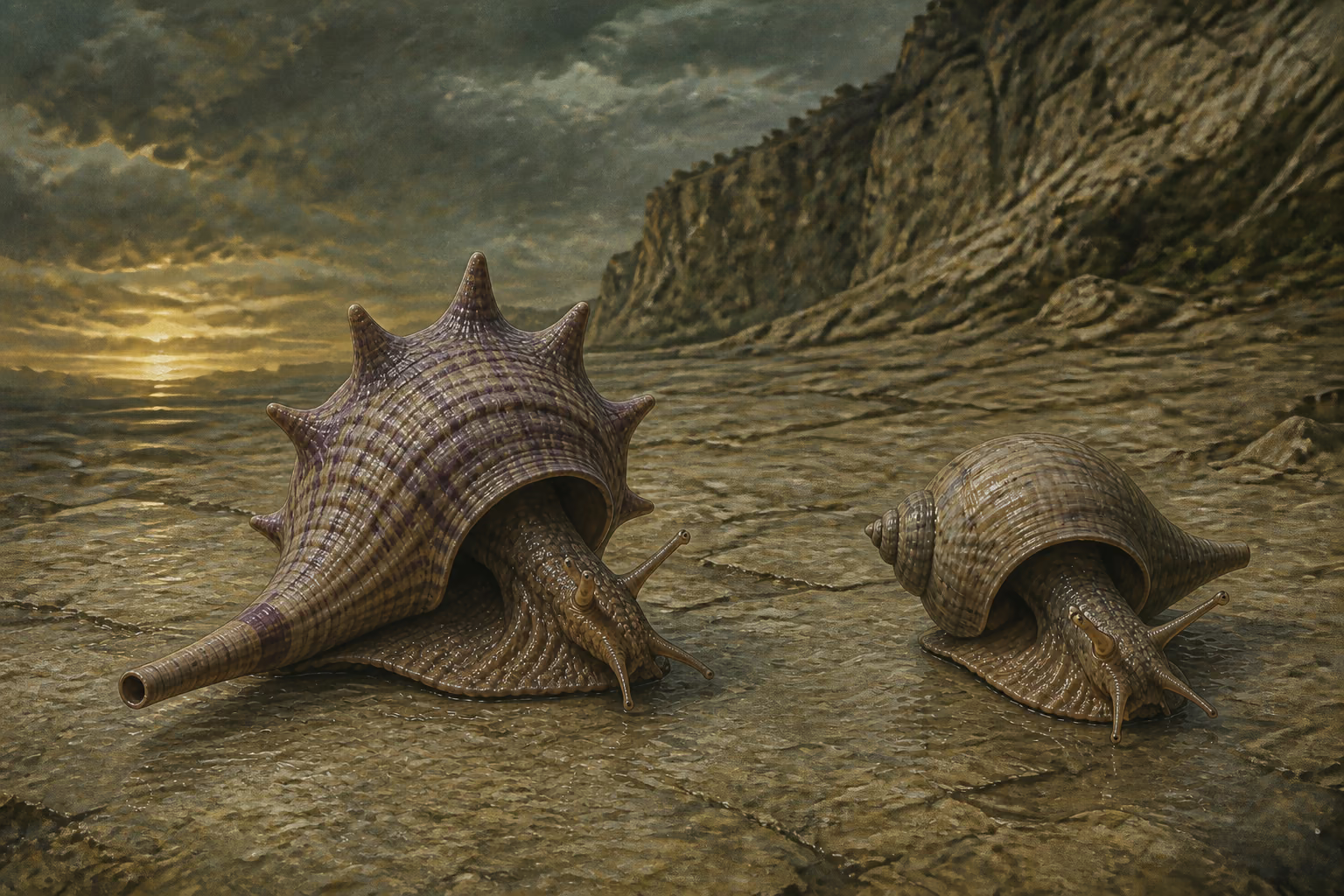
Quod si hactenus transcurrat expositio, fraudatam profecto se luxuria credat nosque indiligentiae damnet. quam ob rem persequemur etiam officinas, ut, tamquam in victu frugum noscitur ratio, sic omnes qui istis gaudent in praemio vitae suae calleant. concharum ad purpuras et conchylia — eadem enim est materia, sed distat temperamento — duo sunt genera: bucinum minor concha ad similitudinem eius qua bucini sonus editur — unde et causa nomini —, rotunditate oris in margine incisa; alterum purpura vocatur canaliculato procurrente rostro et canaliculi latere introrsus tubulato, qua proseratur lingua. praeterea clavatum est ad turbinem usque aculeis in orbem septenis fere, qui non sunt bucino, sed utrisque orbes totidem, quot 5 habeant annos. bucinum non nisi petris adhaeret circaque scopulos legitur.
English · Bostock & Riley 1855–57
Purples live mostly seven years. Like the murex, they keep themselves in concealment for thirty days, about the time of the rising of the Dog-star; in the spring season they unite in large bodies, and by rubbing against each other, produce a viscous spittle, from which a kind of wax is formed. The murex does the same; but the purple has that exquisite juice which is so greatly sought after for the purpose of dyeing cloth, situate in the middle of the throat. This secretion consists of a tiny drop contained in a white vein, from which the precious liquid used for dyeing is distilled, being of the tint of a rose somewhat inclining to black. The rest of the body is entirely destitute of this juice. It is a great point to take the fish alive; for when it dies, it spits out this juice. From the larger ones it is extracted after taking off the shell; but the small fish are crushed alive, together with the shells, upon which they eject this secretion.
In Asia the best purple is that of Tyre, in Africa that of Meninx and the parts of Gætulia that border on the Ocean, and in Europe that of Laconia. It is for this colour that the fasces and the axes of Rome make way in the crowd; it is this that asserts the majesty of childhood; it is this that distinguishes the senator from the man of equestrian rank; by persons arrayed in this colour are prayers addressed to propitiate the gods; on every garment it sheds a lustre, and in the triumphal vestment it is to be seen mingled with gold. Let us be prepared then to excuse this frantic passion for purple, even though at the same time we are compelled to enquire, why it is that such a high value has been set upon the produce of this shell-fish, seeing that while in the dye the smell of it is offensive, and the colour itself is harsh, of a greenish hue, and strongly resembling that of the sea when in a tempestuous state?
The tongue of the purple is a finger in length, and by means of this it finds subsistence, by piercing other shell-fish, so hard is the point of it. They die in fresh water, and in places where rivers discharge themselves into the sea; otherwise, when taken, they will live as long as fifty days on their saliva. All shell-fish grow very fast, and purples more especially; they come to their full size at the end of a year.
Were I at this point to pass on to other subjects, luxury, no doubt would think itself defrauded of its due, and so accuse me of negligence; I must therefore make my way into the very workshops even, so that, just as among articles of food the various kinds and qualities of corn are known, all those who place the enjoyment of life in these luxuries, may have a still better acquaintance with the objects for which they live.
There are two kinds of fish that produce the purple colour; the elements in both are the same, the combinations only are different; the smaller fish is that which is called the “buccinum,” from its resemblance to the conch by which the sound of the buccinus or trumpet is produced, and to this circumstance it owes its name: the opening in it is round, with an incision in the margin. The other fish is known as the “purpura,” or purple, and has a grooved and projecting muzzle, which being tubulated on one side in the interior, forms a passage for the tongue; besides which, the shell is studded with points up to the very apex, which are mostly seven in number, and disposed in a circle; these are not found on the buccinum, though both of them have as many spirals as they are years old. The buccinum attaches itself only to crags, and is gathered about rocky places.