LIBER IX · CAPUT 8
DOLPHINS
Latine · Mayhoff 1906
Velocissimum omnium animalium, non solum marinorum, est delphinus, ocior volucre, acrior telo, ac nisi multum infra rostrum os illi foret medio paene in ventre, nullus piscium celeritatem eius evaderet. sed adfert moram providentia naturae, quia nisi resupini atque conversi non corripiunt, quae causa praecipue velocitatem eorum ostendit. nam cum fame conciti fugientem in vada ima persecutipiscem diutius spiritum continuere, ut arcu missi ad respirandum emicant tantaque vi exiliunt, ut plerumque vela navium transvolent. vagantur fere coniugia; pariunt catulos decimo mense aestivo tempore, interim et binos. nutriunt uberibus, sicut ballaena, atque etiam gestant fetus infantia infirmos; quin et adultos diu comitantur magna erga partum caritate. adolescunt celeriter, X annis putantur ad summam magnitudinem pervenire. vivunt et tricenis, quod cognitum praecisa cauda in experimentum. abduntur tricenis diebus circa canis ortum occultanturque incognito modo, quod eo magis mirum est, si spirare in aqua non queunt. solent in terram erumpere, incerta de causa, nec statim tellure tacta moriuntur multoque ocius fistula clausa. lingua est iis contra naturam aquatilium mobilis, brevis atque lata, haut differens suillae. pro voce gemitus humano similis, dorsum repandum, rostrum simum. qua de causa nomen simonis omnes miro modo agnoscunt maluntque ita appellari.
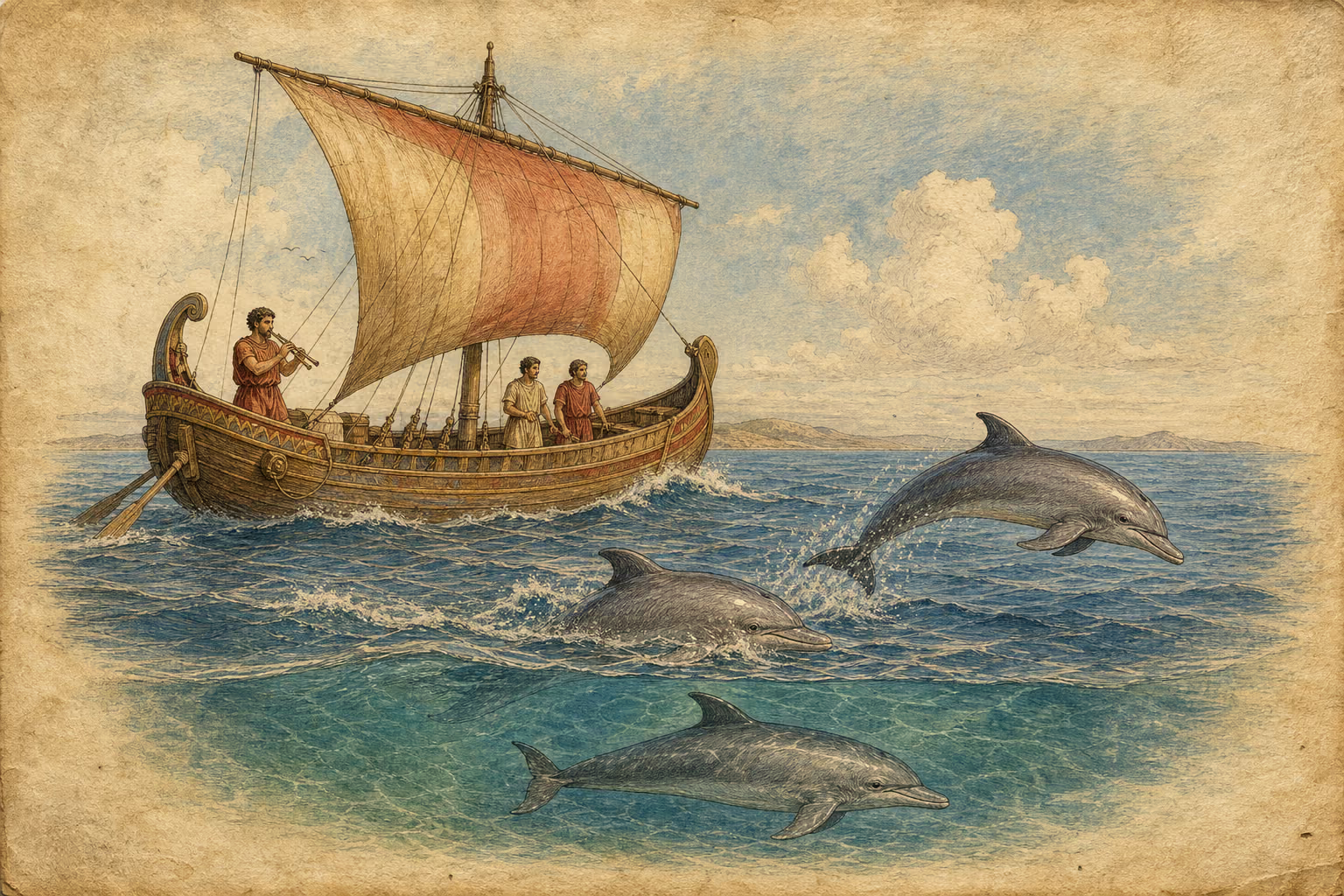
Delphinus non homini tantum amicum animal, verum et musicae arti, mulcetur symphoniae cantu, set praecipue hydrauli sono. hominem non expavescit ut alienum, obviam navigiis venit, adludit exultans, certat etiam et quamvis plena praeterit vela. Divo Augusto principe Lucrinum lacum invectus pauperis cuiusdam puerum ex Baiano Puteol os in ludum litterariumitantem, cum meridiano immorans appellatum eum simonis nomine saepius fragmentis panis, quem ob iter ferebat, adlexisset, miro amore dilexit. pigeret referre, ni res Maecenatis et Fabiani et Flavi Alfii multorumque esset litteris mandata. quocumque diei tempore inclamatus a puero, quamvis occultus atque abditus, ex imo advolabat pastusque e manu praebebat ascensuro dorsum, pinnae aculeos velut vagina condens, receptumque Puteolos per magnum aequor in ludum ferebat simili modo revehens pluribus annis, done morbo extincto puero subinde ad consuetum locum ventitans tristis et maerenti similis ipse quoque, quod nemo dubitaret, desiderio expiravit. alius intra hos annos Africo litore Hipponis Diarruti simili modo ex hominum manu vescens praebensque se tractandum et adludens nantibus inpositosque portans unguento perunctus a Flaviano proconsule Africae et sopitus, ut apparuit, odoris novitate fluctuatusque similis exanimi caruit hominum conversatione ut iniuria fugatus per aliquot menses, mox reversus in eodem miraculo fuit. iniuriae potestatum in hospitales ad visendum venientium Hipponenses in necem eius conpulerunt. ante haec similia de puero in laso urbe memorantur, cuius amore spectatus longo tempore, dum abeuntem in litus avide sequitur, in harenam invectus expiravit. puerum Alexander Magnus Babylone Neptunio sacerdotio praefecit, amorem ilium numinis propitii fuisse interpretatus. in eadem urbe Iaso Hegesidemus scribit et alium puerum Hermian nomine similiter maria perequitantem, cum repentinae procellae fluctibus exanimatus esset, relatum, delphinumque causam leti fatentem non reversum in maria atque in sicco expirasse. hoc idem et Naupacti accidisse Theophrastus tradit. nec modus exemplorum: eadem Amphilochi et Tarentini de pueris delphinisque narrant. quae faciunt ut credatur, Arionem quoque citharoedicae artis, interficere nautis in mari parantibus ad intercipiendos eius quaestus, eblanditum uti prius caneret cithara, congregatis cantu delphinis cum se iecisset in mare, exceptum ab uno Taenarum in litus pervectum.
Est provinciae Narbonensis et in Nemausiensi agro stagnum Latera appellatum, ubi cum homine delphini societate piscantur. innumera vis mugilum stato tempore angustis faucibus stagni in mare erumpit observata aestus reciprocatione. qua de causa praetendi non queunt retia, eaque moles ponderis nullo modo toleretur, etiamsi non sollertia insidietur tempori. simili ratione in altum protinus tendunt, quod vicino gurgite efficitur, locumque solum pandendis retibus habilem effugere festinant. quod ubi animadvertere piscantes — concurrit autem multitudo temporis gnara et magis etiam voluptatis huius avida — totusque populus e litore quanto potest clamore conciet simonemin spectaculi eventum, celeriter delphini exaudiunt desideria aquilonum flatu vocem prosequente, austro vero tardius ex adverso referente; set tum quoque inproviso in auxilium advolare properant. apparet acies, quae protinus disponitur in loco, ubi coniectus est pugnae. opponunt sese ab alto trepidosque in vada urgent: tum piscatores circumdant retia furcisque sublevant. mugilum nihilo minus velocitas transilit: at illos excipiunt delphini et occidisse ad praesens contenti cibos in victoriam differunt. opere proelium fervet, includique retibus se fortissime urgentes gaudent ac, ne id ipsum fugam hostium stimulet, inter navigia et retia natantesve homines ita sensim elabuntur, ut exitus non aperiant. saltu, quod est alias blandissimum iis, nullus conatur evadere, ni summittantur sibi retia. egressus protinus ante vallum proeliatur. ita peracta captura quos interemere diripiunt. sed enixioris operae quam in unius diei praemiuni conscii sibi opperiuntur in posterum nec piscibus tantum, sed et intrita panis e vino satiantur.
Quae de eodem genere piscandi in Iasio sinu Mucianus tradit, hoc differunt, quod ultro neque inclamati praesto sint partesque e manibus accipiant et suum quaeque cumba e delphinis socium habeat, quamvis noctu et ad faces. ipsis quoque inter se publica est societas. capto a rege Cariae alligatoque in portu ingens reliquorum convenit multitude maestitia quadam, quae posset intellegi, miserationem petens, donec dimitti rex eum iussit. quin et parvos semper aliquis grandior comitatur ut custos, conspectique iam sunt defunctum portantes, ne laceraretur a beluis.
English · Bostock & Riley 1855–57
The swiftest not only of the sea animals, but of all animals whatever, is the dolphin. He is more rapid in his movements than a bird, more instantaneous than the flight of an arrow, and were it not for the fact that his month is situate much below his muzzle, almost, indeed, in the middle of the belly, not a fish would be able to escape his pursuit. But Nature, in her prudence, has thrown certain impediments in his way; for unless he turns, and throws himself on his back, he can seize nothing, and it is this circumstance more especially that gives proof of his extraordinary swiftness. For, if pressed by hunger, he will follow a fish, as it flies down, to the very bottom of the water, and then after holding his breath thus long, will dart again to the surface to respire, with the speed of an arrow discharged from a bow; and often, on such occasions, he is known to leap out of the water with such a bound, as to fly right over the sails of a ship.
Dolphins generally go in couples; the females bring forth their young in the tenth month, during the summer season, sometimes two in number. They suckle their young at the teat like the balæna, and even carry them during the weakness of infancy; in addition to which, long after they are grown up, they accompany them, so great is their affection for their progeny. The young ones grow very speedily, and in ten years are supposed to arrive at their full size. The dolphin lives thirty years; a fact that has been ascertained from cutting marks on the tail, by way of experiment. It conceals itself for thirty days, at about the rising of the Dog-star, and hides itself so effectually, that it is not known whither it goes; a thing that is more surprising still, if it is unable to respire under water. Dolphins are in the habit of darting upon the shore, for some reason or other, it is not known what. They do not die the moment that they touch the dry land, but will die much more speedily if the vent-hole is closed. The tongue, contrary to the nature of aquatic animals in general, is moveable, being short and broad, not much unlike that of the pig. Instead of a voice, they emit a moaning sound similar to that made by a human being; the back is arched, and the nose turned up. For this reason it is that they all recognize in a most surprising manner the name of Simo, and prefer to be called by that rather than by any other.
The dolphin is an animal not only friendly to man, but a lover of music as well; he is charmed by melodious concerts, and more especially by the notes of the water-organ. He does not dread man, as though a stranger to him, but comes to meet ships, leaps and bounds to and fro, vies with them in swiftness, and passes them even when in full sail.
In the reign of the late Emperor Augustus, a dolphin which had been carried to the Lucrine Lake conceived a most wonderful affection for the child of a certain poor man, who was in the habit of going that way from Baiæ to Puteoli to school, and who used to stop there in the middle of the day, call him by his name of Simo, and would often entice him to the banks of the lake with pieces of bread which he carried for the purpose. I should really have felt ashamed to mention this, had not the incident been stated in writing in the works of Mæcenas, Fabianus, Flavius Alfius, and many others. At whatever hour of the day he might happen to be called by the boy, and although hidden and out of sight at the bottom of the water, he would instantly fly to the surface, and after feeding from his hand, would present his back for him to mount, taking care to conceal the spiny projection of his fins in their sheath, as it were; and so, sportively taking him up on his back, he would carry him over a wide expanse of sea to the school at Puteoli, and in a similar manner bring him back again. This happened for several years, until at last the boy happened to fall ill of some malady, and died. The dolphin, however, still came to the spot as usual, with a sorrowful air and manifesting every sign of deep affliction, until at last, a thing of which no one felt the slightest doubt, he died purely of sorrow and regret.
Within these few years also, another at Hippo Diarrhytus, on the coast of Africa, in a similar manner used to receive his food from the hands of various persons, present himself for their caresses, sport about among the swimmers, and carry them on his back. On being rubbed with unguents by Flavianus, the then proconsul of Africa, he was lulled to sleep, as it appeared, by the sensation of an odour so new to him, and floated about just as though he had been dead. For some months after this, he carefully avoided all intercourse with man, just as though he had received some affront or other; but at the end of that time he returned, and afforded just the same wonderful scenes as before. At last, the vexations that were caused them by having to entertain so many influential men who came to see this sight, compelled the people of Hippo to put the animal to death.
Before this, there was a similar story told of a child at the city of Iasus, for whom a dolphin was long observed to have conceived a most ardent affection, until at last, as the animal was eagerly following him as he was making for the shore, it was carried by the tide on the sands, and there expired. Alexander the Great appointed this boy high priest of Neptune at Babylon, interpreting this extraordinary attachment as a convincing proof of the favour of that divinity.
Hegesidemus has also informed us, that in the same city of Iasus there was another boy also, Hermias by name, who in a similar manner used to traverse the sea on a dolphin’s back, but that on one occasion a tempest suddenly arising, he lost his life, and was brought back dead; upon which, the dolphin, who thus admitted that he had been the cause of his death, would not return to the sea, but lay down upon the dry land, and there expired.
Theophrastus informs us, that the very same thing happened at Naupactus also; nor, in fact, is there any limit to similar instances. The Amphilochians and the Tarentines have similar stories also about children and dolphins; and all these give an air of credibility to the one that is told of Arion, the famous performer on the lyre. The mariners being on the point of throwing him into the sea, for the purpose of taking possession of the money he had earned, he prevailed upon them to allow him one more song, accompanied with the music of his lyre. The melody attracted numbers of dolphins around the ship, and, upon throwing himself into the sea, he was taken up by one of them, and borne in safety to the shore of the Promontory of Tænarum.
There is in the province of Gallia Narbonensis and in the territory of Nemausus a lake known by the name of Latera, where dolphins fish in company with men. At the narrow outlet of this lake, at stated seasons of the year innumerable multitudes of mullets make their way into the sea, taking advantage of the turn of the tide; hence it is that it is quite impossible to employ nets sufficiently strong to bear so vast a weight, even though the fish had not the instinctive shrewdness to watch their opportunity. By a similar instinct the fish immediately make with all speed towards the deep water which is found in a gulf in that vicinity, and hasten to escape from the only spot that is at all convenient for spreading the nets. As soon as ever the fishermen perceive this, all the people—for great multitudes resort thither, being well aware of the proper time, and especially desirous of sharing in the amusement—shout as loud as they can, and summon Simo to the scene of action. The dolphins very quickly understand that they are in requisition, as a north-east wind speedily carries the sound to their retreats, though a south one would somewhat retard it by carrying it in an opposite direction. Even then however, sooner than you could have possibly supposed, there are the dolphins, in all readiness to assist. They are seen approaching in all haste in battle array, and, immediately taking up their position when the engagement is about to take place, they cut off all escape to the open sea, and drive the terrified fish into shallow water. The fishermen then throw their nets, holding them up at the sides with forks, though the mullets with inconceivable agility instantly leap over them; while the dolphins, on the other hand, are waiting in readiness to receive them, and content themselves for the present with killing them only, postponing all thoughts of eating till after they have secured the victory. The battle waxes hot apace, and the dolphins, pressing on with the greatest vigour, readily allow themselves to be enclosed in the nets; but in order that the fact of their being thus enclosed may not urge the enemy to find additional means of flight, they glide along so stealthily among the boats and nets, or else the swimmers, as not to leave them any opening for escape. By leaping, which at other times is their most favourite amusement, not one among them attempts to make its escape, unless, indeed, the nets are purposely lowered for it; and the instant that it has come out it continues the battle, as it were, up to the very ramparts. At last, when the capture is now completed, they devour those among the fish which they have killed; but being well aware that they have given too active an assistance to be repaid with only one day’s reward, they take care to wait there till the following day, when they are filled not only with fish, but bread crumbs soaked in wine as well.
The account which Mucianus gives of a similar mode of fishing in the Iasian Gulf differs from the preceding one, in the fact that there the dolphins make their appearance of their own accord, and do not require to be called: they receive their share from the hands of the people, each boat having its own particular associate among the dolphins; and this, although the fishing is carried on at night-time by the light of torches.
Dolphins, also, form among themselves a sort of general community. One of them having been captured by a king of Caria and chained up in the harbour, great multitudes of dolphins assembled at the spot, and with signs of sorrow which could not be misunderstood, appealed to the sympathies of the people, until at last the king ordered it to be released. The young dolphins, also, are always attended by a larger one, who acts as a guardian to them; and before now, they have been seen carrying off the body of one which had died, that it might not be devoured by the sea-monsters.