LIBER X · CAPUT 22
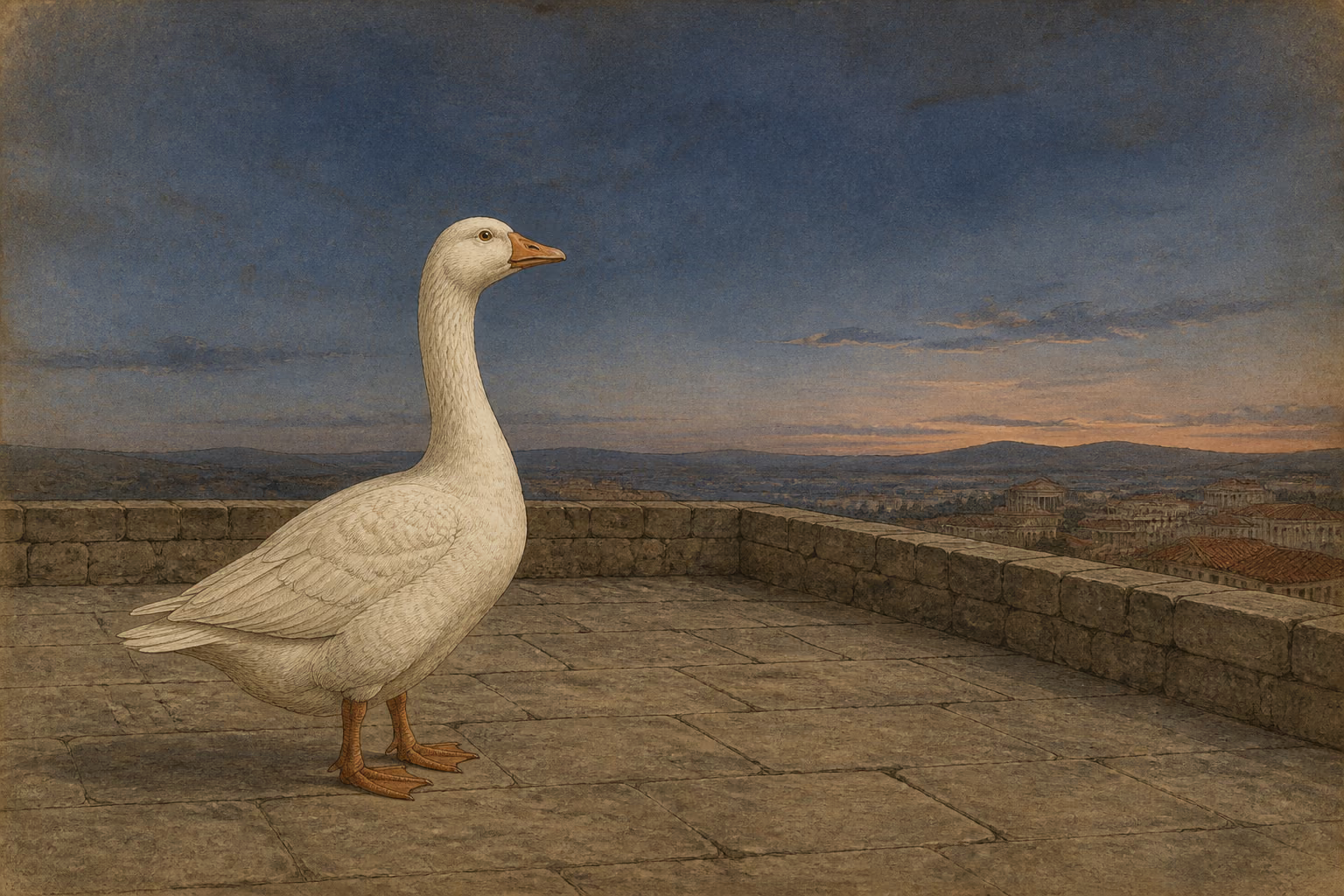
THE GOOSE
Latine · Mayhoff 1906
Et anseri vigil cura Capitolio testata defenso, per id tempus canum silentio proditis rebus, quam ob causam cibaria anserum censores in primis locant. quin et fama amoris Aegii dilecta forma pueri nomine...Olenii et Glauces Ptolemaeo regi cithara canentis, quam eodem tempore et aries amasse proditur. potest et sapientiae videri intellectus iis esse: ita comes perpetuo adhaesisse Lacydi philosopho dicitur, nusquam ab eo, non in publico, non in balineis, non noctu, non interdiu, digressus.
Nostri sapientiores, qui eos iecoris bonitate novere. fartilibus in magnam amplitudinem crescit, exemptum quoque lacte mulso augetur. nec sine causa in quaestione est, quis tantum bonum invenerit, Scipio Metellus vir consularis an Marcus Seius eadem aetate eques Romanus. sed, quod constat, Messalinus Cotta, Messalae oratoris filius, palmas pedum ex iis torrere atque patinis cum gallinaceorum cristis condire repperit; tribuetur enim a me culinis cuiusque palma cum fide. mirum in hac alite a Morinis usque Romam pedibus venire. fessi proferuntur ad primos; ita ceteri stipatione naturali propellunt eos.
Candidorum alterum vectigal in pluma. velluntur quibusdam locis bis anno, rursus plumigeri vestiuntur. mollior quae corpori proxima, et e Germania laudatissima. candidi ibi, verum minores; gantae vocantur. pretium plumae eorum in libras denarii quini. et inde crimina plerumque auxiliorum praefectis, a vigili statione ad haec aucupia dimissis cohortibus totis; eoque deliciae processere, ut sine hoc instrumento durare iam ne virorum quidem cervices possint.
Aliud repperit Syriae pars quae Commagene vocatur, adipem eorum in vase aereo cum cinnamo nive multa obrutum ac rigore gelido maceratum ad usum praeclari medicaminis, quod ab gente dicitur Commagenum.
Anserini generis sunt chenalopeces et, quibus lautiores epulas non novit Britannia, chenerotes, fere ansere minores. decet tetraonas suus nitor absolutaque nigritia, in superciliis cocci rubor. alterum eorum genus vulturum magnitudinem excedit, quorum et colorem reddit, nec ulla ales, excepto struthocamelo, maius corpore inplens pondus, in tantum aucta, ut in terra quoque inmobilis prehendatur. gignunt eos Alpes et septentrionalis regio. in vivariis saporem perdunt. moriuntur contumacia spiritu revocato. proximae iis sunt quas Hispania aves tardas appellat, Graecia ὠτίδας, damnatas in cibis; emissa enim ossibus medulla odoris taedium extemplo sequitur.
English · Bostock & Riley 1855–57
The goose also keeps a vigilant guard; a fact which is well attested by the defence of the Capitol, at a moment when, by the silence of the dogs, the commonwealth had been betrayed: for which reason it is that the Censors always, the first thing of all, attend to the farming-out of the feeding of the sacred geese. What is still more, too, there is a love-story about this animal. At Ægium one is said to have conceived a passion for a beautiful boy, a native of Olenos, and another for Glauce, a damsel who was lute-player to King Ptolemy; for whom at the same time a ram is said also to have conceived a passion. One might almost be tempted to think that these creatures have an appreciation of wisdom: for it is said, that one of them was the constant companion of the philosopher, Lacydes, and would never leave him, either in public or when at the bath, by night or by day.
Our people, however, are more wise; for they only esteem the goose for the goodness of its liver. When they are crammed, this grows to a very large size, and on being taken from the animal, is made still larger by being soaked in honeyed milk. And, indeed, it is not without good reason that it is matter of debate who it was that first discovered so great a delicacy; whether, in fact, it was Scipio Metellus, a man of consular dignity, or M. Seius, a contemporary of his, and a Roman of equestrian rank. However, a thing about which there is no dispute, it was Messalinus Cotta, the son of the orator Messala, who first discovered the art of roasting the webbed feet of the goose, and of cooking them in a ragout with cocks’ combs: for I shall faithfully award each culinary palm to such as I shall find deserving of it. It is a wonderful fact, in relation to this bird, that it comes on foot all the way from the country of the Morini to Rome; those that are tired are placed in the front rank, while the rest, taught by a natural instinct to move in a compact body, drive them on.
A second income, too, is also to be derived from the feathers of the white goose. In some places, this animal is plucked twice a year, upon which the feathers quickly grow again. Those are the softest which lie nearest to the body, and those that come from Germany are the most esteemed: the geese there are white, but of small size, and are called gantæ. The price paid for their feathers is five denarii per pound. It is from this fruitful source that we have repeated charges brought against the commanders of our auxiliaries, who are in the habit of detaching whole cohorts from the posts where they ought to be on guard, in pursuit of these birds: indeed, we have come to such a pitch of effeminacy, that now-a-days, not even the men can think of lying down without the aid of the goose’s feathers, by way of pillow.
The part of Syria which is called Commagene, has discovered another invention also; the fat of the goose is enclosed with some cinnamon in a brazen vessel, and then covered with a thick layer of snow. Under the influence of the excessive cold, it becomes macerated, and fit for use as a medicament, remarkable for its properties: from the country which produces it, it is known to us as “Commagenum.”
To the goose genus belong also the chenalopex, and the cheneros, a little smaller than the common goose, and which forms the most exquisite of all the dainties that Britannia provides for the table. The tetrao is remarkable for the lustre of its plumage, and its extreme darkness, while the eyelids are of a scarlet colour. Another species of this last bird exceeds the vulture in size, and is of a similar colour to it; and, indeed, there is no bird, with the exception of the ostrich, the body of which is of a greater weight; for to such a size does it grow, that it becomes incapable of moving, and allows itself to be taken on the ground. The Alps and the regions of the North produce these birds; but when kept in aviaries, they lose their fine flavour, and by retaining their breath, will die of mere vexation. Next to these in size are the birds which in Spain they call the “tarda,” and in Greece the “otis;” they are looked upon however as very inferior food; the marrow, when disengaged from the bones, immediately emits a most noisome smell.