LIBER X · CAPUT 3
THE DIFFERENT KINDS OF EAGLES
Latine · Mayhoff 1906
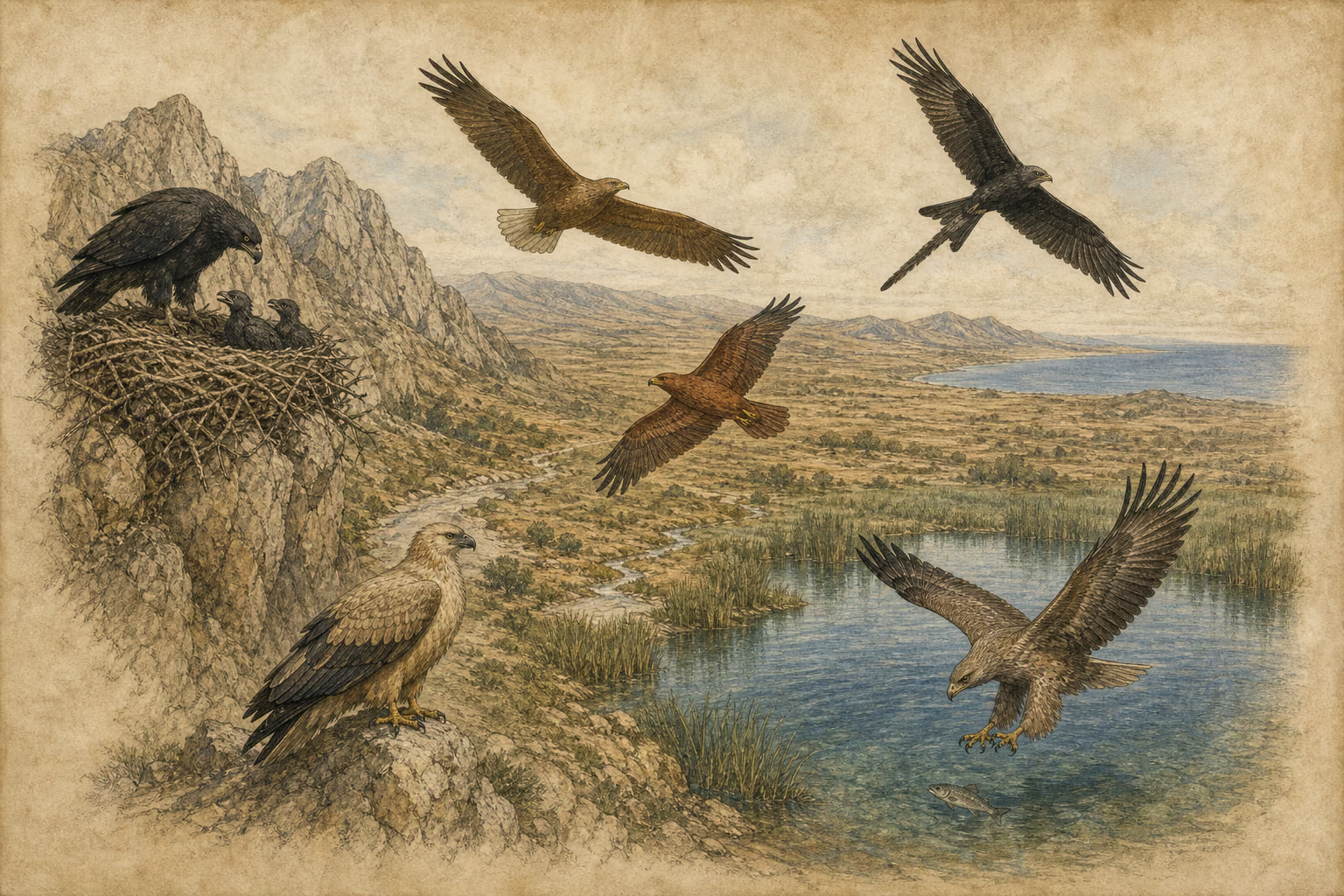
Ex his quas novimus aquilae maximus honos, maxima et vis. sex earum genera. Melanaë tos a Graecis dicta, eadem leporaria, minima magnitudine, viribus praecipua, colore nigricans, sola aquilarum fetus suos alit — ceterae, ut dicemus, fugant —, sola sine clangore, sine murmuratione. conversatur autem in montibus, secundi generis pygargus in oppidis et in campis, albicante cauda. tertii morphnos, quam Homerus et percnum vocat, aliqui et plangum et anatariam, secunda magnitudine et vi; huic vita circa lacus. Phemonoe, Apollinis dicta filia, dentes esse ei prodidit, mutae alias carentique lingua, eandem aquilarum nigerrimam, prominentiore cauda; consensit et Boeus. huius ingenium est et testudines raptas frangere e sublimi iaciendo, quae fors interemit poetam Aeschylum, praedictam fatis, ut ferunt, eius diei ruinam secura caeli fide caventem. quarti generis est percnopterus, eadem oripela rgus, vulturina specie, alis minimis, reliqua magnitudine antecellens, sed inbellis et degener, ut quam verberet corvus; eadem ieiunae semper aviditatis et querulae murmurationis. sola aquilarum exanima fert corpora; ceterae, cum occidere, considunt. haec facit, ut quintum genus γνήσιον vocetur velut verum solumque incorruptae originis, media magnitudine, colore subrutilo, rarum conspectu. superest haliaëtos, clarissima oculorum acie, librans ex alto sese visoque in mari pisce praeceps in eum ruens et discussis pectore aquis rapiens. illa, quam tertiam fecimus, aquaticas aves circa stagna adpetit mergentes se subinde, donec sopitas lassatasque rapiat. spectanda dimicatio, ave ad perfugia litorum tendente, maxime si condensa harundo sit, aquila inde ictu abigente alae et, cum adpetiit in lacu, scandente umbramque suam nanti sub aquam a litore ostendente, rursus ave in diverso et ubi minime se credat expectari emergente. haec causa gregatim avibus natandi, quia plures simul non infestantur respersu pinnarum occaecantes. saepe et aquilae ipsae, non tolerantes pondus adprehensum, una merguntur. haliaëtus tantum inplumes etiamnum pullos suos percutiens subinde cogit adversos intueri solis radios et, si coniventem umectantemque animadvertit, praecipitat e nido velut adulterinum atque degenerem. illum, cuius acies firma contra stetit, educat. haliaëti suum genus non habent, sed ex diverso aquilarum coitu nascuntur. id quidem, quod ex his natum est, in ossifragis genus habet, e quibus vultures minores progenerantur et ex his magni, qui omnino non generant. quidam adiciunt genus aquilae quam barbatam vocant, Tusci vero ossifragam.
Tribus primis et quinto aquilarum generi inaedificatur nido lapis aëtites, quem aliqui dixere gagiten, ad multa remedia utilis, nihil igne deperdens.— est autem lapis iste praegnans intus alio, cum quatias, velut in utero sonante.— sed vis illa medica non nisi nido dereptis. nidificant in petris et arboribus, pariunt et ova terna, excludunt pullos binos; visi sunt et tres aliquando. alterum expellunt taedio nutriendi. quippe eo tempore ipsis cibum negavit natura, prospiciens ne omnium ferarum fetus raperentur. ungues quoque earum invertuntur diebus his, albescunt inedia pinnae, ut merito partus suos oderint. sed eiectos ab iis cognatum genus ossifragi excipiunt et educant cum suis. verum adultos quoque persequitur parens et longe fugat, aemulos scilicet rapinae. et alioqui unum par aquilarum magno ad populandum tractu, ut satietur, indiget. determinant ergo spatia nec in proximo praedantur. rapta non protinus ferunt, sed primo deponunt expertaeque pondus tunc demum abeunt.— oppetunt non senio nec aegritudine, sed fame, in tantum superiore adcrescente rostro, ut aduncitas aperiri non queat.— a meridiano autem tempore operantur et volant; prioribus horis diei, donec impleantur hominum conventu fora, ignavae sedent. aquilarum pinnae mixtas reliquarum alitum pinnas devorant. negant umquam solam hanc alitem fulmine exanimatam; ideo armigeram Iovis consuetudo iudicavit.
English · Bostock & Riley 1855–57
Of all the birds with which we are acquainted, the eagle is looked upon as the most noble, and the most remarkable for its strength. There are six different kinds; the one called “melanaetos” by the Greeks, and “valeria” in our language, the least in size of them all, but the most remarkable for its strength, is of a blackish colour. It is the only one among all the eagles that feeds its young; for the others, as we shall mention just now, drive them away; it is the only one too that has neither cry nor murmur; it is an inhabitant of the mountains. The second kind is the pygargus, an inhabitant of the cities and plains, and distinguished by the whiteness of its tail. The third is the morphnos, which Homer also calls the “percnos,” while others, again, call it the “plangus” and the “anataria;” it is the second in size and strength, and dwells in the vicinity of lakes. Phemonoë, who was styled the “daughter of Apollo,” has stated that this eagle has teeth, but that it has neither voice nor tongue; she says also that it is the blackest of all the eagles, and has a longer tail than the rest; Bœus is of the same opinion. This eagle has the instinct to break the shell of the tortoise by letting it fall from aloft, a circumstance which caused the death of the poet Æschylus. An oracle, it is said, had predicted his death on that day by the fall of a house, upon which he took the precaution of trusting himself only under the canopy of the heavens.
The fourth kind of eagle is the “percnopterus,” also called the “oripelargus;” it has much the appearance of the vulture, with remarkably small wings, while the rest of the body is larger than the others; but it is of a timid and degenerate nature, so much so, that even a raven can beat it. It is always famishing and ravenous, and has a plaintive murmuring cry. It is the only one among the eagles that will carry off the dead carcase; the others settle on the spot where they have killed their prey. The character of this species causes the fifth one to be known by the distinctive name of “gnesios,” as being the genuine eagle, and the only one of untainted lineage; it is of moderate size, of rather reddish colour, and rarely to be met with. The haliætus is the last, and is remarkable for its bright and piercing eye. It poises itself aloft, and the moment it catches sight of a fish in the sea below, pounces headlong upon it, and cleaving the water with its breast, carries off its prey.
The eagle which we have mentioned as forming the third species, pursues the aquatic birds in the vicinity of standing waters: in order to make their escape they plunge into the water every now and then, until at length they are overtaken by lassitude and sleep, upon which the eagle immediately seizes them. The contest that takes place is really a sight worthy to be seen. The bird makes for the shore to seek a refuge, and especially if there should happen to be a bed of reeds there; while in the meantime the eagle endeavours to drive it away with repeated blows of its wings, and tumbles into the water in its attempts to seize it. While it is standing on the shore its shadow is seen by the bird, which immediately dives beneath, and then making its way in an opposite direction, emerges at some point at which it thinks it is the least likely to be looked for. This is the reason why these birds swim in flocks, for when in large numbers they are in no danger from the enemy; as by dashing up the spray with their wings they blind him.
Again, it often happens that the eagle is not able to carry the bird aloft on account of its weight, and in consequence they both of them sink together. The haliætus, and this one only, beats its young ones while in an unfledged state, with its wings, and forces them from time to time to look steadily upon the rays of the sun; and if it sees either of them wink, or even its eye water, it throws it headlong out of the nest, as being spurious and degenerate, while, on the other hand, it rears the one whose gaze remains fixed and steady. The haliætus is not a species of itself, but is an eagle of mixed breed: hence their produce are of the species known as the ossifrage, from which again is produced the smaller vulture; while this in its turn produces the large vulture, which, however, is quite barren.
Some writers add to the above a seventh kind, which they call the “bearded” eagle; the Tuscans, however, call it the ossifrage.
The first three and the fifth class of eagles employ in the construction of their aerie the stone aëtites, by some known as “gangites;” which is employed also for many remedial purposes, and is proof against the action of fire. This stone has the quality also, in a manner, of being pregnant, for when shaken, another stone is heard to rattle within, just as though it were enclosed in its womb; it has no medical properties, however, except immediately after it has been taken from the nest.
Eagles build among rocks and trees; they lay three eggs, and generally hatch but two young ones, though occasionally as many as three have been seen. Being weary of the trouble of rearing both, they drive one of them from the nest: for just at this time the providential foresight of Nature has denied them a sufficiency of food, thereby using due precaution that the young of all the other animals should not become their prey. During this period, also, their talons become reversed, and their feathers grow white from continued hunger, so that it is not to be wondered at that they take a dislike to their young. The ossifrage, however, a kindred species, takes charge of the young ones thus rejected, and rears them with its own; but the parent bird still pursues them with hostility, even when grown up, and drives them away, as being its rivals in rapine. And indeed, under any circumstances, one pair of eagles requires a very considerable space of ground to forage over, in order to find sufficient sustenance; for which reason it is that they mark out by boundaries their respective allotments, and seek their prey in succession to one another. They do not immediately carry off their prey, but first deposit it on the ground, and it is only after they have tested its weight that they fly away with it.
They die, not of old age, nor yet of sickness, or of hunger; but the upper part of the beak grows to such an extent, and becomes so curved, that they are unable to open it. They take the wing, and begin upon the labours of the chase at mid-day; sitting in idleness during the hours of the morning, until such time as the places of public resort are filled with people. The feathers of the eagle, if mixed with those of other birds, will consume them. It is said that this is the only bird that has never been killed by lightning; hence it is, that usage has pronounced it to be the armour-bearer of Jove.