LIBER XI · CAPUT 16
THE REPRODUCTION OF BEES
Latine · Mayhoff 1906
Tertium genus mellis minime probatum silvestre, quod ericaeum vocant. convehitur post primos autumni imbres, cum erice sola floret in silvis, ob id harenoso simile. gignit id maxime arcturi exortus ex a. d. pr. id. Septembres. quidam aestivam mellationem ad arcturi exortum proferunt, quoniam ad aequinoctium autumni ab eo supersint dies XIIII, et ab aequinoctio ad vergiliarum occasum diebus XXXXVIII plurima sit erice. Athenienses eam tetralicen appellant, Euboea sisyrum, putantque apibus esse gratissimam, fortassis quia tune nulla alia sit copia. haec ergo mellatio fine vindemiae et vergiliarum occasu idibus Novembribus fere includitur. relinqui ex ea duas partes apibus ratio persuadet, et semper eas partes favorum, quae habeant erithacen. a bruma ad arcturi exortum diebus LX somno aluntur sine ullo cibo. ab arcturi exortu ad aequinoctium vernum tepidiore tractu iam vigilant, sed etiamnum alvo se continent servatosque in id tempus cibos repetunt. in Italia vero hoc idem a vergiliarum exortu faciunt et in eum dormiunt. alvos quidam in eximendo melle expendunt, ita diribentes quantum relinquant. aequitas quidem etiam in iis obstringitur, feruntque societate fraudata alvos mori. in primis ergo praecipitur, lauti ut purique eximant mella. faetorem mulierumque menses odere. cum eximantur mella, apes abigi fumo utilissimum, ne irascantur aut ipsae avide vorent. fumo crebriore et ignavia earum excitatur ad opera, nam nisi incubavere, favos lividos faciunt. rursus fumo nimio inficiuntur, quando iniuriam celerrime sentiunt mella, vel minimo contactu roris acescentia. et ob id inter genera servatur quod acapnum vocant.
Fetus quonam modo progenerarent, magna inter eruditos et subtilis fuit quaestio. apium enim coitus visus est numquam. plures existimavere ore confingi floribus compositas apte atque utiliter; aliqui coitu unius, qui rex in quoque appelletur examine: hunc esse solum marem, praecipua magnitudine, ne fatiscat; ideo fetum sine eo non edi, apesque reliquas tamquam marem feminas comitari, non tamquam ducem. quam probabilem alias sententiam fucorum proventus coarguit. quae enim ratio, ut idem coitus inperfectos generet alios? propior vero prior existimatio fieret, ni rursus alia difficultas occurreret. quippe nascuntur aliquando in extremis favis apes grandiores, quae ceteras fugant. oestrus vocatur hoc malum, quonam modo nascens, si ipsae fingunt? quod certum est, gallinarum modo incubant. id, quod exclusum est, primo vermiculus videtur candidus, iacens transversus adhaerensque ita ut pars cerae videatur. rex statim mellei coloris, ut electo flore ex omni copia factus, neque vermiculus, sed statim pinniger. cetera turba cum formam capere coepit, nymphae vocantur, ut fuci serenes aut cephenes. si quis alterutris capita demat prius quam pinnas habeant, pro gratissimo sunt pabulo matribus. tempore procedente instillant cibos atque incubant, tum maxime murmurantes, caloris, ut putant, faciendi gratia necessarii excludendis pullis, donec ruptis membranis, quae singulos cingunt, ovorum modo universum agmen emergat. spectatum hoc Romae consularis cuiusdam surburbano, alvis cornu lanternae tralucido factis. fetus intra XLV diem peragitur. fit in favis quibusdam qui vocatur clavus, amarae duritia cerae, cum fetum inde non eduxere morbo aut ignavia aut infecunditate naturali; hic est abortus apium. protinus autem educti operantur quadam disciplina cum matribus, regemque iuvenem aequalis turba comitatur. reges plures inchoantur, ne desint. postea ex his suboles cum adulta esse coepit, concordi suffragio deterrimos necant, ne distrahant agmina. duo autem genera eorum: melior rufus, deterior niger variusque. omnibus forma semper egregia et duplo quam ceteris maior, pinnae breviores, crura recta, ingressus celsior, in fronte macula quodam diademate candicans. multum etiam nitore a volgo differunt.
English · Bostock & Riley 1855–57
The third kind of honey, which is the least esteemed of all, is the wild honey, known by the name of ericæum. It is collected by the bees after the first showers of autumn, when the heather alone is blooming in the woods, from which circumstance it derives its sandy appearance. It is mostly produced at the rising of Arcturus, beginning at the day before the ides of September. Some persons delay the gathering of the summer honey until the rising of Arcturus, because from then till the autumnal equinox there are fourteen days left, and it is from the equinox till the setting of the Vergiliæ, a period of forty-eight days, that the heather is in the greatest abundance. The Athenians call this plant by the name of tetralix, and the Eubœans sisirum, and they look upon it as affording great pleasure to the bees to browse upon, probably because there are no other flowers for them to resort to. This gathering terminates at the end of the vintage and the setting of the Vergiliæ, mostly about the ides of November. Experience teaches us that we ought to leave for the bees two-thirds of this crop, and always that part of the combs as well, which contains the bee-bread.
From the winter solstice to the rising of Arcturus the bees are buried in sleep for sixty days, and live without any nourishment. Between the rising of Arcturus and the vernal equinox, they awake in the warmer climates, but even then they still keep within the hives, and have recourse to the provisions kept in reserve for this period. In Italy, however, they do this immediately after the rising of the Vergiliæ, up to which period they are asleep. Some persons, when they take the honey, weigh the hive and all, and remove just as much as they leave: a due sense of equity should always be stringently observed in dealing with them, and it is generally stated that if imposed upon in this division, the swarm will die of grief. It is particularly recommended also that the person who takes the honey should be well washed and clean: bees have a particular aversion, too, to a thief and a menstruous woman. When the honey is taken, it is the best plan to drive away the bees by means of smoke, lest they should become irritated, or else devour the honey themselves. By often applying smoke, too, they are aroused from their idleness to work; but if they have not duly incubated in the comb, it is apt to become of a livid colour. On the other hand, if they are smoked too often, they will become tainted; the honey, too, a substance which turns sour at the very slightest contact with dew, will very quickly receive injury from the taint thus contracted: hence it is that among the various kinds of honey which are preserved, there is one which is known by the name of acapnon.
How bees generate their young has been a subject of great and subtle research among the learned; seeing that no one has ever witnessed any sexual intercourse among these insects. Many persons have expressed an opinion that they must be produced from flowers, aptly and artistically arranged by Nature; while others, again, suppose that they are produced from an intercourse with the one which is to be found in every swarm, and is usually called the king. This one, they say, is the only male in the hive, and is endowed with such extraordinary proportions, that it may not become exhausted in the performance of its duties. Hence it is, that no offspring can be produced without it, all the other bees being females, and attending it in its capacity of a male, and not as their leader. This opinion, however, which is otherwise not improbable, is sufficiently refuted by the generation of the drones. For on what grounds could it possibly happen that the same intercourse should produce an offspring part of which is perfect, and part in an imperfect state? The first surmise which I have mentioned would appear, indeed, to be much nearer the truth, were it not the case that here another difficulty meets us—the circumstance that sometimes, at the extremity of the combs, there are produced bees of a larger size, which put the others to flight. This noxious bee bears the name of œstrus, and how is it possible that it should ever be produced, if it is the fact that the bees themselves form their progeny?
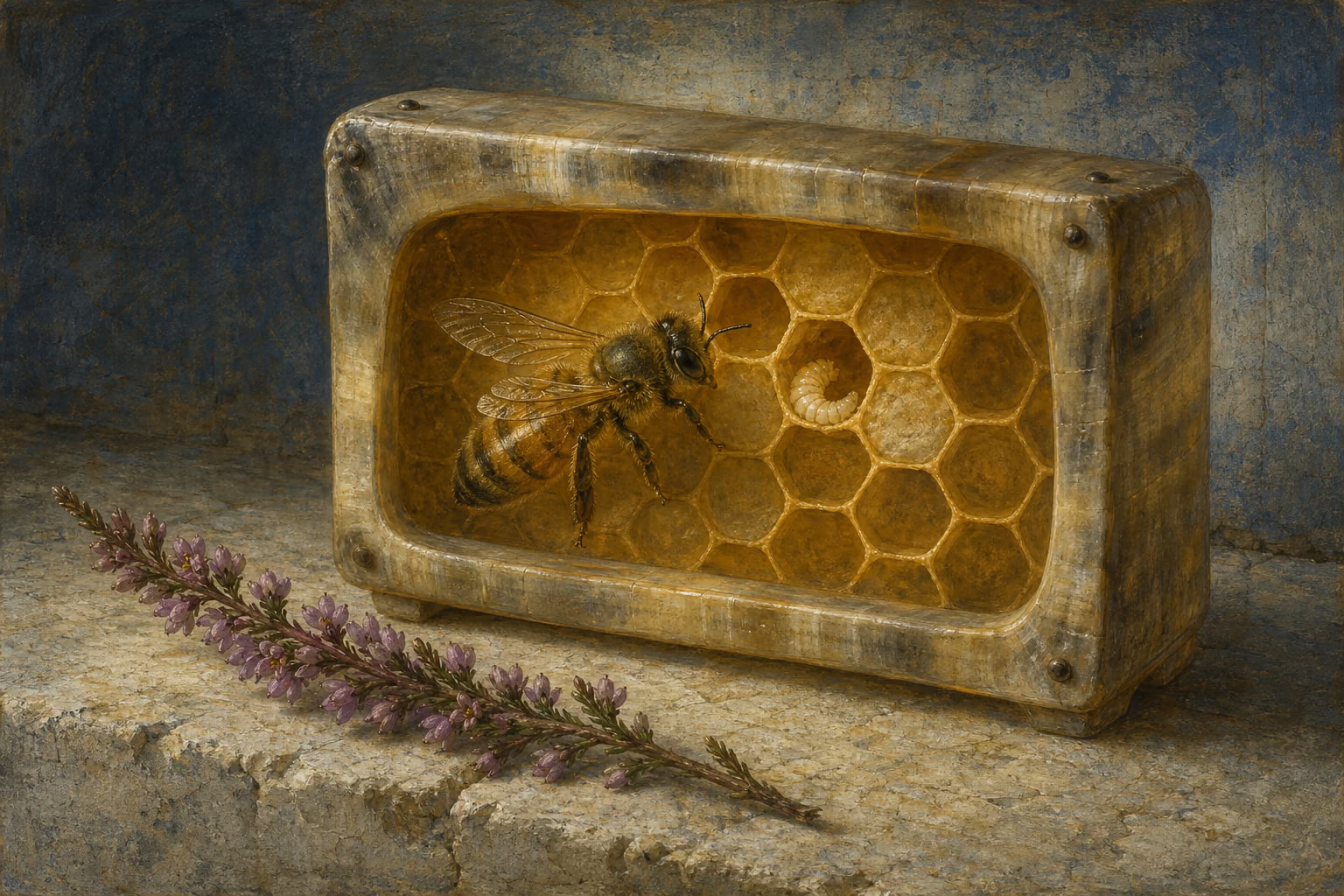
A fact, however, that is well ascertained, is, that bees sit, like the domestic fowl, that which is hatched by them at first having the appearance of a white maggot, and lying across and adhering so tenaciously to the wax as to seem to be part of it. The king, however, from the earliest moment, is of the colour of honey, just as though he were made of the choicest flowers, nor has he at any time the form of a grub, but from the very first is provided with wings. The rest of the bees, as soon as they begin to assume a shape, have the name of nymphæ, while the drones are called sirenes, or cephenes. If a person takes off the head of either kind before the wings are formed, the rest of the body is considered a most choice morsel by the parents. In process of time the parent bees instil nutriment into them, and sit upon them, making on this occasion a loud humming noise, for the purpose, it is generally supposed, of generating that warmth which is so requisite for hatching the young. At length the membrane in which each of them is enveloped, as though it lay in an egg, bursts asunder, and the whole swarm comes to light.
This circumstance was witnessed at the suburban retreat of a man of consular dignity near Rome, whose hives were made of transparent lantern horn: the young were found to be developed in the space of forty-five days. In some combs, there is found what is known by the name of “nail” wax; it is bitter and hard, and is only met with when the bees have failed to hatch their young, either from disease or a natural sterility, it is the abortion, in fact, of the bees. The young ones, the moment they are hatched, commence working with their parents, as though in a course of training, and the newly-born king is accompanied by a multitude of his own age.
That the supply may not run short, each swarm rears several kings; but afterwards, when this progeny begins to arrive at a mature age, with one accord they put to death the inferior ones, lest they should create discord in the swarm. There are two sorts of king bees; those of a reddish colour are better than the black and mottled ones. The kings have always a peculiar form of their own, and are double the size of any of the rest; their wings are shorter than those of the others, their legs are straight, their walk more upright, and they have a white spot on the forehead, which bears some resemblance to a diadem: they differ, too, very much from the rest of the community, in their bright and shining appearance.