LIBER XI · CAPUT 17
THE MODE OF GOVERNMENT OF THE BEES
Latine · Mayhoff 1906
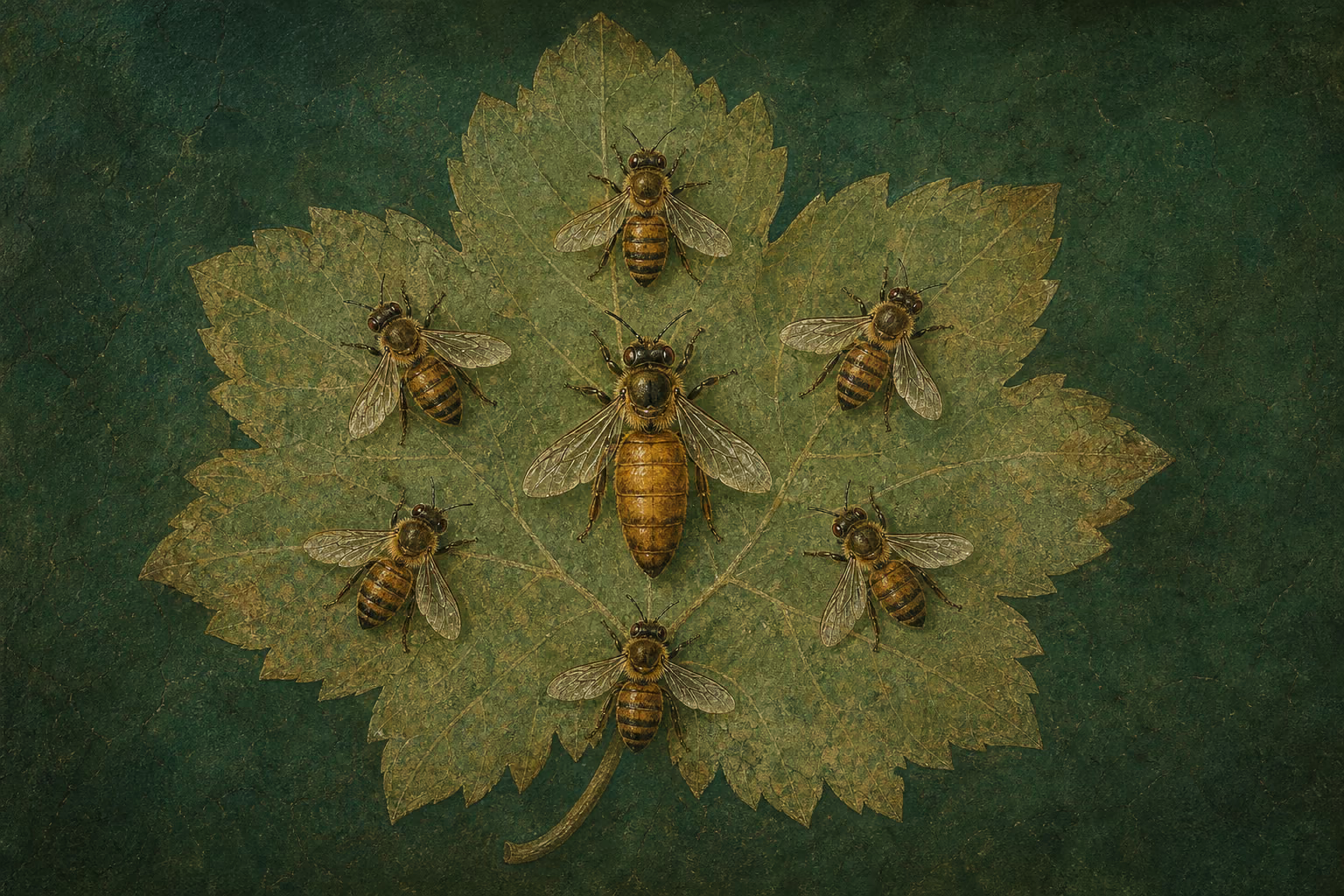
Quaerat nunc aliquis, unusne Hercules fuerit et quot Liberi patres, et reliqua vetustatis situ obruta! ecce in re parva villisque nostris adnexa, cuius adsidue copia est, non constat inter auctores, rex nullumne solus habeat aculeum, maiestate tantum armatus, an dederit quidem eum natura, sed usum eius illi tantum negaverit. illud constat, imperatorem aculeo non uti. mira plebei circa eum obedientia. cum procedit, una est totum examen circaque eum globatur, cingit, protegit, cerni non patitur. reliquo tempore, cum populus in labore est, ipse opera intus circumit, similis exhortanti, solus inmunis. circa eum satellites quidam lictoresque, adsidui custodes auctoritatis. procedit foris non nisi migraturo examine. id multo intellegitur ante, aliquot diebus murmure intus strepente, apparatus indice diem tempestivum eligentium. si quis alam ei detruncet, non fugiat examen. cum processere, se quaeque proximam illi cupit esse, in officio conspici gaudet. fessum umeris sublevant, validius fatigatum ex toto portant. si qua lassata defecit aut forte aberravit, odore persequitur. ubicumque ille consedit, ibi cunctarum castra sunt.
Tunc ostenta faciunt privata ac publica, uva dependente in domibus templisque, saepe expiata magnis eventibus. sedere in ore infantis tum etiam Platonis, suavitatem illam praedulcis eloquii portendentes. sedere in castris Drusi imperatoris, cum prosperrime pugnatum apud Arbalonem est, hautquaquam perpetua haruspicum coniectura, qui dirum id ostentum existimant semper. duce prenso totum tenetur agmen, amisso dilabitur migratque ad alios. esse utique sine rege non possunt. invitae autem interemunt eos, cum plures fuere, potiusque nascentium domos diruunt, si proventus desperatur. tunc et fucos abigunt. quamquam et de his video dubitari propriumque iis genus esse aliquos existimare, sicut furibus, grandissimis inter illos, sed nigris lataque alvo, ita appellatis, quia furtim devorent mella. certum est ab apibus fucos interfici. utique regem non habent. et quo modo sine aculeo nascantur in quaestione est.
Vmido vere melior fetus, sicco mel copiosius; quod si defecit aliquas alvos cibus, impetum in proximas faciunt rapinae proposito. at illae contra derigunt aciem et, si custos adsit, alterutra pars, quae sibi favere sensit, non adpetit eum. ex aliis quoque saepe dimicant causis duasque acies contrarias duosque imperatores instruunt, maxime rixa in convehendis floribus exserta et suos quibusque evocantibus, quae dimicatio iniectu pulveris aut fumo tota discutitur, reconciliatur vero lacte vel aqua mulsa.
English · Bostock & Riley 1855–57
Let a man employ himself, forsooth, in the enquiry whether there has been only one Hercules, how many fathers Liber there have been, and all the other questions which are buried deep in the mould of antiquity! Here behold a tiny object, one to be met with at most of our country retreats, and numbers of which are always at hand, and yet, after all, it is not agreed among authors whether or not the king is the only one among them that is provided with no sting, and is possessed of no other arms than those afforded him by his majestic office, or whether Nature has granted him a sting, and has only denied him the power of making use of it; it being a well-known fact, that the ruling bee never does use a sting. The obedience which his subjects manifest in his presence is quite surprising. When he goes forth, the whole swarm attends him, throngs about him, surrounds him, protects him, and will not allow him to be seen. At other times, when the swarm is at work within, the king is seen to visit the works, and appears to be giving his encouragement, being himself the only one that is exempt from work: around him are certain other bees which act as body-guards and lictors, the careful guardians of his authority. The king never quits the hive except when the swarm is about to depart; a thing which may be known a long time beforehand, as for some days a peculiar buzzing noise is to be heard within, which denotes that the bees are waiting for a favourable day, and making all due preparations for their departure. On such an occasion, if care is taken to deprive the king of one of his wings, the swarm will not fly away. When they are on the wing, every one is anxious to be near him, and takes a pleasure in being seen in the performance of its duty. When he is weary, they support him on their shoulders; and when he is quite tired, they carry him outright. If one of them falls in the rear from weariness, or happens to go astray, it is able to follow the others by the aid of its acuteness of smell. Wherever the king bee happens to settle, that becomes the encampment of all.
And then, too, it is that they afford presages both of private and public interest, clustering, as they do, like a bunch of grapes, upon houses or temples; presages, in fact, that are often accounted for by great events. Bees settled upon the lips of Plato when still an infant even, announcing thereby the sweetness of that persuasive eloquence for which he was so noted. Bees settled, too, in the camp of the chieftain Drusus when he gained the brilliant victory at Arbalo; a proof, indeed, that the conjectures of soothsayers are not by any means infallible, seeing that they are of opinion that this is always of evil augury. When their leader is withheld from them, the swarm can always be detained; and when lost, it will disperse and take its departure to find other kings. Without a king, in fact, they cannot exist, and it is with the greatest reluctance that they put them to death when there are several; they prefer, too, to destroy the cells of the young ones, if they find reason to despair of providing food; in such case they then expel the drones. And yet, with regard to the last, I find that some doubts are entertained; and that there are some authors who are of opinion that they form a peculiar species, like that bee, the very largest among them all, which is known by the name of the “thief,” because it furtively devours the honey; it is distinguished by its black colour and the largeness of its body. It is a well-known fact, however, that the bees are in the habit of killing the drones. These last have no king of their own; but how it is that they are produced without a sting, is a matter still undetermined.
In a wet spring the young swarms are more numerous; in a dry one the honey is most abundant. If food happens to fail the inhabitants of any particular hive, the swarm makes a concerted attack upon a neighbouring one, with the view of plundering it. The swarm that is thus attacked, at once ranges itself in battle array, and if the bee-keeper should happen to be present, that side which perceives itself favoured by him will refrain from attacking him. They often fight, too, for other reasons as well, and the two generals are to be seen drawing up their ranks in battle array against their opponents. The dispute generally arises in culling from the flowers, when each, the moment that it is in danger, summons its companions to its aid. The battle, however, is immediately put an end to by throwing dust among them, or raising a smoke; and if milk or honey mixed with water is placed before them, they speedily become reconciled.