LIBER XI · CAPUT 24
SPIDERS; THE KINDS THAT MAKE WEBS; THE MATERIALS USED BY THEM IN SO DOING
Latine · Mayhoff 1906
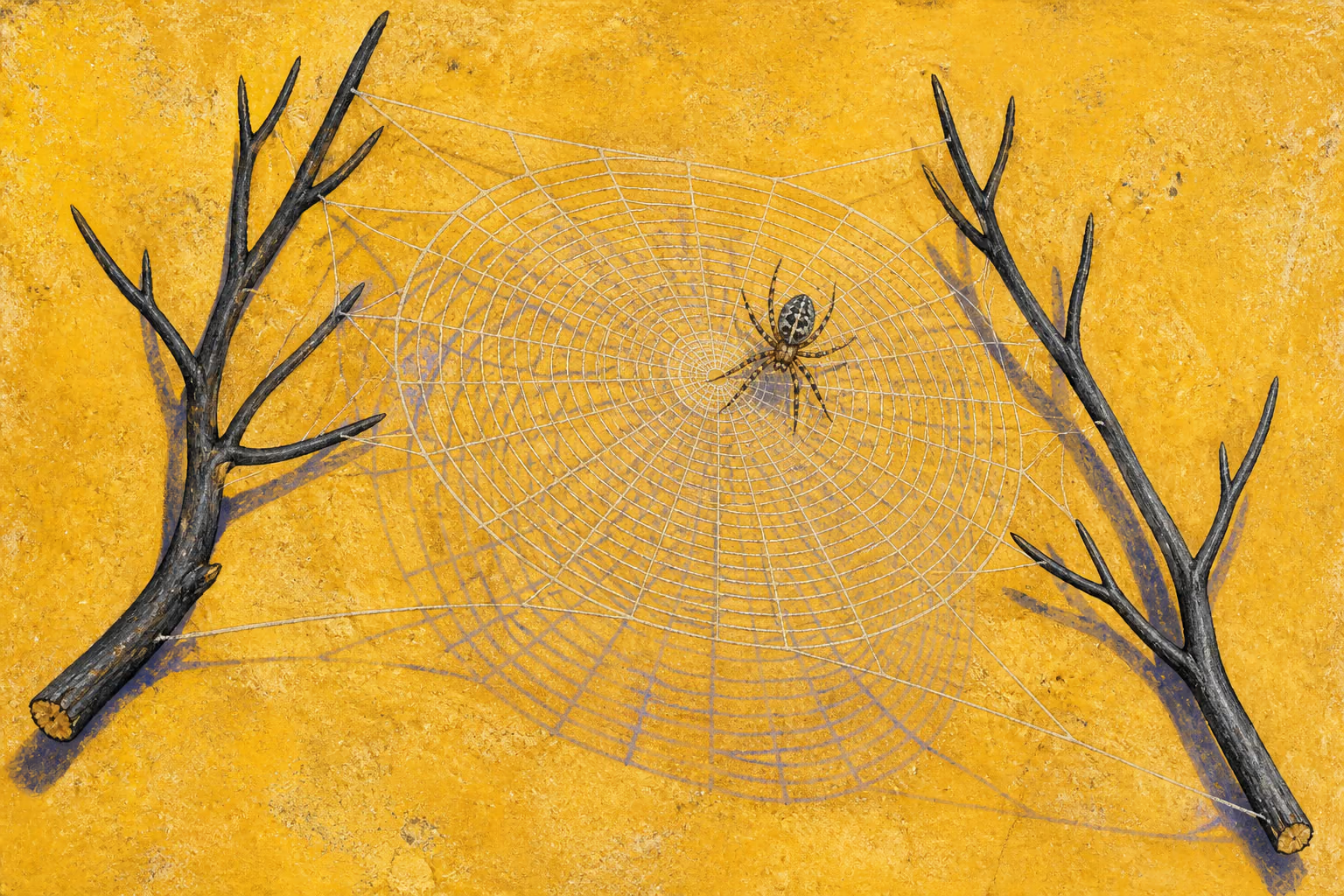
Araneorum his non absurde iungatur natura, digna vel praecipua admiratione. plura autem sunt genera nec dictu necessaria in tanta notitia. phalangia ex iis appellantur quorum noxii morsus, corpus exiguum, varium, acuminatum, adsultim ingredientium. altera eorum species nigri, prioribus cruribus longissimis. omnibus internodia terna in cruribus. luporum minimi non texunt, maiores in terra, et cavernis exigua vestibula praepandunt. tertium eorundem genus erudita operatione conspicuum. orditur telas tantique operis materiae uterus ipsius sufficit, sive ita corrupta alvi natura stato tempore, ut Democrito placet, sive est quaedam intus lanigera fertilitas: tam moderato ungue, tam tereti filo et tam aequali deducit stamina, ipso se pondere usus. texere a medio incipit, circinato orbe subtemina adnectens, maculasque paribus semper intervallis, sed subinde crescentibus ex angusto dilatans indissolubili nodo inplicat. quanta arte celat pedicas a scutulato rete grassantes! quam non ad hoc videtur pertinere crebratae pexitas telae et quadam politurae arte ipsa per se tenax ratio tramae! quam laxus ad flatus ac non respuenda quae veniant sinus! derelicta lasso praetendi summa parte arbitrere licia: at illa difficile cernuntur atque, ut in plagis, lineae offensae praecipitant in sinum. specus ipse qua concamaratur architectura! et contra frigora quanto villosior! quam remotus a medio aliudque agenti similis, inclusus vero sic, ut sit necne intus aliquis cerni non possit! age firmitas, quando rumpentibus ventis, qua pulverum mole degravante! latitudo telae saepe inter duas arbores, cum exercet artem et discit texere, longitudo fili a cacumine ac rursus a terra per illud ipsum velox reciprocatio, subitque pariter ac fila deducit. cum vero captura incidit, quam vigilans et paratus accursus! licet extrema haereat plaga, semper in medium currit, quia sic maxime totum concutiendo inplicat. scissa protinus reficit ad polituram sarciens. namque et lacertarum catulos venantur, os primum tela involventes et tunc demum labra utraque morsu adprehendentes, amphitheatrali spectaculo, cum contigit. sunt ex eo et auguria. quippe incremento amnium futuro telas suas altius tollunt. iidem sereno texunt, nubilo retexunt, ideoque multa aranea imbrium signa sunt. feminam putant esse quae texat, marem qui venetur; ita paria fieri merita coniugio.
Aranei conveniunt clunibus, pariunt vermiculos ovis similes: nam nec horum differri potest genitura, quoniam insectorum vix ulla alia ratio est. pariunt autem om nia in tela, set sparsa, quia saliunt atque ita emittunt. phalangia tantum in ipso specu incubant magnum numerum, qui, ut emersit, matrem consumit, saepe et patrem; adiuvat enim incubare. pariunt autem et trecenos — ceterae pauciores —et incubant triduo. consummantur aranei quater septenis diebus.
English · Bostock & Riley 1855–57
It is by no means an absurdity to append to the silk-worm an account of the spider, a creature which is worthy of our especial admiration. There are numerous kinds of spiders, however, which it will not be necessary here to mention, from the fact of their being so well known. Those that bear the name of phalangium are of small size, with bodies spotted and running to a point; their bite is venomous, and they leap as they move from place to place. Another kind, again, is black, and the fore-legs are remarkable for their length. They have all of them three joints in the legs. The smaller kind of wolf-spider does not make a web, but the larger ones make their holes in the earth, and spread their nets at the narrow entrance thereof. A third kind, again, is remarkable for the skill which it displays in its operations. These spin a large web, and the abdomen suffices to supply the material for so extensive a work, whether it is that, at stated periods the excrements are largely secreted in the abdomen, as Democritus thinks, or that the creature has in itself a certain faculty of secreting a peculiar sort of woolly substance. How steadily does it work with its claws, how beautifully rounded and how equal are the threads as it forms its web, while it employs the weight of its body as an equipoise! It begins at the middle to weave its web, and then extends it by adding the threads in rings around, like a warp upon the woof: forming the meshes at equal intervals, but continually enlarging them as the web increases in breadth, it finally unites them all by an indissoluble knot. With what wondrous art does it conceal the snares that lie in wait for its prey in its checkered nettings! How little, too, would it seem that there is any such trap laid in the compactness of its web and the tenacious texture of the woof, which would appear of itself to be finished and arranged by the exercise of the very highest art! How loose, too, is the body of the web as it yields to the blasts, and how readily does it catch all objects which come in its way! You would fancy that it had left, quite exhausted, the thrums of the upper portion of its net unfinished where they are spread across; it is with the greatest difficulty that they are to be perceived, and yet the moment that an object touches them, like the lines of the hunter’s net, they throw it into the body of the web. With what architectural skill, too, is its hole arched over, and how well defended by a nap of extra thickness against the cold! How carefully, too, it retires into a corner, and appears intent upon anything but what it really is, all the while that it is so carefully shut up from view, that it is impossible to perceive whether there is anything within or not! And then too, how extraordinary the strength of the web! When is the wind ever known to break it, or what accumulation of dust is able to weigh it down?
The spider often spreads its web right across between two trees, when plying its art and learning how to spin; and then, as to its length, the thread extends from the very top of the tree to the ground, while the insect springs up again in an instant from the earth, and travels aloft by the very self-same thread, thus mounting at the same moment and spinning its threads. When its prey falls into its net, how on the alert it is, and with what readiness it runs to seize it! Even though it should be adhering to the very edge of its web, the insect always runs instantly to the middle, as it is by these means that it can most effectually shake the web, and so successfully entangle its prey. When the web is torn, the spider immediately sets about repairing it, and that so neatly, that nothing like patching can ever be seen. The spider lies in wait even for the young of the lizard, and after enveloping the head of the animal, bites its lips; a sight by no means unworthy of the amphitheatre itself, when it is one’s good fortune to witness it. Presages also are drawn from the spider; for when a river is about to swell, it will suspend its web higher than usual. In calm weather these insects do not spin, but when it is cloudy they do, and hence it is, that a great number of cobwebs is a sure sign of showery weather. It is generally supposed that it is the female spider that spins, and the male that lies in wait for prey, thus making an equal division of their duties.
Spiders couple backwards, and produce maggots like eggs; for I ought not to defer making some mention of this subject, seeing, in fact, that of most insects there is hardly anything else to be said. All these eggs they lay in their webs, but scattered about, as they leap from place to place while laying them. The phalangium is the only spider that lays a considerable number of them, in a hole; and as soon as ever the progeny is hatched it devours its mother, and very often the male parent as well, for that, too, aids in the process of incubation. These last produce as many as three hundred eggs, the others a smaller number. Spiders take three days to hatch their eggs. They come to their full growth in twenty-eight days.