LIBER XI · CAPUT 51
THE DIFFERENT VOICES OF ANIMALS
Latine · Mayhoff 1906
Vocem non habere nisi quae pulmonem et arterias habeant, hoc est nisi quae spirent, Aristoteles putat. idcirco et insectis sonum esse, non vocem, intus inmeante spiritu et incluso sonante; alia murmur edere, ut apes, alia contractum stridorem, ut cicadas, receptum enim duobus sub pectore cavis spiritum, mobili occursante membrana intus, attritu eius sonare. muscas, apes, cetera similia cum volatu et incipere audiri et desinere, sonum enim attritu et interiore aura, non anima, reddi; locustas pinnarum et feminum attritu sonare. credatur sane item aquatilium pectines stridere, cum volant, mollia et crusta intecta nec vocem nec sonum ullum habere: sed ceteri pisces, quamvis pulmone et arteria careant, non in totum sine ullo sunt sono — stridorem eum dentibus fieri cavillantur —, et is, qui caper vocatur in Acheloo amne, grunnitum habet et alii, de quibus diximus. ova parientibus si- bilus, serpentibus longus, testudini abruptus. ranis sui generis, ut dictum est, nisi si et in his ferenda dubitatio est, quia vox in ore concipitur, non in pectore. multum tamen in his refert et locorum natura: mutae in Macedonia traduntur, muti et apri. avium loquaciores quae minores, et circa coitus maxime: aliis in pugna vox, ut coturnicibus, aliis ante pugnam, ut perdicibus, aliis cum vicere, ut gallinaceis. isdem sua maribus, aliis eadem et feminis, ut lusciniarum generi. quaedam toto anno canunt, quaedam certis temporibus, ut in singulis dictum est. elephans citra nares ore ipso sternumento similem elidit sonum, per nares autem turbarum raucitati. bubus tantum feminis vox gravior, in alio omni genere exilior quam maribus, in homine etiam castratis. infantis in nascendo nulla auditur ante quam totus emergat utero. primus sermo anniculo; set semenstris locutus est Croesi filius et in crepundiis prodigio, quo totum id concidit regnum. qui celerius fari coepere, tardius ingredi incipiunt. vox roboratur a XIIII annis; eadem in senecta exilior, neque in alio animalium saepius mutatur.
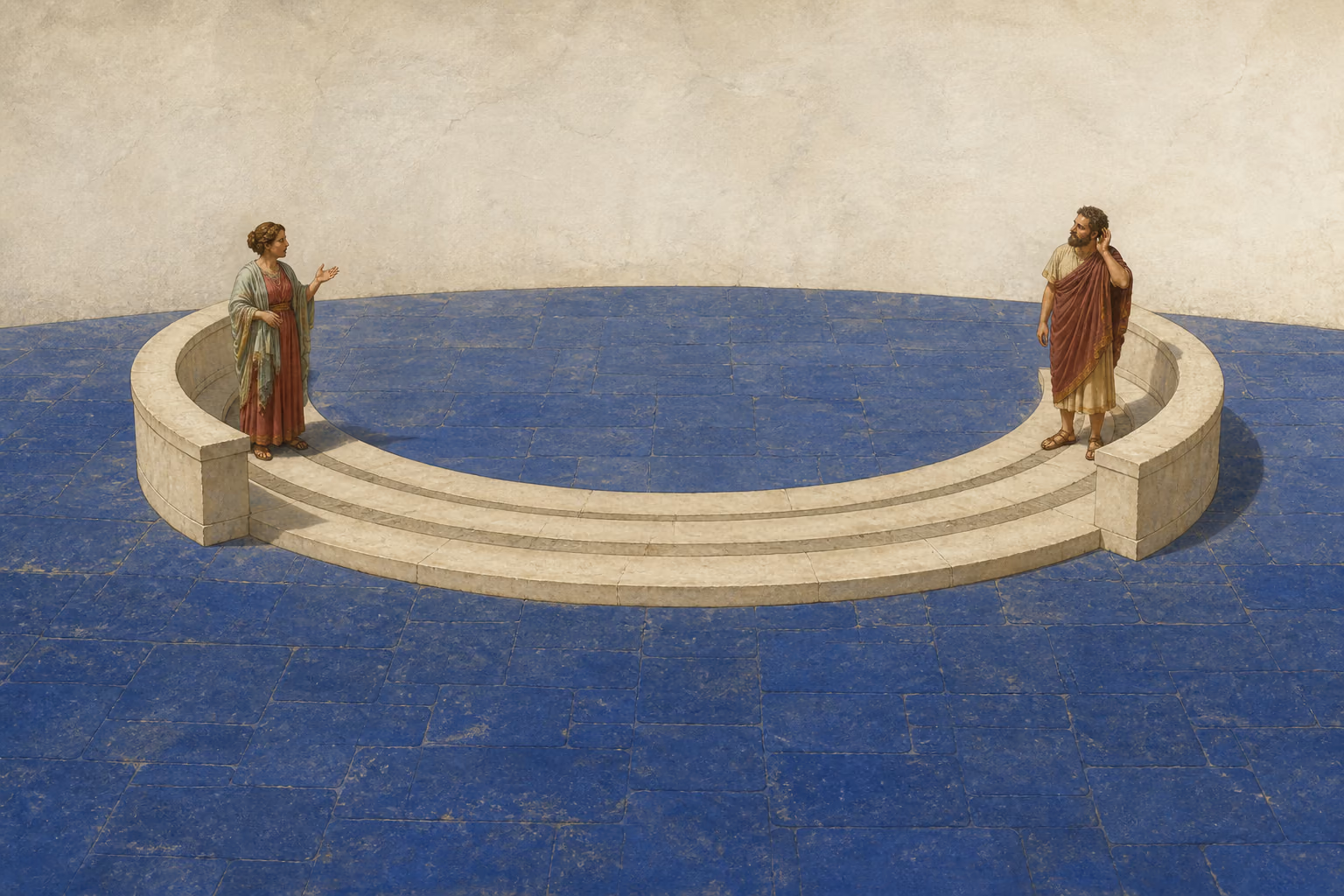
Mira praeterea sunt de voce digna dictu: theatrorum in orchestris scobe aut harena superiacta devoratur, item rudi parietum circumiectu, doliis etiam inanibus. currit eadem recto vel conchato parietum spatio, quamvis levi sono dicta verba ad alterum caput perferens, si nulla inaequalitas impediat. vox in homine magnam voltus habet partem. adgnoscimus ea prius qua cernamus non aliter quam oculis, totidemque sunt hae, quot in rerum natura mortales, et sua cuique sicut facies. hinc illa gentium totque linguarum toto orbe diversitas, hinc tot cantus et moduli flexionesque, sed ante omnia explanatio animi, quae nos distinxit a feris et inter ipsos quoque homines discrimen alterum, aeque quam a beluis, fecit.
English · Bostock & Riley 1855–57
Aristotle is of opinion that no animal has a voice which does not respire, and that hence it is that there is no voice in insects, but only a noise, through the circulation of the air in the interior, and its resounding, by reason of its compression. Some insects, again, he says, emit a sort of humming noise, such as the bee, for instance; others a shrill, long-drawn note, like the grasshopper, the two cavities beneath the thorax receiving the air, which, meeting a moveable membrane within, emits a sound by the attrition.—Also that flies, bees, and other insects of that nature, are only heard while they are flying, and cease to be heard the moment they settle, and that the sound which they emit proceeds from the friction and the air within them, and not from any act of respiration. At all events, it is generally believed that the locust emits a sound by rubbing together the wings and thighs, and that among the aquatic animals the scallop makes a certain noise as it flies. Mollusks, however, and the testaceous animals have no voice and emit no sounds. As for the other fishes, although they are destitute of lungs and the tracheal artery, they are not entirely without the power of emitting certain sounds: it is only a mere joke to say that the noise which they make is produced by grating their teeth together. The fish, too, that is found in the river Acheloüs, and is known as the boar-fish, makes a grunting noise, as do some others which we have previously mentioned. The oviparous animals hiss: in the serpent this hissing is prolonged, in the tortoise it is short and abrupt. Frogs make a peculiar noise of their own, as already stated; unless, indeed, this, too, is to be looked upon as a matter of doubt; but their noise originates in the mouth, and not in the thorax. Still, however, in reference to this subject, the nature of the various localities exercises a very considerable influence, for in Macedonia, it is said, the frogs are dumb, and the same in reference to the wild boars there. Among birds, the smaller ones chirp and twitter the most, and more especially about the time of pairing. Others, again, exercise their voice while fighting, the quail, for instance; others before they begin to fight, such as the partridge; and others when they have gained the victory, the dunghill cock, for instance. The males in these species have a peculiar note of their own, while in others, the nightingale for example, the male has the same note as the female.
Some birds sing all the year round, others only at certain times of the year, as we have already mentioned when speaking of them individually. The elephant produces a noise similar to that of sneezing, by the aid of the mouth, and independently of the nostrils; but by means of the nostrils it emits a sound similar to the hoarse braying of a trumpet. It is only in the bovine race that the voice of the female is the deepest, it being in all other kinds of animals more shrill than that of the male; it is the same also with the male of the human race when castrated. The infant at its birth is never heard to utter a cry before it has entirely left the uterus: it begins to speak at the end of the first year. A son of Crœsus, however, spoke when only six months old, and, while yet wielding the child’s rattle, afforded portentous omens, for it was at the same period that his father’s empire fell. Those children which begin to speak the soonest, begin to walk the latest. The human voice acquires additional strength at the fourteenth year; but in old age it becomes more shrill again, and there is no living creature in which it is subject to more frequent changes.
In addition to the preceding, there are still some singular circumstances that deserve to be mentioned with reference to the voice. If saw-dust or sand is thrown down in the orchestra of a theatre, or if the walls around are left in a rough state, or empty casks are placed there, the voice is absorbed; while, on the other hand, if the wall is quite straight, or if built in a concave form, the voice will move along it, and will convey words spoken in the slightest whisper from one end to the other, if there is no inequality in the surface to impede its progress. The voice, in man, contributes in a great degree to form his physiognomy, for we form a knowledge of a man before we see him by hearing his voice, just as well as if we had seen him with our eyes. There are as many kinds of voices, too, as there are individuals in existence, and each man has his own peculiar voice, just as much as his own peculiar physiognomy. Hence it is, that arises that vast diversity of nations and languages throughout the whole earth: in this, too, originate the many tunes, measures, and inflexions that exist. But, before all other things, it is the voice that serves to express our sentiments, a power that distinguishes us from the beasts; just as, in the same way, the various shades and differences in language that exist among men have created an equally marked difference between us and the brutes.